

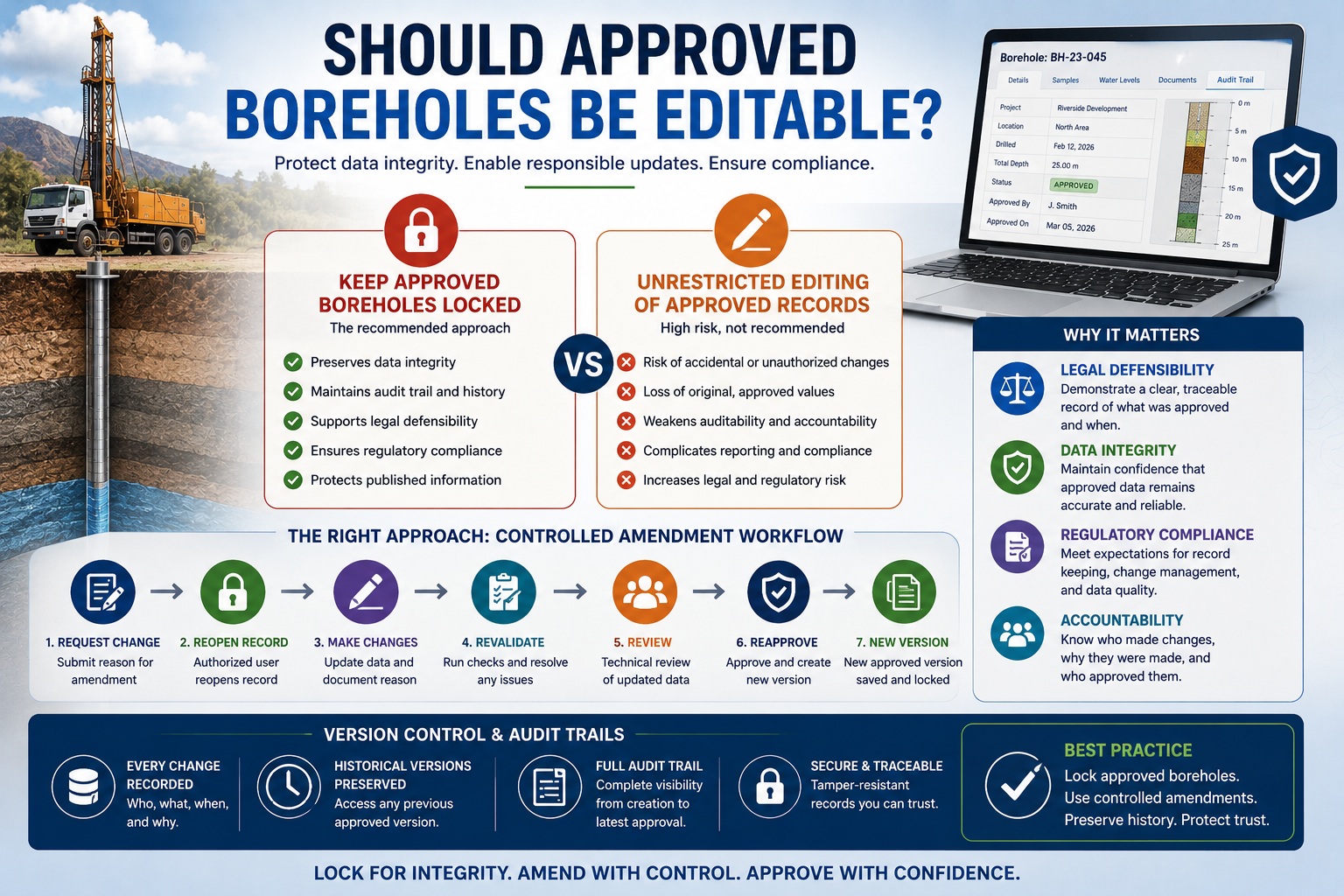
One of the most common questions faced by organizations implementing borehole data management systems is whether approved borehole records should remain editable after they have completed the review and approval process.
At first glance, allowing edits may seem practical. New information becomes available, errors are occasionally discovered, and project requirements evolve. However, unrestricted editing of approved records can introduce significant risks related to data integrity, accountability, regulatory compliance, and legal defensibility.
The challenge is finding the right balance between protecting approved data and maintaining the flexibility required to accommodate legitimate corrections. Modern borehole software addresses this challenge through record locking, amendment workflows, version control, and audit trail mechanisms that preserve trust in the data while supporting continuous improvement.
This article explores whether approved boreholes should be editable and examines the best practices organizations can implement to manage post-approval changes responsibly.
What Does “Approved” Mean?
Before discussing editability, it is important to define what approval represents.
In most geological, environmental, hydrogeological, and geotechnical workflows, approval signifies that a borehole record has:
- Passed validation checks
- Completed technical review
- Addressed identified issues
- Met organizational quality standards
- Been accepted for official project use
Approval effectively transforms a working record into an official project record.
At this stage, the data may be used for:
- Regulatory submissions
- Engineering design
- Risk assessments
- Groundwater modeling
- Resource estimation
- Environmental reporting
- Client deliverables
Because important decisions may depend on approved data, organizations must carefully control what happens after approval.
The Risks of Editable Approved Records
Allowing unrestricted edits to approved boreholes creates several significant risks.
Loss of Data Integrity
The primary purpose of approval is to establish confidence in the data.
If users can modify approved records at any time, stakeholders can no longer be certain that reviewed and approved information remains unchanged.
Questions quickly arise:
- Is this the version that was approved?
- Has the data been altered since approval?
- Were changes reviewed?
- Who authorized the modification?
Confidence in the dataset can erode rapidly when approved records remain freely editable.
Audit and Traceability Challenges
Without proper controls, edits made after approval may not be adequately documented.
Organizations may struggle to determine:
- What changed
- When the change occurred
- Why the change was made
- Who authorized the change
These gaps undermine data governance and complicate future investigations.
Reporting Inconsistencies
Approved boreholes often support published reports.
If approved records are modified after reports are issued, discrepancies may emerge between:
- Historical reports
- Current database values
- Regulatory submissions
- Client deliverables
This creates confusion and may require extensive explanation during audits or project reviews.
Increased Legal Risk
In legal or regulatory proceedings, uncontrolled modifications can raise questions about data reliability.
Organizations may find it difficult to demonstrate:
- Data authenticity
- Proper review procedures
- Approval compliance
- Historical accuracy
These issues can weaken legal defensibility and damage stakeholder confidence.
The Case for Post-Approval Changes
Despite these risks, there are legitimate reasons why approved boreholes sometimes require modification.
Discovery of Errors
Even robust QA/QC processes occasionally miss errors.
Examples include:
- Incorrect coordinates
- Data entry mistakes
- Survey adjustments
- Unit conversion errors
- Laboratory corrections
Preventing all future modifications could leave known inaccuracies permanently embedded within the database.
New Information Becomes Available
Projects often evolve over time.
Examples include:
- Updated laboratory results
- Revised geological interpretations
- Improved survey data
- Additional drilling information
In these situations, organizations need a mechanism for incorporating new knowledge.
Regulatory Requests
Regulators may request clarifications or corrections after data has been submitted.
Organizations must be able to address these requests while preserving compliance and traceability.
The question is therefore not whether changes should ever occur, but how those changes should be managed.
Locked Records: The Preferred Approach
Most modern borehole management systems address this challenge through record locking.
Once a borehole reaches approved status, the record becomes read-only.
Benefits of Locking
Record locking provides several important advantages.
Preserves Approved State
The approved version remains unchanged and available for future reference.
Prevents Accidental Modifications
Users cannot inadvertently alter critical data.
Supports Auditability
The organization can always identify the exact version that was reviewed and approved.
Improves Trust
Stakeholders gain confidence that approved records remain stable and reliable.
For these reasons, locking approved records is widely considered a best practice in data governance.
Amendment Workflows
Locking records does not mean changes become impossible.
Instead, modifications should occur through a controlled amendment workflow.
How Amendment Workflows Work
A typical amendment process may involve:
- Request change.
- Reopen record.
- Document reason for amendment.
- Apply modifications.
- Re-run validation.
- Conduct review.
- Re-approve record.
- Create new approved version.
This process ensures that every change receives the same level of scrutiny as the original record.
Documenting the Reason for Change
Every amendment should include a justification.
Examples include:
- Survey correction
- Laboratory revision
- Data entry error
- Regulatory request
- Geological reinterpretation
Capturing the reason for modification improves transparency and simplifies future audits.
Approval Requirements
Significant amendments should generally require formal approval before becoming effective.
This prevents unauthorized changes from bypassing established QA/QC procedures.
Version Control
Version control is one of the most powerful tools available for managing approved borehole records.
Rather than overwriting approved data, the system creates a new version while preserving historical records.
Example
Consider the following scenario:
Version 1
- Approved March 10
- Groundwater elevation: 102.45 m
Later, a survey correction identifies a more accurate elevation.
Version 2
- Approved April 2
- Groundwater elevation: 102.54 m
Both versions remain accessible.
Users can determine:
- Which version was used in a report
- When the change occurred
- Who approved the revision
- Why the modification was made
Benefits of Version Control
Version control provides:
- Historical preservation
- Regulatory traceability
- Improved accountability
- Error recovery
- Legal defensibility
Most organizations should avoid replacing approved records and instead implement version-based record management.
Regulatory Implications
Regulatory agencies increasingly expect organizations to demonstrate strong data governance practices.
Many environmental and engineering regulations emphasize:
- Data integrity
- Traceability
- Quality assurance
- Change management
- Record retention
Regulatory Expectations
Although requirements vary by jurisdiction, regulators commonly expect organizations to maintain:
- Historical records
- Approval documentation
- Revision history
- Audit trails
- Controlled change processes
Allowing unrestricted editing of approved boreholes can make it difficult to satisfy these expectations.
Regulatory Audits
During inspections or audits, organizations may be asked:
- When was this record approved?
- Has it been modified since approval?
- Why was the change made?
- Who authorized it?
Systems that maintain locked records, version history, and amendment workflows can answer these questions quickly and confidently.
Best Practices for Managing Approved Boreholes
Organizations seeking to balance flexibility and control should consider the following best practices.
Lock Approved Records
Approved boreholes should become read-only by default.
Direct editing should not be permitted.
Implement Formal Amendment Workflows
Changes should follow documented procedures that include review and approval steps.
Preserve Historical Versions
Never overwrite approved data.
Maintain complete version history for every record.
Require Justification for Changes
Every amendment should include a documented reason.
Maintain Comprehensive Audit Trails
Record:
- User identity
- Timestamp
- Previous value
- New value
- Approval status
Revalidate After Changes
Modified records should undergo validation before reapproval.
Require Reapproval
Significant changes should trigger a new approval cycle.
Control Permissions
Only authorized users should have the ability to initiate amendments.
Recommended Workflow
A robust post-approval workflow may follow this sequence:
- Draft
- Validation
- Review
- Approved
- Locked
- Amendment Requested
- Reopened
- Revised
- Revalidated
- Reapproved
- New Version Approved
This approach preserves data integrity while accommodating necessary corrections.
Conclusion
Approved boreholes generally should not remain freely editable. Once a record has completed validation, review, and approval, it becomes an official project record that may support regulatory submissions, engineering decisions, and legal documentation. Allowing unrestricted changes after approval can undermine data integrity, reduce accountability, and create compliance risks.
However, approved records should not become permanently frozen. Organizations must retain the ability to correct errors, incorporate new information, and respond to regulatory requirements. The most effective approach is to combine locked records with controlled amendment workflows, comprehensive audit trails, and robust version control.
By treating approved boreholes as protected records while enabling carefully governed revisions, organizations can achieve the right balance between flexibility and trust. This approach strengthens QA/QC programs, improves regulatory compliance, and ensures that borehole data remains a reliable foundation for decision-making throughout the project lifecycle.