

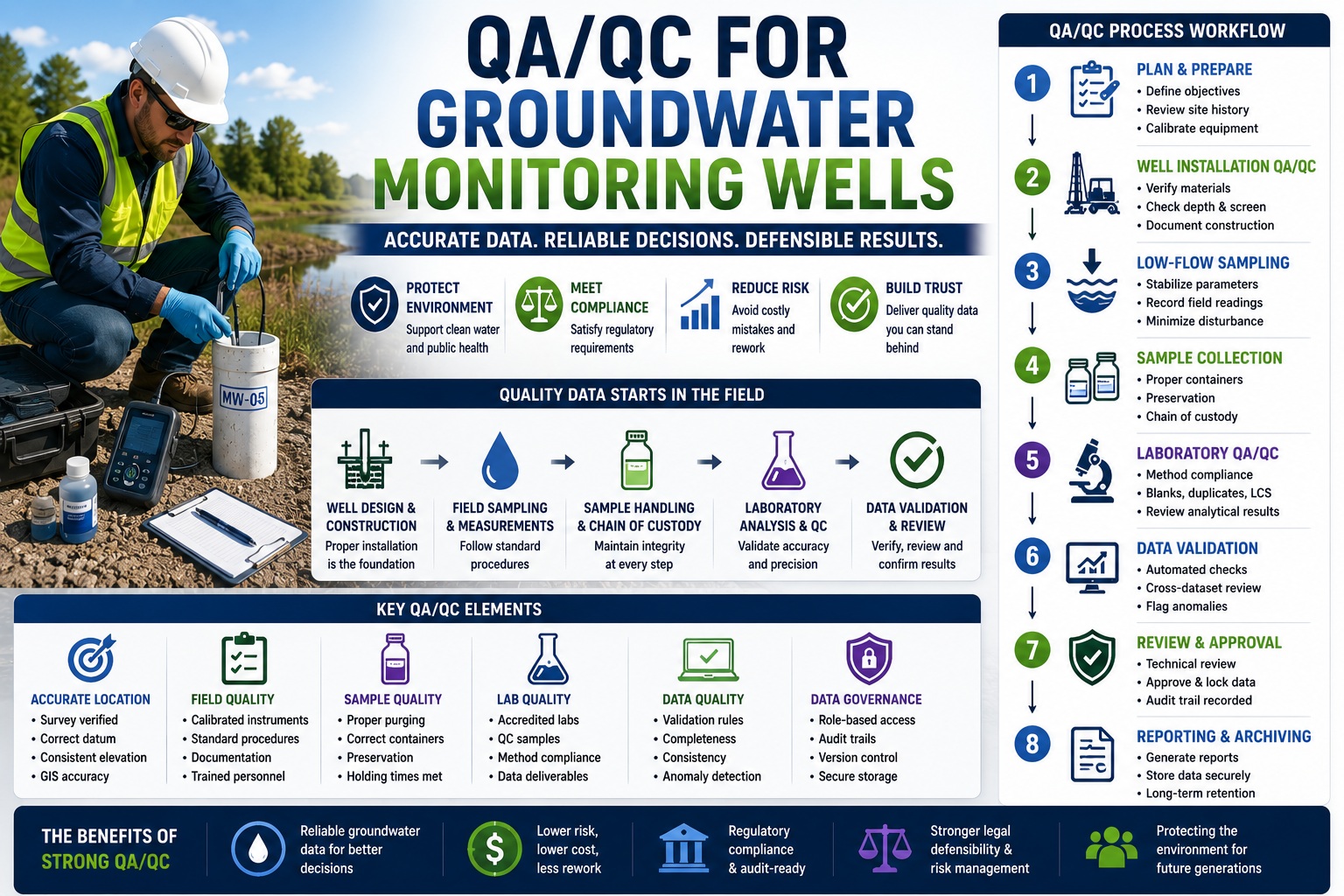
Best Practices for Ensuring Accurate, Reliable, and Defensible Groundwater Data
Groundwater monitoring wells play a critical role in environmental investigations, contaminated site assessments, landfill monitoring, mining operations, industrial compliance programs, hydrogeological studies, and long-term groundwater resource management. Decisions involving public health, environmental protection, remediation strategies, regulatory compliance, and millions of dollars in project costs often depend on the quality of the data collected from these wells.
Unlike a single borehole investigation, groundwater monitoring programs typically continue for years or even decades. During that time, hundreds or thousands of measurements may be collected from the same wells, including groundwater elevations, field parameters, purge volumes, and laboratory analytical results. Small errors made during well construction, data collection, or record management can accumulate over time, affecting trend analysis, contaminant plume interpretation, hydraulic gradient calculations, and regulatory reporting.
Quality Assurance (QA) and Quality Control (QC) are therefore essential throughout the entire lifecycle of a monitoring well—from planning and installation through sampling, data management, reporting, and eventual well decommissioning.
This article examines best practices for QA/QC in groundwater monitoring programs, covering well construction, field measurements, laboratory analysis, data validation, workflow management, and long-term data governance.
Why QA/QC Matters for Groundwater Monitoring
Groundwater monitoring data supports decisions involving:
- Contaminated site investigations
- Environmental remediation
- Regulatory compliance
- Drinking water protection
- Landfill monitoring
- Industrial facilities
- Mining operations
- Infrastructure development
- Environmental due diligence
Errors in groundwater data can result in:
- Incorrect plume interpretation
- Improper remediation design
- Missed contamination
- False contamination trends
- Regulatory non-compliance
- Increased project costs
- Legal disputes
A comprehensive QA/QC program reduces these risks while improving confidence in environmental decisions.
QA Versus QC
Although often used together, Quality Assurance and Quality Control have different objectives.
Quality Assurance (QA)
QA focuses on preventing problems before they occur through:
- Standard operating procedures
- Personnel training
- Equipment calibration
- Workflow documentation
- Data governance
QA establishes the framework for producing reliable data.
Quality Control (QC)
QC focuses on detecting errors after data has been collected.
Examples include:
- Validation checks
- Duplicate samples
- Laboratory QC samples
- Data review
- Statistical analysis
QC confirms that established procedures are working effectively.
Both are essential for a successful monitoring program.
QA/QC Begins with Well Design
Data quality starts long before the first groundwater sample is collected.
Poorly designed or improperly installed wells can produce unreliable data regardless of subsequent sampling procedures.
Construction Verification
QA should verify:
- Borehole depth
- Screen interval
- Screen diameter
- Filter pack placement
- Bentonite seal thickness
- Surface seal construction
- Protective casing installation
Construction records should be complete and permanently retained.
Cross-Validation of Construction Data
Construction details should be compared against:
- Drilling logs
- As-built diagrams
- Survey information
- Well completion reports
Inconsistencies should be resolved before the well enters service.
Well Identification
Every monitoring well should have a unique identifier.
Examples include:
- MW-01
- MW-02A
- GW-15
- PZ-07
Duplicate identifiers create confusion during sampling and reporting.
A structured database should prevent duplicate well IDs automatically.
Survey and Coordinate QA/QC
Location accuracy is fundamental.
Incorrect coordinates affect:
- Plume mapping
- Hydraulic gradients
- GIS analysis
- Groundwater models
QA procedures should verify:
- Coordinate system
- Datum
- Survey method
- Elevation reference
- Survey accuracy
Modern GPS or professional land surveys should be documented where appropriate.
Water Level Measurements
Groundwater elevations are among the most frequently collected monitoring data.
Because these measurements are used to determine groundwater flow direction and hydraulic gradients, even small errors can significantly affect interpretations.
Common Measurement Errors
Examples include:
- Incorrect measuring point
- Wrong reference elevation
- Equipment calibration errors
- Recording mistakes
- Unit conversion errors
QA Procedures
Field personnel should verify:
- Measuring point consistency
- Water level units
- Date and time
- Measuring equipment
- Calibration records
Repeated measurements may be appropriate when unusual values are observed.
Field Sampling QA/QC
Groundwater sampling requires consistent field procedures.
Variations in sampling methods can affect analytical results.
Standardized Sampling Procedures
Organizations should document:
- Purging procedures
- Low-flow sampling methods
- Stabilization criteria
- Sample containers
- Preservation methods
- Holding times
Following standardized procedures improves data consistency.
Equipment Calibration
Field instruments measuring:
- pH
- Conductivity
- Dissolved oxygen
- Oxidation-reduction potential (ORP)
- Temperature
- Turbidity
should be calibrated according to manufacturer recommendations.
Calibration records should become part of the project documentation.
Laboratory QA/QC
Laboratory analysis introduces another important stage of quality control.
Accurate field sampling alone cannot compensate for poor laboratory procedures.
Laboratory Quality Control Samples
Typical QC samples include:
Field Duplicates
Evaluate sampling precision.
Equipment Blanks
Verify decontamination effectiveness.
Trip Blanks
Detect contamination during transportation.
Field Blanks
Identify contamination introduced during sampling.
Laboratory Control Samples
Confirm analytical performance.
Each contributes to overall confidence in analytical results.
Chain of Custody
Every environmental sample should be traceable from collection through laboratory analysis.
Chain-of-custody documentation should record:
- Sample ID
- Collection date
- Collection time
- Sampler
- Preservation
- Transfer history
- Laboratory receipt
A complete chain of custody strengthens regulatory compliance and legal defensibility.
Data Validation
Validation ensures that groundwater data is complete, consistent, and technically reasonable before it enters the project database.
Automated Validation Rules
Modern groundwater databases can automatically evaluate:
- Missing water levels
- Duplicate measurements
- Invalid coordinates
- Impossible elevations
- Missing sampling dates
- Duplicate sample IDs
- Invalid laboratory codes
Automation significantly reduces manual review time.
Cross-Dataset Validation
Relationships between datasets should also be checked.
Examples include:
| Dataset Comparison | Validation |
|---|---|
| Well depth vs screen interval | Screen within borehole |
| Water level vs casing elevation | Physically possible |
| Sample depth vs well construction | Sample within screened interval |
| Laboratory result vs sample ID | Valid relationship |
Cross-validation identifies inconsistencies that may otherwise remain hidden.
Trend Analysis
Long-term monitoring programs benefit from statistical review.
Trend analysis helps identify:
- Unexpected concentration changes
- Sudden water level shifts
- Seasonal patterns
- Instrument drift
- Data anomalies
Not every anomaly indicates contamination.
Some may reflect:
- Equipment failure
- Data entry errors
- Sampling inconsistencies
Trend analysis helps distinguish genuine environmental changes from data quality issues.
Metadata Management
Groundwater data should include more than numerical values.
Metadata records essential contextual information.
Examples include:
- Sampling method
- Equipment used
- Calibration records
- Weather conditions
- Well condition
- Sampler identity
- Laboratory methods
Comprehensive metadata improves long-term interpretability.
Workflow Management
Quality control should be integrated into the monitoring workflow.
A recommended process includes:
Step 1
Schedule monitoring event.
Step 2
Verify well status.
Step 3
Collect field measurements.
Step 4
Collect groundwater samples.
Step 5
Complete chain of custody.
Step 6
Receive laboratory results.
Step 7
Run automated validation.
Step 8
Technical review.
Step 9
Approve results.
Step 10
Generate regulatory reports.
Structured workflows improve consistency while reducing errors.
Audit Trails
Groundwater records frequently support regulatory reporting and legal proceedings.
Organizations should maintain audit trails documenting:
- Data entry
- Modifications
- Validation
- Review
- Approval
- Report generation
Audit trails strengthen accountability and evidence preservation.
Data Governance
Successful monitoring programs depend on well-defined governance.
Governance should establish:
- User permissions
- Approval authority
- Change management
- Revision workflows
- Record retention
- Data ownership
These policies ensure that monitoring records remain accurate throughout their lifecycle.
Common QA/QC Problems
Recurring issues include:
Incorrect Well IDs
Duplicate or inconsistent naming.
Missing Water Levels
Incomplete monitoring records.
Laboratory Mismatches
Analytical results linked to incorrect samples.
Coordinate Errors
Incorrect GIS locations.
Incomplete Metadata
Missing calibration or sampling information.
Delayed Data Entry
Increased risk of transcription errors.
Most of these issues can be identified through automated validation.
Digital Groundwater Databases
Modern groundwater databases provide significant QA/QC advantages over spreadsheets.
Capabilities include:
- Automated validation
- Integrated borehole records
- GIS integration
- Laboratory imports
- Audit trails
- Workflow management
- Electronic approvals
- Regulatory reporting
These features improve both efficiency and data quality.
Preparing for Regulatory Audits
Environmental regulators increasingly expect:
- Complete documentation
- Validated datasets
- Traceable records
- QA/QC procedures
- Audit-ready workflows
Organizations should routinely review:
- Well construction records
- Calibration logs
- Validation reports
- Chain-of-custody forms
- Laboratory QA/QC results
Being prepared before an audit reduces both stress and compliance risk.
Emerging Technologies
Groundwater QA/QC continues to evolve.
Modern systems increasingly incorporate:
- Automated validation engines
- Cloud-based field data collection
- Mobile sampling applications
- AI-assisted anomaly detection
- Digital signatures
- Real-time dashboards
- Integration with GIS and environmental databases
These technologies improve consistency while reducing manual effort.
Best Practices Summary
Organizations can improve groundwater monitoring quality by following several key principles:
- Design wells correctly from the outset.
- Standardize sampling procedures across all personnel.
- Calibrate field instruments before every monitoring event.
- Maintain complete chain-of-custody documentation.
- Validate all field and laboratory data before reporting.
- Use automated cross-dataset validation whenever possible.
- Preserve metadata and audit trails.
- Require technical review before approving results.
- Implement role-based permissions and revision controls.
- Store monitoring data in structured databases rather than spreadsheets.
Conclusion
Groundwater monitoring wells generate some of the most valuable long-term environmental data used by engineers, hydrogeologists, regulators, and environmental consultants. Maintaining the accuracy, consistency, and traceability of this information requires a comprehensive QA/QC program that spans well design, construction, sampling, laboratory analysis, validation, reporting, and long-term governance. By combining standardized procedures, automated validation, structured workflows, audit trails, and modern digital databases, organizations can significantly improve data quality while reducing regulatory risk, improving decision-making, and strengthening the legal defensibility of their groundwater monitoring programs. As environmental investigations become increasingly data-driven, robust QA/QC practices will remain essential for protecting groundwater resources and supporting sound scientific and engineering decisions.