

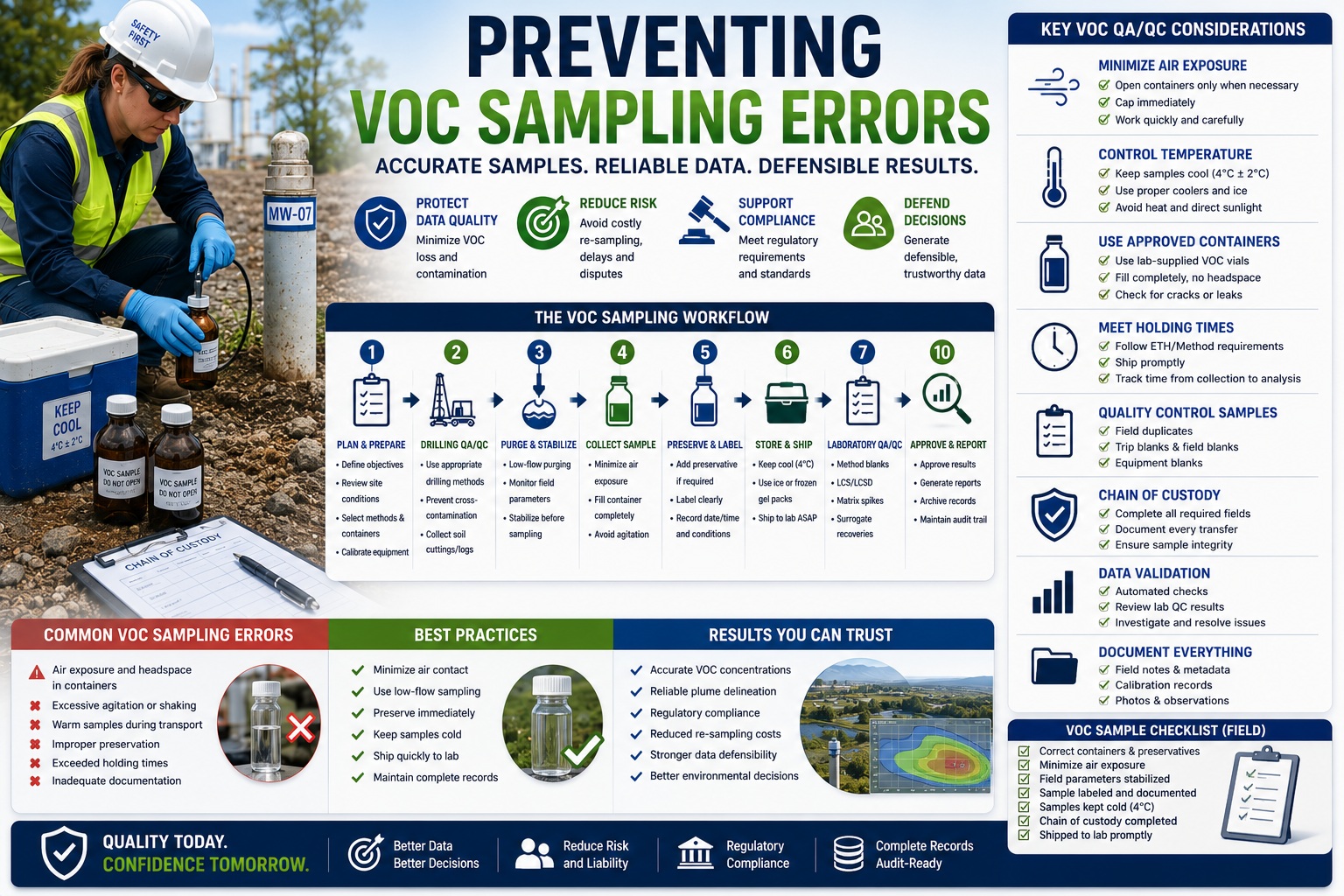
Best Practices for Accurate Volatile Organic Compound Sampling in Environmental Investigations
Volatile Organic Compounds (VOCs) are among the most frequently analyzed contaminants during environmental site assessments, groundwater investigations, landfill monitoring, industrial compliance programs, and remediation projects. Because VOCs readily evaporate into the atmosphere, they are also among the easiest contaminants to lose during sampling, handling, transportation, and laboratory preparation.
Unlike many inorganic contaminants, VOC concentrations can change significantly if proper sampling procedures are not followed. A sample exposed to air for only a few seconds may lose a measurable portion of its volatile constituents. Improper sample containers, excessive agitation, delayed preservation, or inadequate quality control procedures can all produce laboratory results that no longer represent actual site conditions.
These errors can have significant consequences. Underestimating contamination may result in incomplete remediation or regulatory non-compliance, while overestimating contamination can lead to unnecessary cleanup costs, project delays, and disputes with regulators or property owners.
A comprehensive Quality Assurance and Quality Control (QA/QC) program is therefore essential for every VOC investigation. From borehole drilling and sample collection to chain of custody, laboratory analysis, and data validation, every step must be carefully controlled.
This article examines common sources of VOC sampling errors and presents best practices for preventing them throughout the environmental investigation process.
Why VOC Sampling Is Different
Most environmental samples remain relatively stable during collection and transportation.
VOC samples do not.
Volatile compounds naturally evaporate when exposed to air, making them particularly sensitive to:
- Temperature changes
- Sample agitation
- Delayed preservation
- Container selection
- Air exposure
- Improper handling
Maintaining sample integrity requires strict adherence to standardized procedures.
Common Sources of VOC Sampling Errors
Understanding where errors occur is the first step toward preventing them.
Air Exposure
Perhaps the most common source of VOC loss is exposure to air.
Opening containers for extended periods or allowing soil samples to remain uncovered permits volatile compounds to escape.
Even brief exposure can alter analytical results.
Sample Agitation
Excessive mixing, shaking, or transferring samples increases volatilization.
Field personnel should minimize unnecessary sample handling.
Temperature
VOC samples should remain cool from collection until laboratory receipt.
Elevated temperatures accelerate evaporation.
Improper cooling is a frequent cause of sample degradation.
Delayed Preservation
Many VOC analytical methods require immediate preservation.
Delays increase the likelihood of concentration changes.
Improper Containers
VOC samples should only be collected using approved containers specified by the laboratory and analytical method.
Incorrect containers may:
- Allow leakage
- Permit volatilization
- Introduce contamination
QA Begins Before Sampling
Successful VOC investigations begin during project planning.
Quality Assurance should establish:
- Sampling objectives
- Analytical methods
- Required detection limits
- Sampling locations
- Equipment requirements
- Preservation procedures
Planning reduces field uncertainty and improves consistency.
Borehole Drilling QA/QC
Drilling methods influence VOC sample quality.
Improper drilling techniques may:
- Mix soil intervals
- Introduce contaminants
- Increase volatilization
- Disturb natural stratigraphy
Selecting Appropriate Drilling Methods
The chosen drilling method should minimize disturbance to the target interval.
Factors include:
- Soil type
- Target analytes
- Sampling depth
- Regulatory requirements
Equipment Decontamination
Cross-contamination is a common QA concern.
Sampling equipment should be thoroughly cleaned between boreholes using documented decontamination procedures.
Equipment blanks help verify cleaning effectiveness.
Soil VOC Sampling
Collecting representative soil samples requires careful technique.
Minimize Air Exposure
Whenever possible:
- Open containers only when necessary.
- Transfer samples immediately.
- Cap containers without delay.
Avoid Mixing
Composite samples are generally inappropriate for VOC analysis because mixing increases volatilization.
Discrete samples typically provide more representative results.
Fill Containers Properly
Many laboratory methods require containers to be completely filled.
Headspace allows VOCs to partition into air, reducing measured concentrations.
Proper filling techniques reduce this risk.
Groundwater VOC Sampling
Groundwater VOC sampling introduces additional QA/QC considerations.
Low-Flow Sampling
Low-flow sampling reduces:
- Turbidity
- Aeration
- Volatilization
- Disturbance
It is widely accepted as a best practice for many groundwater investigations.
Stabilization Criteria
Before collecting samples, field parameters such as:
- pH
- Conductivity
- Temperature
- Dissolved oxygen
- Oxidation-reduction potential (ORP)
should stabilize according to project procedures.
Avoid Aeration
Groundwater should flow gently into sample containers.
Splashing increases VOC loss.
Chain of Custody
Every VOC sample should be fully traceable.
Chain-of-custody documentation should include:
- Sample ID
- Collection date
- Collection time
- Sampler
- Preservation method
- Requested analyses
- Transfer history
- Laboratory receipt
Incomplete documentation may compromise data defensibility.
Sample Preservation
Preservation begins immediately after collection.
Common preservation practices include:
- Cooling samples to approximately 4°C
- Chemical preservatives where required
- Proper storage orientation
- Rapid transportation
Holding times should never be exceeded.
Holding Times
VOC analytical methods specify maximum holding times between collection and laboratory analysis.
Late analysis may invalidate results.
Organizations should monitor:
- Collection time
- Shipping time
- Laboratory receipt
- Analysis completion
Automated tracking systems can reduce compliance risks.
Laboratory QA/QC
Laboratory quality control is equally important.
Reliable field sampling cannot compensate for poor analytical practices.
Laboratory QC Samples
Typical QC samples include:
Method Blanks
Detect laboratory contamination.
Laboratory Control Samples
Verify analytical accuracy.
Matrix Spikes
Evaluate matrix effects.
Duplicate Analyses
Measure analytical precision.
Surrogate Recoveries
Confirm method performance.
These QC measures help ensure laboratory reliability.
Field QA/QC Samples
Environmental investigations should include field quality control samples.
Field Duplicates
Evaluate sampling precision.
Trip Blanks
Trip blanks detect contamination during transportation.
They are especially important for VOC investigations because of the sensitivity of volatile compounds.
Equipment Blanks
Equipment blanks verify that cleaning procedures are effective.
Field Blanks
Field blanks identify contamination introduced during field activities.
Together, these samples provide confidence in environmental results.
Data Validation
VOC analytical data should never be accepted without review.
Validation verifies that results meet project quality requirements.
Automated Validation
Modern environmental databases can automatically identify:
- Missing VOC analyses
- Duplicate sample IDs
- Holding time exceedances
- Missing preservation
- Incomplete chain of custody
- Laboratory reporting inconsistencies
Automation improves both speed and consistency.
Cross-Dataset Validation
Additional QA checks compare related information.
Examples include:
| Comparison | Validation |
|---|---|
| Sample depth vs borehole depth | Valid interval |
| VOC sample vs lithology | Appropriate sampling location |
| Groundwater sample vs well construction | Screen interval confirmed |
| Laboratory report vs chain of custody | Matching sample IDs |
These relationships strengthen overall data quality.
Metadata Matters
Accurate VOC investigations require detailed metadata.
Examples include:
- Sampling method
- Drill rig
- Weather conditions
- Preservation method
- Sampler
- Instrument calibration
- Laboratory method
- Detection limits
Metadata often becomes critical during regulatory reviews.
Workflow Management
Successful VOC programs follow structured workflows.
A recommended process includes:
Step 1
Develop sampling plan.
Step 2
Verify equipment calibration.
Step 3
Collect samples using approved procedures.
Step 4
Preserve samples immediately.
Step 5
Complete chain of custody.
Step 6
Ship under controlled conditions.
Step 7
Receive laboratory results.
Step 8
Run automated validation.
Step 9
Technical review.
Step 10
Approve data for reporting.
Standardized workflows reduce variability and improve consistency.
Audit Trails
Environmental investigations frequently become subject to regulatory review or litigation.
Audit trails should record:
- Sample creation
- Data entry
- Validation
- Review
- Approval
- Corrections
This documentation demonstrates that QA/QC procedures were followed.
Data Governance
Effective VOC QA/QC requires strong governance.
Organizations should define:
- Sampling responsibilities
- Approval authority
- Validation requirements
- Data retention policies
- Revision procedures
- User permissions
Governance ensures consistency across projects and personnel.
Common VOC QA/QC Mistakes
Recurring issues include:
- Headspace in sample containers
- Warm samples during transport
- Missing trip blanks
- Incorrect preservatives
- Exceeded holding times
- Duplicate sample IDs
- Poor chain-of-custody documentation
- Incorrect laboratory methods
Many of these problems are preventable through training and automated validation.
Digital Environmental Databases
Modern environmental databases provide significant advantages for VOC investigations.
Capabilities include:
- Sample tracking
- Chain-of-custody management
- Automated validation
- Laboratory imports
- GIS integration
- Audit trails
- Electronic approvals
- Regulatory reporting
These tools improve both efficiency and data quality.
Emerging Technologies
VOC QA/QC continues to evolve.
Emerging technologies include:
- Mobile field data collection
- Barcode sample tracking
- RFID chain-of-custody systems
- AI-assisted anomaly detection
- Real-time laboratory integration
- Automated reporting dashboards
These innovations reduce manual errors while improving traceability.
Best Practices Summary
Organizations can significantly improve VOC data quality by:
- Planning investigations carefully before fieldwork.
- Selecting appropriate drilling and sampling methods.
- Minimizing air exposure during sample collection.
- Avoiding unnecessary agitation.
- Preserving samples immediately.
- Maintaining cold-chain transportation.
- Using trip blanks, field blanks, duplicates, and equipment blanks.
- Validating laboratory and field data automatically.
- Maintaining complete audit trails and chain-of-custody records.
- Storing environmental information in structured databases with formal QA/QC workflows.
Conclusion
Preventing VOC sampling errors requires careful attention to every stage of the environmental investigation process. Because volatile organic compounds are highly sensitive to handling, even small deviations from established procedures can significantly affect analytical results and subsequent engineering or regulatory decisions. By combining standardized sampling techniques, rigorous preservation procedures, comprehensive quality control samples, automated validation, structured workflows, and strong data governance, organizations can greatly improve the accuracy, reliability, and legal defensibility of VOC investigations. As environmental regulations become increasingly data-driven, robust QA/QC practices will continue to be essential for protecting public health, supporting sound remediation decisions, and maintaining confidence in environmental monitoring programs.