

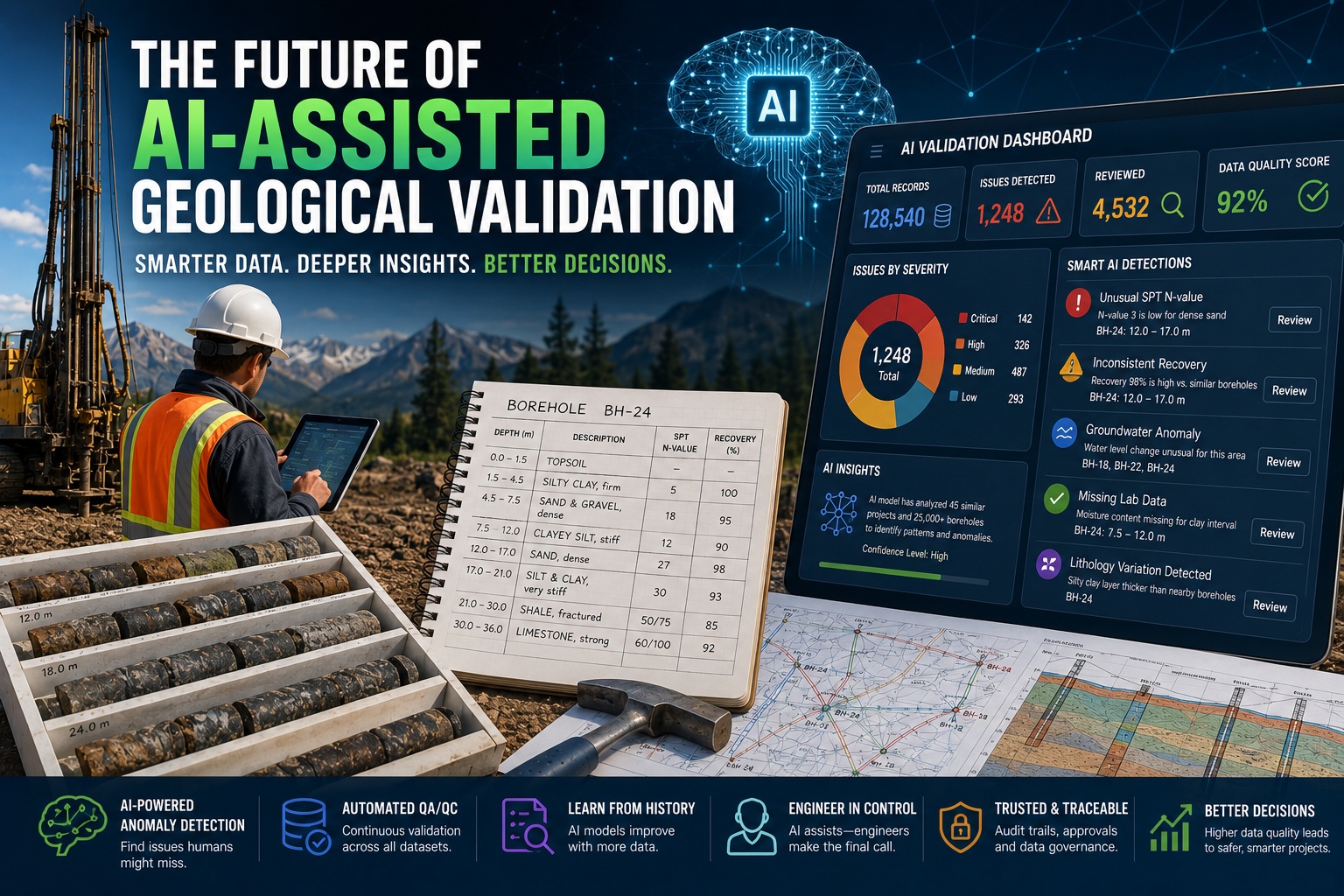
Artificial intelligence is rapidly changing the way engineers and geoscientists work. From predictive maintenance and autonomous drilling to environmental assessments and digital twins, AI is helping organizations analyze larger datasets, automate repetitive tasks, and uncover patterns that would be difficult—or impossible—for humans to detect manually.
One of the most promising applications is AI-assisted geological validation.
For decades, geological Quality Assurance and Quality Control (QA/QC) has relied on manual reviews, engineering judgment, and rule-based validation systems. While these methods remain essential, today’s projects generate far more data than traditional workflows were designed to handle. Large infrastructure projects, mining programs, environmental investigations, and groundwater studies can produce millions of individual records spanning borehole logs, laboratory results, field testing, geophysical surveys, groundwater measurements, and historical investigations.
Artificial intelligence is not replacing geologists or geotechnical engineers. Instead, it is becoming a powerful assistant that continuously reviews data, identifies anomalies, highlights inconsistencies, recommends corrective actions, and helps engineers focus on the issues that matter most.
This article explores how AI-assisted geological validation is evolving, where it adds value, and why it represents the next generation of digital borehole data management.
From Rule-Based Validation to Intelligent Validation
Traditional validation systems rely on predefined engineering rules.
Examples include:
- Recovery cannot exceed 100%.
- SCR cannot exceed TCR.
- RQD cannot exceed SCR.
- SPT N-values must match recorded blow counts.
- Borehole intervals cannot overlap.
- Groundwater measurements cannot exceed borehole depth.
- Required laboratory fields must exist.
These rules are deterministic—they identify violations of known engineering principles quickly and consistently.
Artificial intelligence extends this capability by recognizing patterns that cannot easily be expressed as simple rules.
Rather than asking:
“Is this value impossible?”
AI asks:
“Does this value make sense in the context of everything else we know?”
Why Geological Data Is Ideal for AI
Geological investigations generate diverse but highly structured datasets.
Examples include:
- Borehole logs
- Lithology
- Soil classifications
- Rock descriptions
- Recovery
- RQD
- SCR
- TCR
- SPT results
- Laboratory analyses
- Groundwater measurements
- Geophysical surveys
- Maps
- Historical reports
- Cross-sections
- Three-dimensional models
Each dataset supports and reinforces the others.
This interconnected structure makes geological information particularly well suited for machine learning and AI-assisted analysis.
Finding Patterns Humans May Miss
Human reviewers naturally focus on individual boreholes.
AI can examine:
- Every borehole simultaneously.
- Entire regional datasets.
- Historical investigations.
- Thousands of laboratory reports.
- Millions of interval records.
This allows subtle patterns to emerge.
Examples include:
- Consistent logging differences between crews.
- Equipment calibration issues.
- Laboratory bias.
- Repeated transcription mistakes.
- Unexpected regional geological trends.
These patterns may not be visible during traditional QA/QC.
Detecting Unusual Geological Relationships
Modern AI systems can identify unusual combinations such as:
- High Recovery with very poor RQD.
- Dense sand with extremely low SPT values.
- Organic soils with unrealistic density.
- Strong rock with unusually low core recovery.
- Abrupt groundwater changes between adjacent boreholes.
- Laboratory results inconsistent with field observations.
These situations are not necessarily errors.
Instead, AI identifies records that deserve engineering review.
Learning from Historical Projects
One of AI’s greatest strengths is its ability to learn from previous investigations.
For example:
An organization may possess:
- 50,000 boreholes
- 30 years of projects
- Multiple geological environments
- Millions of validated records
AI can learn:
- Typical geological sequences.
- Normal SPT ranges.
- Expected groundwater behaviour.
- Common lithological transitions.
- Regional engineering characteristics.
Future projects can then be compared against this historical knowledge.
Intelligent Data Completeness Checks
Traditional validation simply asks:
Is this field empty?
AI asks:
Should this information exist?
Examples include:
Rock interval
Missing RQD
AI recognizes that similar boreholes almost always contain RQD.
The system recommends:
“RQD may be missing.”
Similarly:
Peat interval
Missing moisture content
AI identifies this omission because peat investigations almost always include moisture testing.
Natural Language Understanding
Modern geological logging frequently contains free-text descriptions.
Examples:
“Brown silty clay becoming sandy with occasional gravel.”
Traditional validation cannot easily interpret this information.
AI language models can extract:
- Lithology
- Colour
- Consistency
- Weathering
- Grain size
- Moisture
- Structure
These structured observations can then be compared with:
- Laboratory data
- Soil classifications
- SPT values
- Groundwater observations
This dramatically expands automated QA/QC capabilities.
Reviewing Historical Reports
Many organizations possess decades of:
- PDF reports
- Scanned borehole logs
- Geological reports
- Environmental assessments
AI can assist by:
- Reading reports.
- Extracting borehole information.
- Identifying locations.
- Comparing historical and current investigations.
- Detecting conflicting interpretations.
Rather than replacing existing databases, AI helps unlock information that previously existed only in documents.
Assisting Resource Estimation
In mining projects, AI can help validate information used for resource estimation.
Examples include:
- Assay consistency.
- Density relationships.
- Lithology continuity.
- Structural interpretations.
- Mineralized domains.
- Grade distribution.
By highlighting unusual patterns before modeling begins, AI supports more reliable geological interpretations and resource estimates.
Improving Infrastructure Projects
Transportation agencies increasingly maintain digital geotechnical databases covering:
- Highways
- Bridges
- Railways
- Airports
- Transit systems
AI can assist by:
- Identifying conflicting boreholes.
- Predicting missing information.
- Detecting unusual groundwater changes.
- Finding duplicate investigations.
- Comparing current and historical projects.
This improves long-term infrastructure asset management.
Supporting Environmental Investigations
Environmental projects generate information from:
- Soil samples
- Groundwater wells
- Laboratory chemistry
- Historical reports
- Regulatory databases
- Site inspections
AI can compare:
- VOC concentrations
- Groundwater elevations
- Historical contamination
- Adjacent properties
- Previous investigations
The result is faster identification of potential environmental concerns while leaving final interpretation to qualified professionals.
Intelligent Recommendations
Future validation systems will do more than identify problems.
They will recommend solutions.
Examples include:
“Recovery exceeds SCR by an unusual amount.”
Suggested actions:
- Review drilling records.
- Verify interval length.
- Confirm calculation.
Similarly:
“N-value unusually low for dense sand.”
Suggested review:
- Confirm blow counts.
- Verify soil classification.
- Review groundwater conditions.
These recommendations reduce investigation time while preserving engineering oversight.
Human Expertise Remains Essential
AI should never replace professional judgment.
Instead:
AI performs:
- Pattern recognition.
- Data comparison.
- Repetitive review.
- Historical searches.
- Report summarization.
Engineers perform:
- Geological interpretation.
- Design decisions.
- Risk assessment.
- Regulatory approvals.
- Professional certification.
The best results occur when AI and human expertise work together.
Explainable AI
Engineering decisions require transparency.
Therefore, AI-assisted validation should always explain:
- Why an issue was flagged.
- Which datasets were compared.
- Confidence level.
- Supporting evidence.
- Recommended review.
Engineers must understand the reasoning before accepting recommendations.
Explainable AI builds trust while supporting regulatory compliance.
Integrating AI with Rule-Based Validation
The most effective systems combine deterministic validation with AI assistance.
For example:
Rule-Based Engine
- Recovery > 100%
Result:
Error
AI Engine
Recovery = 98%
RQD = 4%
Nearby boreholes average 82%
Result:
Unusual geological relationship
Engineering review recommended.
Together these approaches provide both certainty and intelligence.
The Role of WinLoG
The future vision for WinLoG extends beyond traditional rule-based QA/QC to include AI-assisted geological validation that complements existing engineering workflows. While deterministic validation will continue to enforce engineering rules—such as verifying Recovery, RQD, SCR, TCR, SPT calculations, groundwater measurements, and laboratory consistency—AI can provide an additional layer of insight.
Potential capabilities include identifying unusual geological relationships, summarizing validation findings, recommending corrective actions, recognizing inconsistencies across multiple datasets, extracting structured information from historical reports, and assisting with the migration of legacy borehole databases. AI could also help engineers search decades of project information, compare new investigations with historical work, and prioritize the most significant validation issues.
Importantly, every AI recommendation would remain subject to review by qualified professionals. WinLoG’s vision is not to automate engineering judgment, but to give geologists and geotechnical engineers better tools to work more efficiently, improve data quality, and reduce the time spent reviewing routine issues.
Challenges Ahead
Despite its promise, AI-assisted geological validation faces several challenges:
- Data quality: AI models require accurate, well-structured historical data to produce reliable recommendations.
- Standardization: Consistent terminology, coding systems, and data formats improve AI performance.
- Transparency: Engineers need clear explanations for every recommendation.
- Privacy and security: Sensitive project data must be protected through secure deployment and governance.
- Human oversight: AI outputs should always be reviewed by qualified professionals before influencing engineering decisions.
Addressing these challenges will ensure AI becomes a trusted engineering assistant rather than a black-box decision maker.
Best Practices for Preparing for AI
Organizations interested in AI-assisted validation can begin today by:
- Standardizing geological and geotechnical coding systems.
- Digitizing historical borehole records.
- Implementing automated rule-based QA/QC.
- Maintaining complete audit trails.
- Preserving high-quality historical datasets.
- Using structured databases instead of spreadsheets wherever possible.
- Validating imported data before adding it to corporate archives.
- Encouraging consistent logging procedures across projects.
These practices create the high-quality data foundation that AI systems require.
Conclusion
Artificial intelligence represents the next major evolution in geological QA/QC. By combining machine learning, natural language processing, historical knowledge, and advanced pattern recognition with established engineering validation rules, AI-assisted geological validation can help organizations detect anomalies, improve data quality, reduce manual review time, and make better-informed decisions.
However, AI is most valuable when viewed as an assistant rather than a replacement for professional expertise. Geological interpretation, engineering design, and regulatory responsibility will continue to depend on qualified professionals who understand the context behind the data.
Organizations that invest today in standardized data, automated validation, and strong data governance will be best positioned to take advantage of AI as these technologies mature. The future of geological validation is not simply faster—it is smarter, more connected, more transparent, and better equipped to support the increasingly complex challenges of modern geotechnical, geological, environmental, and transportation projects.
vernance will be best positioned to take advantage of AI as these technologies mature. The future of geological validation is not simply faster—it is smarter, more connected, more transparent, and better equipped to support the increasingly complex challenges of modern geotechnical, geological, environmental, and transportation projects.