

Best Practices for Validating Rock Core Quality Measurements in Geological and Geotechnical Investigations
Rock core logging is one of the most important activities performed during geotechnical investigations and mineral exploration drilling. The measurements collected from drill core—including Core Recovery, Rock Quality Designation (RQD), Solid Core Recovery (SCR), and Total Core Recovery (TCR)—provide essential information about rock mass quality, fracture intensity, drilling conditions, excavation performance, slope stability, tunnel design, and resource evaluation.
These parameters are used daily by engineering geologists, geotechnical engineers, mining engineers, hydrogeologists, and resource geologists. They influence major design decisions involving tunnels, dams, foundations, open pits, underground mines, and infrastructure projects.
Because these measurements are so influential, even small errors can have significant consequences. An incorrectly calculated RQD may overestimate rock quality. An invalid SCR value may affect tunnel support design. Recovery measurements greater than 100 percent or inconsistent relationships between SCR, TCR, and RQD can indicate data entry errors, incorrect measurements, or misunderstandings of logging procedures.
Modern geological databases can eliminate many of these problems by combining standardized logging procedures with automated validation rules, cross-dataset consistency checks, structured workflows, and independent technical review.
This article examines best practices for validating Recovery, RQD, SCR, and TCR measurements and explains how automated QA/QC improves the reliability and defensibility of rock core data.
Why Rock Core Validation Matters
Rock quality measurements influence numerous engineering and exploration activities.
Examples include:
- Rock mass classification
- Tunnel support design
- Foundation engineering
- Slope stability analysis
- Underground mine design
- Open pit design
- Resource estimation
- Hydrogeological investigations
Errors introduced during core logging often propagate throughout downstream analyses.
Validation helps detect these errors before they affect engineering decisions.
Understanding the Four Core Measurements
Although related, Recovery, TCR, SCR, and RQD each describe different characteristics of the recovered core.
Total Core Recovery (TCR)
TCR measures the total length of all recovered core pieces expressed as a percentage of the drilled run length.
It includes:
- Intact core
- Broken fragments
- Small pieces
- Weathered material
Because all recovered material is included, TCR is typically the highest recovery-related value.
Example:
Run length:
1.50 m
Recovered core:
1.44 m
TCR:
96%
Solid Core Recovery (SCR)
SCR measures only competent, solid pieces of core that satisfy the project’s minimum criteria.
Loose fragments and highly broken material are excluded.
SCR provides a better indication of competent rock than TCR.
Consequently:
SCR is generally less than or equal to TCR.
Rock Quality Designation (RQD)
RQD measures the percentage of intact core pieces greater than 100 mm in length.
Developed by Deere in the 1960s, RQD remains one of the most widely used indicators of rock mass quality.
Higher RQD values generally indicate fewer fractures and better rock quality.
Core Recovery
Many organizations also calculate overall core recovery independently of TCR.
Depending on local procedures, Recovery may represent:
- Total recovered length
- Recovered drilling interval
- Project-specific recovery calculations
Organizations should clearly define how Recovery is calculated within their QA procedures.
Expected Relationships
Because these measurements describe related characteristics of the same core, logical relationships should always exist.
The most common relationship is:
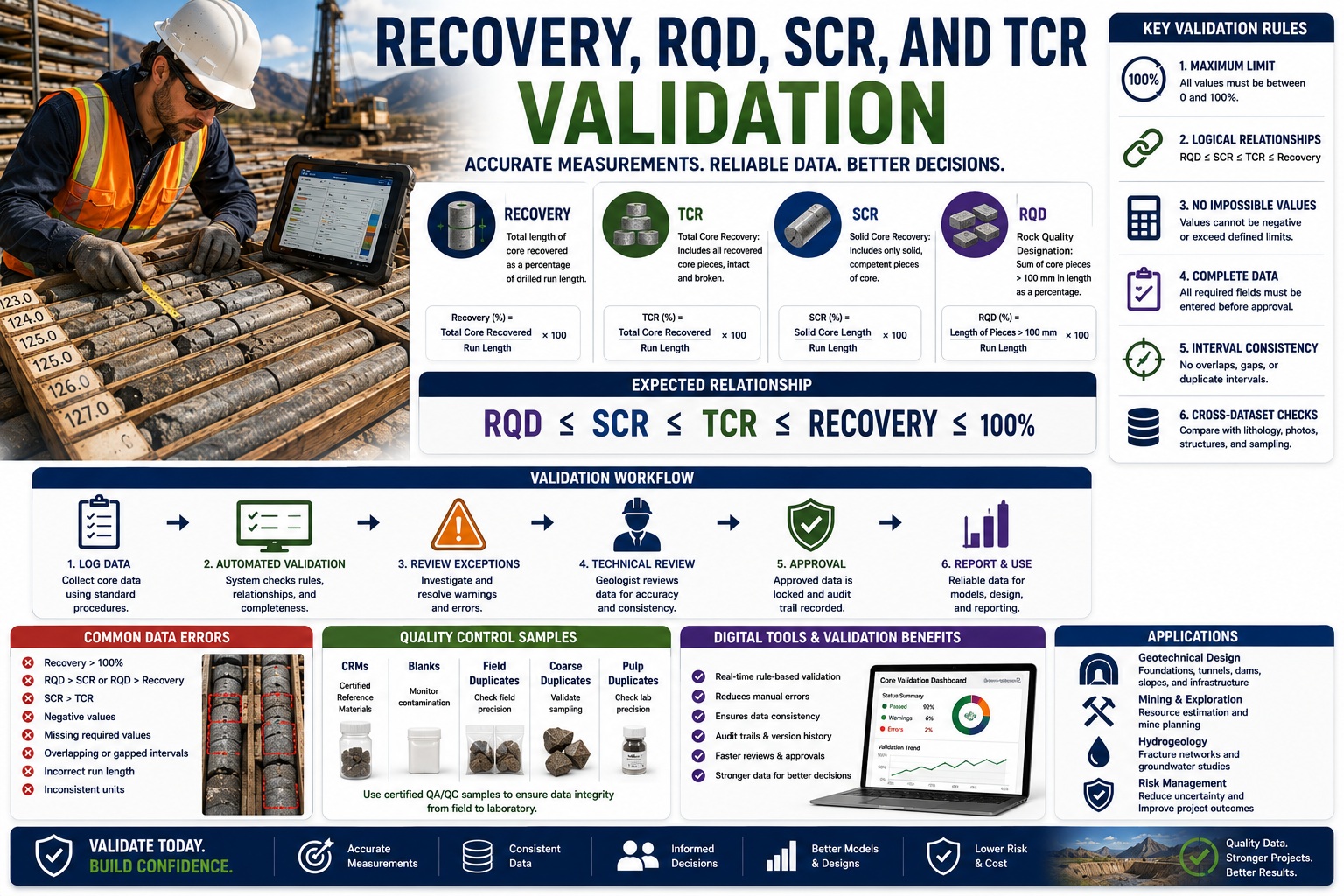
RQD ≤ SCR ≤ TCR ≤ Recovery ≤ 100%
When these relationships are violated, validation warnings or errors should be generated.
Standardized Logging Procedures
Validation begins with consistent logging procedures.
Organizations should document:
- Measurement methods
- Minimum fragment sizes
- RQD procedures
- SCR criteria
- Core reconstruction methods
- Broken core handling
Without standardized procedures, validation becomes far less effective.
Digital Core Measurement
Many organizations now perform logging using digital geological databases.
Digital systems provide advantages including:
- Automatic calculations
- Real-time validation
- Reduced transcription errors
- Consistent units
- Immediate feedback
Digital logging greatly improves QA/QC compared with manual spreadsheets.
Automated Validation Rules
Modern geological software can automatically evaluate recovery measurements.
Examples include:
Rule 1 — Recovery Cannot Exceed 100%
Recovery values above 100% indicate measurement or calculation errors.
Severity:
Error
Rule 2 — TCR Cannot Exceed Recovery
Since TCR measures recovered core, it cannot exceed total recovery.
Validation:
TCR ≤ Recovery
Severity:
Error
Rule 3 — SCR Cannot Exceed TCR
Solid core cannot exceed total recovered core.
Validation:
SCR ≤ TCR
Severity:
Error
Rule 4 — RQD Cannot Exceed SCR
RQD measures only long competent pieces.
Validation:
RQD ≤ SCR
Severity:
Error
Rule 5 — RQD Cannot Exceed Recovery
Validation:
RQD ≤ Recovery
Severity:
Error
Rule 6 — Negative Values
Recovery measurements cannot be negative.
Severity:
Error
Rule 7 — Missing Values
Where core has been logged, required measurements should be present.
Missing:
- Recovery
- SCR
- TCR
- RQD
should generate completeness warnings.
Cross-Dataset Validation
Validation should extend beyond individual values.
Relationships between datasets provide powerful QA/QC opportunities.
Lithology vs RQD
RQD generally applies only to competent rock.
If RQD appears within unconsolidated soil intervals, the data should be reviewed.
Core Boxes vs Logged Recovery
Recovered core visible in photographs should reasonably match logged recovery.
Large discrepancies may indicate logging errors.
Recovery vs Drilling Method
Certain drilling techniques may influence recovery.
Validation rules can identify unexpected results requiring review.
Structural Logging
Highly fractured intervals typically correspond with lower RQD values.
Although not always true, significant inconsistencies should be reviewed by experienced geologists.
Completeness Validation
Before approval, geological databases should verify that all required measurements have been recorded.
Examples include:
✓ Recovery
✓ RQD
✓ SCR
✓ TCR
✓ Run length
✓ Lithology
✓ Depth interval
✓ Logger
✓ Logging date
Missing information should prevent final approval until resolved or formally justified.
Range Validation
Validation should confirm realistic values.
Typical limits include:
| Parameter | Valid Range |
|---|---|
| Recovery | 0–100% |
| TCR | 0–100% |
| SCR | 0–100% |
| RQD | 0–100% |
Values outside these ranges should generate immediate errors.
Duplicate Interval Validation
Each recovery interval should be unique.
Validation should detect:
- Duplicate intervals
- Overlapping intervals
- Gaps
- Incorrect depth ordering
Interval validation prevents numerous downstream problems.
Metadata Validation
Recovery measurements should include supporting metadata.
Examples:
- Logger
- Logging date
- Drill hole ID
- Run number
- Core size
- Orientation method
Metadata improves traceability and supports future audits.
Technical Review
Automation cannot replace geological judgment.
Senior reviewers should evaluate:
- Core reconstruction
- Fracture interpretation
- Weathering effects
- Unusual recovery
- Broken core handling
Independent review remains an essential component of QA/QC.
Workflow Integration
Recovery validation should form part of the overall geological workflow.
Recommended process:
Step 1
Core logging completed.
↓
Step 2
Automated validation executed.
↓
Step 3
Validation exceptions reviewed.
↓
Step 4
Technical review.
↓
Step 5
Approval.
↓
Step 6
Data locked.
Structured workflows improve accountability while reducing accidental errors.
Audit Trails
Every modification should be recorded.
Audit records should capture:
- User
- Date
- Previous value
- New value
- Reason for change
Audit trails strengthen both quality assurance and legal defensibility.
Common Logging Errors
Frequently encountered problems include:
- Recovery greater than 100%
- RQD greater than Recovery
- SCR greater than TCR
- Missing recovery values
- Duplicate intervals
- Incorrect run lengths
- Incorrect units
- RQD recorded within soil
- Missing metadata
Most of these errors can be identified automatically.
Data Governance
Successful QA/QC depends upon clear governance.
Organizations should define:
- Logging standards
- Validation rules
- Reviewer responsibilities
- Approval authority
- Revision procedures
- Data retention policies
Governance ensures consistency across drilling campaigns.
Benefits of Automated Validation
Modern geological databases provide substantial advantages over manual review.
Benefits include:
- Immediate error detection
- Consistent calculations
- Reduced manual checking
- Faster approvals
- Higher confidence
- Improved audit readiness
- Better resource models
- Reduced engineering risk
Automation allows geologists to focus on interpretation rather than data verification.
Emerging Technologies
Recovery validation continues to evolve.
Modern systems increasingly incorporate:
- Digital core scanners
- AI-assisted fracture recognition
- Automated RQD calculation
- Machine vision core measurements
- Cloud-based geological databases
- Real-time validation dashboards
- Digital approval workflows
These technologies will further improve consistency while reducing human error.
Best Practices Checklist
Organizations should:
✓ Standardize recovery measurement procedures.
✓ Define Recovery, TCR, SCR, and RQD consistently.
✓ Capture data digitally whenever possible.
✓ Validate relationships automatically.
✓ Compare related datasets.
✓ Require independent technical review.
✓ Preserve audit trails.
✓ Maintain complete metadata.
✓ Lock approved records.
✓ Review validation reports before resource modelling or engineering design.
Example Validation Matrix
| Validation Rule | Severity | Action |
|---|---|---|
| Recovery > 100% | Error | Reject record |
| TCR > Recovery | Error | Correct value |
| SCR > TCR | Error | Correct value |
| RQD > SCR | Error | Correct value |
| Missing RQD | Warning | Review interval |
| Missing Recovery | Warning | Complete data |
| Duplicate Interval | Error | Resolve conflict |
| Gap Between Runs | Warning | Verify drilling records |
Conclusion
Recovery, TCR, SCR, and RQD are among the most important measurements collected during rock core logging, forming the basis for geotechnical assessment, resource estimation, and engineering design. Because these values are closely related, they provide an ideal opportunity for automated QA/QC through logical validation rules and cross-dataset consistency checks. By implementing standardized logging procedures, digital data capture, automated validation engines, structured review workflows, comprehensive audit trails, and strong data governance, organizations can significantly improve the accuracy, consistency, and defensibility of their geological databases. As exploration and geotechnical projects continue to generate larger and more complex datasets, rigorous validation of rock quality measurements will remain essential for delivering reliable geological information and supporting confident engineering and mining decisions.
Best Practices for Validating Rock Core Quality Measurements in Geological and Geotechnical Investigations
Rock core logging is one of the most important activities performed during geotechnical investigations and mineral exploration drilling. The measurements collected from drill core—including Core Recovery, Rock Quality Designation (RQD), Solid Core Recovery (SCR), and Total Core Recovery (TCR)—provide essential information about rock mass quality, fracture intensity, drilling conditions, excavation performance, slope stability, tunnel design, and resource evaluation.
These parameters are used daily by engineering geologists, geotechnical engineers, mining engineers, hydrogeologists, and resource geologists. They influence major design decisions involving tunnels, dams, foundations, open pits, underground mines, and infrastructure projects.
Because these measurements are so influential, even small errors can have significant consequences. An incorrectly calculated RQD may overestimate rock quality. An invalid SCR value may affect tunnel support design. Recovery measurements greater than 100 percent or inconsistent relationships between SCR, TCR, and RQD can indicate data entry errors, incorrect measurements, or misunderstandings of logging procedures.
Modern geological databases can eliminate many of these problems by combining standardized logging procedures with automated validation rules, cross-dataset consistency checks, structured workflows, and independent technical review.
This article examines best practices for validating Recovery, RQD, SCR, and TCR measurements and explains how automated QA/QC improves the reliability and defensibility of rock core data.
Why Rock Core Validation Matters
Rock quality measurements influence numerous engineering and exploration activities.
Examples include:
- Rock mass classification
- Tunnel support design
- Foundation engineering
- Slope stability analysis
- Underground mine design
- Open pit design
- Resource estimation
- Hydrogeological investigations
Errors introduced during core logging often propagate throughout downstream analyses.
Validation helps detect these errors before they affect engineering decisions.
Understanding the Four Core Measurements
Although related, Recovery, TCR, SCR, and RQD each describe different characteristics of the recovered core.
Total Core Recovery (TCR)
TCR measures the total length of all recovered core pieces expressed as a percentage of the drilled run length.
It includes:
- Intact core
- Broken fragments
- Small pieces
- Weathered material
Because all recovered material is included, TCR is typically the highest recovery-related value.
Example:
Run length:
1.50 m
Recovered core:
1.44 m
TCR:
96%
Solid Core Recovery (SCR)
SCR measures only competent, solid pieces of core that satisfy the project’s minimum criteria.
Loose fragments and highly broken material are excluded.
SCR provides a better indication of competent rock than TCR.
Consequently:
SCR is generally less than or equal to TCR.
Rock Quality Designation (RQD)
RQD measures the percentage of intact core pieces greater than 100 mm in length.
Developed by Deere in the 1960s, RQD remains one of the most widely used indicators of rock mass quality.
Higher RQD values generally indicate fewer fractures and better rock quality.
Core Recovery
Many organizations also calculate overall core recovery independently of TCR.
Depending on local procedures, Recovery may represent:
- Total recovered length
- Recovered drilling interval
- Project-specific recovery calculations
Organizations should clearly define how Recovery is calculated within their QA procedures.
Expected Relationships
Because these measurements describe related characteristics of the same core, logical relationships should always exist.
The most common relationship is:
RQD ≤ SCR ≤ TCR ≤ Recovery ≤ 100%
When these relationships are violated, validation warnings or errors should be generated.
Standardized Logging Procedures
Validation begins with consistent logging procedures.
Organizations should document:
- Measurement methods
- Minimum fragment sizes
- RQD procedures
- SCR criteria
- Core reconstruction methods
- Broken core handling
Without standardized procedures, validation becomes far less effective.
Digital Core Measurement
Many organizations now perform logging using digital geological databases.
Digital systems provide advantages including:
- Automatic calculations
- Real-time validation
- Reduced transcription errors
- Consistent units
- Immediate feedback
Digital logging greatly improves QA/QC compared with manual spreadsheets.
Automated Validation Rules
Modern geological software can automatically evaluate recovery measurements.
Examples include:
Rule 1 — Recovery Cannot Exceed 100%
Recovery values above 100% indicate measurement or calculation errors.
Severity:
Error
Rule 2 — TCR Cannot Exceed Recovery
Since TCR measures recovered core, it cannot exceed total recovery.
Validation:
TCR ≤ Recovery
Severity:
Error
Rule 3 — SCR Cannot Exceed TCR
Solid core cannot exceed total recovered core.
Validation:
SCR ≤ TCR
Severity:
Error
Rule 4 — RQD Cannot Exceed SCR
RQD measures only long competent pieces.
Validation:
RQD ≤ SCR
Severity:
Error
Rule 5 — RQD Cannot Exceed Recovery
Validation:
RQD ≤ Recovery
Severity:
Error
Rule 6 — Negative Values
Recovery measurements cannot be negative.
Severity:
Error
Rule 7 — Missing Values
Where core has been logged, required measurements should be present.
Missing:
- Recovery
- SCR
- TCR
- RQD
should generate completeness warnings.
Cross-Dataset Validation
Validation should extend beyond individual values.
Relationships between datasets provide powerful QA/QC opportunities.
Lithology vs RQD
RQD generally applies only to competent rock.
If RQD appears within unconsolidated soil intervals, the data should be reviewed.
Core Boxes vs Logged Recovery
Recovered core visible in photographs should reasonably match logged recovery.
Large discrepancies may indicate logging errors.
Recovery vs Drilling Method
Certain drilling techniques may influence recovery.
Validation rules can identify unexpected results requiring review.
Structural Logging
Highly fractured intervals typically correspond with lower RQD values.
Although not always true, significant inconsistencies should be reviewed by experienced geologists.
Completeness Validation
Before approval, geological databases should verify that all required measurements have been recorded.
Examples include:
✓ Recovery
✓ RQD
✓ SCR
✓ TCR
✓ Run length
✓ Lithology
✓ Depth interval
✓ Logger
✓ Logging date
Missing information should prevent final approval until resolved or formally justified.
Range Validation
Validation should confirm realistic values.
Typical limits include:
| Parameter | Valid Range |
|---|---|
| Recovery | 0–100% |
| TCR | 0–100% |
| SCR | 0–100% |
| RQD | 0–100% |
Values outside these ranges should generate immediate errors.
Duplicate Interval Validation
Each recovery interval should be unique.
Validation should detect:
- Duplicate intervals
- Overlapping intervals
- Gaps
- Incorrect depth ordering
Interval validation prevents numerous downstream problems.
Metadata Validation
Recovery measurements should include supporting metadata.
Examples:
- Logger
- Logging date
- Drill hole ID
- Run number
- Core size
- Orientation method
Metadata improves traceability and supports future audits.
Technical Review
Automation cannot replace geological judgment.
Senior reviewers should evaluate:
- Core reconstruction
- Fracture interpretation
- Weathering effects
- Unusual recovery
- Broken core handling
Independent review remains an essential component of QA/QC.
Workflow Integration
Recovery validation should form part of the overall geological workflow.
Recommended process:
Step 1
Core logging completed.
↓
Step 2
Automated validation executed.
↓
Step 3
Validation exceptions reviewed.
↓
Step 4
Technical review.
↓
Step 5
Approval.
↓
Step 6
Data locked.
Structured workflows improve accountability while reducing accidental errors.
Audit Trails
Every modification should be recorded.
Audit records should capture:
- User
- Date
- Previous value
- New value
- Reason for change
Audit trails strengthen both quality assurance and legal defensibility.
Common Logging Errors
Frequently encountered problems include:
- Recovery greater than 100%
- RQD greater than Recovery
- SCR greater than TCR
- Missing recovery values
- Duplicate intervals
- Incorrect run lengths
- Incorrect units
- RQD recorded within soil
- Missing metadata
Most of these errors can be identified automatically.
Data Governance
Successful QA/QC depends upon clear governance.
Organizations should define:
- Logging standards
- Validation rules
- Reviewer responsibilities
- Approval authority
- Revision procedures
- Data retention policies
Governance ensures consistency across drilling campaigns.
Benefits of Automated Validation
Modern geological databases provide substantial advantages over manual review.
Benefits include:
- Immediate error detection
- Consistent calculations
- Reduced manual checking
- Faster approvals
- Higher confidence
- Improved audit readiness
- Better resource models
- Reduced engineering risk
Automation allows geologists to focus on interpretation rather than data verification.
Emerging Technologies
Recovery validation continues to evolve.
Modern systems increasingly incorporate:
- Digital core scanners
- AI-assisted fracture recognition
- Automated RQD calculation
- Machine vision core measurements
- Cloud-based geological databases
- Real-time validation dashboards
- Digital approval workflows
These technologies will further improve consistency while reducing human error.
Best Practices Checklist
Organizations should:
✓ Standardize recovery measurement procedures.
✓ Define Recovery, TCR, SCR, and RQD consistently.
✓ Capture data digitally whenever possible.
✓ Validate relationships automatically.
✓ Compare related datasets.
✓ Require independent technical review.
✓ Preserve audit trails.
✓ Maintain complete metadata.
✓ Lock approved records.
✓ Review validation reports before resource modelling or engineering design.
Example Validation Matrix
| Validation Rule | Severity | Action |
|---|---|---|
| Recovery > 100% | Error | Reject record |
| TCR > Recovery | Error | Correct value |
| SCR > TCR | Error | Correct value |
| RQD > SCR | Error | Correct value |
| Missing RQD | Warning | Review interval |
| Missing Recovery | Warning | Complete data |
| Duplicate Interval | Error | Resolve conflict |
| Gap Between Runs | Warning | Verify drilling records |
Conclusion
Recovery, TCR, SCR, and RQD are among the most important measurements collected during rock core logging, forming the basis for geotechnical assessment, resource estimation, and engineering design. Because these values are closely related, they provide an ideal opportunity for automated QA/QC through logical validation rules and cross-dataset consistency checks. By implementing standardized logging procedures, digital data capture, automated validation engines, structured review workflows, comprehensive audit trails, and strong data governance, organizations can significantly improve the accuracy, consistency, and defensibility of their geological databases. As exploration and geotechnical projects continue to generate larger and more complex datasets, rigorous validation of rock quality measurements will remain essential for delivering reliable geological information and supporting confident engineering and mining decisions.