

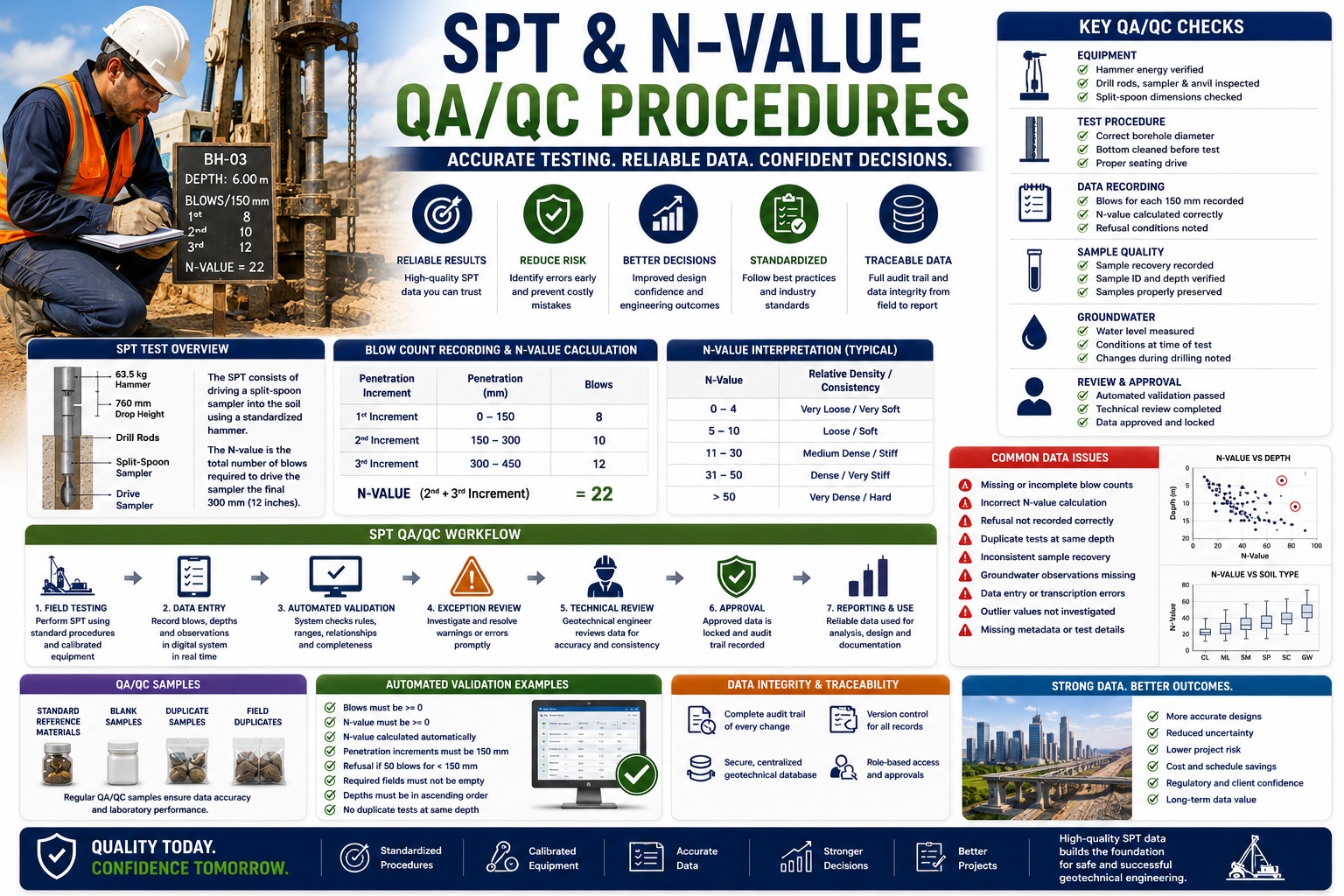
Best Practices for Ensuring Accurate Standard Penetration Test Data in Geotechnical Investigations
The Standard Penetration Test (SPT) remains one of the most widely performed in-situ tests in geotechnical engineering. For more than a century, engineers have relied on SPT N-values to estimate soil density, relative strength, bearing capacity, liquefaction potential, settlement characteristics, and numerous other engineering parameters. From residential developments to bridges, dams, tunnels, highways, and high-rise buildings, SPT results often form the foundation of geotechnical design.
Despite its widespread use, the Standard Penetration Test is also one of the most vulnerable field tests to inconsistencies. Differences in drilling techniques, hammer efficiency, equipment condition, borehole preparation, data recording, and interpretation can all influence measured N-values. A simple transcription error or an incorrectly recorded blow count can significantly affect engineering calculations and ultimately influence project costs and safety.
For this reason, modern geotechnical investigations increasingly incorporate comprehensive Quality Assurance (QA) and Quality Control (QC) procedures throughout the SPT workflow. These procedures begin before drilling starts and continue through field data collection, automated validation, technical review, approval, reporting, and long-term database management.
This article examines best practices for QA/QC of SPT and N-value data and explains how automated validation, structured workflows, and digital geotechnical databases improve the reliability, consistency, and defensibility of Standard Penetration Test results.
Why SPT Data Quality Matters
SPT results influence numerous engineering decisions.
Examples include:
- Foundation design
- Bearing capacity calculations
- Settlement analysis
- Liquefaction assessments
- Retaining wall design
- Slope stability evaluations
- Pavement design
- Earthwork planning
Errors in SPT data can propagate throughout the design process, potentially leading to:
- Conservative and costly designs
- Under-designed foundations
- Construction delays
- Additional site investigations
- Regulatory questions
- Professional liability claims
Ensuring high-quality SPT data reduces these risks and increases confidence in engineering recommendations.
Understanding the Standard Penetration Test
The Standard Penetration Test measures the resistance of soil to penetration by driving a split-spoon sampler into the ground using a standardized hammer.
The recorded N-value is generally the total number of hammer blows required to drive the sampler through the final 300 mm (12 inches) of penetration after an initial seating drive.
Although the concept is simple, obtaining reliable results depends on careful control of numerous variables.
Sources of SPT Error
Many factors can influence recorded N-values.
Common sources of error include:
- Incorrect hammer energy
- Worn sampling equipment
- Improper rod lengths
- Borehole instability
- Incorrect borehole diameter
- Excessive drilling disturbance
- Poor sample recovery
- Incorrect blow count recording
- Data transcription errors
A robust QA/QC program addresses each of these risks.
Quality Assurance Begins Before Drilling
QA starts during project planning.
Organizations should establish:
- Applicable testing standards
- Equipment inspection procedures
- Calibration requirements
- Personnel qualifications
- Field documentation requirements
- Validation procedures
Standardized operating procedures help ensure consistency between crews and projects.
Equipment Inspection
Before fieldwork begins, drilling equipment should be inspected.
Typical checks include:
- Hammer condition
- Hammer drop height
- Automatic hammer operation
- Split-spoon dimensions
- Drill rods
- Anvil condition
- Rope and cathead (where applicable)
Damaged or worn equipment can significantly affect measured N-values.
Borehole Preparation
Proper borehole preparation is essential.
QA procedures should verify:
- Borehole diameter
- Borehole stability
- Correct drilling method
- Bottom cleaning before testing
- Groundwater observations
Poor borehole conditions may invalidate test results.
Recording Blow Counts
Each SPT test records hammer blows for three successive penetration increments.
Field logs should clearly document:
| Penetration | Blows |
|---|---|
| First 150 mm | 8 |
| Second 150 mm | 10 |
| Third 150 mm | 12 |
The reported N-value is normally calculated using the second and third increments according to the applicable standard and project requirements.
Digital logging software should calculate the N-value automatically to eliminate arithmetic errors.
Automated N-Value Calculation
Manual calculations introduce unnecessary risk.
Modern geotechnical databases automatically calculate:
- Total blows
- N-value
- Refusal conditions
- Penetration depth
Automation eliminates many transcription mistakes.
Validation Rules
Automated validation greatly improves SPT quality.
Typical rules include:
Rule 1 — Negative Blow Counts
Blow counts cannot be negative.
Severity:
Error
Rule 2 — Missing Blow Counts
If an SPT test exists, required blow counts must be recorded.
Severity:
Warning
Rule 3 — Missing N-Value
If blow counts are available, an N-value should exist or be calculated automatically.
Severity:
Warning
Rule 4 — Impossible N-Values
Values outside reasonable engineering limits should be reviewed.
Examples:
- Negative values
- Extremely high values
- Zero values where penetration occurred
Severity:
Warning or Error, depending on project rules.
Rule 5 — Duplicate Tests
Multiple SPT tests at the same depth should be reviewed.
Severity:
Warning
Refusal Conditions
Refusal should be documented consistently.
Examples include:
- 50 blows for less than 150 mm penetration
- Project-specific refusal criteria
- Practical refusal
The database should distinguish refusal from high N-values to avoid misleading interpretations.
Sample Recovery Validation
SPT testing also produces soil samples.
Validation should verify:
- Recovery length
- Sample identification
- Sample container
- Laboratory submission
Poor recovery may affect interpretation of N-values.
Cross-Dataset Validation
SPT data should not be validated in isolation.
Relationships between datasets provide valuable QA/QC opportunities.
N-Value vs Soil Type
Examples include:
- Very loose sands with extremely high N-values.
- Soft clays with unusually high resistance.
- Dense gravels with exceptionally low blow counts.
These may indicate either unusual geology or data entry errors.
N-Value vs Sample Recovery
Very low recovery combined with high N-values should be reviewed.
N-Value vs Groundwater
Groundwater conditions significantly influence interpretation.
Validation should confirm groundwater observations are available where required.
N-Value vs Consistency/Density
Field descriptions should generally align with measured resistance.
Examples:
| Soil Description | Expected Trend |
|---|---|
| Very Loose Sand | Low N-value |
| Dense Sand | Higher N-value |
| Soft Clay | Low resistance |
| Very Stiff Clay | Higher resistance |
These rules should generate warnings rather than automatic failures because natural variability exists.
Statistical Validation
Modern databases increasingly perform statistical QA/QC.
Examples include:
- Outlier detection
- Unexpected depth trends
- Comparison with nearby boreholes
- Sudden changes in resistance
Statistical validation identifies unusual results requiring review.
Metadata Validation
SPT records should include:
- Borehole ID
- Test depth
- Sampler type
- Hammer type
- Logger
- Date
- Driller
- Drilling method
Metadata strengthens traceability and future interpretation.
Technical Review
Automation cannot replace engineering judgment.
Experienced reviewers should evaluate:
- Geological consistency
- Drilling conditions
- Sample quality
- Groundwater influence
- Refusal interpretation
- Correlation with nearby boreholes
Technical review remains an essential QA activity.
Workflow Integration
SPT QA/QC should follow a structured workflow.
Step 1
Field data collection.
↓
Step 2
Automatic validation.
↓
Step 3
Validation exceptions reviewed.
↓
Step 4
Technical review.
↓
Step 5
Approval.
↓
Step 6
Database locked.
Structured workflows improve consistency and accountability.
Audit Trails
Every change should be recorded.
Audit records should capture:
- User
- Date
- Time
- Original value
- Modified value
- Reason for change
Audit trails strengthen legal defensibility.
Data Governance
Organizations should define:
- Logging standards
- Validation rules
- Reviewer responsibilities
- Approval authority
- Reopening procedures
- Record retention
Governance promotes consistent SPT practices across projects.
Digital Geotechnical Databases
Compared with spreadsheets, structured databases provide:
- Automated calculations
- Validation rules
- Cross-dataset checks
- GIS integration
- Laboratory links
- Workflow management
- Audit trails
- Electronic approvals
Digital systems substantially improve SPT data quality.
Artificial Intelligence and SPT QA/QC
Emerging AI technologies are beginning to enhance geotechnical QA/QC.
Potential applications include:
- Automatic anomaly detection
- Comparison with historical boreholes
- Soil consistency prediction
- Liquefaction screening
- Confidence scoring
- Pattern recognition
AI should assist engineers rather than replace professional judgment.
Common SPT Data Problems
Frequently encountered issues include:
- Missing blow counts
- Incorrect N-value calculations
- Duplicate test depths
- Incorrect refusal coding
- Missing groundwater observations
- Sample numbering errors
- Inconsistent soil descriptions
- Transcription mistakes
- Missing metadata
Automated validation can identify many of these before reports are issued.
Best Practices Checklist
Organizations should:
✓ Standardize SPT procedures.
✓ Inspect drilling equipment regularly.
✓ Capture blow counts digitally.
✓ Calculate N-values automatically.
✓ Validate blow counts in real time.
✓ Cross-check SPT data with lithology.
✓ Review statistical outliers.
✓ Preserve complete metadata.
✓ Maintain audit trails.
✓ Require independent technical review.
✓ Lock approved records.
The Future of SPT Data Quality
Geotechnical investigations continue to evolve toward fully digital workflows.
Emerging technologies include:
- Mobile field logging
- Cloud synchronization
- AI-assisted validation
- Automated geotechnical dashboards
- Digital approvals
- Real-time QA/QC monitoring
- Integrated geological databases
These technologies improve consistency while reducing manual effort and transcription errors.
Conclusion
The Standard Penetration Test remains one of the most important field tests in geotechnical engineering, and the quality of its results directly affects foundation design, settlement analysis, liquefaction assessments, and numerous other engineering decisions. By implementing standardized field procedures, automated N-value calculations, real-time validation rules, cross-dataset verification, structured workflows, technical review, audit trails, and robust data governance, organizations can significantly improve the accuracy, consistency, and defensibility of their SPT data. As digital geotechnical databases and AI-assisted validation continue to evolve, comprehensive QA/QC procedures will remain essential for ensuring that every recorded N-value supports reliable engineering analysis, informed decision-making, and long-term confidence in geotechnical investigations.
Best Practices for Ensuring Accurate Standard Penetration Test Data in Geotechnical Investigations
The Standard Penetration Test (SPT) remains one of the most widely performed in-situ tests in geotechnical engineering. For more than a century, engineers have relied on SPT N-values to estimate soil density, relative strength, bearing capacity, liquefaction potential, settlement characteristics, and numerous other engineering parameters. From residential developments to bridges, dams, tunnels, highways, and high-rise buildings, SPT results often form the foundation of geotechnical design.
Despite its widespread use, the Standard Penetration Test is also one of the most vulnerable field tests to inconsistencies. Differences in drilling techniques, hammer efficiency, equipment condition, borehole preparation, data recording, and interpretation can all influence measured N-values. A simple transcription error or an incorrectly recorded blow count can significantly affect engineering calculations and ultimately influence project costs and safety.
For this reason, modern geotechnical investigations increasingly incorporate comprehensive Quality Assurance (QA) and Quality Control (QC) procedures throughout the SPT workflow. These procedures begin before drilling starts and continue through field data collection, automated validation, technical review, approval, reporting, and long-term database management.
This article examines best practices for QA/QC of SPT and N-value data and explains how automated validation, structured workflows, and digital geotechnical databases improve the reliability, consistency, and defensibility of Standard Penetration Test results.
Why SPT Data Quality Matters
SPT results influence numerous engineering decisions.
Examples include:
- Foundation design
- Bearing capacity calculations
- Settlement analysis
- Liquefaction assessments
- Retaining wall design
- Slope stability evaluations
- Pavement design
- Earthwork planning
Errors in SPT data can propagate throughout the design process, potentially leading to:
- Conservative and costly designs
- Under-designed foundations
- Construction delays
- Additional site investigations
- Regulatory questions
- Professional liability claims
Ensuring high-quality SPT data reduces these risks and increases confidence in engineering recommendations.
Understanding the Standard Penetration Test
The Standard Penetration Test measures the resistance of soil to penetration by driving a split-spoon sampler into the ground using a standardized hammer.
The recorded N-value is generally the total number of hammer blows required to drive the sampler through the final 300 mm (12 inches) of penetration after an initial seating drive.
Although the concept is simple, obtaining reliable results depends on careful control of numerous variables.
Sources of SPT Error
Many factors can influence recorded N-values.
Common sources of error include:
- Incorrect hammer energy
- Worn sampling equipment
- Improper rod lengths
- Borehole instability
- Incorrect borehole diameter
- Excessive drilling disturbance
- Poor sample recovery
- Incorrect blow count recording
- Data transcription errors
A robust QA/QC program addresses each of these risks.
Quality Assurance Begins Before Drilling
QA starts during project planning.
Organizations should establish:
- Applicable testing standards
- Equipment inspection procedures
- Calibration requirements
- Personnel qualifications
- Field documentation requirements
- Validation procedures
Standardized operating procedures help ensure consistency between crews and projects.
Equipment Inspection
Before fieldwork begins, drilling equipment should be inspected.
Typical checks include:
- Hammer condition
- Hammer drop height
- Automatic hammer operation
- Split-spoon dimensions
- Drill rods
- Anvil condition
- Rope and cathead (where applicable)
Damaged or worn equipment can significantly affect measured N-values.
Borehole Preparation
Proper borehole preparation is essential.
QA procedures should verify:
- Borehole diameter
- Borehole stability
- Correct drilling method
- Bottom cleaning before testing
- Groundwater observations
Poor borehole conditions may invalidate test results.
Recording Blow Counts
Each SPT test records hammer blows for three successive penetration increments.
Field logs should clearly document:
| Penetration | Blows |
|---|---|
| First 150 mm | 8 |
| Second 150 mm | 10 |
| Third 150 mm | 12 |
The reported N-value is normally calculated using the second and third increments according to the applicable standard and project requirements.
Digital logging software should calculate the N-value automatically to eliminate arithmetic errors.
Automated N-Value Calculation
Manual calculations introduce unnecessary risk.
Modern geotechnical databases automatically calculate:
- Total blows
- N-value
- Refusal conditions
- Penetration depth
Automation eliminates many transcription mistakes.
Validation Rules
Automated validation greatly improves SPT quality.
Typical rules include:
Rule 1 — Negative Blow Counts
Blow counts cannot be negative.
Severity:
Error
Rule 2 — Missing Blow Counts
If an SPT test exists, required blow counts must be recorded.
Severity:
Warning
Rule 3 — Missing N-Value
If blow counts are available, an N-value should exist or be calculated automatically.
Severity:
Warning
Rule 4 — Impossible N-Values
Values outside reasonable engineering limits should be reviewed.
Examples:
- Negative values
- Extremely high values
- Zero values where penetration occurred
Severity:
Warning or Error, depending on project rules.
Rule 5 — Duplicate Tests
Multiple SPT tests at the same depth should be reviewed.
Severity:
Warning
Refusal Conditions
Refusal should be documented consistently.
Examples include:
- 50 blows for less than 150 mm penetration
- Project-specific refusal criteria
- Practical refusal
The database should distinguish refusal from high N-values to avoid misleading interpretations.
Sample Recovery Validation
SPT testing also produces soil samples.
Validation should verify:
- Recovery length
- Sample identification
- Sample container
- Laboratory submission
Poor recovery may affect interpretation of N-values.
Cross-Dataset Validation
SPT data should not be validated in isolation.
Relationships between datasets provide valuable QA/QC opportunities.
N-Value vs Soil Type
Examples include:
- Very loose sands with extremely high N-values.
- Soft clays with unusually high resistance.
- Dense gravels with exceptionally low blow counts.
These may indicate either unusual geology or data entry errors.
N-Value vs Sample Recovery
Very low recovery combined with high N-values should be reviewed.
N-Value vs Groundwater
Groundwater conditions significantly influence interpretation.
Validation should confirm groundwater observations are available where required.
N-Value vs Consistency/Density
Field descriptions should generally align with measured resistance.
Examples:
| Soil Description | Expected Trend |
|---|---|
| Very Loose Sand | Low N-value |
| Dense Sand | Higher N-value |
| Soft Clay | Low resistance |
| Very Stiff Clay | Higher resistance |
These rules should generate warnings rather than automatic failures because natural variability exists.
Statistical Validation
Modern databases increasingly perform statistical QA/QC.
Examples include:
- Outlier detection
- Unexpected depth trends
- Comparison with nearby boreholes
- Sudden changes in resistance
Statistical validation identifies unusual results requiring review.
Metadata Validation
SPT records should include:
- Borehole ID
- Test depth
- Sampler type
- Hammer type
- Logger
- Date
- Driller
- Drilling method
Metadata strengthens traceability and future interpretation.
Technical Review
Automation cannot replace engineering judgment.
Experienced reviewers should evaluate:
- Geological consistency
- Drilling conditions
- Sample quality
- Groundwater influence
- Refusal interpretation
- Correlation with nearby boreholes
Technical review remains an essential QA activity.
Workflow Integration
SPT QA/QC should follow a structured workflow.
Step 1
Field data collection.
↓
Step 2
Automatic validation.
↓
Step 3
Validation exceptions reviewed.
↓
Step 4
Technical review.
↓
Step 5
Approval.
↓
Step 6
Database locked.
Structured workflows improve consistency and accountability.
Audit Trails
Every change should be recorded.
Audit records should capture:
- User
- Date
- Time
- Original value
- Modified value
- Reason for change
Audit trails strengthen legal defensibility.
Data Governance
Organizations should define:
- Logging standards
- Validation rules
- Reviewer responsibilities
- Approval authority
- Reopening procedures
- Record retention
Governance promotes consistent SPT practices across projects.
Digital Geotechnical Databases
Compared with spreadsheets, structured databases provide:
- Automated calculations
- Validation rules
- Cross-dataset checks
- GIS integration
- Laboratory links
- Workflow management
- Audit trails
- Electronic approvals
Digital systems substantially improve SPT data quality.
Artificial Intelligence and SPT QA/QC
Emerging AI technologies are beginning to enhance geotechnical QA/QC.
Potential applications include:
- Automatic anomaly detection
- Comparison with historical boreholes
- Soil consistency prediction
- Liquefaction screening
- Confidence scoring
- Pattern recognition
AI should assist engineers rather than replace professional judgment.
Common SPT Data Problems
Frequently encountered issues include:
- Missing blow counts
- Incorrect N-value calculations
- Duplicate test depths
- Incorrect refusal coding
- Missing groundwater observations
- Sample numbering errors
- Inconsistent soil descriptions
- Transcription mistakes
- Missing metadata
Automated validation can identify many of these before reports are issued.
Best Practices Checklist
Organizations should:
✓ Standardize SPT procedures.
✓ Inspect drilling equipment regularly.
✓ Capture blow counts digitally.
✓ Calculate N-values automatically.
✓ Validate blow counts in real time.
✓ Cross-check SPT data with lithology.
✓ Review statistical outliers.
✓ Preserve complete metadata.
✓ Maintain audit trails.
✓ Require independent technical review.
✓ Lock approved records.
The Future of SPT Data Quality
Geotechnical investigations continue to evolve toward fully digital workflows.
Emerging technologies include:
- Mobile field logging
- Cloud synchronization
- AI-assisted validation
- Automated geotechnical dashboards
- Digital approvals
- Real-time QA/QC monitoring
- Integrated geological databases
These technologies improve consistency while reducing manual effort and transcription errors.
Conclusion
The Standard Penetration Test remains one of the most important field tests in geotechnical engineering, and the quality of its results directly affects foundation design, settlement analysis, liquefaction assessments, and numerous other engineering decisions. By implementing standardized field procedures, automated N-value calculations, real-time validation rules, cross-dataset verification, structured workflows, technical review, audit trails, and robust data governance, organizations can significantly improve the accuracy, consistency, and defensibility of their SPT data. As digital geotechnical databases and AI-assisted validation continue to evolve, comprehensive QA/QC procedures will remain essential for ensuring that every recorded N-value supports reliable engineering analysis, informed decision-making, and long-term confidence in geotechnical investigations.