

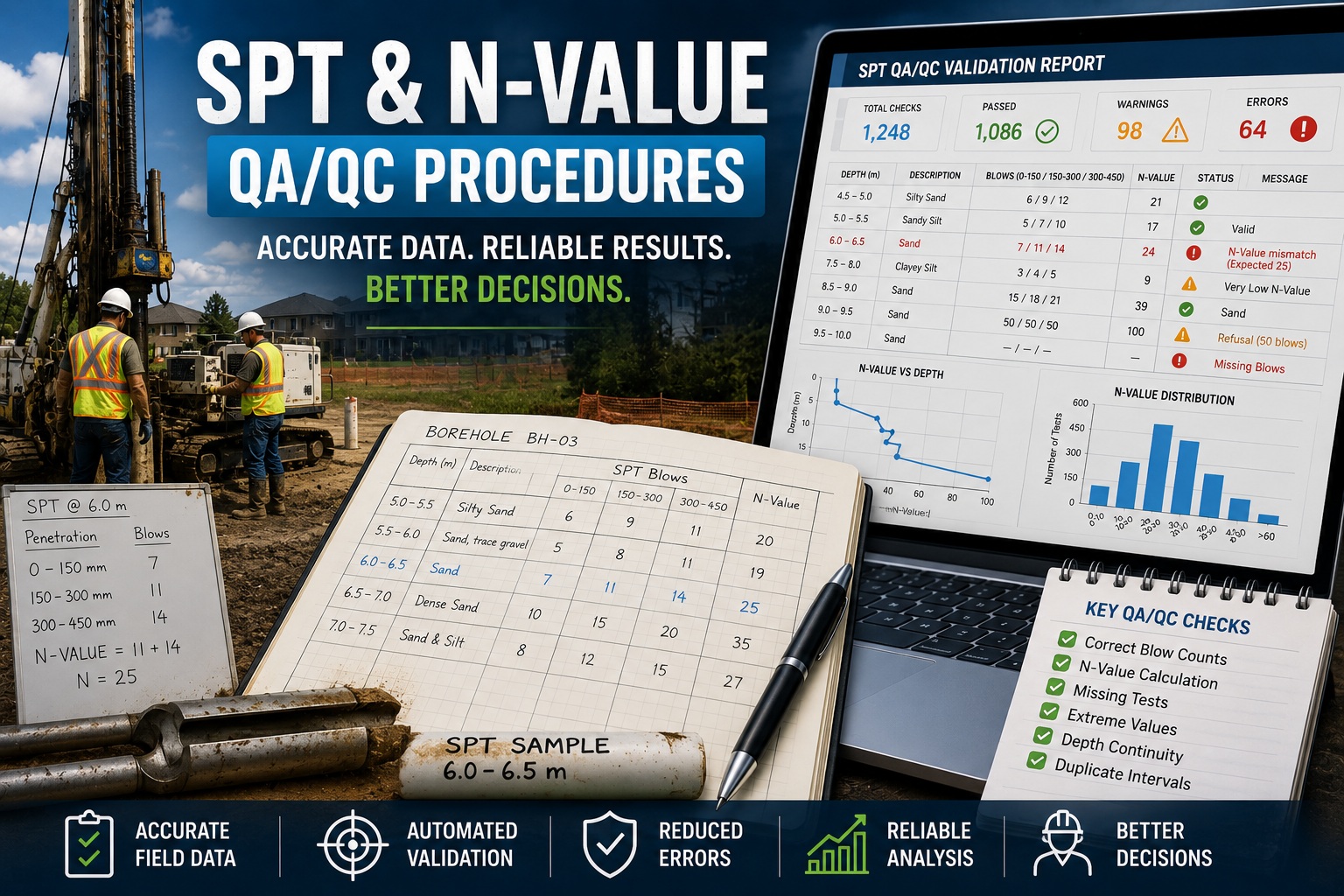
The Standard Penetration Test (SPT) is one of the most widely performed in-situ geotechnical tests in the world. From building foundations and bridges to highways, dams, pipelines, and environmental investigations, SPT results are used daily by geotechnical engineers to evaluate subsurface conditions and support critical engineering decisions.
At the heart of every SPT is the N-value, a measurement that estimates soil resistance to penetration. Although the test appears straightforward, obtaining reliable N-values requires careful attention to drilling procedures, sampling methods, equipment calibration, data recording, and quality assurance.
Errors introduced during drilling, sampling, or data entry can significantly affect foundation designs, settlement analyses, liquefaction assessments, and bearing capacity calculations. For this reason, modern geotechnical organizations are increasingly adopting automated Quality Assurance and Quality Control (QA/QC) systems to validate SPT data throughout the project lifecycle.
This article explains the importance of SPT and N-value QA/QC, identifies common sources of error, and demonstrates how automated validation improves data quality and engineering confidence.
What Is the Standard Penetration Test?
The Standard Penetration Test is an in-situ field test performed during borehole drilling to estimate the relative density or consistency of subsurface materials.
The test involves driving a split-spoon sampler into the soil using a standardized hammer and recording the number of hammer blows required to penetrate the final 300 mm (12 inches) of the sampling interval.
The resulting blow count is reported as the SPT N-value.
The procedure is standardized under several international standards, including:
- ASTM D1586
- ISO 22476
- CSA and regional transportation specifications
Because the procedure is standardized, maintaining strict QA/QC is essential to ensure results are comparable across projects.
Why N-Values Matter
SPT N-values are used in numerous geotechnical analyses, including:
- Bearing capacity
- Foundation design
- Settlement analysis
- Liquefaction assessment
- Earthquake engineering
- Pile design
- Soil classification
- Relative density estimation
- Consistency of cohesive soils
- Ground improvement design
Since many empirical engineering correlations are based directly on N-values, inaccurate data can lead to unconservative or overly conservative designs.
Understanding Blow Counts
A standard SPT consists of three successive 150 mm penetrations.
The first 150 mm is considered a seating drive and is generally discarded.
The final two 150 mm penetrations are added together to calculate the reported N-value.
Example:
| Penetration | Blows |
|---|---|
| First 150 mm | 6 |
| Second 150 mm | 10 |
| Third 150 mm | 12 |
Reported N-value:
10 + 12 = 22
Recording all three blow counts—not just the final N-value—is an important QA/QC practice because it allows engineers to verify calculations and identify unusual penetration behavior.
Common Sources of Error
Although SPT is standardized, many factors can affect the reliability of results.
Common issues include:
- Incorrect hammer energy
- Worn split-spoon samplers
- Improper drilling methods
- Rod friction
- Incorrect borehole diameter
- Inadequate borehole cleaning
- Misrecorded blow counts
- Decimal point errors
- Unit conversion mistakes
- Data transcription errors
- Missing test intervals
Many of these errors can be detected automatically before reports are issued.
Data Entry Errors
Large drilling programs often involve thousands of SPT tests.
Typical data entry mistakes include:
- Missing blow counts
- Incorrect totals
- Negative values
- Impossible values
- Reversed intervals
- Duplicate records
Automated validation identifies these issues immediately, reducing the need for manual review.
QA/QC Rule 1: Blow Counts Cannot Be Negative
Negative blow counts are physically impossible.
Example:
First Drive = -3
This should immediately generate an error.
QA/QC Rule 2: N-Value Must Equal Recorded Blow Counts
One of the simplest validation rules verifies the reported N-value against the recorded field data.
Example:
Blow counts:
6 / 11 / 13
Expected N-value:
11 + 13 = 24
If the reported N-value is 21, automated validation flags the discrepancy.
QA/QC Rule 3: Missing Blow Counts
Sometimes only the final N-value is entered.
Although usable, missing individual blow counts reduce traceability.
Validation can identify incomplete SPT records.
QA/QC Rule 4: Impossible N-Values
Extremely high or low values should be reviewed.
Examples:
N = -5
Impossible.
N = 400
Likely a transcription error.
Rather than automatically rejecting extreme values, validation systems typically flag them for engineering review.
QA/QC Rule 5: Duplicate SPT Tests
Duplicate intervals often occur during spreadsheet imports.
Example:
12.0–12.5 m
appearing twice.
Validation detects duplicate depth intervals and duplicate sample identifiers.
QA/QC Rule 6: Missing SPT in Required Soil Types
Many organizations require SPT testing at specified intervals or within certain soil formations.
Validation can verify that required tests have been performed.
QA/QC Rule 7: N-Values Should Match Soil Conditions
Cross-dataset validation compares N-values with geological descriptions.
Examples include:
Very loose sand with N = 80
or
Hard clay with N = 2
These values may be correct, but they warrant engineering review.
Cross-Checking with Geological Logging
Modern QA/QC systems compare SPT results against lithological descriptions.
Examples include:
Loose sand with exceptionally high N-values.
Soft clay with refusal.
Dense gravel with very low N-values.
Organic peat with unusually high penetration resistance.
These comparisons do not automatically indicate errors, but they identify records that deserve closer examination.
Refusal Conditions
Refusal occurs when penetration cannot continue under standardized testing conditions.
Typical refusal criteria include:
- 50 blows for any 150 mm increment
- 100 blows for 300 mm
- Project-specific agency limits
Validation ensures refusal is recorded consistently according to company or agency standards.
Liquefaction Studies Depend on Reliable Data
Liquefaction analyses rely heavily on corrected SPT N-values.
Errors in field data can affect:
- Earthquake hazard assessments
- Seismic foundation design
- Infrastructure resilience
- Dam safety studies
Because these analyses influence public safety, rigorous QA/QC is essential.
Batch Validation Across Entire Projects
Modern geotechnical software can validate every SPT record within an entire project in seconds.
Automated validation checks:
- Missing tests
- Duplicate intervals
- Incorrect N-values
- Invalid blow counts
- Impossible values
- Required fields
- Interval continuity
- Geological consistency
Project-wide validation produces a comprehensive report identifying only those records requiring attention.
Supporting Data Migration
Many firms are migrating historical borehole databases from spreadsheets, legacy software, or paper records.
Migration commonly introduces:
- Missing blow counts
- Incorrect N-value calculations
- Unit conversion errors
- Duplicate samples
- Field mapping mistakes
Running automated validation immediately after import provides confidence that historical SPT data remain reliable before being used in new engineering analyses.
Regulatory and Client Requirements
Transportation agencies, municipalities, mining companies, and infrastructure owners increasingly require documented QA/QC procedures for geotechnical investigations.
Automated validation supports these requirements by providing:
- Standardized rule enforcement
- Consistent project reviews
- Validation reports
- Audit trails
- Documented corrections
- Demonstrable compliance with company procedures
This improves transparency during technical reviews and supports defensible engineering decisions.
Integrating QA/QC into Daily Workflows
The most effective organizations incorporate validation throughout the project rather than waiting until report preparation.
A typical workflow includes:
- Record field blow counts.
- Calculate the N-value.
- Validate during data entry.
- Import laboratory or geological data.
- Revalidate after edits.
- Resolve validation warnings.
- Perform project-wide QA/QC.
- Approve data for reporting and design.
Continuous validation helps detect errors early, reducing rework and improving project efficiency.
WinLoG Automated SPT Validation
WinLoG includes an advanced validation engine specifically designed for borehole, geotechnical, geological, and environmental data. The system automatically evaluates SPT and N-value records using engineering rules rather than simple database checks.
Validation rules can verify blow count calculations, identify missing or duplicate SPT tests, detect impossible N-values, compare results against lithology and sampling information, validate interval continuity, and ensure consistency with project standards. The validation engine can also evaluate related data such as Recovery, RQD, SCR, groundwater observations, laboratory results, and sample records to identify cross-dataset inconsistencies.
Validation may be performed during data entry, after importing AGS, DIGGS, CSV, or legacy databases, or across an entire project before final reporting. Detailed validation reports classify findings by severity, explain why each issue was flagged, and maintain an audit trail of corrections, making the QA/QC process transparent and repeatable.
Organizations can further customize the rule library to reflect company procedures, client specifications, or transportation agency requirements, ensuring consistent quality across every project.
Best Practices for SPT QA/QC
Organizations can improve SPT data quality by following several proven practices:
- Record all three individual blow counts.
- Verify calculated N-values automatically.
- Calibrate drilling and sampling equipment regularly.
- Standardize field data collection procedures.
- Validate data during entry rather than after reporting.
- Review extreme values before approval.
- Check SPT results against lithology and groundwater conditions.
- Validate imported historical data.
- Maintain complete audit trails of corrections.
- Use standardized coding and reporting formats.
These practices improve consistency, reduce transcription errors, and increase confidence in geotechnical analyses.
Conclusion
The Standard Penetration Test remains one of the most important field investigations in geotechnical engineering, but its value depends entirely on the quality of the data collected. Accurate blow counts, correctly calculated N-values, consistent logging, and standardized procedures are essential for reliable engineering interpretations.
Automated QA/QC provides a practical and efficient way to ensure data quality by checking every SPT record for missing information, impossible values, calculation errors, duplicate intervals, and inconsistencies with geological conditions. By integrating validation into daily workflows rather than relying solely on manual reviews, organizations can improve efficiency, reduce errors, and produce more defensible geotechnical data.
As digital borehole databases continue to grow and engineering projects demand greater accountability, automated SPT and N-value validation is becoming an indispensable component of modern geotechnical data management.