

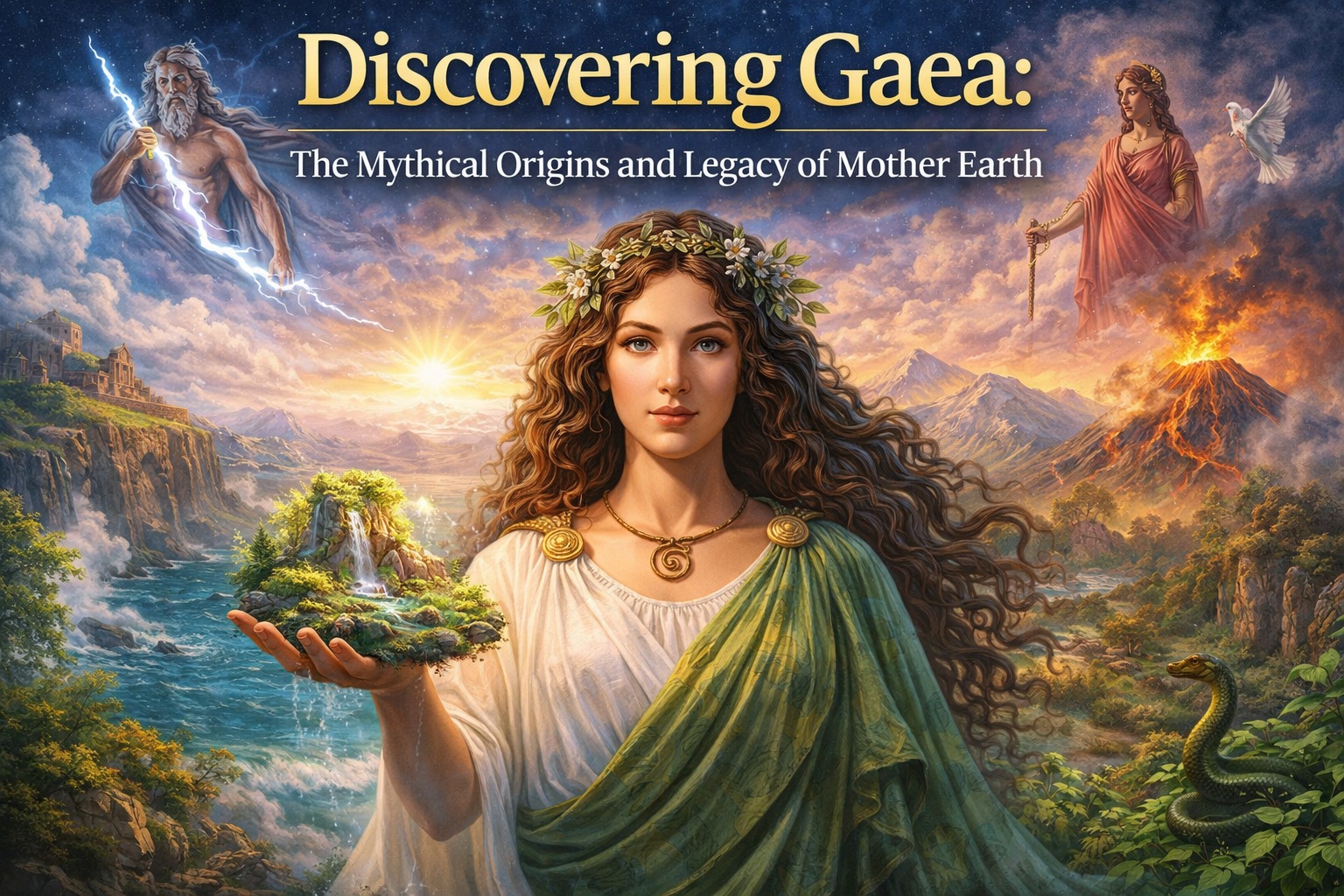
Long before the rise of the Olympian gods, before the stories of heroes and epic battles, there existed a primordial force that shaped the very foundation of existence itself—Gaea, the embodiment of Earth in Greek mythology. Known as Mother Earth, Gaea represents not only the physical world but also the origin of life, the source from which all things emerged.
Her story is one of creation, power, conflict, and enduring legacy. From the birth of the cosmos to her influence on modern environmental thinking, Gaea remains one of the most profound and symbolic figures in mythology.
This article explores the mythical origins, role, and lasting legacy of Gaea, revealing why her story still resonates today.
The Primordial Beginning: Chaos and Creation
In Greek mythology, everything begins with Chaos—a vast, formless void. From this emptiness emerged the first primordial deities, including:
- Gaea (Earth)
- Tartarus (the Underworld)
- Eros (love and creation)
- Nyx (night)
Gaea was not created from something else—she simply came into existence, fully formed and powerful. She was both the ground beneath and the life that would grow upon it.
The Self-Creation of the Earth
Unlike later gods who were born from parents, Gaea is unique because she is self-generating. She created:
- The sky (Uranus)
- The mountains (Ourea)
- The sea (Pontus)
This act of self-creation symbolizes the Earth as a complete and sustaining system, capable of generating life independently—a concept that continues to influence modern ecological thinking.
Gaea and Uranus: The Birth of the Titans
After creating Uranus, Gaea united with him, and together they produced the first generation of powerful beings:
- The Titans (including Cronus, Rhea, Oceanus)
- The Cyclopes
- The Hecatoncheires (hundred-handed giants)
These children represented the raw forces of nature—strength, time, and elemental power.
Conflict with Uranus
Despite their powerful offspring, Uranus feared his children and imprisoned them within Gaea. This act caused immense suffering, as Gaea—being the Earth itself—felt their confinement within her.
In response, she devised a plan.
She fashioned a sickle and persuaded her son Cronus to overthrow Uranus. Cronus ambushed his father, marking one of the earliest examples of cosmic rebellion in mythology.
This event:
- Separated Earth and Sky
- Allowed life to flourish independently
- Began the cycle of generational conflict among the gods
The Rise of the Olympians
Cronus would later repeat his father’s mistake, fearing his own children and attempting to prevent them from rising against him. However, his son Zeus ultimately overthrew him, leading to the reign of the Olympian gods.
Gaea’s Role in the Titanomachy
Gaea played a complex role in the war between the Titans and Olympians (the Titanomachy):
- She initially supported her Titan children
- Later, she advised Zeus on how to win
It was Gaea who told Zeus to release the Cyclopes and Hecatoncheires, whose strength helped secure victory.
This dual role highlights Gaea as:
- A balancing force
- A protector of cosmic order
- A being whose loyalty lies with equilibrium rather than individuals
Gaea as the Mother of All Life
Gaea is more than a mythological figure—she is the personification of life itself.
Everything that grows, lives, and dies is connected to her:
- Plants and forests
- Animals and humans
- Rivers and mountains
Symbolism of Mother Earth
Gaea represents:
- Fertility and abundance
- Stability and grounding
- Cycles of life and death
Her image often includes:
- Lush vegetation
- Flowing water
- Animals and natural elements
This symbolism reinforces the idea that the Earth is not just a place—it is a living entity.
Gaea’s Later Mythological Influence
Even after the rise of the Olympians, Gaea remained a powerful and sometimes unpredictable force.
The Giants and Revenge
Angered by the defeat of the Titans, Gaea gave birth to the Giants, who challenged the Olympian gods in the Gigantomachy.
This act shows that:
- Gaea does not passively accept imbalance
- She can become a force of destruction when necessary
The Oracle of Delphi
Before it became associated with Apollo, the Oracle at Delphi was originally linked to Gaea. This connection emphasizes her role as:
- A source of wisdom
- A connection between Earth and divine knowledge
Gaea in Philosophy and Early Science
Ancient philosophers saw Gaea as more than mythology—they viewed her as a representation of natural systems.
Early Interpretations
Thinkers began to interpret Gaea as:
- A metaphor for the Earth’s interconnected systems
- A symbol of natural balance and harmony
This laid the groundwork for later scientific concepts.
The Gaia Hypothesis: Myth Meets Science
In the 20th century, scientist James Lovelock introduced the Gaia Hypothesis, which suggests that:
The Earth functions as a self-regulating system, maintaining conditions suitable for life.
This idea echoes the ancient concept of Gaea as:
- A living organism
- A self-sustaining entity
- A system in balance
While scientific in nature, the Gaia Hypothesis demonstrates how mythology can inspire modern understanding.
Gaea in Modern Culture
Gaea’s influence extends far beyond ancient mythology.
Environmental Movements
Gaea has become a powerful symbol in:
- Environmental activism
- Sustainability movements
- Ecological awareness
She represents the idea that:
- Humans are part of nature, not separate from it
- The Earth must be protected and respected
Literature and Media
Gaea appears in:
- Fantasy literature
- Films and television
- Video games
Often portrayed as:
- A nurturing mother
- A powerful elemental force
- A guardian of nature
The Enduring Legacy of Gaea
Why does Gaea still matter today?
Because her story speaks to something fundamental:
- Our connection to the Earth
- The balance between creation and destruction
- The responsibility we have as inhabitants of the planet
Lessons from Gaea
Gaea teaches us:
- Balance is essential – Nature thrives on equilibrium
- Actions have consequences – Disruption leads to conflict
- Life is interconnected – Everything is part of a larger system
Gaea and Environmental Responsibility
In today’s world, the symbolism of Gaea is more relevant than ever.
Climate change, pollution, and environmental degradation remind us that:
- The Earth is not infinite
- Natural systems can be disrupted
- Balance must be maintained
Gaea’s story encourages:
- Sustainable practices
- Respect for natural systems
- Long-term thinking
Conclusion
Gaea is one of the most powerful and enduring figures in mythology. As the primordial Earth goddess, she represents the origin of life, the foundation of existence, and the delicate balance that sustains the world.
From her role in the creation of the cosmos to her influence on modern science and environmental thought, Gaea’s legacy continues to shape how we understand our place in the world.
Her story is not just a myth—it is a reminder.
A reminder that the Earth is alive in its own way.
A reminder that balance is fragile.
And a reminder that we are all, ultimately, part of something much greater.