

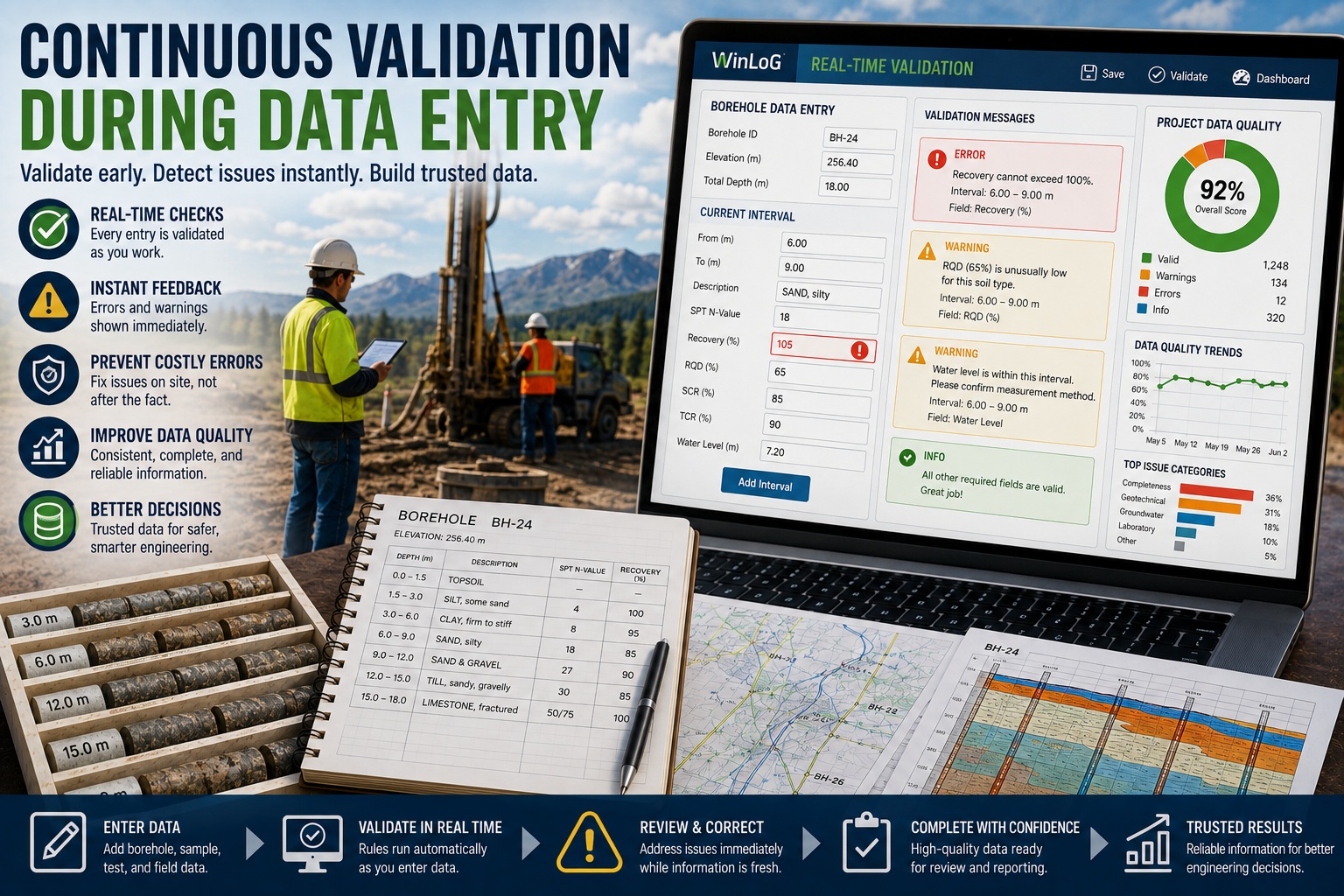
The quality of any geological, geotechnical, hydrogeological, or environmental investigation depends on the accuracy of the data collected in the field and entered into the project database. Every borehole interval, groundwater measurement, Standard Penetration Test (SPT), laboratory result, and geological observation contributes to engineering decisions that may affect public safety, project costs, regulatory compliance, and long-term infrastructure performance.
Unfortunately, many organizations still rely on a traditional workflow where data are entered first and validated days—or even weeks—later. By the time problems are discovered, drilling crews have left the site, laboratory testing has progressed, reports have been drafted, and project schedules have advanced. Correcting errors becomes more expensive, more time-consuming, and sometimes impossible.
Modern borehole management systems are changing this approach through continuous validation during data entry. Rather than waiting until the end of a project, the software automatically checks every new record as it is entered, identifying missing information, calculation errors, inconsistent relationships, and unusual engineering values before they propagate through the database.
Continuous validation transforms QA/QC from a final review task into an integral part of the data collection process. This article explains why continuous validation is becoming an essential best practice, the types of issues it can detect, and how it improves the quality and reliability of subsurface data.
The Traditional QA/QC Workflow
For many years, borehole data followed a familiar sequence:
- Field data were collected.
- Information was entered into a database.
- Laboratory results were imported.
- Geological logs were completed.
- Reports were prepared.
- QA/QC was performed.
- Errors were corrected.
Although this process worked, it had significant disadvantages.
Problems discovered late in the project often required engineers to:
- Search through field notes.
- Contact drilling contractors.
- Recalculate values.
- Re-import laboratory data.
- Revise reports.
- Delay project delivery.
Some missing information simply could not be recovered after drilling had been completed.
Why Early Validation Matters
The cost of correcting an error increases dramatically as a project progresses.
For example:
- A missing lithology description detected during logging can be corrected immediately.
- The same omission discovered after reports have been issued may require extensive revisions.
- A missing groundwater measurement identified while the drilling rig is still on site can often be collected.
- The same missing measurement identified weeks later may require a return visit.
Continuous validation helps identify issues while they are still inexpensive to resolve.
What Is Continuous Validation?
Continuous validation means that the software automatically evaluates data every time information changes.
Validation may occur when:
- A borehole interval is saved.
- A sample is added.
- A groundwater measurement is entered.
- Laboratory results are imported.
- Geological logging is updated.
- Coordinates are modified.
- SPT data are recorded.
- Project settings change.
Rather than waiting for users to request validation manually, the system continuously monitors data quality throughout the project lifecycle.
Immediate Feedback
One of the greatest advantages of continuous validation is immediate feedback.
Instead of discovering dozens of issues at project completion, users receive notifications while they are still working.
For example:
A geologist enters:
Recovery = 105%
The software immediately reports:
Recovery cannot exceed 100%.
The correction takes only seconds.
Without continuous validation, this error may remain unnoticed until final QA/QC.
Detecting Missing Information
Many validation rules simply ensure that required information exists.
Examples include:
- Missing lithology
- Missing groundwater measurements
- Missing borehole coordinates
- Missing laboratory sample IDs
- Missing Recovery
- Missing RQD
- Missing SPT blow counts
- Missing moisture content
Because the software identifies omissions immediately, users can complete records before moving to the next task.
Validating Engineering Relationships
Continuous validation extends beyond checking whether fields are populated.
It also verifies logical engineering relationships.
Examples include:
- Recovery ≤ 100%
- SCR ≤ TCR
- RQD ≤ SCR
- RQD only in rock intervals
- Groundwater depth within borehole depth
- Sample intervals within logged intervals
- No overlapping depth intervals
- No gaps between intervals
These rules help prevent technically invalid data from entering the database.
Cross-Dataset Validation
Modern borehole databases contain multiple interconnected datasets.
Continuous validation can compare:
- Geological logging
- Laboratory results
- Groundwater records
- SPT tests
- Recovery measurements
- RQD values
- Sample records
- Project metadata
Examples include:
Soft clay with unusually high SPT values.
Organic soils with unrealistic density.
Rock intervals missing Recovery.
Laboratory moisture inconsistent with field observations.
These cross-dataset comparisons provide a much deeper level of QA/QC than independent field checks.
Preventing Data Entry Errors
Many common problems originate during manual data entry.
Examples include:
- Typographical errors
- Decimal point mistakes
- Unit conversion errors
- Duplicate records
- Incorrect coordinates
- Invalid dates
- Copy-and-paste mistakes
- Wrong sample numbers
Continuous validation identifies these problems immediately before they spread throughout the project.
Supporting Field Investigations
Field personnel benefit significantly from real-time validation.
Examples include:
SPT entered without blow counts.
Groundwater level deeper than total borehole depth.
Duplicate sample number.
Invalid soil classification.
These issues can often be corrected while drilling continues.
Laboratory Integration
Continuous validation also applies to laboratory data.
As results are imported, the software can verify:
- Sample IDs exist.
- Required tests are complete.
- Laboratory units are correct.
- Moisture content is within reasonable limits.
- Grain size percentages total appropriately.
- Atterberg Limits are internally consistent.
- Duplicate laboratory records do not exist.
Early detection prevents incorrect laboratory information from influencing engineering analyses.
Import Validation
Many projects import data from:
- AGS files
- DIGGS files
- CSV files
- Legacy databases
- Spreadsheets
Continuous validation automatically evaluates imported records before they become part of the project database.
Typical checks include:
- Missing mandatory fields
- Duplicate boreholes
- Invalid coordinates
- Overlapping intervals
- Incorrect units
- Invalid codes
- Broken relationships
This provides confidence that imported information meets company standards.
Supporting Review Workflows
Continuous validation integrates naturally with structured QA/QC workflows.
Typical lifecycle:
Draft
↓
Validated
↓
Reviewed
↓
Approved
↓
Issued
Instead of allowing incomplete data to move through the workflow, validation confirms that required quality standards have been met before each stage.
Project Dashboards
Continuous validation also improves project visibility.
Managers can monitor:
- Number of validation errors
- Outstanding warnings
- Completed boreholes
- Missing laboratory data
- Pending reviews
- Data completeness
- Confidence scores
Dashboards help prioritize work and prevent quality issues from accumulating unnoticed.
Reducing Project Risk
Errors in borehole databases can affect:
- Foundation design
- Resource estimation
- Environmental assessments
- Groundwater modeling
- Transportation engineering
- Regulatory submissions
Continuous validation reduces these risks by preventing incorrect information from propagating through calculations, reports, GIS systems, and digital twins.
Supporting AI-Assisted Validation
Continuous validation provides high-quality data for artificial intelligence.
AI systems rely on:
- Complete records
- Consistent terminology
- Standardized coding
- Accurate relationships
Without continuous QA/QC, AI recommendations become less reliable.
Rule-based validation therefore provides an essential foundation for future AI-assisted engineering.
WinLoG Continuous Validation
WinLoG is designed to perform validation as an ongoing process rather than a single project milestone. As users enter or modify borehole information, the validation engine can automatically evaluate geological, geotechnical, hydrogeological, and environmental data against configurable engineering rules.
The system checks borehole locations, interval continuity, Recovery, RQD, SCR, TCR, SPT calculations, groundwater observations, laboratory imports, lithology, sample records, and cross-dataset relationships while users are actively working. Errors and warnings are presented immediately, allowing issues to be corrected before they affect downstream workflows.
Continuous validation also integrates with governed review processes, project dashboards, audit trails, and customizable rule libraries. Organizations can define company-specific, client-specific, or agency-specific validation requirements, ensuring that data quality standards are enforced consistently across every project.
Best Practices for Continuous Validation
Organizations implementing continuous validation should consider several best practices:
- Validate data immediately after entry.
- Standardize geological and laboratory terminology.
- Use controlled vocabularies and coding systems.
- Configure validation rules to reflect company standards.
- Perform automatic validation after every data import.
- Review warnings promptly rather than allowing them to accumulate.
- Integrate validation with project approval workflows.
- Maintain complete audit trails of corrections.
- Train users to interpret validation messages correctly.
- Perform periodic project-wide validation before major milestones.
These practices maximize the effectiveness of continuous QA/QC while reducing rework.
Looking Ahead
As digital engineering continues to evolve, continuous validation will become even more sophisticated. Future systems will combine deterministic engineering rules with artificial intelligence, allowing software not only to detect errors but also to identify unusual patterns, predict missing information, recommend corrective actions, and prioritize issues based on engineering significance.
Continuous validation will also become more tightly integrated with digital twins, cloud collaboration platforms, field data collection applications, and intelligent borehole databases. Engineers will have access to live quality metrics throughout the project, enabling faster decisions and greater confidence in the data supporting design and construction.
Conclusion
Continuous validation fundamentally changes how organizations manage borehole data quality. Rather than treating QA/QC as a final review activity, it embeds quality assurance directly into the data entry process, allowing problems to be identified and corrected while information is still fresh and field investigations are still underway.
By validating geological logs, SPT data, groundwater measurements, laboratory results, borehole intervals, and engineering relationships in real time, organizations can reduce errors, improve efficiency, strengthen regulatory compliance, and increase confidence in every engineering decision.
As projects become larger, more collaborative, and increasingly data-driven, continuous validation is rapidly becoming a cornerstone of modern borehole data management. Combined with automated QA/QC, intelligent databases, governed workflows, and AI-assisted analysis, it provides the foundation for more accurate, reliable, and defensible subsurface information throughout the lifecycle of every project.