

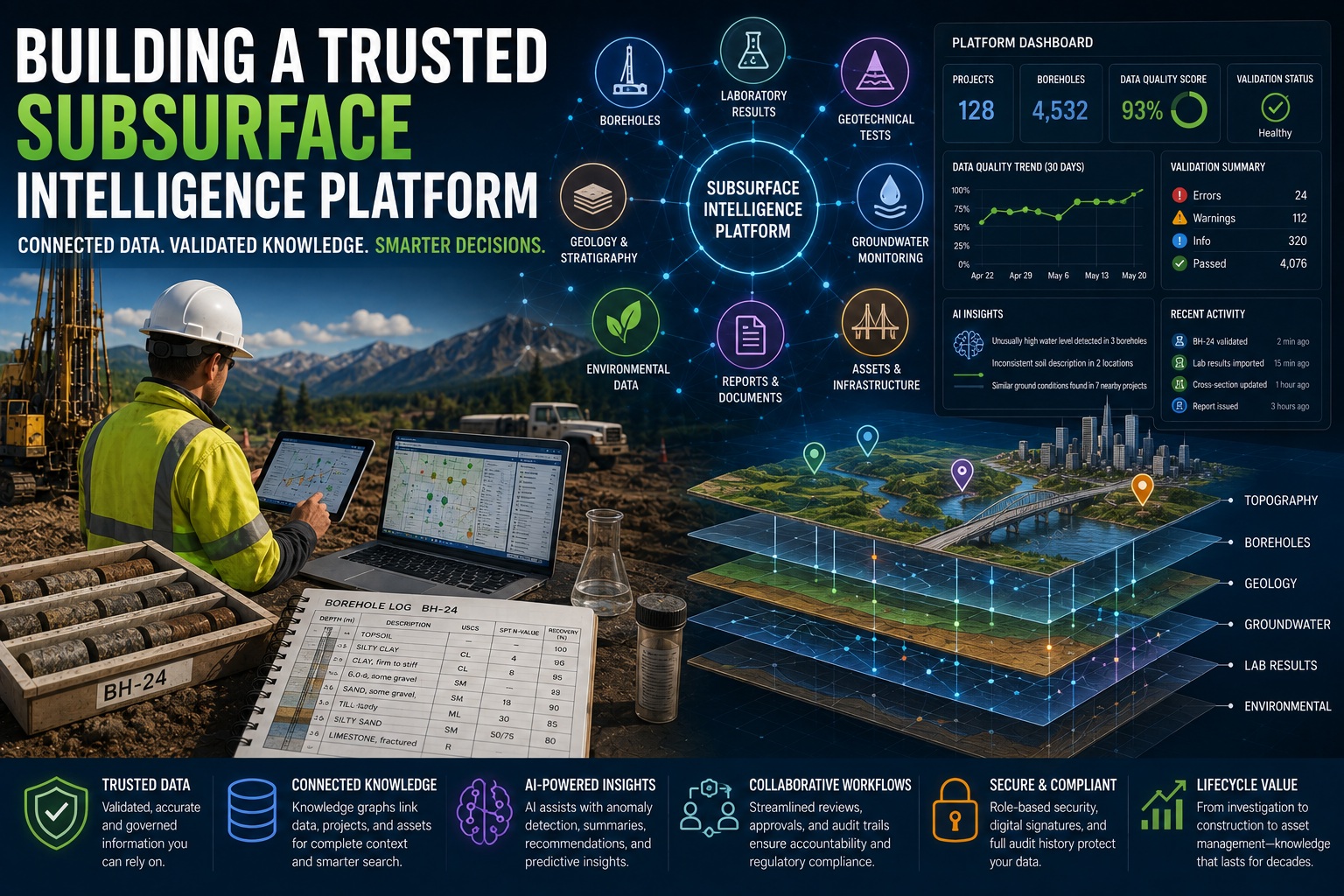
The subsurface is one of the least visible yet most critical components of every engineering project. Before a bridge can be designed, a mine developed, a contaminated site remediated, or a groundwater supply evaluated, engineers must understand what lies beneath the surface. That understanding depends on data—millions of individual observations collected from boreholes, samples, laboratory analyses, geophysical surveys, groundwater monitoring programs, and historical investigations.
For decades, organizations have invested heavily in collecting this information. Yet much of it remains fragmented across spreadsheets, paper logs, disconnected databases, PDF reports, and legacy software systems. Valuable engineering knowledge is often difficult to locate, difficult to validate, and difficult to reuse.
The next generation of digital engineering is moving beyond simply managing data. It is focused on creating Trusted Subsurface Intelligence Platforms—integrated systems that combine high-quality data, automated validation, governance, artificial intelligence, knowledge graphs, digital twins, and collaborative workflows into a single, connected environment.
Rather than functioning as a traditional borehole database, a trusted subsurface intelligence platform becomes the organization’s authoritative source for all subsurface knowledge, supporting engineering decisions throughout the entire lifecycle of an asset.
This article explores the key components of such a platform, why trust is essential, and how organizations can build a foundation for the future of digital geoscience.
Why Trust Matters
Engineering decisions are only as reliable as the information on which they are based.
A single incorrect groundwater elevation, misplaced borehole coordinate, or erroneous laboratory result can influence:
- Foundation design
- Resource estimation
- Slope stability analysis
- Environmental risk assessments
- Infrastructure planning
- Construction costs
- Regulatory submissions
As projects become more complex and data volumes continue to grow, manually verifying every record becomes increasingly impractical.
Trust must therefore be built directly into the platform itself.
Beyond Traditional Borehole Databases
Conventional borehole databases were designed primarily to store information.
Typical capabilities included:
- Borehole logs
- Sample records
- Laboratory results
- Report generation
- Basic querying
While these functions remain essential, modern engineering organizations require considerably more.
Today’s platform must also:
- Validate information automatically.
- Understand relationships between datasets.
- Support AI-assisted analysis.
- Preserve complete audit trails.
- Manage workflows.
- Connect historical investigations.
- Integrate with GIS and digital twins.
- Support regulatory compliance.
The database becomes a knowledge platform rather than a filing cabinet.
The Foundation: High-Quality Data
Every intelligent platform begins with reliable information.
Essential datasets include:
Geological Data
- Lithology
- Stratigraphy
- Rock descriptions
- Structures
- Weathering
Geotechnical Data
- SPT
- CPT
- Recovery
- RQD
- SCR
- TCR
- Laboratory testing
Hydrogeological Data
- Groundwater levels
- Hydraulic conductivity
- Pump tests
- Monitoring wells
Environmental Data
- Soil chemistry
- Groundwater chemistry
- Vapour sampling
- Monitoring programs
Spatial Information
- Coordinates
- Elevations
- Survey data
- Maps
- Cross-sections
Each dataset contributes to the platform’s overall intelligence.
Automated Validation
Trust begins with quality assurance.
Modern platforms continuously validate:
- Missing information
- Invalid coordinates
- Overlapping intervals
- Incorrect SPT calculations
- Impossible Recovery values
- Missing RQD
- Duplicate samples
- Laboratory inconsistencies
- Groundwater anomalies
- Cross-dataset relationships
Continuous validation ensures data quality throughout the project rather than only during final review.
Governance
Reliable data also require effective governance.
Governance establishes:
- Standard terminology
- Controlled vocabularies
- Data ownership
- Approval workflows
- Security
- Version control
- Audit trails
Every change becomes traceable.
Every approval becomes documented.
Every decision becomes defensible.
Knowledge Graphs
Traditional databases store records.
Knowledge graphs store relationships.
For example:
Borehole
↓
Sample
↓
Laboratory Result
↓
Foundation Recommendation
↓
Bridge Structure
↓
Maintenance History
Instead of isolated records, the platform creates an interconnected engineering knowledge network.
This dramatically improves searching and decision-making.
Artificial Intelligence
Artificial intelligence builds upon high-quality, governed data.
Rather than replacing engineers, AI assists by:
- Detecting anomalies
- Summarizing reports
- Searching historical investigations
- Recommending validation checks
- Identifying similar projects
- Predicting missing information
- Prioritizing engineering reviews
AI becomes another engineering tool rather than an autonomous decision-maker.
Digital Twins
Infrastructure owners increasingly maintain digital twins representing roads, bridges, tunnels, airports, and utilities.
A trusted subsurface intelligence platform connects these digital assets directly to:
- Boreholes
- Groundwater wells
- Geological models
- Laboratory testing
- Monitoring programs
- Historical investigations
Selecting an asset immediately reveals the subsurface information supporting its design and ongoing maintenance.
Lifecycle Information Management
Subsurface information remains valuable long after construction ends.
Historical borehole data support:
- Asset rehabilitation
- Infrastructure expansion
- Utility relocation
- Environmental monitoring
- Emergency response
- Future investigations
A trusted platform preserves this knowledge for decades.
Collaboration
Modern engineering projects involve:
- Geologists
- Geotechnical engineers
- Hydrogeologists
- Environmental scientists
- Surveyors
- Laboratory personnel
- Project managers
- Government agencies
A unified platform allows every discipline to work from the same trusted information rather than maintaining separate datasets.
Standardization
Successful platforms standardize:
- Soil classifications
- Rock descriptions
- Laboratory units
- Coordinate systems
- Sample numbering
- Geological terminology
- Metadata
Standardization enables automation, AI, and interoperability.
Supporting Industry Standards
Trusted platforms should support common industry exchange formats including:
- AGS
- DIGGS
- CSV
- GIS formats
- BIM integration
Open data standards reduce vendor lock-in while improving collaboration across organizations.
Security
Trust also depends on protecting information.
Modern platforms should provide:
- User authentication
- Role-based permissions
- Digital signatures
- Encryption
- Secure backups
- Disaster recovery
- Audit logging
Engineering data often remain valuable for many decades and must be protected accordingly.
Continuous Improvement
Unlike static databases, intelligent platforms continuously improve.
Every completed project contributes:
- New geological knowledge.
- Additional validation rules.
- Historical comparisons.
- AI training data.
- Engineering experience.
- Lessons learned.
The platform becomes increasingly valuable over time.
Project Dashboards
Executives and project managers need visibility into data quality.
Typical dashboards include:
- Validation status
- Data completeness
- Outstanding issues
- Review progress
- Groundwater monitoring
- Laboratory status
- Project health
- Confidence scores
Dashboards transform raw information into actionable management insights.
Supporting Regulatory Compliance
Government agencies increasingly expect digital project deliverables supported by:
- Complete audit trails
- Standardized data
- Validation reports
- Review workflows
- Secure document management
A trusted platform simplifies compliance while reducing administrative effort.
Integrating Historical Information
Many organizations possess decades of:
- Paper logs
- PDF reports
- Legacy databases
- Spreadsheets
Rather than treating historical information as archives, intelligent platforms integrate these records into the same searchable knowledge base as current projects.
This dramatically increases the value of historical investigations.
WinLoG’s Vision for a Trusted Subsurface Intelligence Platform
WinLoG is evolving beyond a traditional borehole logging application toward a comprehensive subsurface intelligence platform. Its long-term vision combines structured geological, geotechnical, hydrogeological, and environmental data management with automated QA/QC, governed workflows, intelligent search, AI-assisted validation, and connected engineering knowledge.
Within this vision, every borehole becomes part of a broader ecosystem that links projects, laboratory analyses, groundwater monitoring, geological models, engineering reports, infrastructure assets, maps, and historical investigations. Automated validation continuously improves data quality, while knowledge graphs provide context and relationships that help engineers discover relevant information more quickly. AI-assisted tools enhance—not replace—professional judgment by identifying anomalies, summarizing findings, recommending validation checks, and helping users navigate large volumes of historical data.
Support for AGS, DIGGS, GIS, digital twins, and customizable rule libraries ensures that organizations can integrate WinLoG into broader engineering workflows while maintaining governance, auditability, and regulatory compliance. The result is a trusted source of subsurface knowledge that supports better decisions from project planning through long-term asset management.
Building the Platform: A Practical Roadmap
Organizations do not need to implement every capability at once. A phased approach often delivers the greatest value.
Phase 1 – Establish Reliable Data
- Centralize borehole information.
- Standardize terminology.
- Implement automated QA/QC.
- Digitize historical records.
Phase 2 – Strengthen Governance
- Introduce approval workflows.
- Maintain audit trails.
- Define ownership and permissions.
- Implement version control.
Phase 3 – Connect Information
- Link reports, maps, and boreholes.
- Build knowledge graph relationships.
- Integrate GIS and laboratory systems.
- Enable project dashboards.
Phase 4 – Add Intelligence
- Deploy AI-assisted validation.
- Implement intelligent search.
- Support predictive analytics.
- Integrate digital twins.
This staged approach minimizes disruption while delivering measurable improvements at each step.
The Future
The future of subsurface engineering is not simply about collecting more data—it is about creating trusted knowledge.
Tomorrow’s platforms will understand engineering relationships, learn from historical projects, recommend corrective actions, connect multidisciplinary information, and provide engineers with immediate access to decades of organizational experience.
As artificial intelligence, digital twins, cloud collaboration, and intelligent databases continue to evolve, trusted subsurface intelligence platforms will become the foundation for safer infrastructure, more accurate geological models, improved environmental stewardship, and better-informed engineering decisions.
Conclusion
Building a trusted subsurface intelligence platform is no longer just an IT initiative—it is a strategic investment in engineering quality, organizational knowledge, and long-term project success.
By combining high-quality data, automated validation, strong governance, knowledge graphs, artificial intelligence, digital twins, and secure collaboration, organizations can transform isolated borehole records into an integrated source of trusted engineering intelligence.
For geotechnical consultants, mining companies, environmental firms, transportation agencies, and infrastructure owners alike, the future belongs to organizations that can not only collect subsurface data but also validate it, connect it, understand it, and apply it with confidence. A trusted subsurface intelligence platform makes that future possible, ensuring that every engineering decision is supported by complete, accurate, and context-rich information that continues to grow in value over time.