

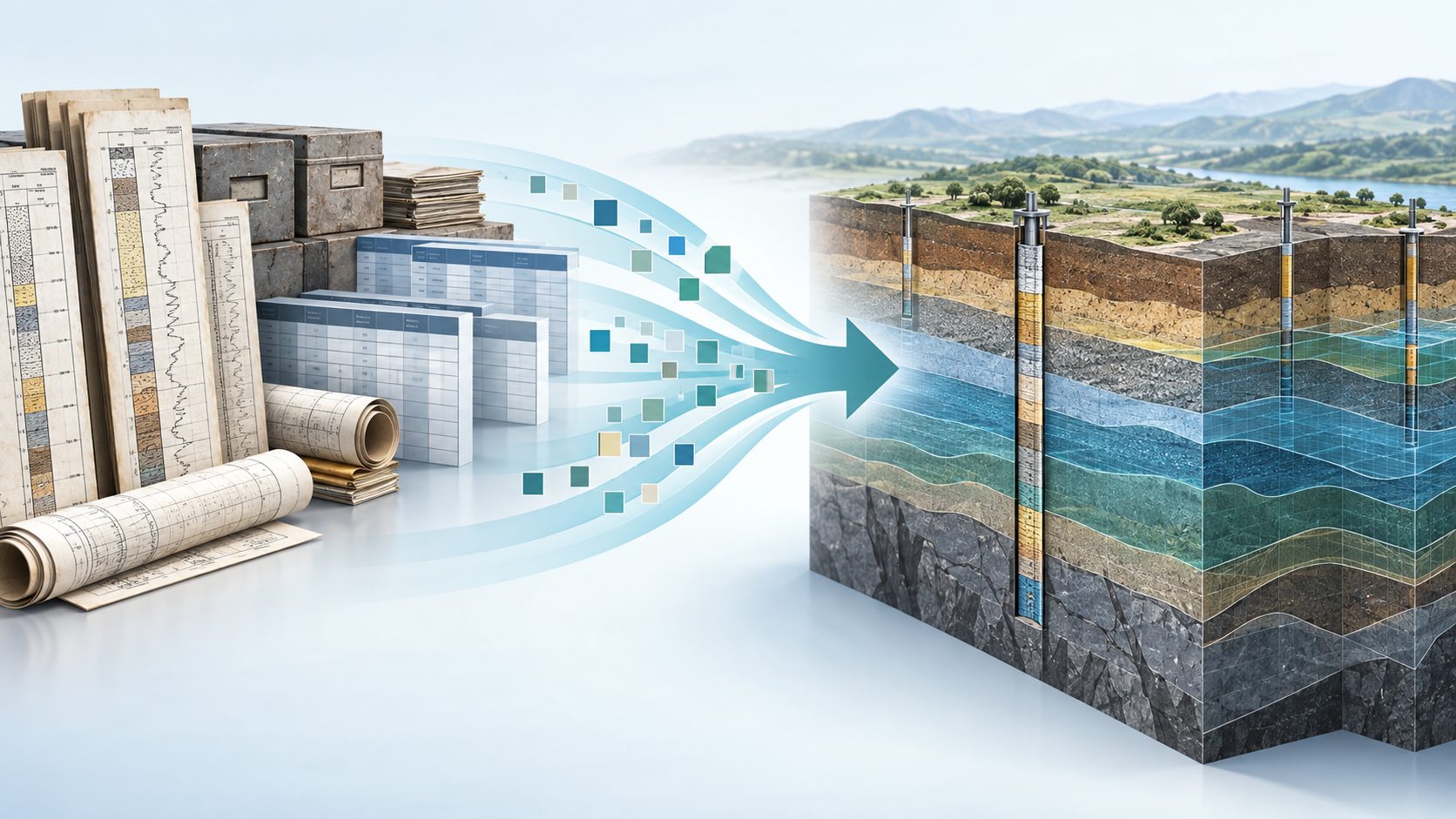
For many geotechnical, environmental, geological, and infrastructure organizations, the challenge of modernizing software is not choosing a new system. It is deciding what to do with decades of existing data.
Borehole logs, laboratory results, project databases, templates, geological descriptions, monitoring records, and historical investigations may be spread across legacy applications, local databases, spreadsheets, government systems, and archived project folders. Even when an organization wants to move forward, the risk of disrupting this accumulated information can delay migration for years.
GAEA Technologies is developing the GAEA Migration Center to make that transition more systematic.
Rather than treating migration as a one-time file conversion, the Migration Center is being designed as a central environment for moving geotechnical and environmental information into and between GAEA applications while preserving as much useful structure and context as possible.
Why Data Migration Has Become a Major Issue
Engineering software often remains in use much longer than ordinary business applications.
A borehole database created 10, 15, or even 25 years ago may still contain information that is important to current projects. Organizations may also have hundreds or thousands of archived investigations that cannot simply be abandoned when software changes.
This creates several challenges.
Legacy applications may no longer receive meaningful development. Older database technologies can become difficult to maintain. Software may depend on aging operating systems. Staff members who understand the original data structure may retire or leave the organization. In some cases, the computer running the legacy software eventually becomes the weak link in an otherwise valuable archive.
The result is a common situation: an organization knows it should modernize, but the historical data makes the transition appear too risky or time-consuming.
The Migration Center is intended to reduce that barrier.
More Than a File Import Utility
GAEA already provides import and export capabilities throughout its software products. The Migration Center expands on that concept by bringing migration workflows together into a more consistent environment.
The goal is to help users understand:
- where their data is coming from;
- how that information maps into the destination system;
- what information can be transferred automatically;
- what requires review;
- whether important fields are missing or incompatible; and
- what happened during the migration.
This becomes increasingly important when projects contain much more than a simple borehole location and lithology description.
Modern subsurface databases may include sampling intervals, laboratory analyses, groundwater observations, rock core information, geotechnical tests, environmental chemistry, geophysical measurements, project metadata, and specialized log presentation settings.
Successful migration therefore requires more than copying columns from one database to another.
Planned Support for Legacy GAEA Projects
One important objective of the Migration Center is to simplify migration from earlier generations of GAEA software.
Many organizations have used WinLoG and GaeaSynergy for decades. Some still maintain projects created using considerably older versions because those projects contain valuable historical information.
The Migration Center is planned to provide workflows for bringing compatible legacy project information into current GAEA environments while giving users a consistent interface for reviewing the migration process.
This is particularly useful for organizations that want to consolidate historical project archives instead of keeping multiple generations of software available indefinitely.
Moving from gINT
The retirement of Bentley’s gINT product line has created a particularly important migration challenge for the geotechnical industry.
Many consultants, government agencies, transportation departments, and engineering organizations accumulated substantial gINT databases and customized reporting structures over many years.
Replacing the application itself is only one part of the problem. Organizations may also need to preserve project information, field structures, lookup lists, and reporting conventions developed around their existing workflows.
GAEA’s Migration Center roadmap includes capabilities intended to assist with the migration of appropriate gINT project information into GAEA’s geotechnical data environment.
The objective is not to assume that every gINT database is identical. Customization is one of the reasons gINT became widely used, and it is also one of the reasons migration must be handled carefully.
A migration workflow should make mappings visible and reviewable instead of hiding the conversion process.
AGS and DIGGS Interoperability
Open data exchange formats are becoming increasingly important as infrastructure owners and engineering organizations seek to reduce dependence on proprietary project formats.
The Migration Center roadmap includes support for recognized geotechnical exchange standards such as AGS and DIGGS.
These formats can help organizations exchange subsurface information with clients, consultants, government agencies, and other software systems without requiring both parties to use the same database application.
Supporting standardized formats also complements GAEA’s broader philosophy that engineering information should remain usable beyond the software in which it was originally collected.
Government Well and Borehole Databases
Public agencies maintain large collections of well, borehole, geological, groundwater, and environmental information.
This information can provide valuable regional context when beginning a new investigation, but importing it into a project can require significant manual preparation.
Another planned area of the Migration Center is the ability to assist with importing supported public database information into GAEA projects.
A centralized migration workflow can make it easier to transform external records into structured project information that can be reviewed, mapped, analyzed, and compared with an organization’s own investigation data.
Migration Should Include Validation
Moving a database successfully does not automatically mean the information is correct.
Historical datasets may contain missing fields, inconsistent units, overlapping intervals, incorrect coordinates, invalid codes, or values that were accepted by an older system without verification.
This makes migration a natural point at which to improve data quality.
GAEA’s development direction combines migration capabilities with the expanding validation and QA/QC tools available within WinLoG and the broader GaeaSynergy environment.
Instead of simply asking, “Did the records import?” organizations can increasingly ask:
Did the records import correctly, and is the resulting information internally consistent?
That distinction can be extremely important when historical information is being prepared for future engineering use.
A Gradual Migration Strategy
Organizations do not necessarily need to move every historical project at once.
For many companies, a staged approach is more practical.
An organization might begin with a small group of representative projects, confirm database mappings and reporting requirements, establish internal procedures, and then expand the migration to additional archives.
High-value or frequently referenced projects can be migrated first. Older projects that are rarely accessed can remain archived until they are needed.
This approach reduces risk and allows users to become comfortable with the new environment before committing to a large conversion effort.
Preserving the Value of Historical Data
Historical subsurface information can become more valuable over time.
A boring completed twenty years ago may provide useful context for a new transportation project. An old monitoring well may help establish long-term groundwater conditions. Historical laboratory results may reveal changes in environmental conditions. Previous foundation investigations can reduce uncertainty before new field work begins.
The difficulty is that these benefits can only be realized if the information remains accessible.
Migration is therefore not simply an IT exercise. It is part of preserving an organization’s engineering knowledge.
Part of GAEA’s Development Roadmap
The Migration Center is being developed as part of GAEA Technologies’ broader development roadmap.
Initial development focuses on improving migration and interoperability for existing digital data sources, including legacy GAEA projects, gINT-related information, recognized exchange formats, and external databases.
Future development is planned to extend these capabilities further, including tools aimed at recovering useful information from less structured historical records.
The long-term objective is straightforward: make it easier for organizations to move forward without leaving decades of valuable subsurface information behind.
Preparing for Migration
Organizations considering a future migration can begin preparing even before changing software.
Useful steps include identifying major legacy databases, documenting custom fields and lookup lists, locating reporting templates, determining which projects are still actively referenced, and identifying information that exists only in paper or PDF archives.
This inventory provides a clearer picture of migration complexity and helps distinguish information that can be transferred automatically from information that may require special treatment.
Looking Ahead
Engineering organizations should not have to choose between modern software and access to their historical information.
The GAEA Migration Center is being developed to provide a more structured bridge between legacy data, industry exchange standards, external information sources, and GAEA’s current software environment.
As development progresses, GAEA will publish additional information about supported migration workflows, data formats, and practical strategies for organizations preparing to modernize their subsurface data systems.
Related resources
- GAEA Development Roadmap
- WinLoG Borehole Logging Software
- GaeaSynergy Geotechnical and Environmental Data Management
- WinLoG Validation and QA/QC
- Data Migration Services