

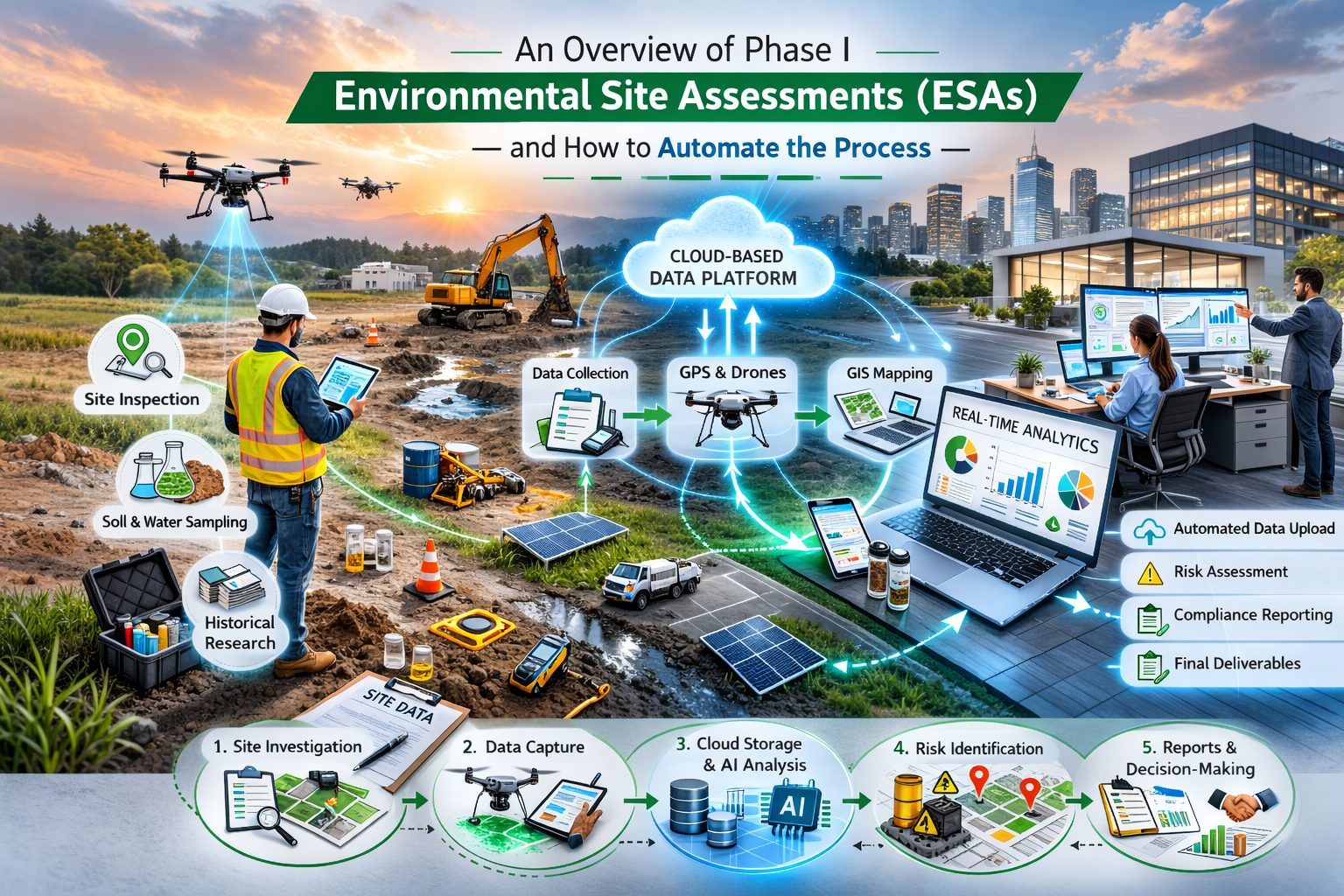
When it comes to commercial real estate, what you can’t see often matters most. Whether you’re a buyer, a lender, or a developer, a Phase I Environmental Site Assessment (ESA) is your first line of defense against “unpleasant and costly surprises” regarding soil or groundwater contamination.
What is a Phase I ESA?
A Phase I ESA is a non-invasive, preliminary investigation used to identify “Areas of Potential Environmental Concern” (APECs) or “Recognized Environmental Conditions” (RECs). Unlike a Phase II assessment, this stage involves no physical sampling of soil, water, or air. Instead, it relies on historical research and visual inspections to determine if a property might be contaminated.
The Core Components
To satisfy industry standards, such as the ASTM E1527-21 or the CSA Z768-01 in Canada, a Phase I ESA typically includes:
- Records Review: A deep dive into land titles, fire insurance maps, and regulatory databases (like those for underground storage tanks) dating back to the property’s first development.
- Site Reconnaissance: A visual tour of the property and its surroundings to look for signs of spills, chemical storage, or stressed vegetation.
- Interviews: Conversations with current and past owners, operators, and local officials to uncover details not found in written records.
- Evaluation & Reporting: A final report summarizing the findings and providing a clear recommendation on whether a Phase II ESA (intrusive testing) is necessary.
Why Do You Need One?
- Liability Protection: Under laws like CERCLA in the U.S., performing “All Appropriate Inquiries” (AAI) can protect buyers from being held financially responsible for pre-existing contamination.
- Lender Requirements: Most banks will not finance a commercial loan without a clean Phase I ESA to ensure the collateral’s value isn’t compromised by environmental debt.
- Informed Decision-Making: Knowing about potential cleanup costs early allows for price negotiations or the ability to walk away from a bad deal.
How Long Is It Valid?
Timing is critical. A Phase I ESA is generally considered “viable” for up to 180 days from its completion date. If the transaction occurs between 180 days and one year, certain components (like the site visit and interviews) must be updated to remain valid.
Modernizing Environmental Due Diligence: Automating Phase I ESAs
In the fast-paced commercial real estate world, the traditional manual approach to a Phase I Environmental Site Assessment (ESA) is becoming a bottleneck. Environmental consultants are increasingly turning to advanced software solutions like GAEA Technologies’ E-ASR (Environmental Automated Standardized Reporting) to transform this labor-intensive process into a high-efficiency workflow.
How GAEA E-ASR Automates the Process
Standard Phase I ESAs require meticulous data collection from historical records, site visits, and interviews. E-ASR streamlines these tasks through:
- Mobile Data Collection: Field technicians use pre-designed templates on tablets or laptops to collect data directly on-site, eliminating the need for manual transcription later.
- Intelligent Data Merging: The software doesn’t just fill in blanks; it uses “Dynamic Response Insertion” to automatically pull in specific regulatory language or entire paragraphs based on the answers provided.
- Visual Integration: Site photos, georeferenced maps, and street-view images are automatically integrated into the correct sections of the final report.
Standardization and Quality Control
Beyond speed—E-ASR can reduce report preparation time by up to 70%—standardization is a key benefit:
- Industry Standard Compliance: Reports can be tailored to meet rigorous global and regional standards, such as ASTM E1527-21 in the U.S. or CSA Z768-01 in Canada.
- Eliminating Errors: By using “Macros” (Lookup Lists), organizations can restrict data entry to predefined values, ensuring consistency across all reports and eliminating typos.
- Automated Formatting: The software handles table of contents generation, appendix labeling, and even cross-references lab results against regulatory standards to highlight exceedances.
Manual vs. Automated Phase I ESA Reporting
Implementing an automated reporting system like GAEA Technologies E-ASR can significantly transform the economic profile of environmental site assessments. While manual reporting is often perceived as having lower upfront costs, a detailed cost-benefit analysis reveals substantial long-term financial and operational advantages through automation.
The following table summarizes the key differences in investment and return between traditional manual methods and automated systems like E-ASR:
| Factor | Manual Methods (e.g., Word/Excel) | Automated Systems (e.g., E-ASR) |
|---|---|---|
| Labor Intensity | Extremely high; requires manual data entry and formatting. | Low; data is collected once in the field and auto-merged. |
| Reporting Speed | Can take days or weeks for complex projects. | Reduces reporting time by up to 70% to 80%. |
| Data Accuracy | Prone to human transcription and formula errors. | Enhanced through real-time validation and standardized templates. |
| Initial Cost | Low (existing office software). | Higher initial software investment/subscription. |
| Operational ROI | Limited by fixed human labor hours. | Average ROI of 10.4% through efficiency gains. |
Key Benefits of Automation (E-ASR)
- Direct Cost Savings: Automating environmental reporting tasks can lead to approximately 70% savings in operational costs. By reducing administrative hours, firms can decrease the overhead associated with each report.
- Error Mitigation: Manual data entry is a significant source of error. Automated systems eliminate transcription mistakes by pulling data directly from mobile devices into standardized reports, reducing the costly need for subsequent error rectification.
- Scalability: Automated platforms allow consultants to manage a higher volume of projects without a proportional increase in staff, enabling business growth without massive overhead spikes.
- Compliance Confidence: E-ASR templates are pre-aligned with industry standards like ASTM E1527-21 and CSA Z768-01, ensuring reports are consistently audit-ready and compliant with evolving regulations.
www.gaeatech.com +3
The “Trust Premium”
Beyond direct financial gains, automated reporting builds a “trust premium” with stakeholders. Lenders and investors increasingly reward the transparency and verifiability of automated data with better access to capital and potentially lower interest rates.
Summary
A Phase I ESA is an essential due diligence tool for identifying environmental risks through records, site visits, and interviews. It protects stakeholders from liability and ensures informed financial decisions without the need for immediate, costly soil testing.
Modern software like GAEA’s E-ASR automates the Phase I ESA by using mobile data collection and intelligent merging to generate reports up to 70% faster. This ensures every document meets high professional and regulatory standards (like ASTM or CSA) while significantly reducing human error and administrative overhead.
Disclaimer: This analysis is provided for informational purposes only and does not constitute financial or legal advice regarding environmental liability. Consulting with a qualified environmental professional is recommended for specific property assessments.
Regulatory & Standard-Setting Bodies
- ASTM International – E1527-21 Standard: The primary industry standard used in the U.S. for Phase I ESAs. Linking here shows your content is aligned with the most recent 2021 updates.
- U.S. EPA – All Appropriate Inquiries (AAI): Explains the legal requirements for property buyers to obtain liability protection under CERCLA.
- CSA Group – Phase I ESA Standard (Z768-01): The equivalent standard for Canadian environmental assessments.
Comprehensive Guides & Checklists
- Ontario.ca – Guide for Phase One ESAs: A detailed government guide on completing assessments under specific environmental regulations (Reg. 153/04).
- West Virginia DEP – User’s Guide to Phase I ESAs: A clear, downloadable PDF that breaks down what a Phase I involves for non-professionals,
Deep-Dive Industry Insights
- Environmental Law & Liability Overview: An article detailing the legal implications of the newest ASTM standards for property transactions.
- Phase 1 ESA Checklist & Process: A practical blog post that outlines the step-by-step physical and records-based inspection process.
Learn more about our Environmental Site Assessment Solutions
Related Articles
- Environmental Site Assessment Automation: Transforming Phase I and Phase II Environmental Reporting
- Automating Phase I Environmental Site Assessments: Tools and Best Practices
- Automating Phase II Environmental Site Assessment Reporting
- How Automated Environmental Reporting Reduces Consulting Costs
- Digital Workflows for Environmental Due Diligence Investigations
- The Role of Data Automation in Modern Environmental Consulting
- Automating Environmental Compliance Reporting for Regulatory Submissions
- Meeting ASTM Standards with Automated Phase I ESA Reporting
- Automated Environmental Reporting for Brownfield Redevelopment Projects
- Cloud-Based Platforms for Environmental Investigation Data
- The Future of Automated Environmental Site Assessments
- Efficiency at Your Fingertips: Merging Questionnaire Data into Professional Reports with E-ASR
- Automating Environmental Excellence: Reporting with GAEA Technologies E-ASR
- Efficiency Redefined: Automating Environmental Reporting with E-ASR
- Streamlining Site Assessments: How Well Log Software Accelerates Contamination Reporting
- Reducing MTTR By 40%: The Power Of Automated Report Generation
- Why Automated Environmental Reporting Is the Game Changer Your Business Needs
External References
- ASTM Standard Practice for Environmental Site Assessments: Phase I Environmental Site Assessment Process
- US EPA Standards and Practices for All Appropriate Inquiries
- CSA Z768 — Phase I Environmental Site Assessment
- CSA Z769 — Phase II Environmental Site Assessment
- BS 10175 — Investigation of Potentially Contaminated Sites
- Australian National Environment Protection Measure (NEPM)