

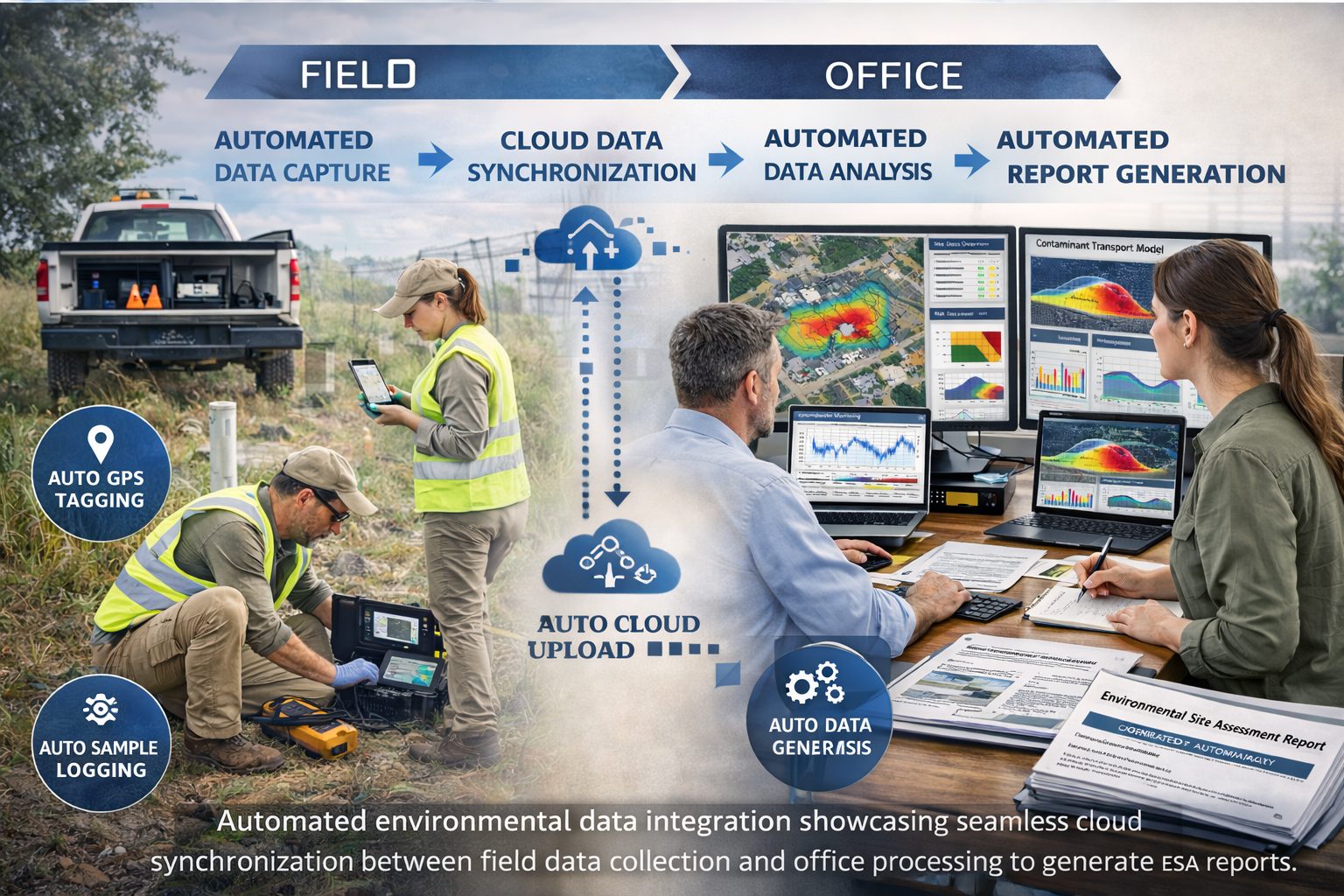
Environmental consulting has evolved significantly over the past several decades. What once relied heavily on manual data collection, paper records, and labor-intensive reporting has increasingly transitioned into a digital, data-driven discipline. Modern environmental projects—from site investigations to groundwater modeling and regulatory compliance reporting—generate enormous amounts of data. Managing, analyzing, and interpreting this data efficiently has become one of the central challenges facing environmental professionals.
Data automation has emerged as a powerful solution to this challenge. By automating the collection, organization, analysis, and reporting of environmental data, consulting firms can improve efficiency, reduce errors, and provide better insights into environmental conditions. Data automation does not replace scientific expertise; rather, it enhances the ability of environmental professionals to interpret complex datasets and make informed decisions.
This article explores the role of data automation in modern environmental consulting, the technologies driving this transformation, and the benefits and best practices associated with implementing automated environmental data workflows.
Understanding Data Automation in Environmental Consulting
Data automation refers to the use of software systems and digital technologies to automatically collect, process, analyze, and manage data with minimal manual intervention. In environmental consulting, data automation can apply to many different aspects of environmental investigations and project management.
Environmental projects generate diverse datasets, including:
- Soil and groundwater analytical results
- Geological and hydrogeological data
- Monitoring well measurements
- Environmental regulatory records
- GIS spatial datasets
- Environmental monitoring data
- Laboratory analytical results
Historically, environmental consultants manually compiled these datasets using spreadsheets, reports, and paper records. This approach often led to fragmented information systems and time-consuming workflows.
Data automation enables environmental professionals to integrate these datasets into centralized digital systems that automatically process and organize environmental information.
Why Data Automation Is Becoming Essential
Environmental consulting projects have become increasingly complex due to several factors.
Growing Data Volumes
Modern environmental investigations generate large amounts of data. A single contaminated site investigation may involve hundreds of soil and groundwater samples, each containing analytical results for dozens of chemical compounds.
Managing these datasets manually can quickly become overwhelming.
Increasing Regulatory Requirements
Environmental regulations often require detailed documentation of environmental conditions, monitoring programs, and remediation activities.
Automated data systems help environmental professionals manage these reporting requirements more efficiently.
Faster Project Timelines
Property transactions, infrastructure development, and remediation projects often operate under tight schedules. Automated workflows allow consulting firms to complete investigations and prepare reports more quickly.
Improved Decision-Making
Data automation enables consultants to analyze environmental datasets more effectively. Automated visualization tools and environmental models can reveal patterns and trends that may not be immediately obvious from raw data.
Key Areas Where Data Automation Is Used
Data automation plays a role in many aspects of environmental consulting workflows.
Automated Environmental Data Collection
Environmental data collection has traditionally relied on manual field notes and data entry. Today, digital field tools allow environmental professionals to collect data electronically.
Examples of automated data collection include:
- Digital borehole logging tools
- Mobile groundwater monitoring applications
- GPS-enabled field inspection software
- Automated environmental monitoring sensors
These tools capture field measurements directly in digital formats, eliminating the need for manual transcription.
Digital data collection also allows information to be uploaded instantly to centralized databases.
Laboratory Data Automation
Laboratory analytical results are one of the most important sources of environmental data. Laboratories typically provide results in electronic data deliverable (EDD) formats.
Automated systems can import laboratory datasets directly into environmental databases.
Benefits include:
- Faster data processing
- Reduced transcription errors
- automated data validation checks
Automated laboratory data management systems can also flag results that exceed regulatory thresholds.
Environmental Data Management Systems
Environmental data management systems (EDMS) serve as centralized platforms for organizing environmental investigation data.
These systems allow environmental professionals to store and manage:
- Sampling location data
- Laboratory analytical results
- groundwater monitoring data
- borehole logs
- field observations
Centralized data systems improve project coordination and ensure that environmental datasets remain accessible throughout the life of a project.
GIS-Based Environmental Data Automation
Geographic Information Systems (GIS) are essential tools in environmental consulting. GIS platforms allow environmental professionals to analyze spatial relationships between environmental features.
Automated GIS workflows can generate maps that display:
- contaminant plume distributions
- groundwater flow patterns
- sampling locations
- nearby environmental hazards
GIS automation allows environmental consultants to rapidly update maps when new data becomes available.
Automated Environmental Modeling
Environmental modeling tools are widely used to simulate contaminant transport in soil and groundwater.
Automated modeling workflows can integrate data from environmental databases to generate models that predict:
- contaminant migration pathways
- groundwater flow directions
- potential exposure risks
These models help consultants evaluate environmental conditions and design remediation strategies.
Automated Environmental Reporting
One of the most time-consuming tasks in environmental consulting is preparing technical reports. Automated reporting systems significantly streamline this process.
These systems use report templates linked to environmental databases to generate reports automatically.
Automated reports can include:
- data tables
- contaminant plume maps
- groundwater monitoring graphs
- geological cross-sections
- investigation summaries
Because report content is connected to underlying datasets, updates to environmental data automatically update the report.
Benefits of Data Automation in Environmental Consulting
The adoption of automated data workflows offers numerous advantages for environmental consulting firms.
Improved Efficiency
Automation dramatically reduces the time required to process environmental datasets and prepare reports.
Consultants can focus more on interpreting environmental conditions rather than managing administrative tasks.
Reduced Human Error
Manual data handling introduces opportunities for transcription errors and inconsistencies.
Automated systems reduce these risks by linking environmental datasets directly to reporting tools.
Better Data Integration
Environmental investigations often require data from multiple sources. Automated systems integrate these datasets into unified platforms that improve accessibility and analysis.
Enhanced Data Visualization
Automated visualization tools generate high-quality maps, charts, and figures that improve the interpretation of environmental data.
Clear visualizations help communicate environmental conditions to regulators, stakeholders, and project managers.
Improved Collaboration
Cloud-based environmental data platforms allow project teams to collaborate in real time.
Geologists, engineers, hydrogeologists, and project managers can access shared datasets from any location.
Best Practices for Implementing Data Automation
While data automation provides many advantages, successful implementation requires careful planning.
Standardize Data Structures
Environmental datasets should follow standardized formats to ensure compatibility with automated systems.
Standardization improves the efficiency of data integration and automated analysis.
Integrate Field and Office Systems
Digital workflows should connect field data collection tools with office-based data management systems.
This integration ensures that field data becomes immediately available for analysis and reporting.
Maintain Data Quality Controls
Automation should be supported by strong quality control procedures.
Environmental professionals should verify:
- laboratory analytical results
- spatial data accuracy
- interpretation of environmental conditions
Quality assurance ensures that automated workflows maintain scientific reliability.
Provide Staff Training
Environmental professionals must be trained to use automated data systems effectively.
Training programs should cover:
- environmental data management systems
- GIS analysis tools
- automated reporting platforms
- digital field data collection tools
Proper training ensures consistent use of automation tools across projects.
Emerging Technologies in Environmental Data Automation
Several emerging technologies are expected to further enhance data automation capabilities in environmental consulting.
Artificial Intelligence
Artificial intelligence is increasingly being used to analyze environmental datasets.
AI tools can identify patterns and trends in large datasets, potentially assisting consultants in interpreting environmental conditions.
Applications may include:
- identifying contamination hotspots
- detecting anomalies in monitoring data
- predicting contaminant migration trends
Internet of Things Environmental Monitoring
IoT sensors allow continuous monitoring of environmental conditions such as groundwater levels, air quality, and surface water quality.
These sensors automatically transmit data to environmental databases, enabling real-time monitoring systems.
Cloud-Based Environmental Data Platforms
Cloud platforms allow environmental consultants to access project data from anywhere while maintaining centralized data management systems.
Cloud technologies support remote collaboration and improve project coordination.
Digital Twin Environmental Models
Digital twin technologies create dynamic virtual representations of environmental systems.
These models integrate environmental datasets, monitoring data, and simulation tools to provide comprehensive environmental analyses.
Challenges of Data Automation
Despite its advantages, data automation also presents several challenges.
Software Integration
Environmental consultants often use multiple software tools. Integrating these systems into seamless workflows can be complex.
Data Quality Issues
Automated systems depend on accurate data. Poor data quality can compromise automated analyses.
Initial Implementation Costs
Implementing automated systems may require investments in software, training, and infrastructure.
Maintaining Professional Judgment
Automation should enhance—not replace—scientific expertise. Environmental professionals must interpret automated results within the context of site-specific conditions.
The Future of Data Automation in Environmental Consulting
Environmental consulting is rapidly becoming a data-driven discipline. As environmental datasets grow larger and more complex, automation will play an increasingly important role in managing and interpreting environmental information.
Future environmental consulting workflows will likely integrate:
- automated environmental monitoring networks
- AI-assisted environmental analysis
- advanced geospatial visualization tools
- cloud-based environmental data platforms
- automated regulatory reporting systems
These technologies will enable environmental professionals to conduct investigations more efficiently while providing deeper insights into environmental conditions.
Automation will also support more proactive environmental management by enabling continuous monitoring and real-time data analysis.
Conclusion
Data automation is transforming modern environmental consulting. By automating the collection, organization, analysis, and reporting of environmental data, consulting firms can improve efficiency, reduce errors, and enhance environmental decision-making.
Technologies such as digital field tools, environmental data management systems, GIS platforms, automated modeling tools, and automated reporting systems are reshaping how environmental investigations are conducted.
However, successful implementation requires standardized data management practices, robust quality control procedures, and ongoing training for environmental professionals.
As environmental consulting continues to evolve, data automation will become an essential component of modern environmental investigations. By embracing automated data workflows, environmental professionals can better manage complex environmental datasets and deliver more effective environmental solutions.
Learn more about our Environmental Site Assessment Solutions
Related Articles
- Environmental Site Assessment Automation: Transforming Phase I and Phase II Environmental Reporting
- Automating Phase I Environmental Site Assessments: Tools and Best Practices
- Automating Phase II Environmental Site Assessment Reporting
- How Automated Environmental Reporting Reduces Consulting Costs
- Digital Workflows for Environmental Due Diligence Investigations
- Automating Environmental Compliance Reporting for Regulatory Submissions
- Meeting ASTM Standards with Automated Phase I ESA Reporting
- Automated Environmental Reporting for Brownfield Redevelopment Projects
- Cloud-Based Platforms for Environmental Investigation Data
- The Future of Automated Environmental Site Assessments
- An Overview of Phase I Environmental Site Assessments and How to Automate the Process
- Efficiency at Your Fingertips: Merging Questionnaire Data into Professional Reports with E-ASR
- Automating Environmental Excellence: Reporting with GAEA Technologies E-ASR
- Efficiency Redefined: Automating Environmental Reporting with E-ASR
- Streamlining Site Assessments: How Well Log Software Accelerates Contamination Reporting
- Reducing MTTR By 40%: The Power Of Automated Report Generation
- Why Automated Environmental Reporting Is the Game Changer Your Business Needs
External References
- ASTM Standard Practice for Environmental Site Assessments: Phase I Environmental Site Assessment Process
- US EPA Standards and Practices for All Appropriate Inquiries
- CSA Z768 — Phase I Environmental Site Assessment
- CSA Z769 — Phase II Environmental Site Assessment
- BS 10175 — Investigation of Potentially Contaminated Sites
- Australian National Environment Protection Measure (NEPM)