

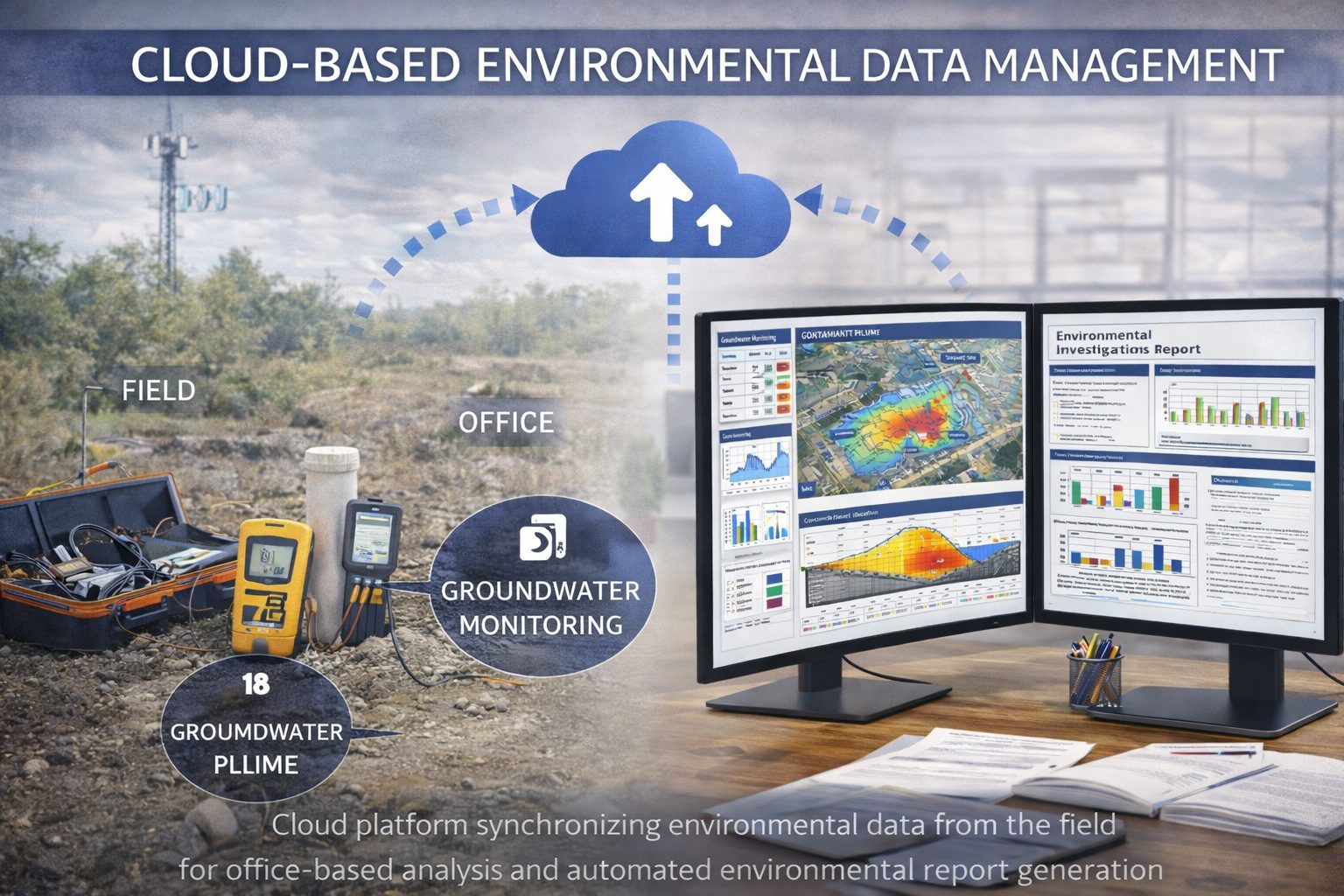
Environmental investigations generate vast amounts of data. Soil and groundwater sampling results, geological logs, environmental monitoring records, laboratory analytical data, and spatial datasets must all be collected, analyzed, and documented to understand environmental conditions at a site. Traditionally, environmental consulting firms managed these datasets using spreadsheets, local databases, and paper records stored across multiple systems.
However, as environmental investigations become more complex and data volumes increase, traditional data management approaches are no longer sufficient. Environmental professionals now require platforms that can store large datasets, support collaboration across teams, integrate spatial analysis tools, and generate regulatory reports efficiently.
Cloud-based platforms for environmental investigation data have emerged as a powerful solution to these challenges. By providing centralized, accessible, and scalable data management systems, cloud technologies allow environmental professionals to manage investigation data more effectively while improving collaboration, transparency, and reporting efficiency.
This article explores the role of cloud-based platforms in environmental investigations, the technologies behind these systems, and best practices for implementing cloud-based environmental data management workflows.
Understanding Environmental Investigation Data
Environmental investigations involve collecting and analyzing data to evaluate environmental conditions at a site. These investigations are conducted for many purposes, including contaminated site assessments, environmental due diligence, regulatory compliance, remediation planning, and environmental monitoring programs.
Environmental investigation datasets typically include a wide range of information.
Types of Environmental Investigation Data
Soil and Groundwater Analytical Results
Environmental sampling programs often involve collecting soil and groundwater samples that are analyzed for contaminants such as:
- petroleum hydrocarbons
- volatile organic compounds (VOCs)
- heavy metals
- pesticides and herbicides
- polycyclic aromatic hydrocarbons (PAHs)
Laboratory results must be organized, interpreted, and incorporated into environmental reports.
Geological and Hydrogeological Data
Subsurface conditions play a critical role in contaminant transport. Environmental investigations typically include geological observations such as:
- soil stratigraphy
- lithology descriptions
- groundwater levels
- permeability characteristics
Borehole logs and monitoring well data provide essential information for understanding site hydrogeology.
Environmental Monitoring Data
Long-term environmental monitoring programs generate continuous datasets that track environmental conditions over time.
Examples include:
- groundwater level measurements
- groundwater quality monitoring
- air quality monitoring
- surface water monitoring
Monitoring data must be stored in organized systems that allow long-term trend analysis.
Spatial Environmental Data
Environmental investigations rely heavily on spatial analysis. GIS datasets may include:
- sampling locations
- contaminant plume maps
- geological cross-sections
- infrastructure features
Spatial datasets help environmental professionals visualize environmental conditions and interpret contamination patterns.
Limitations of Traditional Environmental Data Management
Historically, environmental investigation data was managed using a combination of spreadsheets, local databases, and project-specific folders. While these methods were adequate for smaller datasets, they present several challenges for modern environmental projects.
Fragmented Data Storage
Environmental data is often stored across multiple locations, including local computers, laboratory files, GIS systems, and paper records. This fragmentation can make it difficult to locate and manage data.
Limited Collaboration
Traditional systems typically store data locally, which limits collaboration between team members working in different offices or locations.
Risk of Data Loss
Local data storage systems are vulnerable to hardware failures, accidental deletions, and inadequate backup procedures.
Difficult Data Integration
Combining datasets from different sources can be time-consuming when data is stored in incompatible formats.
Cloud-based platforms address many of these challenges by providing centralized data management environments.
What Are Cloud-Based Environmental Data Platforms?
Cloud-based environmental data platforms are digital systems hosted on remote servers that allow environmental professionals to store, manage, analyze, and share environmental investigation data.
Instead of storing data locally, these platforms store environmental datasets within secure cloud environments that can be accessed from anywhere with an internet connection.
Cloud platforms typically integrate several key capabilities:
- centralized environmental databases
- GIS mapping tools
- automated data integration
- collaborative project management tools
- automated reporting systems
These integrated platforms enable environmental professionals to manage entire investigation workflows within a single digital environment.
Key Features of Cloud-Based Environmental Data Platforms
Modern cloud-based environmental data platforms offer several features designed specifically for environmental consulting workflows.
Centralized Data Management
One of the primary advantages of cloud platforms is centralized data storage.
Environmental datasets—including sampling results, monitoring data, borehole logs, and GIS layers—can be stored within structured databases that support efficient data management.
Centralized systems ensure that all project data is accessible to authorized team members.
Real-Time Data Access
Cloud platforms allow environmental professionals to access project data from any location using internet-enabled devices.
This capability supports remote work, field data access, and collaboration between geographically distributed teams.
Automated Data Integration
Cloud platforms can automatically integrate data from multiple sources.
Examples include:
- laboratory electronic data deliverables
- field data collection applications
- environmental monitoring sensors
- GIS datasets
Automated integration eliminates the need for manual data entry and reduces transcription errors.
GIS and Spatial Data Integration
Many cloud-based environmental platforms integrate GIS capabilities directly within the system.
These platforms allow users to visualize environmental data spatially through:
- contaminant plume maps
- sampling location maps
- geological cross-sections
- infrastructure maps
GIS integration improves the interpretation of environmental conditions and supports environmental modeling.
Automated Reporting Tools
Cloud platforms often include automated reporting features that generate technical reports directly from environmental databases.
These tools can produce reports that include:
- laboratory data tables
- groundwater monitoring graphs
- site maps and figures
- environmental interpretations
Automated reporting significantly reduces the time required to prepare environmental documentation.
Secure Data Storage and Backup
Cloud platforms typically provide robust data security and backup systems.
Features may include:
- encrypted data storage
- automated backups
- access controls and user permissions
- audit trails for data changes
These security measures protect sensitive environmental investigation data.
Benefits of Cloud-Based Environmental Data Platforms
The adoption of cloud-based platforms offers several important advantages for environmental consulting firms and project stakeholders.
Improved Collaboration
Cloud systems allow environmental professionals to collaborate in real time.
Geologists, hydrogeologists, engineers, and project managers can access shared datasets and contribute to project analyses regardless of location.
Enhanced Data Accessibility
Environmental professionals can access project data from field locations, offices, or remote work environments.
Field teams can review previous sampling data or geological logs while conducting site investigations.
Increased Efficiency
Automated data integration and reporting tools significantly reduce the time required to manage environmental datasets and prepare technical reports.
Improved Data Consistency
Centralized data systems ensure that all project team members work with the same datasets, reducing inconsistencies between analyses and reports.
Scalable Data Management
Cloud platforms can scale to accommodate large datasets and long-term monitoring programs.
As projects grow, additional data storage and processing capabilities can be added without major infrastructure changes.
Applications of Cloud Platforms in Environmental Consulting
Cloud-based environmental data platforms support a wide range of environmental consulting activities.
Environmental Site Assessments
Cloud platforms help manage data associated with Phase I and Phase II Environmental Site Assessments, including historical records, site inspection observations, and sampling data.
Contaminated Site Investigations
Environmental investigations involving soil and groundwater sampling generate large datasets that can be stored and analyzed within cloud platforms.
Groundwater Monitoring Programs
Long-term monitoring programs benefit from centralized data systems that track groundwater levels and contaminant concentrations over time.
Environmental Compliance Reporting
Cloud platforms allow organizations to store environmental monitoring data and generate regulatory compliance reports.
Remediation Project Management
Environmental remediation projects require ongoing data collection and performance monitoring.
Cloud systems help consultants manage remediation data and evaluate treatment system effectiveness.
Best Practices for Implementing Cloud-Based Environmental Data Platforms
Successful adoption of cloud-based systems requires careful planning.
Establish Data Standards
Environmental data should be stored using standardized formats that ensure compatibility with analysis and reporting tools.
Standardization improves data integration across projects.
Integrate Field Data Collection
Mobile field data collection tools should connect directly to cloud databases to ensure that field observations are captured digitally.
Train Environmental Professionals
Environmental professionals should receive training on cloud-based data platforms to ensure consistent use of data management systems.
Training should cover data entry procedures, GIS tools, and reporting features.
Implement Data Security Policies
Organizations should implement security policies that protect environmental data while allowing authorized access.
Access controls and user permissions should be defined clearly.
Maintain Quality Assurance Procedures
Quality control procedures should be implemented to verify the accuracy of environmental datasets stored within cloud systems.
Environmental professionals should review data before using it for analysis or reporting.
Emerging Trends in Cloud-Based Environmental Data Management
Cloud platforms continue to evolve as new technologies emerge.
Artificial Intelligence for Environmental Data Analysis
AI tools may assist environmental professionals in analyzing environmental datasets and identifying patterns in contamination data.
Machine learning algorithms could support environmental modeling and risk assessment.
Real-Time Environmental Monitoring
IoT sensors allow continuous monitoring of environmental conditions such as groundwater levels, air quality, and surface water quality.
Cloud platforms can integrate real-time monitoring data for dynamic environmental analysis.
Digital Environmental Dashboards
Interactive dashboards allow environmental managers to visualize environmental data and monitoring results in real time.
Dashboards help project teams quickly identify environmental trends and potential compliance issues.
The Future of Cloud-Based Environmental Data Platforms
Environmental consulting is becoming increasingly data-driven. As environmental investigations generate larger datasets and require more complex analyses, cloud-based data platforms will become essential tools for environmental professionals.
Future cloud platforms may integrate advanced technologies such as AI-driven environmental modeling, automated regulatory reporting systems, and interactive digital site models.
These integrated platforms will allow environmental professionals to conduct investigations more efficiently while providing deeper insights into environmental conditions.
Cloud-based systems will also support greater transparency and collaboration between environmental consultants, regulators, property owners, and project stakeholders.
Conclusion
Environmental investigations generate large and complex datasets that must be managed carefully to support environmental assessments, regulatory compliance, and remediation planning.
Traditional data management approaches often struggle to handle these datasets efficiently. Cloud-based platforms provide a modern solution by offering centralized data storage, real-time access, automated data integration, and advanced visualization tools.
By adopting cloud-based environmental data platforms, environmental consulting firms can improve collaboration, increase efficiency, enhance data accuracy, and streamline environmental reporting workflows.
As environmental investigations continue to evolve, cloud technologies will play an increasingly important role in supporting modern environmental consulting practices.
Learn more about our Environmental Site Assessment Solutions
Related Articles
- Environmental Site Assessment Automation: Transforming Phase I and Phase II Environmental Reporting
- Automating Phase I Environmental Site Assessments: Tools and Best Practices
- Automating Phase II Environmental Site Assessment Reporting
- How Automated Environmental Reporting Reduces Consulting Costs
- Digital Workflows for Environmental Due Diligence Investigations
- The Role of Data Automation in Modern Environmental Consulting
- Automating Environmental Compliance Reporting for Regulatory Submissions
- Meeting ASTM Standards with Automated Phase I ESA Reporting
- Automated Environmental Reporting for Brownfield Redevelopment Projects
- The Future of Automated Environmental Site Assessments
- An Overview of Phase I Environmental Site Assessments and How to Automate the Process
- Efficiency at Your Fingertips: Merging Questionnaire Data into Professional Reports with E-ASR
- Automating Environmental Excellence: Reporting with GAEA Technologies E-ASR
- Efficiency Redefined: Automating Environmental Reporting with E-ASR
- Streamlining Site Assessments: How Well Log Software Accelerates Contamination Reporting
- Reducing MTTR By 40%: The Power Of Automated Report Generation
- Why Automated Environmental Reporting Is the Game Changer Your Business Needs
External References
- ASTM Standard Practice for Environmental Site Assessments: Phase I Environmental Site Assessment Process
- US EPA Standards and Practices for All Appropriate Inquiries
- CSA Z768 — Phase I Environmental Site Assessment
- CSA Z769 — Phase II Environmental Site Assessment
- BS 10175 — Investigation of Potentially Contaminated Sites
- Australian National Environment Protection Measure (NEPM)