

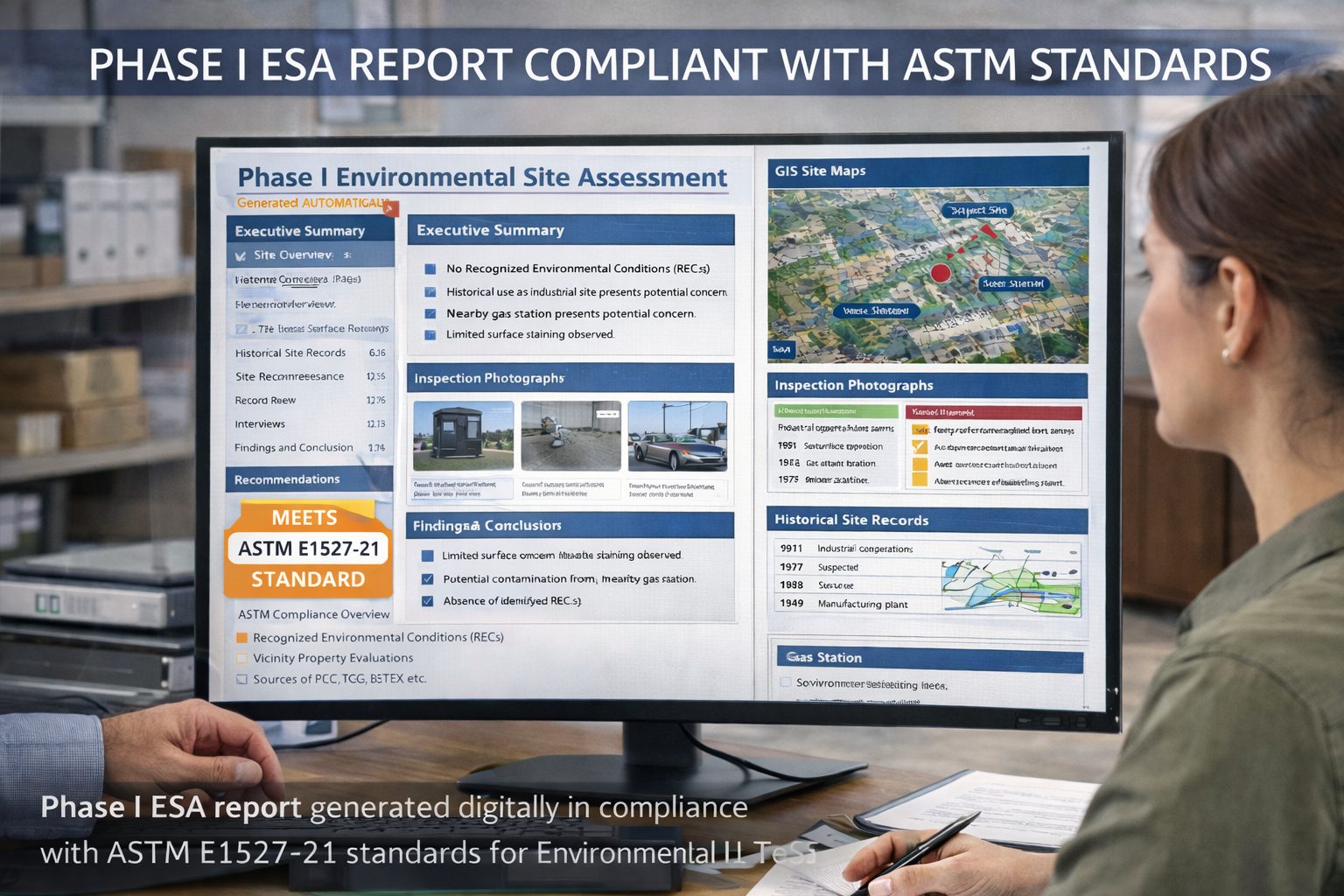
Environmental due diligence is a critical component of property transactions, infrastructure development, and environmental risk management. One of the most widely used tools for environmental due diligence is the Phase I Environmental Site Assessment (ESA). Phase I ESAs help identify potential environmental liabilities associated with a property and are typically conducted according to the standards established by ASTM International.
ASTM standards provide a structured methodology for conducting Phase I Environmental Site Assessments. These standards define the scope of work, reporting requirements, and investigative procedures necessary to meet regulatory and legal requirements. In many jurisdictions, compliance with ASTM standards is essential for property purchasers seeking liability protections under environmental legislation.
While the ASTM methodology has remained relatively consistent, the tools used to conduct Phase I ESAs have evolved significantly. Environmental consulting firms increasingly rely on automated reporting systems and digital data workflows to improve efficiency, accuracy, and consistency in Phase I ESA documentation.
This article explores how automated reporting technologies help environmental professionals meet ASTM standards while improving the quality and efficiency of Phase I Environmental Site Assessments.
Understanding ASTM Standards for Phase I Environmental Site Assessments
ASTM International publishes widely recognized standards for environmental site assessments. The most commonly used standard is ASTM E1527, which outlines the procedures for conducting Phase I Environmental Site Assessments.
The ASTM Phase I ESA standard establishes a systematic approach for evaluating environmental conditions associated with a property. The primary objective is to identify Recognized Environmental Conditions (RECs) that may indicate the presence or likely presence of hazardous substances or petroleum products.
ASTM standards also provide guidance for documenting environmental findings in a structured report format.
Objectives of ASTM-Compliant Phase I ESAs
ASTM Phase I ESAs aim to achieve several key objectives:
- Identify potential environmental contamination risks
- Document historical land uses that may have involved hazardous materials
- Evaluate potential environmental liabilities associated with property ownership
- Provide environmental due diligence documentation for property transactions
Compliance with ASTM standards is often required to demonstrate that environmental due diligence has been conducted according to accepted professional practices.
Key Components of ASTM Phase I ESA Investigations
ASTM standards define several essential components that must be included in a Phase I Environmental Site Assessment.
Records Review
Records review involves analyzing historical and regulatory records related to the subject property and surrounding areas.
Common records reviewed during Phase I ESAs include:
- historical aerial photographs
- fire insurance maps (such as Sanborn maps)
- topographic maps
- city directories
- environmental regulatory databases
- building permits and land use records
These records help environmental professionals identify past land uses that may have involved hazardous substances.
Site Reconnaissance
Site reconnaissance involves a physical inspection of the property to observe environmental conditions that may indicate contamination risks.
During site inspections, environmental professionals evaluate features such as:
- chemical storage areas
- underground and aboveground storage tanks
- waste handling practices
- staining or distressed vegetation
- drainage features
The inspection provides direct observations that support environmental conclusions.
Interviews
ASTM standards require interviews with individuals who have knowledge of the property.
Interview subjects may include:
- current property owners or managers
- facility operators
- local government officials
- previous site occupants
These interviews can provide valuable insights into historical site activities and environmental incidents.
Report Preparation
The final Phase I ESA report summarizes all investigation findings and provides conclusions regarding potential environmental risks.
ASTM standards specify that reports should include several key sections, including:
- site description
- records review findings
- site reconnaissance observations
- interview summaries
- conclusions regarding Recognized Environmental Conditions
Proper documentation is essential to demonstrate compliance with ASTM standards.
Challenges in Traditional Phase I ESA Reporting
While ASTM standards provide a clear framework for conducting Phase I ESAs, traditional reporting workflows often involve time-consuming manual processes.
Common challenges include:
Manual Data Compilation
Environmental consultants often gather information from multiple sources, including historical records, field notes, regulatory databases, and interview documentation.
Manually organizing this information into a structured report can require significant effort.
Inconsistent Documentation
Manual reporting processes may result in inconsistencies between reports prepared by different consultants or project teams.
Standardized reporting tools can help improve consistency.
Transcription Errors
Handwritten field notes and manual data entry increase the risk of transcription errors.
Time-Intensive Report Preparation
Preparing a detailed Phase I ESA report can take many hours or even days, especially for complex properties.
Automation technologies can significantly reduce these challenges.
What Is Automated Phase I ESA Reporting?
Automated Phase I ESA reporting involves the use of digital platforms that integrate environmental data collection, analysis, and report generation.
These systems allow environmental professionals to capture data digitally during investigations and automatically generate reports that comply with ASTM reporting requirements.
Automated reporting systems typically integrate:
- digital field inspection tools
- environmental databases
- GIS mapping platforms
- automated report templates
By connecting these components into a unified workflow, environmental consultants can streamline Phase I ESA reporting processes.
Key Features of Automated Phase I ESA Reporting Systems
Automated Phase I reporting platforms include several features that support ASTM-compliant investigations.
Digital Site Inspection Tools
Mobile inspection tools allow environmental professionals to document site conditions using smartphones or tablets.
These tools may include:
- digital inspection checklists
- GPS-enabled photo documentation
- voice-to-text field notes
- automated timestamps
Digital inspection tools ensure that field observations are accurately recorded and immediately available for reporting.
Automated Records Review Integration
Automated systems can integrate historical environmental records and regulatory databases directly into investigation workflows.
Examples include:
- environmental regulatory databases
- contaminated site inventories
- historical aerial imagery databases
Automated integration improves the efficiency of records review processes.
GIS Mapping and Spatial Analysis
Geographic Information Systems (GIS) play an important role in Phase I ESA investigations.
GIS platforms allow environmental professionals to map:
- the subject property
- nearby industrial facilities
- contaminated sites
- environmental hazards
Automated GIS workflows can generate site maps that support Phase I ESA documentation.
Standardized Report Templates
Automated reporting systems use predefined templates that align with ASTM reporting requirements.
These templates include structured sections for:
- site descriptions
- investigation methods
- records review findings
- site observations
- environmental conclusions
Because templates are standardized, reports maintain consistent formatting across projects.
Automated Photo and Document Management
Photographic documentation is an important component of site inspections.
Automated systems organize photographs and link them directly to inspection records within reports.
This ensures that images remain associated with specific site observations.
Automated Report Generation
Once investigation data has been collected, automated reporting platforms can generate Phase I ESA reports using stored data and templates.
These reports automatically include:
- site inspection summaries
- maps and figures
- photographs
- records review findings
Automated generation dramatically reduces report preparation time.
Benefits of Automated ASTM-Compliant Reporting
Automation provides several important advantages for environmental consulting firms conducting Phase I ESAs.
Improved Efficiency
Automated workflows significantly reduce the time required to prepare Phase I ESA reports.
Consultants can focus more on environmental analysis rather than document formatting.
Increased Consistency
Standardized reporting templates ensure that all reports follow the same structure and terminology.
Consistency improves quality control and regulatory acceptance.
Reduced Data Entry Errors
Digital data collection eliminates many transcription errors associated with manual reporting processes.
Enhanced Data Integration
Automated systems integrate field data, regulatory records, and spatial information into unified investigation workflows.
This improves the completeness of environmental assessments.
Faster Project Turnaround
Automated reporting allows consulting firms to complete Phase I ESA projects more quickly, which is particularly valuable for real estate transactions with tight deadlines.
Best Practices for Implementing Automated Phase I ESA Reporting
Environmental consulting firms should adopt strategic approaches when implementing automated reporting systems.
Align Reporting Templates with ASTM Standards
Automated report templates should be designed to match the structure required by ASTM standards.
This ensures that reports remain compliant with industry guidelines.
Standardize Field Data Collection
Digital inspection forms should include standardized checklists that reflect ASTM site reconnaissance requirements.
Integrate GIS and Environmental Databases
GIS platforms and environmental regulatory databases should be integrated into automated workflows to support efficient records review and spatial analysis.
Maintain Quality Assurance Procedures
Automated systems should be supported by peer review and quality control processes to verify environmental conclusions.
Professional judgment remains essential in environmental investigations.
Provide Staff Training
Environmental professionals must be trained to use automated reporting tools effectively.
Training ensures consistent use of digital systems across projects.
The Future of Automated Environmental Due Diligence
As digital technologies continue to evolve, automated Phase I ESA reporting systems will become even more advanced.
Future systems may integrate:
- artificial intelligence for records review analysis
- automated environmental risk identification
- real-time environmental data integration
- cloud-based collaboration platforms
These technologies will further streamline environmental due diligence investigations and improve the accuracy of environmental assessments.
Conclusion
ASTM standards provide a structured framework for conducting Phase I Environmental Site Assessments and documenting environmental due diligence investigations. While traditional reporting workflows have relied on manual data compilation and report preparation, automation technologies are transforming the way Phase I ESA reports are produced.
Automated reporting systems integrate digital field inspection tools, environmental databases, GIS mapping platforms, and standardized report templates to streamline the investigation process.
These technologies improve efficiency, reduce errors, and ensure consistent compliance with ASTM reporting requirements.
By adopting automated reporting systems and digital investigation workflows, environmental consulting firms can conduct ASTM-compliant Phase I Environmental Site Assessments more efficiently while maintaining the high standards of professional practice required for environmental due diligence.
Learn more about our Environmental Site Assessment Solutions
Related Articles
- Environmental Site Assessment Automation: Transforming Phase I and Phase II Environmental Reporting
- Automating Phase I Environmental Site Assessments: Tools and Best Practices
- Automating Phase II Environmental Site Assessment Reporting
- How Automated Environmental Reporting Reduces Consulting Costs
- Digital Workflows for Environmental Due Diligence Investigations
- The Role of Data Automation in Modern Environmental Consulting
- Automating Environmental Compliance Reporting for Regulatory Submissions
- Automated Environmental Reporting for Brownfield Redevelopment Projects
- Cloud-Based Platforms for Environmental Investigation Data
- The Future of Automated Environmental Site Assessments
- An Overview of Phase I Environmental Site Assessments and How to Automate the Process
- Efficiency at Your Fingertips: Merging Questionnaire Data into Professional Reports with E-ASR
- Automating Environmental Excellence: Reporting with GAEA Technologies E-ASR
- Efficiency Redefined: Automating Environmental Reporting with E-ASR
- Streamlining Site Assessments: How Well Log Software Accelerates Contamination Reporting
- Reducing MTTR By 40%: The Power Of Automated Report Generation
- Why Automated Environmental Reporting Is the Game Changer Your Business Needs
External References
- ASTM Standard Practice for Environmental Site Assessments: Phase I Environmental Site Assessment Process
- US EPA Standards and Practices for All Appropriate Inquiries
- CSA Z768 — Phase I Environmental Site Assessment
- CSA Z769 — Phase II Environmental Site Assessment
- BS 10175 — Investigation of Potentially Contaminated Sites
- Australian National Environment Protection Measure (NEPM)