

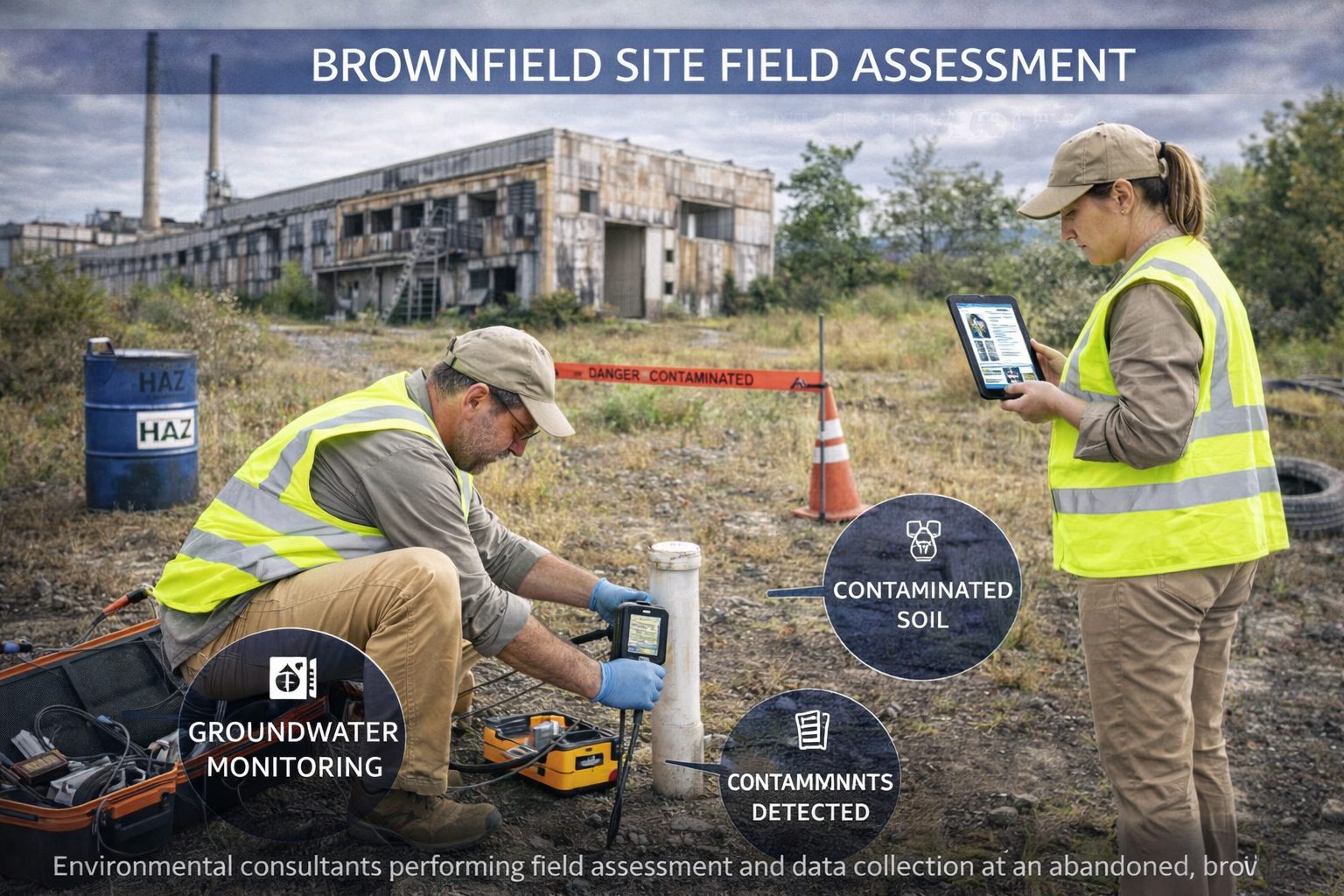
Brownfield redevelopment has become a critical component of sustainable urban development. Across North America and many parts of the world, formerly industrial or contaminated properties are being redeveloped into residential, commercial, and mixed-use developments. These projects transform underutilized land into productive assets while reducing pressure to develop undeveloped greenfield areas.
However, brownfield sites often present complex environmental challenges. Contamination from past industrial activities can affect soil, groundwater, and soil gas, requiring detailed environmental investigations and remediation planning before redevelopment can proceed. Regulatory agencies require extensive documentation to ensure that redevelopment activities meet environmental protection standards.
Environmental consulting firms play a central role in brownfield redevelopment by conducting site investigations, risk assessments, remediation planning, and regulatory reporting. These projects generate large volumes of environmental data, and preparing the required reports can be time-consuming.
To address these challenges, many environmental professionals are adopting automated environmental reporting systems. These systems integrate environmental data management, geographic information systems (GIS), laboratory data integration, and automated report generation tools. By automating reporting workflows, environmental consultants can improve efficiency, reduce errors, and streamline regulatory submissions.
This article explores how automated environmental reporting systems support brownfield redevelopment projects, the technologies involved, and best practices for implementing automated reporting workflows.
Understanding Brownfield Redevelopment
Brownfields are properties where real or perceived environmental contamination complicates redevelopment or reuse. These sites are often former industrial facilities, manufacturing plants, gas stations, landfills, or storage facilities where hazardous materials may have been used or released.
Redeveloping brownfield properties offers significant environmental and economic benefits. Instead of expanding development into undeveloped areas, brownfield redevelopment revitalizes existing urban land while addressing environmental contamination.
Common Sources of Brownfield Contamination
Brownfield sites may contain contaminants associated with historical industrial activities, including:
- petroleum hydrocarbons
- volatile organic compounds (VOCs)
- polycyclic aromatic hydrocarbons (PAHs)
- heavy metals
- solvents and degreasers
These contaminants may be present in soil, groundwater, surface water, or soil gas.
Environmental Investigations in Brownfield Projects
Brownfield redevelopment typically involves several stages of environmental investigation and remediation planning.
Phase I Environmental Site Assessment
A Phase I Environmental Site Assessment identifies potential environmental concerns based on historical records, site inspections, and regulatory database reviews.
Phase II Environmental Site Investigation
Phase II investigations involve collecting soil and groundwater samples to confirm whether contamination is present and determine its extent.
Risk Assessment
Environmental risk assessments evaluate whether contamination poses risks to human health or ecological receptors.
Remediation Planning
If contamination exceeds regulatory limits, remediation strategies must be developed to mitigate environmental risks.
Each of these steps requires detailed environmental reporting to satisfy regulatory requirements.
The Complexity of Environmental Reporting in Brownfield Projects
Brownfield redevelopment projects often involve large volumes of environmental data collected over multiple investigation phases.
Environmental consultants must manage and interpret data such as:
- soil and groundwater analytical results
- borehole logs and geological observations
- groundwater monitoring data
- contaminant plume maps
- risk assessment results
Preparing environmental reports for regulators, property owners, and redevelopment teams can require significant effort.
Regulatory Documentation Requirements
Regulatory agencies often require detailed documentation for brownfield projects, including:
- environmental site investigation reports
- groundwater monitoring reports
- risk assessment reports
- remediation action plans
- site closure documentation
Each report must follow specific regulatory guidelines and include accurate supporting data.
Challenges of Traditional Reporting Workflows
Traditional environmental reporting workflows rely heavily on manual processes.
Common challenges include:
- compiling laboratory analytical data from spreadsheets
- manually drafting contaminant plume maps
- preparing cross-sections and site figures
- formatting large technical reports
These processes can be time-consuming and increase the potential for errors.
Automation technologies provide a powerful solution to these challenges.
What Is Automated Environmental Reporting?
Automated environmental reporting involves the use of integrated digital systems to streamline the preparation of environmental reports.
Instead of manually compiling data and preparing reports, environmental consultants use automated platforms that link environmental datasets directly to reporting templates.
Automated reporting systems typically include:
- environmental data management systems
- GIS visualization tools
- automated laboratory data integration
- template-based report generation
These systems transform raw environmental data into structured reports more efficiently.
Key Technologies Supporting Automated Brownfield Reporting
Several digital technologies enable automated reporting workflows in brownfield redevelopment projects.
Environmental Data Management Systems
Environmental data management systems (EDMS) provide centralized databases for storing and organizing environmental investigation data.
These systems can manage:
- soil sample results
- groundwater analytical results
- borehole logs
- monitoring well data
- site inspection records
Centralized data management ensures that environmental information remains organized and accessible throughout the project lifecycle.
Automated Laboratory Data Integration
Laboratory analytical results are one of the largest sources of data in environmental investigations.
Laboratories typically provide results in electronic data deliverable (EDD) formats.
Automated systems can import these datasets directly into environmental databases.
This process eliminates manual data entry and reduces transcription errors.
GIS-Based Data Visualization
GIS platforms allow environmental professionals to visualize environmental conditions spatially.
GIS tools can generate maps showing:
- sampling locations
- contaminant concentration distributions
- groundwater flow patterns
- site infrastructure
Automated GIS workflows allow environmental consultants to generate contaminant plume maps directly from environmental databases.
Automated Geological Cross-Section Generation
Subsurface geological conditions play an important role in contaminant transport.
Automated cross-section tools can generate subsurface visualizations using borehole and monitoring well data.
These cross-sections illustrate:
- soil stratigraphy
- groundwater levels
- contaminant distributions
Automated cross-section generation improves the efficiency and consistency of environmental reports.
Automated Contaminant Plume Mapping
Mapping contaminant plumes is essential for evaluating the extent of contamination.
Automated contouring tools can generate concentration maps based on environmental sampling data.
These maps help environmental professionals identify contamination hotspots and evaluate contaminant migration pathways.
Template-Based Report Generation
Automated reporting systems use predefined templates designed to meet regulatory reporting requirements.
These templates include sections for:
- site background information
- investigation methodology
- data summaries
- environmental interpretation
- conclusions and recommendations
Because data tables and figures are linked directly to environmental databases, reports update automatically when datasets change.
Benefits of Automated Reporting in Brownfield Redevelopment
Automation offers several advantages for environmental consulting firms working on brownfield projects.
Faster Report Preparation
Automated reporting significantly reduces the time required to prepare environmental reports.
Consultants can generate maps, tables, and figures in minutes rather than hours.
Improved Data Accuracy
Direct integration with environmental databases reduces transcription errors and ensures that reports reflect the most current data.
Enhanced Data Visualization
Automated visualization tools produce high-quality maps and figures that improve communication of environmental conditions.
Clear visualizations help regulators and redevelopment stakeholders understand contamination patterns.
Increased Project Efficiency
Automated workflows allow environmental consultants to manage large datasets more efficiently, improving overall project timelines.
Improved Regulatory Compliance
Automated reporting systems help ensure that reports follow regulatory formats and include all required documentation.
This reduces the likelihood of regulatory review delays.
Best Practices for Implementing Automated Reporting Systems
Successful implementation of automated environmental reporting systems requires careful planning.
Standardize Environmental Data Structures
Environmental data should be stored in standardized formats to support automated analysis and reporting.
Consistent data structures improve compatibility between software platforms.
Integrate Field Data Collection
Digital field tools should be integrated with environmental databases to ensure that field observations are captured in electronic formats.
This integration eliminates manual data entry.
Establish Data Quality Controls
Automated workflows should include quality assurance procedures to verify the accuracy of environmental datasets.
Environmental professionals should review laboratory results and spatial data before generating reports.
Provide Staff Training
Environmental consultants must be trained to use automated reporting systems effectively.
Training should cover data management procedures, GIS tools, and reporting workflows.
Emerging Technologies in Brownfield Reporting
Automation technologies continue to evolve as new innovations emerge.
Artificial Intelligence for Environmental Data Analysis
AI tools may assist environmental professionals in analyzing environmental datasets and identifying contamination patterns.
Machine learning algorithms could help identify relationships between geological conditions and contaminant distributions.
Cloud-Based Environmental Data Platforms
Cloud platforms allow environmental professionals to access project data from anywhere.
Cloud-based systems support collaboration between consultants, regulators, and redevelopment teams.
Digital Site Models
Three-dimensional site models integrate geological and chemical data into interactive visualizations.
These models help environmental professionals understand contaminant transport pathways and evaluate remediation strategies.
The Future of Automated Brownfield Reporting
Brownfield redevelopment projects will continue to generate increasingly complex environmental datasets.
Automated reporting systems will become essential tools for managing these datasets and preparing regulatory documentation.
Future reporting platforms may integrate:
- AI-assisted environmental analysis
- real-time monitoring data integration
- advanced geospatial modeling tools
- automated regulatory submission systems
These technologies will enable environmental professionals to conduct more efficient and data-driven environmental investigations.
Conclusion
Brownfield redevelopment projects require detailed environmental investigations and extensive regulatory reporting. Traditional reporting workflows often involve time-consuming manual processes that can slow project timelines and increase the risk of errors.
Automated environmental reporting systems are transforming brownfield redevelopment by integrating environmental data management systems, GIS visualization tools, automated laboratory data integration, and template-based report generation.
These technologies allow environmental consultants to manage large environmental datasets more efficiently, produce accurate reports, and meet regulatory requirements more effectively.
As brownfield redevelopment continues to play a key role in sustainable urban development, automated environmental reporting will become an increasingly important component of modern environmental consulting workflows.
Learn more about our Environmental Site Assessment Solutions
Related Articles
- Environmental Site Assessment Automation: Transforming Phase I and Phase II Environmental Reporting
- Automating Phase I Environmental Site Assessments: Tools and Best Practices
- Automating Phase II Environmental Site Assessment Reporting
- How Automated Environmental Reporting Reduces Consulting Costs
- Digital Workflows for Environmental Due Diligence Investigations
- The Role of Data Automation in Modern Environmental Consulting
- Automating Environmental Compliance Reporting for Regulatory Submissions
- Meeting ASTM Standards with Automated Phase I ESA Reporting
- Cloud-Based Platforms for Environmental Investigation Data
- The Future of Automated Environmental Site Assessments
- An Overview of Phase I Environmental Site Assessments and How to Automate the Process
- Efficiency at Your Fingertips: Merging Questionnaire Data into Professional Reports with E-ASR
- Automating Environmental Excellence: Reporting with GAEA Technologies E-ASR
- Efficiency Redefined: Automating Environmental Reporting with E-ASR
- Streamlining Site Assessments: How Well Log Software Accelerates Contamination Reporting
- Reducing MTTR By 40%: The Power Of Automated Report Generation
- Why Automated Environmental Reporting Is the Game Changer Your Business Needs
External References
- ASTM Standard Practice for Environmental Site Assessments: Phase I Environmental Site Assessment Process
- US EPA Standards and Practices for All Appropriate Inquiries
- CSA Z768 — Phase I Environmental Site Assessment
- CSA Z769 — Phase II Environmental Site Assessment
- BS 10175 — Investigation of Potentially Contaminated Sites
- Australian National Environment Protection Measure (NEPM)