

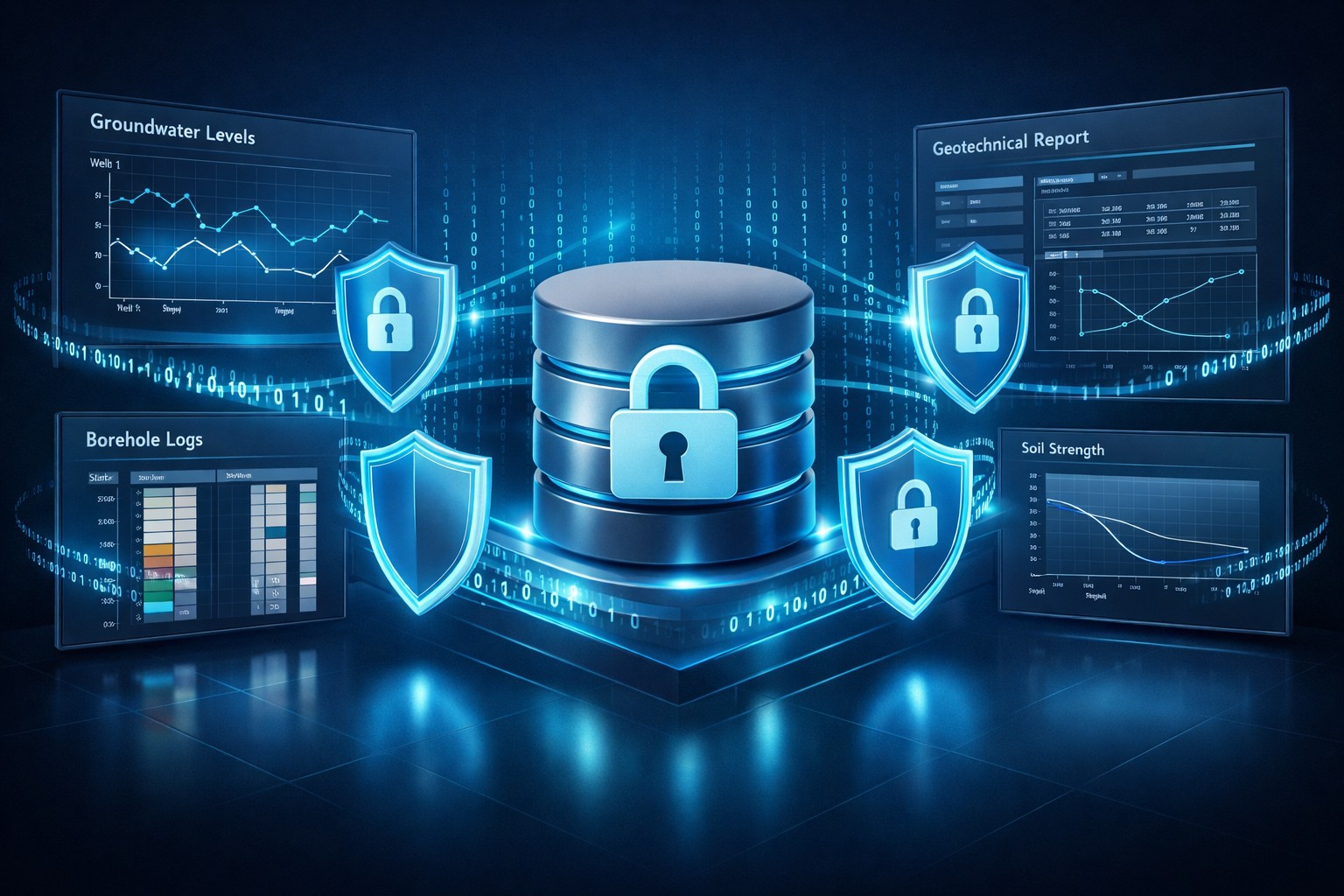
Engineering firms handle some of the most sensitive technical information in the modern economy. Borehole logs, environmental monitoring records, infrastructure designs, laboratory test results, and regulatory submissions all represent high-value intellectual property and legally defensible data.
A breach, loss, or corruption of this information can lead to regulatory penalties, project delays, litigation risk, and reputational damage. As engineering data becomes increasingly digital and cloud-based, organizations must adopt a structured security strategy that protects data from collection through long-term archival.
This guide explains the core principles, threats, and best practices for securing engineering data systems.
Why Engineering Data Security Matters
Engineering data is different from general business data. It often supports regulatory compliance, environmental reporting, safety decisions, and infrastructure design.
A compromised dataset can affect:
- Environmental compliance reporting
- Geotechnical risk assessments
- Infrastructure design calculations
- Legal defensibility of reports
- Long-term monitoring programs
For example, groundwater monitoring records or soil laboratory results may need to remain traceable and verifiable for decades. Any alteration—even accidental—can undermine regulatory credibility.
Because of this, engineering data management systems must prioritize:
- Integrity – data must not be altered improperly
- Traceability – all changes must be tracked
- Availability – data must be accessible when needed
- Confidentiality – sensitive information must remain protected
These four pillars form the foundation of engineering data security.
Reliable engineering analysis depends on trustworthy datasets. If underlying data becomes corrupted, modified without authorization, or poorly documented, the resulting interpretations may lead to incorrect engineering decisions. This challenge is particularly significant in subsurface investigations, where engineers must account for geological variability. Our article on quantifying and visualizing subsurface uncertainty explains how engineers can better evaluate geological risk while maintaining confidence in their data.
Common Threats to Engineering Data
Unauthorized Access
Unauthorized access occurs when users view or modify data without permission. This can result from:
- Weak password policies
- Shared user accounts
- Poorly configured permissions
- Lack of role-based access control
Engineering organizations often have multiple stakeholders including consultants, contractors, and regulators. Without strict permission controls, sensitive data may be exposed unintentionally.
Data Corruption or Loss
Engineering data frequently moves between field devices, laboratory systems, and reporting platforms. Each transfer introduces potential risk.
Common causes include:
- Manual data entry errors
- File version confusion
- Spreadsheet overwrites
- Hardware failure
- Incomplete backups
Even a small change—such as a decimal error in a soil strength value—can significantly impact engineering conclusions.
Cybersecurity Attacks
Engineering firms are increasingly targeted by cybercriminals due to the value of technical intellectual property.
Typical threats include:
- Ransomware attacks
- Phishing emails targeting engineers
- Malware embedded in shared files
- Network intrusion attempts
These attacks can lock organizations out of their own data or expose sensitive project information.
Lack of Auditability
Without a proper audit trail, it becomes impossible to determine:
- Who changed data
- When the change occurred
- Why the change was made
This creates serious compliance and legal risks, particularly for environmental monitoring programs where regulatory agencies require full data traceability.
Best Practices for Engineering Data Security
Implement Role-Based Access Control (RBAC)
Not every user should have the same privileges.
A well-designed system defines multiple access levels, such as:
Administrator
- Full system access
- Manage users and security settings
- Configure databases and integrations
Power User
- Edit datasets and manage projects
- Approve data changes
- Run advanced reports
Limited User
- View data and run reports
- Enter field or lab data
Guest / Viewer
- Read-only access to approved datasets
This structure ensures that users only access the information necessary for their role.
Use Password-Protected Projects
Project-level protection adds another layer of security by restricting access to sensitive datasets.
For example, a system might allow administrators to:
- Lock projects with password authentication
- Restrict editing privileges
- Control external data sharing
- Manage team-based permissions
This prevents accidental access to confidential site investigations or proprietary engineering work.
Maintain Comprehensive Audit Trails
Every data change should be logged automatically.
A proper audit trail records:
- User name
- Timestamp
- Previous value
- New value
- Reason for modification
Audit trails provide full transparency and legal defensibility, particularly when submitting data to regulatory agencies.
Audit trails are essential for regulatory compliance in environmental and geotechnical engineering projects. Groundwater monitoring programs and environmental investigations often rely on datasets collected over many years. Secure engineering data systems track every modification to a dataset, providing a defensible record of how data has been used in analysis and reporting. These capabilities are particularly important for environmental modeling workflows such as those described in our article on building audit-proof contaminant fate models for regulatory compliance.
Automate Data Validation
Automated validation reduces human error and protects data integrity.
Typical validation rules include:
- Range checks for laboratory results
- Format validation for coordinates or dates
- Duplicate record detection
- Required field verification
Automated validation ensures that incorrect data never enters the system in the first place.
Engineering datasets frequently originate from multiple sources, including field instruments, laboratory systems, and third-party consultants. Ensuring that imported datasets remain accurate and consistent is an essential part of data security and governance. Our guide on viewing and comparing LAS well log files demonstrates how engineers can validate and review geoscience datasets before they are integrated into a central engineering database.
Encrypt Data Storage and Transmission
Engineering data should always be encrypted when:
- Stored in databases
- Transmitted across networks
- Shared with external collaborators
Common encryption practices include:
- HTTPS secure connections
- Encrypted database storage
- Secure API data exchange
- Cloud storage encryption
Encryption protects information even if systems are compromised.
Implement Reliable Backup Strategies
Engineering data must always be recoverable.
A robust backup strategy includes:
- Daily automated backups
- Off-site storage
- Versioned backup archives
- Disaster recovery procedures
Organizations should regularly test backup restoration to ensure data can be recovered quickly.
Building a Secure Engineering Data Ecosystem
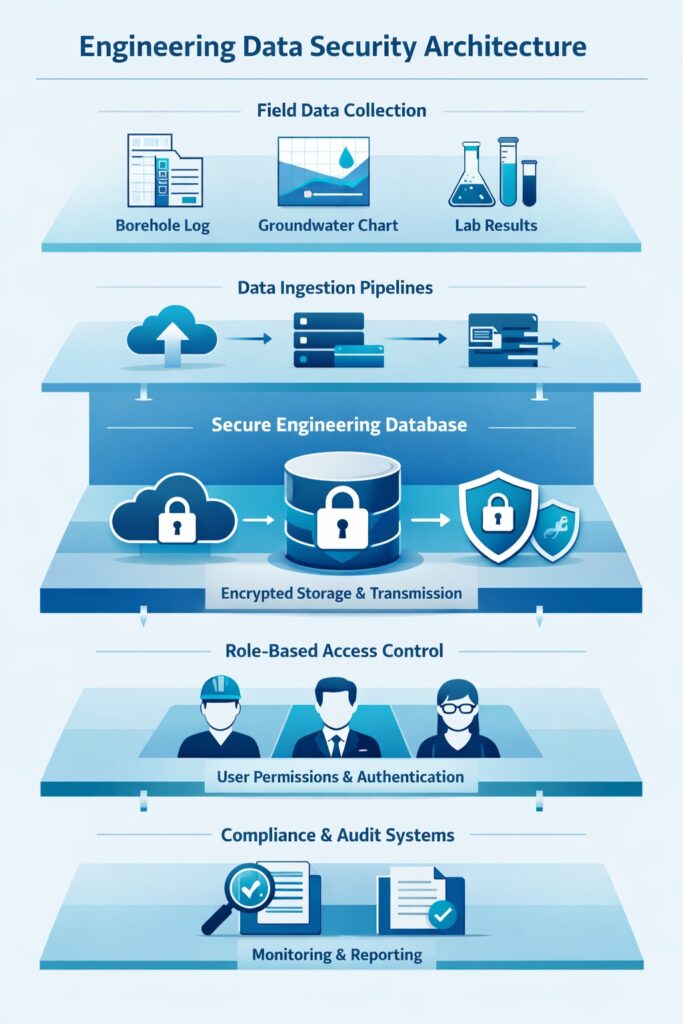
Security should not exist as an isolated feature. Instead, it must be integrated throughout the entire data lifecycle:
- Field Data Collection
- Laboratory Data Import
- Data Validation and Review
- Reporting and Analysis
- Long-Term Archival
Modern engineering data platforms increasingly combine:
- Centralized databases
- automated validation engines
- secure collaboration tools
- cloud-based infrastructure
This integrated approach dramatically reduces risk compared with traditional spreadsheet-based workflows.
Modern engineering organizations increasingly rely on integrated platforms that combine database management, visualization tools, and analytical workflows within a single environment. These platforms allow engineers to move seamlessly from field data collection to interpretation while maintaining strong governance controls and secure access management. Solutions such as the GaeaSynergy engineering data platform are designed specifically to support secure geotechnical and environmental data workflows across the entire project lifecycle.
The Future of Engineering Data Security
Emerging technologies are beginning to transform engineering data protection.
Key innovations include:
AI-Driven Anomaly Detection
Machine learning algorithms can detect unusual data patterns that may indicate errors or tampering.
Blockchain-Based Data Provenance
Distributed ledgers can create immutable records of engineering data changes.
Zero-Trust Security Models
Every system interaction is verified continuously rather than relying on traditional perimeter security.
As engineering datasets grow larger and more complex, these technologies will become increasingly important.
Final Thoughts
Engineering data is more than just information—it represents scientific evidence, regulatory documentation, and valuable intellectual property.
Protecting that data requires a combination of:
- strong access controls
- secure infrastructure
- automated validation
- complete auditability
- reliable backups
Organizations that implement a structured engineering data security strategy will reduce risk, improve regulatory compliance, and build greater trust with clients and regulators.
Related Topics
- Security & Governance in Geoscience Data
- How to Secure Geotechnical Databases from Unauthorized Access
- AI Governance for Geoscience Data
- Data Loss in Subsurface Engineering Projects
- Best Practices for Environmental Data Security and Compliance
- Secure Data Sharing Across Organizations
- Preventing Data Loss in Subsurface Engineering Projects
- Data Ethics in Environmental and Geotechnical Engineering
- Managing Multi-User Collaboration in Subsurface Databases
- Data Ownership and Responsibility in Engineering Firms
- Cloud vs On-Premise Security for Geoscience Data
- Configuring User Privilege Levels & Password-Protected Projects in GaeaSynergy
- Securing Your Subsurface Data: A Master Guide to User Management in GaeaSynergy
- Smart Licensing for Modern Geosciences: Managing GaeaSynergy with Ease