

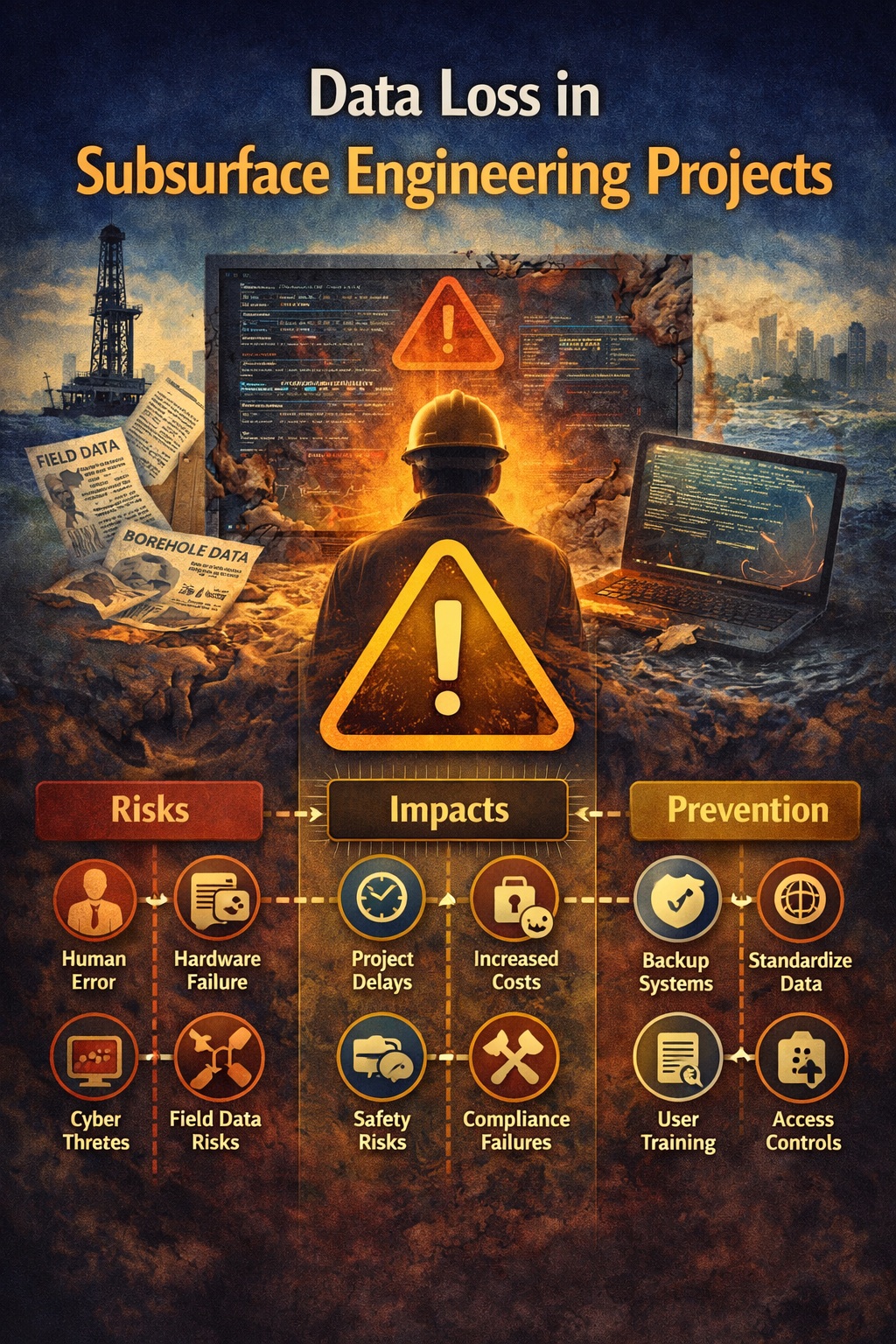
Understanding the risks, impacts, and prevention strategies for critical geoscience data
Introduction
Subsurface engineering projects depend on one fundamental asset: data.
From borehole logs and geotechnical testing results to groundwater monitoring and geophysical surveys, data forms the backbone of:
- engineering design
- risk assessment
- regulatory compliance
- long-term asset management
Yet despite its importance, data loss remains one of the most underestimated risks in geotechnical and environmental engineering.
Unlike many other industries, subsurface data is:
- expensive to collect
- time-consuming to generate
- often impossible to reproduce
When data is lost, the consequences extend far beyond inconvenience—they can impact project timelines, budgets, safety, and legal standing.
In this article, we explore:
- what data loss means in subsurface engineering
- common causes and real-world risks
- impacts on projects and organizations
- strategies to mitigate and prevent data loss
What Is Data Loss?
Data loss refers to the unintentional destruction, corruption, or inaccessibility of data.
In subsurface engineering, this may include:
- missing borehole logs
- corrupted lab results
- lost field data
- overwritten datasets
- inaccessible project databases
Data loss can be:
- temporary (recoverable)
- permanent (irreversible)
Why Data Loss Is Critical in Subsurface Engineering
🔹 Irreplaceable Field Data
Subsurface data often comes from:
- drilling campaigns
- sampling programs
- in-situ testing
These activities cannot always be repeated due to:
- cost constraints
- site changes
- regulatory limitations
🔹 Regulatory and Compliance Requirements
Environmental and geotechnical data must often be:
- retained long-term
- available for audits
- traceable and verifiable
🔹 Legal and Liability Exposure
Data is frequently used in:
- disputes
- claims
- regulatory investigations
Loss of data can weaken:
- legal defenses
- project documentation
🔹 Project Continuity
Data loss disrupts:
- workflows
- collaboration
- decision-making
Types of Data Loss
🔹 Physical Data Loss
Loss of physical records such as:
- paper logs
- maps
- field notebooks
🔹 Digital Data Loss
Loss of electronic data due to:
- deletion
- corruption
- system failures
🔹 Logical Data Loss
Data exists but is:
- inaccessible
- corrupted
- improperly structured
Common Causes of Data Loss
⚠️ Human Error
- accidental deletion
- overwriting files
- incorrect data handling
⚠️ Hardware Failure
- server crashes
- disk failures
- equipment damage
⚠️ Software Issues
- bugs
- corrupted files
- failed updates
⚠️ Cybersecurity Threats
- ransomware
- hacking
- malware
⚠️ Poor Data Management Practices
- lack of backups
- inconsistent storage
- fragmented systems
⚠️ Field Data Risks
- lost notebooks
- damaged devices
- incomplete data capture
Data Lifecycle Risks
Data loss can occur at any stage:
🔹 Collection
- incomplete data capture
- equipment malfunction
🔹 Transfer
- corrupted files
- transmission errors
🔹 Storage
- hardware failure
- poor organization
🔹 Processing
- overwriting data
- incorrect transformations
🔹 Archiving
- outdated formats
- poor retention practices
Real-World Consequences of Data Loss
🔹 Project Delays
Missing data requires:
- rework
- additional investigations
🔹 Increased Costs
Recollecting data is often:
- expensive
- time-consuming
🔹 Compliance Failures
Missing data can result in:
- incomplete reporting
- regulatory penalties
🔹 Safety Risks
Incorrect or missing data can lead to:
- flawed designs
- unsafe conditions
🔹 Reputational Damage
Clients and regulators lose trust.
Identifying Vulnerabilities
To manage data loss, organizations must identify:
- single points of failure
- weak backup systems
- unsecured data transfers
- lack of governance
Preventing Data Loss: Key Strategies
1. Implement Robust Backup Systems
Use:
- automated backups
- multiple storage locations
2. Follow the 3-2-1 Backup Rule
- 3 copies of data
- 2 storage types
- 1 offsite copy
3. Centralize Data Management
Reduce fragmentation with:
- centralized databases
- integrated systems
4. Apply Version Control
Track changes and enable rollback.
5. Use Access Controls
Limit:
- editing
- deletion
6. Enable Audit Trails
Track:
- user activity
- data changes
7. Standardize Data Formats
Ensure consistency across systems.
Protecting Field Data
Field data is particularly vulnerable.
🔐 Best Practices:
- use digital data capture tools
- sync data regularly
- verify data before leaving site
- maintain backups
Cybersecurity and Data Loss
🔐 Key Threats:
- ransomware
- phishing attacks
🔐 Mitigation:
- encryption
- firewalls
- user training
- MFA
Disaster Recovery Planning
🔹 Key Components:
- recovery objectives (RTO/RPO)
- backup restoration procedures
- communication plans
Role of Technology
🔹 Cloud Systems
Provide:
- redundancy
- scalability
🔹 On-Premise Systems
Offer:
- control
- customization
🔹 Hybrid Systems
Combine:
- security
- flexibility
Governance and Policies
🔹 Define Roles
Assign:
- data owners
- custodians
🔹 Establish Policies
Include:
- backup frequency
- retention rules
🔹 Conduct Audits
Regularly review systems.
Common Mistakes to Avoid
- relying on a single backup
- not testing backups
- ignoring security
- storing data in silos
- lack of training
Future Trends
🔹 Cloud Adoption
Increasing use of cloud platforms.
🔹 AI Monitoring
Detecting risks early.
🔹 Automation
Reducing human error.
🔹 Digital Twins
Require reliable data continuity.
Building a Data Protection Culture
Organizations must:
- prioritize data protection
- train employees
- enforce policies
Conclusion
Data loss in subsurface engineering projects is a critical risk that cannot be ignored.
By understanding:
- causes
- impacts
- prevention strategies
organizations can protect their most valuable asset—their data.
Because in subsurface engineering: When data is lost, knowledge is lost—and the integrity of decisions is compromised.
Related Articles
- Security & Governance in Geoscience Data
- How to Secure Geotechnical Databases from Unauthorized Access
- AI Governance for Geoscience Data
- Best Practices for Environmental Data Security and Compliance
- Secure Data Sharing Across Organizations
- Preventing Data Loss in Subsurface Engineering Projects
- Data Ethics in Environmental and Geotechnical Engineering
- Managing Multi-User Collaboration in Subsurface Databases
- Data Ownership and Responsibility in Engineering Firms
- Cloud vs On-Premise Security for Geoscience Data
- The Ultimate Guide to Engineering Data Security
- Configuring User Privilege Levels & Password-Protected Projects in GaeaSynergy
- Securing Your Subsurface Data: A Master Guide to User Management in GaeaSynergy
- Smart Licensing for Modern Geosciences: Managing GaeaSynergy with Ease