

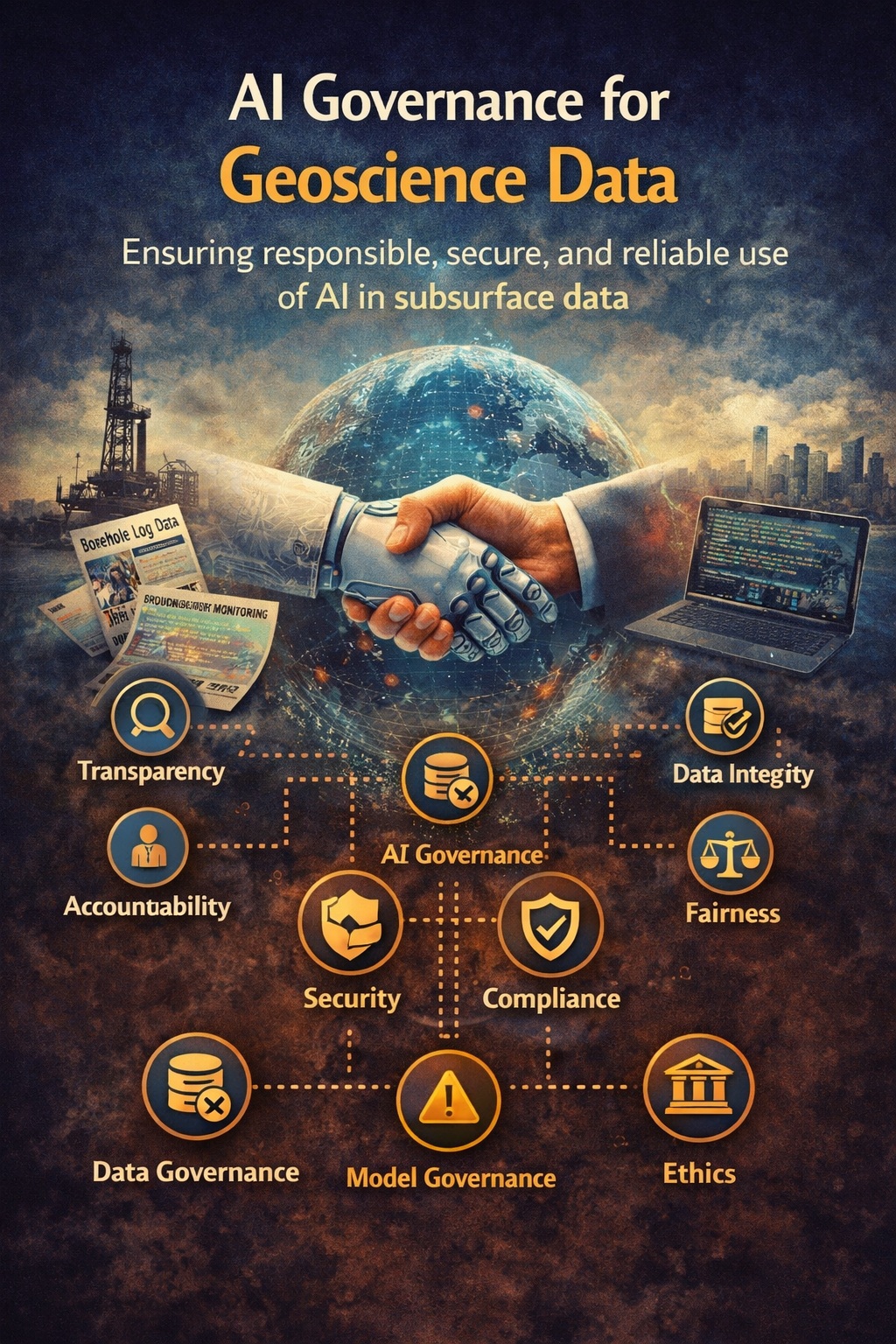
Ensuring responsible, secure, and reliable use of AI in subsurface data management
Introduction
Artificial Intelligence (AI) is rapidly transforming how geoscience and engineering organizations manage, analyze, and interpret data. From automating borehole log classification to predicting groundwater behavior and optimizing site investigations, AI is unlocking powerful new capabilities.
But with these capabilities comes a new challenge:
How do you govern AI systems to ensure they are accurate, ethical, secure, and compliant?
AI systems rely heavily on geoscience data—data that is often:
- complex
- incomplete
- sensitive
- high-impact
Without proper governance, AI can introduce risks such as:
- biased or inaccurate predictions
- lack of transparency
- regulatory non-compliance
- data misuse
This is where AI governance becomes essential.
In this guide, we explore how organizations can implement AI governance frameworks for geoscience data, ensuring that AI-driven insights are trustworthy, compliant, and aligned with engineering standards.
What Is AI Governance?
AI governance refers to the policies, processes, and controls that ensure AI systems are used responsibly and effectively.
It includes:
- data governance
- model validation
- risk management
- ethical considerations
- compliance
Why AI Governance Matters in Geoscience
🔹 High-Stakes Decisions
AI outputs influence:
- engineering designs
- environmental remediation
- infrastructure safety
🔹 Complex and Imperfect Data
Geoscience data is often:
- sparse
- heterogeneous
- uncertain
AI models must account for these limitations.
🔹 Regulatory and Legal Risks
AI-driven decisions must:
- comply with regulations
- be defensible
🔹 Trust and Transparency
Stakeholders need to understand:
- how AI decisions are made
- what data was used
Key Risks of AI in Geoscience Data
⚠️ Bias in Data
Incomplete or biased datasets can lead to:
- incorrect predictions
- unfair outcomes
⚠️ Lack of Transparency
“Black box” models make it difficult to:
- explain decisions
- justify outcomes
⚠️ Over-Reliance on AI
Users may:
- trust AI blindly
- ignore data limitations
⚠️ Data Quality Issues
Poor data leads to:
- unreliable models
- flawed insights
⚠️ Security Risks
AI systems may expose:
- sensitive data
- vulnerabilities
Core Principles of AI Governance
1. Transparency
Ensure AI models are:
- explainable
- interpretable
2. Accountability
Define:
- who is responsible for AI outputs
- who approves decisions
3. Data Integrity
Use:
- accurate
- validated data
4. Fairness
Avoid:
- biased outcomes
- discriminatory results
5. Security
Protect:
- data
- models
6. Compliance
Align with:
- regulations
- industry standards
AI Governance Framework for Geoscience
1. Data Governance
Ensure:
- data quality
- standardization
- traceability
2. Model Governance
Include:
- validation
- testing
- monitoring
3. Risk Management
Identify:
- potential failures
- impacts
4. Lifecycle Management
Manage AI systems through:
- development
- deployment
- maintenance
5. Documentation
Maintain:
- model documentation
- data sources
- assumptions
Best Practices for AI Governance
Use High-Quality Data
Ensure:
- completeness
- accuracy
- consistency
Validate Models Regularly
Test:
- performance
- reliability
Implement Explainable AI
Use techniques that:
- clarify decisions
- improve trust
4. Monitor AI Systems
Track:
- performance
- anomalies
5. Maintain Human Oversight
AI should:
- support decisions
- not replace judgment
6. Secure AI Systems
Protect:
- data inputs
- model outputs
Technology Considerations
🔹 Cloud Platforms
Enable:
- scalable AI processing
🔹 On-Premise Systems
Offer:
- control
- security
🔹 Hybrid Systems
Balance:
- flexibility
- governance
🔹 AI Tools
Include:
- machine learning platforms
- analytics tools
Real-World Use Cases
🔹 Borehole Data Classification
AI automates:
- lithology classification
Governance ensures:
- accuracy
- validation
🔹 Groundwater Prediction
AI models:
- simulate behavior
Governance ensures:
- reliability
- transparency
🔹 Environmental Risk Assessment
AI identifies:
- contamination risks
Governance ensures:
- defensibility
Common Mistakes to Avoid
- using poor-quality data
- ignoring model validation
- lack of transparency
- over-reliance on AI
- insufficient security
Regulatory and Ethical Considerations
🔹 Data Privacy
Ensure compliance with:
- privacy laws
🔹 Ethical Use
Avoid:
- misuse of data
- harmful outcomes
🔹 Professional Standards
Align with:
- engineering ethics
Future Trends
🔹 Explainable AI
Growing focus on:
- transparency
🔹 AI Regulation
Increasing oversight globally.
🔹 Integration with Digital Twins
AI powering real-time systems.
🔹 Automation and Efficiency
AI streamlining workflows.
Building an AI Governance Strategy
Step 1: Assess Needs
Identify:
- use cases
- risks
Step 2: Define Policies
Establish:
- guidelines
- controls
Step 3: Implement Tools
Use:
- governance platforms
- monitoring tools
Step 4: Train Teams
Ensure understanding of:
- AI systems
- responsibilities
Step 5: Monitor and Improve
Continuously:
- evaluate
- update
Conclusion
AI governance is essential for ensuring that geoscience data is used responsibly and effectively.
Organizations that implement strong governance frameworks benefit from:
- more reliable AI insights
- improved compliance
- reduced risk
- greater stakeholder trust
Related Articles
- Security & Governance in Geoscience Data
- How to Secure Geotechnical Databases from Unauthorized Access
- Data Loss in Subsurface Engineering Projects
- Best Practices for Environmental Data Security and Compliance
- Secure Data Sharing Across Organizations
- Preventing Data Loss in Subsurface Engineering Projects
- Data Ethics in Environmental and Geotechnical Engineering
- Managing Multi-User Collaboration in Subsurface Databases
- Data Ownership and Responsibility in Engineering Firms
- Cloud vs On-Premise Security for Geoscience Data
- The Ultimate Guide to Engineering Data Security
- Configuring User Privilege Levels & Password-Protected Projects in GaeaSynergy
- Securing Your Subsurface Data: A Master Guide to User Management in GaeaSynergy
- Smart Licensing for Modern Geosciences: Managing GaeaSynergy with Ease