

Introduction
As engineering firms become increasingly data-driven, a critical question continues to surface:
Who owns the data—and who is responsible for it?
From geotechnical investigations and environmental monitoring to infrastructure design and construction records, engineering projects generate vast amounts of data. This data is not only valuable—it is often legally sensitive, contractually bound, and operationally critical.
Yet many organizations still operate without clear definitions of:
- data ownership
- accountability
- access control
- long-term responsibility
This creates risk.
Misunderstanding data ownership can lead to:
- legal disputes
- data loss
- compliance failures
- project delays
- damaged client relationships
In this guide, we’ll explore how engineering firms can define, manage, and enforce data ownership and responsibility across projects, teams, and systems.
What Is Data Ownership?
Data ownership refers to the legal and organizational rights over data, including:
- who controls it
- who can access it
- who can modify it
- who is accountable for its accuracy and security
In engineering contexts, ownership is often more complex than it appears.
🔹 Types of Data Ownership
1. Legal Ownership
Defined by contracts, regulations, or intellectual property rights.
Example:
A client may legally own all project data generated during a site investigation.
2. Operational Ownership
Refers to who manages and maintains the data day-to-day.
Example:
An engineering firm may store and manage data even if the client owns it.
3. Custodianship
The responsibility for safeguarding and maintaining data integrity.
Example:
A database administrator or data manager acts as a custodian.
👉 In many cases:
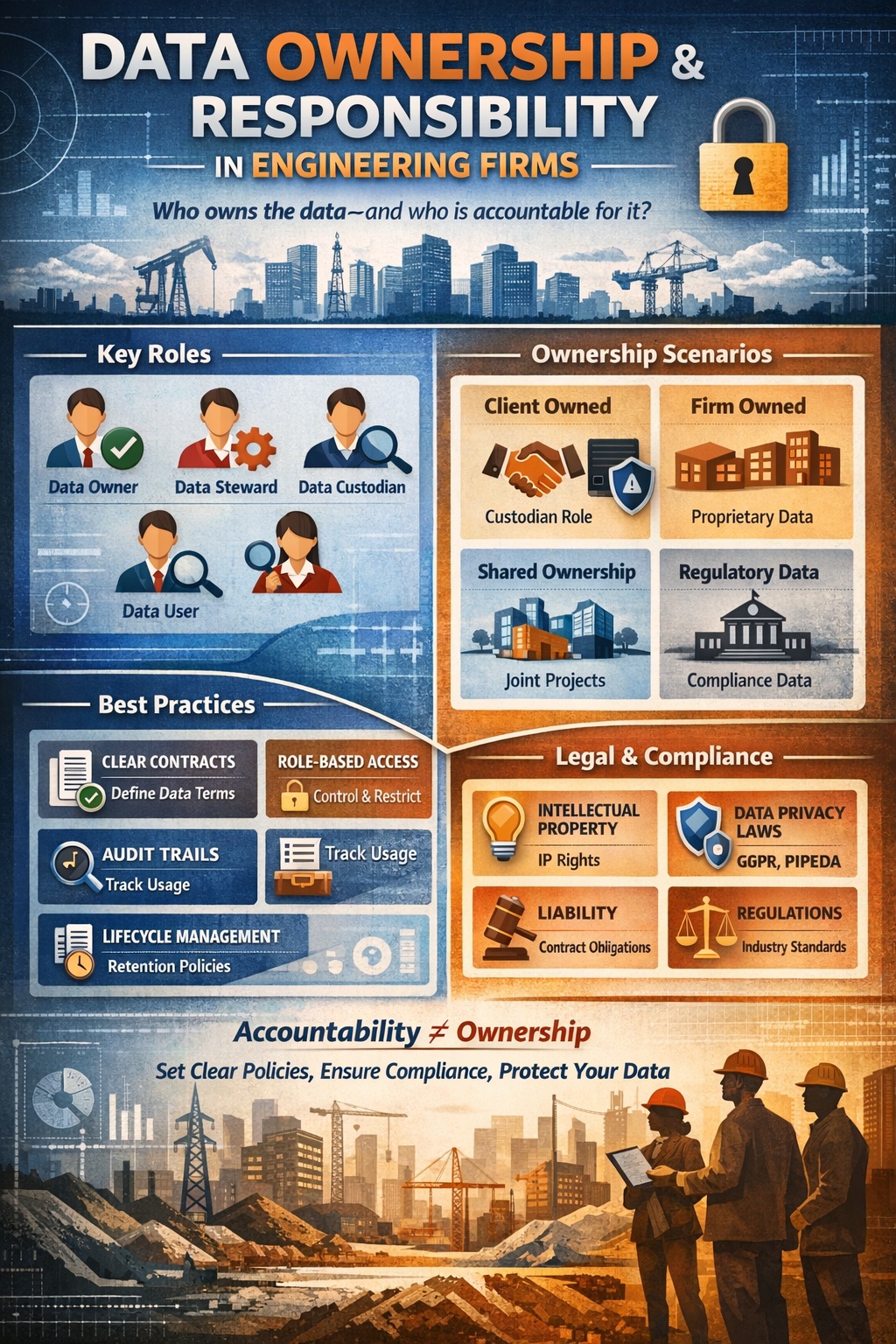
Ownership ≠ Responsibility
And that’s where problems begin.
Why Data Ownership Matters in Engineering
🔹 1. Legal Protection
Engineering data is often tied to:
- contracts
- liability
- regulatory compliance
Incorrect ownership assumptions can result in:
- disputes over deliverables
- misuse of data
- intellectual property conflicts
🔹 2. Data Integrity and Trust
Clear ownership ensures:
- accountability for data quality
- consistent data standards
- reliable decision-making
🔹 3. Regulatory Compliance
Environmental and geotechnical data may be subject to:
- audits
- reporting requirements
- legal scrutiny
Without defined ownership, compliance becomes difficult.
🔹 4. Long-Term Data Value
Engineering data often has value beyond the original project:
- future developments
- asset management
- environmental monitoring
Ownership determines who can reuse or monetize that data.
Common Challenges in Engineering Firms
Despite its importance, data ownership is often poorly defined.
⚠️ Ambiguous Contracts
Many contracts do not clearly specify:
- who owns raw data vs processed data
- rights to reuse data
- data retention responsibilities
⚠️ Multiple Stakeholders
Projects involve:
- clients
- consultants
- subcontractors
- regulators
Each may have different expectations of ownership.
⚠️ Fragmented Systems
Data may be stored across:
- spreadsheets
- field devices
- databases
- third-party software
This makes ownership tracking difficult.
⚠️ Lack of Governance
Without policies, firms rely on:
- informal practices
- individual decisions
- inconsistent workflows
Defining Data Responsibility
If ownership defines rights, responsibility defines accountability.
🔹 Key Roles in Data Responsibility
1. Data Owner
- Defines how data is used
- Approves access
- Ensures compliance
2. Data Steward
- Maintains data quality
- Enforces standards
- Manages metadata
3. Data Custodian
- Handles storage and security
- Manages infrastructure
- Implements backups
4. Data Users
- Access and use data
- Must follow policies
👉 A strong framework clearly separates these roles.
Data Ownership in Different Engineering Scenarios
🔹 Scenario 1: Client-Owned Data
Common in consulting projects.
- Client owns all data
- Firm acts as custodian
- Firm must ensure:
- security
- accuracy
- proper delivery
🔹 Scenario 2: Firm-Owned Data
Applies to:
- internal R&D
- proprietary models
- reusable datasets
Firm controls:
- access
- usage
- commercialization
🔹 Scenario 3: Shared Ownership
Occurs when:
- multiple parties contribute data
- joint ventures exist
Requires:
- clear agreements
- defined responsibilities
🔹 Scenario 4: Regulatory Data
Data submitted to regulators may:
- become public
- require long-term retention
- be subject to strict controls
Key Components of a Data Ownership Framework
🔐 1. Clear Contract Language
Define:
- ownership of raw vs processed data
- usage rights
- retention requirements
- transfer conditions
🔐 2. Role-Based Access Control (RBAC)
Ensure:
- users access only necessary data
- sensitive data is protected
🔐 3. Data Classification
Categorize data as:
- confidential
- internal
- public
- regulated
🔐 4. Audit Trails
Track:
- access
- changes
- data movement
🔐 5. Data Lifecycle Management
Define:
- creation
- storage
- usage
- archiving
- deletion
Best Practices for Engineering Firms
✅ 1. Define Ownership Early
Include data ownership in:
- project proposals
- contracts
- kickoff meetings
✅ 2. Separate Ownership from Responsibility
Clarify:
- who owns the data
- who manages it
- who is accountable
✅ 3. Standardize Data Policies
Create organization-wide policies for:
- data handling
- security
- retention
✅ 4. Use Centralized Systems
Avoid data silos by using:
- centralized databases
- integrated platforms
✅ 5. Train Teams
Ensure all staff understand:
- data policies
- security practices
- their responsibilities
✅ 6. Regularly Review and Audit
Update:
- access permissions
- ownership definitions
- compliance practices
Legal and Compliance Considerations
Engineering firms must consider:
🔹 Intellectual Property (IP)
Who owns:
- models
- methodologies
- derived insights
🔹 Data Privacy Laws
Applicable when handling:
- personal data
- environmental health data
Examples:
- GDPR
- PIPEDA
🔹 Contractual Obligations
Ensure compliance with:
- client agreements
- project specifications
🔹 Liability
Incorrect or misused data can result in:
- legal claims
- financial penalties
Technology’s Role in Data Ownership
Modern platforms help enforce ownership and responsibility through:
🔹 Access Control Systems
- role-based permissions
- user authentication
🔹 Audit Logging
- track all user actions
🔹 Version Control
- maintain data history
🔹 Centralized Databases
- single source of truth
🔹 Cloud and Hybrid Systems
- scalable storage
- secure collaboration
Future Trends
🔹 Data as an Asset
Engineering firms increasingly treat data as:
- intellectual property
- competitive advantage
🔹 AI and Automation
AI requires:
- high-quality, well-governed data
🔹 Increased Regulation
Data governance requirements are expanding globally.
🔹 Digital Twins
Ownership becomes critical when:
- models represent real-world assets
Common Mistakes to Avoid
- Not defining ownership in contracts
- Assuming ownership equals responsibility
- Allowing uncontrolled data access
- Failing to audit data usage
- Storing data in multiple disconnected systems
Building a Culture of Data Accountability
Technology alone is not enough.
Organizations must foster:
- accountability
- transparency
- discipline
This includes:
- leadership commitment
- clear policies
- ongoing training
Conclusion
Data ownership and responsibility are not just administrative concerns—they are strategic priorities.
Engineering firms that clearly define and manage these concepts benefit from:
- reduced risk
- improved compliance
- stronger client trust
- better decision-making
As data becomes central to every project, organizations must move beyond informal practices and implement structured governance frameworks.
Related Articles
- Security & Governance in Geoscience Data
- How to Secure Geotechnical Databases from Unauthorized Access
- AI Governance for Geoscience Data
- Data Loss in Subsurface Engineering Projects
- Best Practices for Environmental Data Security and Compliance
- Secure Data Sharing Across Organizations
- Preventing Data Loss in Subsurface Engineering Projects
- Data Ethics in Environmental and Geotechnical Engineering
- Managing Multi-User Collaboration in Subsurface Databases
- Cloud vs On-Premise Security for Geoscience Data
- The Ultimate Guide to Engineering Data Security
- Configuring User Privilege Levels & Password-Protected Projects in GaeaSynergy
- Securing Your Subsurface Data: A Master Guide to User Management in GaeaSynergy
- Smart Licensing for Modern Geosciences: Managing GaeaSynergy with Ease