

Introduction
Modern landfills are complex engineered systems designed to safely contain municipal, industrial, and hazardous waste while minimizing environmental impacts. One of the most critical environmental concerns associated with landfill operations is the potential contamination of groundwater. When rainwater or moisture percolates through waste materials, it can dissolve organic compounds, heavy metals, and other contaminants, creating a polluted liquid known as leachate. If leachate migrates into the surrounding soil or aquifers, it can contaminate groundwater supplies and pose risks to ecosystems and human health.
To prevent this from occurring, engineers design sophisticated landfill liner systems that act as protective barriers between waste materials and the surrounding environment. These liner systems are engineered to contain leachate, prevent contaminant migration, and direct liquids toward collection systems for treatment and disposal.
Designing an effective landfill liner system requires a multidisciplinary approach that integrates geotechnical engineering, hydrogeology, environmental science, and regulatory compliance. Engineers must consider soil properties, groundwater conditions, waste composition, climatic factors, and long-term performance to ensure that landfill containment systems remain effective for decades or even centuries.
This article explores how landfill liner systems are designed to prevent groundwater contamination, the materials and technologies used in modern landfill engineering, and the critical role these systems play in environmental protection.
Why Groundwater Protection Is Critical in Landfill Design
Groundwater is one of the most important sources of drinking water worldwide. In many regions, aquifers provide the primary supply for municipalities, agriculture, and industry. Protecting groundwater from contamination is therefore a central objective in landfill design and environmental regulation.
Historically, poorly designed landfills allowed leachate to migrate into surrounding soils and groundwater systems. These uncontrolled waste disposal sites often resulted in long-term contamination problems that required extensive environmental remediation.
Today, modern landfill engineering focuses on preventing contamination before it occurs. By installing robust liner systems and leachate management infrastructure, engineers can effectively isolate waste materials from surrounding groundwater systems.
Key objectives of landfill liner design include:
- Preventing leachate from escaping the landfill
- Protecting underlying aquifers and groundwater supplies
- Reducing environmental risks and long-term liabilities
- Complying with environmental regulations
- Supporting safe waste management practices
Well-designed liner systems significantly reduce the likelihood that contaminants will migrate into groundwater.
What Is a Landfill Liner System?
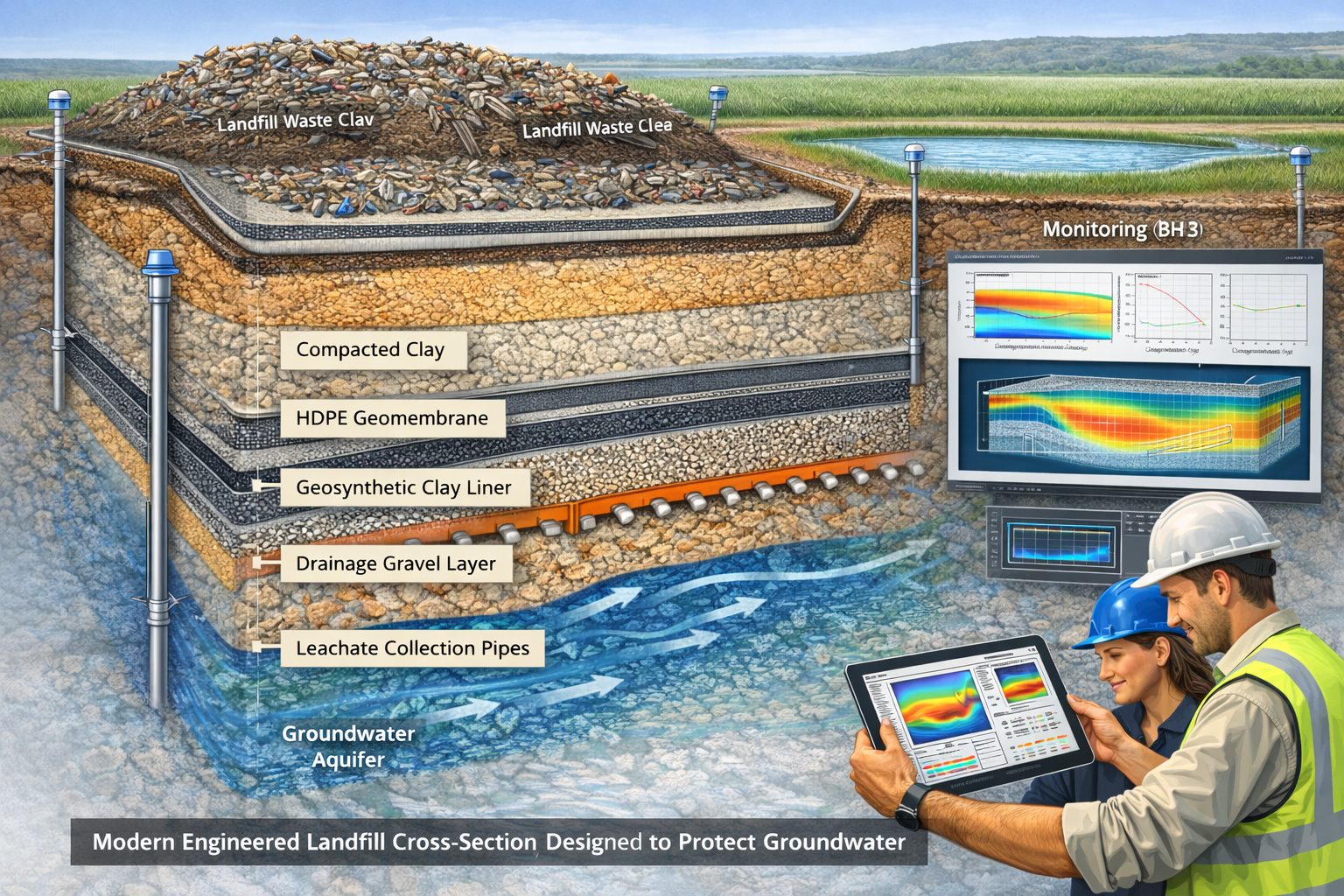
A landfill liner system is an engineered barrier constructed beneath a landfill to prevent the migration of leachate into surrounding soil and groundwater.
These systems typically consist of multiple layers of natural and synthetic materials designed to provide redundancy and long-term containment.
A typical liner system may include:
- Compacted clay layers
- Geosynthetic clay liners
- High-density polyethylene (HDPE) geomembranes
- Drainage layers
- Leachate collection systems
Each component serves a specific function in preventing contaminant migration and ensuring effective leachate management.
Modern liner systems are often referred to as composite liners because they combine natural and synthetic materials to create multiple protective barriers.
Understanding Leachate and Contaminant Migration
Before designing a liner system, engineers must understand how leachate forms and how contaminants can migrate through subsurface environments.
Leachate Formation
Leachate is generated when water infiltrates landfill waste materials and dissolves soluble contaminants. Sources of water include:
- Rainfall infiltration
- Snowmelt
- Moisture contained within waste materials
- Surface runoff entering the landfill
The composition of leachate varies depending on the waste type and landfill age, but it often contains:
- Organic compounds
- Heavy metals
- Ammonia
- Dissolved salts
- Industrial chemicals
Because leachate can contain high concentrations of pollutants, preventing its migration into groundwater is a top priority.
Pathways for Groundwater Contamination
Without a properly designed liner system, leachate can migrate through several pathways:
- Vertical seepage through soil and rock
- Lateral flow through permeable geological layers
- Transport along fractures in bedrock
- Migration through poorly compacted soil zones
Landfill liner systems are specifically designed to block these migration pathways.
Components of Modern Landfill Liner Systems
Modern landfill liner systems rely on multiple layers of protective materials to create redundant containment barriers.
Compacted Clay Liners
Compacted clay liners are one of the oldest and most widely used landfill containment materials. Clay soils have extremely low permeability, meaning they allow very little water to pass through.
To create a clay liner, engineers compact clay soil in layers until it achieves the desired hydraulic conductivity, typically on the order of:
- 10⁻⁷ to 10⁻⁹ cm/s
This low permeability significantly limits the movement of water and contaminants.
Clay liners also provide:
- Chemical adsorption capacity
- Self-healing properties for small cracks
- Long-term durability
However, clay liners can be susceptible to drying, cracking, or chemical degradation if not properly maintained.
Geomembranes
Geomembranes are synthetic impermeable sheets used as primary barriers in landfill liner systems.
The most common material used is high-density polyethylene (HDPE), which offers excellent chemical resistance and extremely low permeability.
Geomembranes provide several advantages:
- Near-zero hydraulic conductivity
- High resistance to chemical attack
- Flexibility to accommodate settlement
- Long service life
HDPE geomembranes are typically installed in large panels that are welded together to create a continuous barrier.
Proper installation and quality control are critical to ensure that seams remain watertight.
Geosynthetic Clay Liners (GCLs)
Geosynthetic clay liners combine the advantages of natural clay with geosynthetic materials.
A GCL typically consists of:
- A layer of bentonite clay sandwiched between geotextile fabrics
When exposed to water, bentonite expands and forms a low-permeability barrier.
GCLs offer several benefits:
- Thin and lightweight
- Easy to install
- Excellent sealing capability
- Self-healing properties
These liners are often used in combination with geomembranes to form composite liner systems.
Drainage Layers
Drainage layers are designed to collect and transport leachate away from the landfill base.
These layers typically consist of:
- Gravel or sand
- Geonet drainage materials
- Perforated collection pipes
The drainage system directs leachate toward collection pipes, preventing liquid from accumulating above the liner.
Reducing leachate pressure on the liner system improves containment performance.
Leachate Collection Systems
Leachate collection systems remove accumulated leachate from the landfill and transport it to treatment facilities.
Key components include:
- Perforated drainage pipes
- Pumping systems
- Storage tanks
- Monitoring systems
These systems prevent leachate buildup and allow operators to manage liquids safely.
Composite Liner Systems
Modern landfill designs typically use composite liner systems that combine multiple materials to improve containment performance.
A typical composite liner system may include:
- Compacted clay layer
- Geomembrane liner
- Geosynthetic clay liner
- Drainage layer
- Leachate collection system
This multi-layer approach provides redundancy. Even if one layer is compromised, additional barriers remain in place to prevent contamination.
Composite liner systems are now standard practice in most modern landfill facilities.
Hydrogeologic Considerations in Liner Design
Landfill liner design must account for local hydrogeologic conditions to ensure effective groundwater protection.
Key considerations include:
Groundwater Depth
Landfills should ideally be located above deep groundwater tables to minimize contamination risks.
Soil and Rock Permeability
The permeability of underlying geological materials influences how contaminants could migrate if a liner fails.
Low-permeability soils provide additional natural protection.
Groundwater Flow Direction
Understanding groundwater flow patterns helps engineers predict how contamination might spread if leakage occurs.
Bedrock Fractures
Fractured bedrock can provide pathways for contaminant migration and must be carefully evaluated during site selection.
Hydrogeologic investigations often include:
- Borehole drilling
- Groundwater monitoring wells
- Hydraulic conductivity testing
- Geological mapping
Regulatory Standards for Landfill Liners
Environmental regulations establish strict design standards for landfill liner systems.
These regulations typically specify:
- Minimum liner thickness
- Maximum hydraulic conductivity
- Required materials and components
- Leachate collection requirements
- Groundwater monitoring systems
Regulatory agencies often require detailed engineering designs and environmental impact assessments before approving landfill construction.
Compliance with these regulations ensures that landfill facilities operate safely and protect surrounding ecosystems.
Monitoring and Long-Term Performance
Even well-designed liner systems must be monitored throughout the life of a landfill.
Monitoring programs typically include:
- Groundwater sampling
- Leachate monitoring
- Settlement monitoring
- Liner integrity inspections
Groundwater monitoring wells are installed around landfill sites to detect potential contamination early.
Long-term monitoring may continue for decades after landfill closure to ensure that containment systems remain effective.
Advances in Landfill Liner Technology
Advances in materials science and environmental engineering continue to improve landfill containment systems.
Emerging technologies include:
Advanced Geosynthetics
New geosynthetic materials offer improved durability, chemical resistance, and installation efficiency.
Leak Detection Systems
Modern liner systems may include sensors that detect leaks or moisture infiltration in real time.
Double Liner Systems
Some facilities use double liner systems with intermediate leak detection layers to provide additional protection.
Improved Numerical Modeling
Advanced modeling tools allow engineers to simulate leachate migration and evaluate liner system performance before construction.
These innovations help reduce environmental risks and improve long-term landfill safety.
Conclusion
Landfill liner systems are a critical component of modern waste management infrastructure. By providing engineered barriers between waste materials and the surrounding environment, these systems prevent leachate from contaminating soil and groundwater resources.
Effective liner design requires a combination of natural materials, synthetic geomembranes, drainage systems, and leachate collection infrastructure. Together, these components form composite containment systems that provide multiple layers of protection against contaminant migration.
Careful site investigation, hydrogeologic analysis, and regulatory compliance are essential to ensuring that landfill facilities operate safely and sustainably. Advances in materials technology and environmental modeling continue to improve liner performance and reduce long-term environmental risks.
As global waste generation increases and environmental protection becomes more critical, well-designed landfill liner systems will remain essential tools for protecting groundwater resources and supporting responsible waste management practices.
Learn more about our Contaminant Transport Modeling Solutions
Related Articles
- Contaminant Transport Modelling and Landfill Design: A Complete Guide for Environmental Engineers
- How Contaminant Transport Models Predict Groundwater Pollution
- Understanding Leachate Generation and Transport in Landfills
- Advection–Dispersion Modelling in Groundwater Systems
- Hydrogeological Data Required for Contaminant Transport Models
- Regulatory Requirements for Landfill Design and Groundwater Protection
- Unlock Global Expertise: Free Research Viewer for POLLUTE and MIGRATE
- Mastering the Plume: POLLUTEv8 vs. MODFLOW vs. FEFLOW vs. PATH3D
- Core Features of POLLUTEv8
- Mastering Contaminant Transport: Special Features of POLLUTEv8
- Navigating Contaminant Migration with POLLUTE: A Modern Approach to Landfill Design
- Beyond The MCL: Building Audit-Proof Contaminant Fate Models For 2026 Regulatory Submissions
- Using Predictive Models to Meet 2026 Primary Drinking Water Regulations
- Driving Environmental Research: How GAEA Technologies POLLUTE Software is Used in Academic and Industry Reports
- Modeling Your Way to ‘No Further Action’: How Predictive Simulation Shaves Years Off Remediation Timelines
- Meeting The New 2026 EPA Reporting Standards For PFAS: Why Traditional Spreadsheet Modeling No Longer Suffices
- Using Predictive Models to Meet 2026 Primary Drinking Water Regulations
- Unlocking Sustainable Solutions: The Role of POLLUTE Software in Landfill Design and Contaminant Transport Modelling
- Contaminant Transport Modelling and Landfill Design Insights
- Geomembrane Degradation in Landfill Liners: Causes, Modeling, and Long-Term Performance
- Clogging of Landfill Leachate Collection Systems: Causes, Impacts, and Prevention
- Determining Diffusion Coefficients for Contaminant Transport Modeling
- Use and Determination of Distribution Coefficients for Contaminant Transport Modeling
- Non-Linear Sorption in Contaminant Transport Modeling
- Phase Change in Collection Systems in Contaminant Transport Modeling for Landfills
External References
- EPA guidance on landfill design and leachate management
- EPA landfill liner and leachate collection regulations
- USGS groundwater contamination resources
- USGS groundwater flow and transport processes
- International Solid Waste Association landfill guidelines
- Canadian landfill environmental regulations
- Technical guidance on geomembrane landfill liners
- Geosynthetics used in landfill liner systems
- Hydrogeology and groundwater contamination research
- Service life of HDPE geomembranes in landfill environments
- Geomembrane lifetime prediction methods
- Service life of polyethylene geomembrane barriers
- HDPE geomembrane service life prediction
- Effect of temperature on geomembrane lifespan
- Antioxidant depletion in HDPE geomembranes
- Geomembrane liner degradation and failure mechanisms
- Groundwater Contaminant Migration Processes