

Introduction
Geological cross-sections are one of the most widely used tools for interpreting subsurface conditions in geotechnical engineering, hydrogeology, environmental investigations, and mining exploration. By correlating borehole logs across a site, geologists can visualize how soil and rock layers extend beneath the ground surface.
Cross-sections play a crucial role in communicating subsurface information to engineers, planners, and project stakeholders. They help identify geological structures, evaluate soil stratigraphy, understand groundwater systems, and support infrastructure design.
Despite their importance, geological cross-sections are often prone to interpretation errors. Many of these errors arise from poor data preparation, incorrect assumptions about geological continuity, or misuse of geological modeling software.
Because boreholes provide only discrete samples of the subsurface, geologists must interpret what occurs between them. This process requires careful analysis of borehole data, regional geology, and depositional environments.
Even small mistakes in cross-section construction can lead to misleading interpretations that affect engineering decisions.
This article explores the most common mistakes made when creating geological cross-sections and explains how geologists and engineers can avoid these pitfalls.
Mistake 1: Assuming Geological Layers Are Continuous
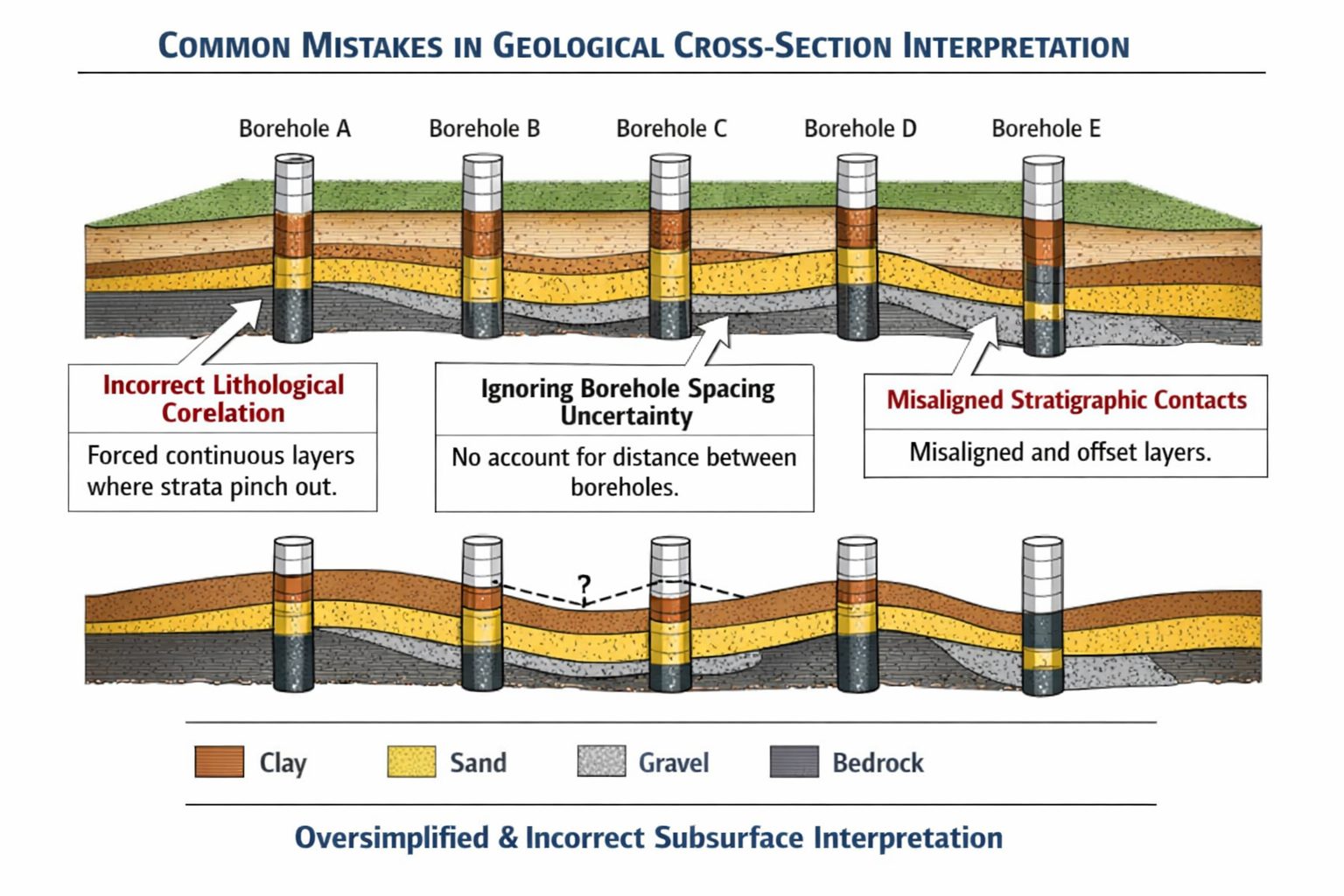
One of the most common errors in cross-section interpretation is assuming that geological layers extend continuously between boreholes.
In reality, subsurface geology is rarely uniform. Sedimentary processes often produce layers that vary in thickness, composition, and lateral extent.
For example, a sand layer encountered in one borehole may transition into silty sand or clay a short distance away.
If geologists automatically connect layers between boreholes without considering geological variability, the cross-section may suggest unrealistic continuity.
Instead, cross-sections should reflect the possibility that layers may thin, change composition, or terminate between boreholes.
Recognizing natural geological variability is essential for producing realistic subsurface interpretations.
Mistake 2: Ignoring Pinch-Outs
Pinch-outs occur when geological layers gradually thin and disappear.
These features are common in sedimentary environments where depositional conditions change across the landscape.
If pinch-outs are not recognized, cross-sections may incorrectly connect layers that should terminate between boreholes.
For example, if a sand layer appears in one borehole but not in another, it may indicate that the layer pinches out between the two locations.
Cross-sections should represent this thinning rather than forcing an unrealistic connection.
Careful examination of layer thickness trends across boreholes can help identify potential pinch-outs.
Mistake 3: Misinterpreting Lithology Descriptions
Lithology descriptions recorded in borehole logs may vary depending on the geologist performing the logging.
For example, similar materials may be described as:
- silty sand
- sand with silt
- sandy silt
Although these materials may represent similar depositional environments, inconsistent terminology can make correlation difficult.
If lithology descriptions are interpreted too literally, cross-sections may incorrectly treat similar materials as separate layers.
Standardizing lithology descriptions before creating cross-sections can greatly improve interpretation accuracy.
Mistake 4: Over-Reliance on Software Interpolation
Modern geological software can automatically generate cross-sections and interpolate geological layers between boreholes.
While these tools are extremely useful, they should not replace geological interpretation.
Interpolation algorithms typically assume that layers extend smoothly between data points. This can produce visually appealing models but may not accurately represent geological reality.
Automated software may fail to recognize important features such as:
- pinch-outs
- erosional surfaces
- buried channels
- facies transitions
Geologists must review automated interpretations and adjust correlations manually when necessary.
Software should assist interpretation, not replace it.
Mistake 5: Poor Borehole Data Preparation
Cross-sections are only as reliable as the borehole data used to construct them.
Poorly organized borehole databases can introduce errors into cross-section interpretation.
Common data issues include:
- overlapping depth intervals
- inconsistent lithology naming
- incorrect borehole coordinates
- missing elevation data
If these errors are not corrected before modeling, the resulting cross-sections may be misleading.
Proper borehole database preparation is essential before importing data into cross-section software.
Mistake 6: Using Widely Spaced Boreholes Without Acknowledging Uncertainty
Another common mistake is interpreting cross-sections too confidently when boreholes are widely spaced.
Large gaps between boreholes introduce significant uncertainty into subsurface interpretation.
Geological features such as sand lenses, buried channels, or localized clay deposits may exist between boreholes but remain undetected.
Cross-sections should acknowledge these uncertainties rather than presenting interpretations as definitive.
Geologists may use dashed lines or shading to indicate areas where interpretation confidence is lower.
Recognizing data limitations helps prevent overconfidence in geological models.
Mistake 7: Ignoring Regional Geological Context
Subsurface interpretation should never rely solely on borehole logs.
Regional geological history provides important context for understanding how geological layers were formed.
For example, glacial environments often produce highly variable sediment deposits, while river systems commonly create sand channels surrounded by finer sediments.
Understanding these depositional environments helps geologists interpret borehole data more accurately.
Ignoring regional geology may lead to unrealistic correlations between boreholes.
Mistake 8: Misaligning Boreholes Along Section Lines
When constructing cross-sections, boreholes must be accurately positioned along the section line.
If boreholes are misaligned or incorrectly projected onto the section line, the distances between them may be distorted.
This can affect the interpretation of layer continuity and thickness.
Careful verification of borehole coordinates and section geometry is essential before generating cross-sections.
Mistake 9: Over-Simplifying Geological Complexity
Subsurface geology is often complex, with layers that change composition and thickness across a site.
Simplifying these variations too much can lead to unrealistic models.
For example, combining multiple distinct layers into a single unit may obscure important geological features.
While simplification may be necessary for visualization purposes, cross-sections should still capture the key characteristics of the geological system.
Maintaining an appropriate balance between clarity and accuracy is important.
Mistake 10: Failing to Update Cross-Sections When New Data Is Collected
Geological interpretations should evolve as new information becomes available.
If additional boreholes are drilled during a project, cross-sections should be updated to incorporate the new data.
Failing to update interpretations can result in outdated models that no longer reflect the available evidence.
Digital geological modeling software makes it easier to update cross-sections as new borehole data is collected.
Maintaining current interpretations improves the reliability of engineering decisions.
Best Practices for Avoiding Cross-Section Errors
Several best practices can help reduce errors in geological cross-sections.
First, ensure that borehole databases are properly prepared before generating cross-sections.
Second, standardize lithology descriptions to ensure consistent layer correlations.
Third, consider geological variability and avoid assuming continuous layers between boreholes.
Fourth, review automated software interpretations carefully and apply geological expertise.
Finally, communicate uncertainty clearly in cross-section diagrams and engineering reports.
These practices help ensure that cross-sections accurately represent subsurface conditions.
The Importance of Geological Judgment
Although digital tools have greatly improved the efficiency of geological modeling, cross-section interpretation still requires geological judgment.
Geologists must interpret borehole data within the context of depositional environments, regional stratigraphy, and geological processes.
Automated algorithms cannot fully replicate this reasoning.
By combining careful data analysis with geological expertise, professionals can produce cross-sections that provide meaningful insight into subsurface conditions.
Conclusion
Geological cross-sections are powerful tools for visualizing subsurface geology and supporting engineering design. However, producing accurate cross-sections requires careful interpretation and attention to data quality.
Common mistakes such as assuming layer continuity, ignoring pinch-outs, misinterpreting lithology descriptions, and over-relying on software can lead to misleading geological models.
By understanding these potential pitfalls and applying best practices in data preparation and interpretation, geologists and engineers can create cross-sections that accurately reflect subsurface conditions.
Reliable geological cross-sections ultimately support safer infrastructure design, more effective environmental management, and better understanding of the complex geological systems beneath our feet.
Learn more about our Solutions
- GaeaSynergy Platform for Geoscientific Analysis
- WinLoG Borehole and Well Log Data Management
- WinFence Cross-section and Fence Diagram Visualization
Related Articles
- Geological Cross-Sections from Borehole Data: A Complete Engineering Guide
- Subsurface Visualization: Turning Borehole Data into Clear Geological Insight
- How Borehole Spacing Affects Geological Cross-Section Accuracy
- Preparing Borehole Databases for Cross-Section Software
- How Lithological Correlation Works Between Boreholes
- Understanding Fence Diagrams in Geological Modeling
- Common Data Errors in Borehole Databases and How to Fix Them
- Using Geological Cross-Sections in Geotechnical Engineering
- Borehole Coordinate Systems and Mapping for Geological Modeling
- Depth vs Elevation in Borehole Databases for Geological Modeling
- Interpreting Geological Variability Between Boreholes
- Building Geological Cross-Sections from Borehole Data: A Step-by-Step Workflow
- How Geological Software Interpolates Subsurface Layers Between Boreholes
- Borehole Data Visualization Techniques for Geological Modeling
- Managing Large Borehole Data Sets in Engineering Projects
- Understanding Pinch-Outs and Missing Geological Layers in Subsurface Interpretation