

Introduction
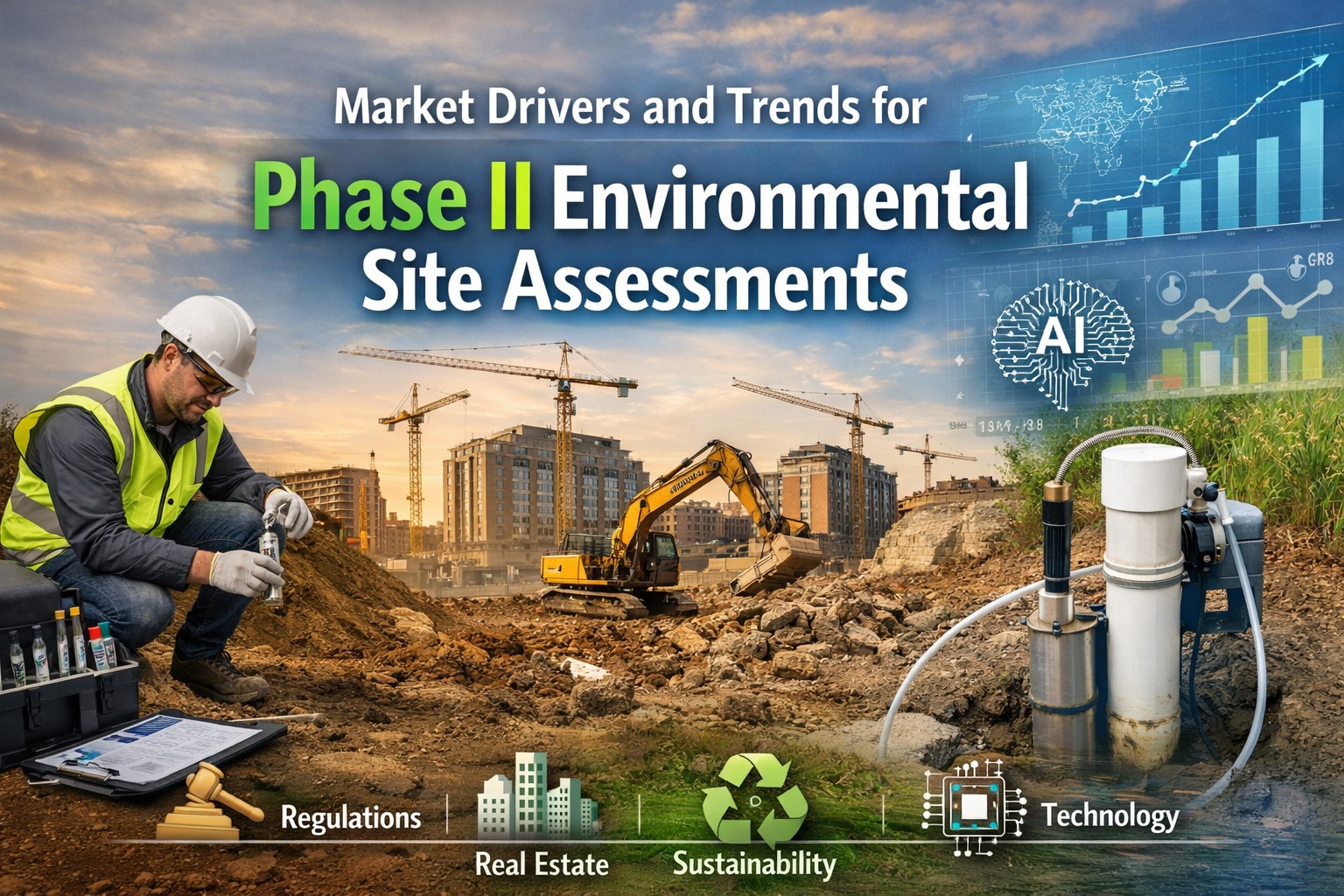
The market for Phase II Environmental Site Assessments (ESAs) sits at the intersection of environmental protection, real estate development, and regulatory compliance. As land use pressures increase and environmental standards evolve, Phase II ESAs have become an indispensable tool for identifying and managing subsurface contamination risks. These investigations go beyond historical reviews and visual inspections—typical of Phase I ESAs—by incorporating intrusive testing such as soil sampling, groundwater monitoring, and laboratory analysis.
In recent years, the demand for Phase II ESAs has grown steadily, particularly across North America, where regulatory frameworks are well-established and enforcement is robust. The environmental consulting sector, which includes Phase II ESA services, is expanding in response to heightened awareness of environmental liabilities, increased development activity, and the global shift toward sustainability.
This article explores the key market drivers, emerging trends, challenges, and future outlook shaping the Phase II ESA industry.
Understanding the Role of Phase II ESAs
A Phase II ESA is typically conducted when a Phase I ESA identifies Recognized Environmental Conditions (RECs). Its primary objective is to confirm the presence or absence of contamination and to delineate its extent and severity. These findings are critical for stakeholders such as property developers, lenders, regulators, and environmental consultants.
Phase II investigations often include:
- Soil and groundwater sampling
- Soil vapor testing
- Installation of monitoring wells
- Laboratory analysis of contaminants (e.g., hydrocarbons, heavy metals, VOCs)
- Risk assessment and reporting
The results directly influence property valuation, development feasibility, and remediation strategies.
Key Market Drivers
1. Regulatory Framework and Enforcement
One of the most significant drivers of the Phase II ESA market is the regulatory environment. Governments at federal, provincial, and municipal levels impose strict environmental standards to protect human health and ecosystems.
In Ontario, regulations such as Ontario Regulation 153/04 under the Environmental Protection Act mandate environmental site assessments for properties undergoing changes in land use—particularly when transitioning from industrial to residential or commercial purposes.
These regulations require property owners and developers to demonstrate that sites meet specific soil and groundwater quality standards before redevelopment can proceed. Non-compliance can result in significant penalties, legal liabilities, and project delays.
Globally, similar regulatory frameworks reinforce the need for thorough environmental investigations. As regulations continue to evolve and become more stringent, the demand for Phase II ESAs is expected to rise accordingly.
2. Real Estate and Development Activity
The real estate sector is a major driver of Phase II ESA demand. Environmental due diligence is a standard requirement in commercial property transactions, particularly for high-value or historically industrial sites.
Lenders, investors, and insurers rely on Phase II ESA reports to assess environmental risks and potential cleanup costs. Without this information, financing may be withheld or conditional, making these assessments a critical step in the transaction process.
The global environmental site assessment market was valued at approximately US$483 million in 2024 and is projected to reach US$766 million by 2031, reflecting steady growth driven by ongoing urbanization and redevelopment.
Brownfield redevelopment projects—where previously used industrial land is repurposed—are especially reliant on Phase II ESAs. These projects not only require contamination assessment but also remediation planning to ensure safe reuse.
3. Increased Environmental Awareness and Corporate Responsibility
Public awareness of environmental issues has increased significantly over the past decade. Climate change, pollution, and ecological degradation are now central concerns for governments, businesses, and communities.
As a result, many organizations are adopting Corporate Social Responsibility (CSR) initiatives and Environmental, Social, and Governance (ESG) frameworks. These programs encourage proactive environmental risk management, including voluntary environmental site assessments.
Companies are increasingly conducting Phase II ESAs not just for compliance, but to:
- Demonstrate environmental stewardship
- Enhance brand reputation
- Mitigate long-term liabilities
- Align with investor expectations
This shift from reactive to proactive environmental management is a key trend driving market growth.
4. Technological Advancements
Technology is transforming the way Phase II ESAs are conducted, improving both efficiency and accuracy.
Key innovations include:
- Geographic Information Systems (GIS): Enables spatial analysis of contamination patterns and site characteristics
- Cloud Computing: Facilitates real-time data sharing and collaboration among stakeholders
- AI and Data Analytics: Enhances interpretation of complex datasets and predictive modeling
- Remote Sensing and Drones: Improve site reconnaissance and mapping capabilities
Digital platforms for environmental data management—such as EDMS solutions—are streamlining workflows, reducing errors, and enabling better decision-making.
These advancements are particularly valuable for large or complex sites where traditional methods may be time-consuming or insufficient.
5. Sustainable Development and Clean Energy Initiatives
The global push toward sustainability and clean energy is another major driver of Phase II ESA demand.
Renewable energy projects—such as solar farms, wind turbines, and battery storage facilities—require environmental assessments to evaluate site suitability and compliance with environmental standards.
Similarly, green building initiatives and sustainable urban development projects often involve previously developed land, necessitating thorough contamination assessments.
Governments are also incentivizing brownfield redevelopment as part of broader sustainability strategies, further increasing the need for Phase II ESAs.
Challenges and Considerations
1. Cost and Complexity
Phase II ESAs are significantly more expensive and complex than Phase I assessments. Costs can vary widely depending on:
- Site size and location
- Type and extent of contamination
- Number of samples required
- Laboratory analysis complexity
These factors can create financial barriers for smaller developers or delay project timelines. In some cases, high assessment costs may even deter property transactions altogether.
2. Variability in Scope and Quality
Not all Phase II ESAs are created equal. The scope of work can vary depending on consultant expertise, client budget, and regulatory requirements.
“Low-cost” assessments may involve limited sampling or incomplete analysis, leading to inaccurate conclusions and potential legal risks. Poor-quality assessments can result in:
- Undetected contamination
- Regulatory non-compliance
- Increased remediation costs
- Liability disputes
Ensuring high-quality, standards-compliant assessments is critical for reliable outcomes.
3. Data Gaps and Uncertainty
Despite advances in technology, uncertainty remains a challenge in environmental investigations.
Subsurface conditions can be highly variable and difficult to characterize. Factors such as:
- Complex geology
- Heterogeneous contamination distribution
- Presence of Species at Risk
- Limited site access
can lead to data gaps that require additional investigation or conservative assumptions.
Managing uncertainty is a key skill for environmental professionals and often influences project timelines and costs.
Emerging Trends in the Phase II ESA Market
Digital Transformation of Environmental Consulting
The integration of digital tools is accelerating across the industry. Environmental professionals are increasingly using centralized platforms to manage data, automate reporting, and improve collaboration.
This trend is particularly relevant for firms developing proprietary tools or software solutions tailored to geoscience workflows.
Increased Demand for Brownfield Redevelopment
Urban land scarcity is driving interest in redeveloping previously used sites. Governments are offering incentives and streamlined approvals for brownfield projects, making them more attractive to developers.
Phase II ESAs play a central role in these projects by identifying contamination risks and informing remediation strategies.
Integration with Risk Assessment and Remediation Planning
Phase II ESAs are increasingly being integrated with risk assessment and remediation planning processes. Rather than serving as standalone reports, they are becoming part of a broader environmental management strategy.
This integrated approach improves efficiency and ensures that assessment findings directly inform decision-making.
Standardization and Best Practices
Industry standards—such as ASTM guidelines—are helping to improve consistency and quality across Phase II ESA reports. Standardization reduces variability and enhances confidence among stakeholders.
At the same time, regulatory bodies continue to refine requirements, pushing the industry toward higher levels of rigor and accountability.
Market Outlook
The outlook for the Phase II ESA market is strongly positive. Several factors support continued growth:
- Increasing regulatory stringency
- Ongoing urbanization and land redevelopment
- Rising environmental awareness
- Expansion of clean energy projects
- Advancements in technology
North America is expected to remain a dominant market, driven by established regulatory frameworks and active real estate sectors. However, emerging markets are also beginning to adopt stricter environmental standards, creating new opportunities for growth.
Environmental risk management is no longer optional—it is a fundamental component of responsible development and investment. As a result, the demand for high-quality Phase II ESAs will continue to grow.
Conclusion
Phase II Environmental Site Assessments are a critical component of modern environmental and real estate practices. They provide the scientific evidence needed to make informed decisions about land use, investment, and risk management.
The market is being shaped by a combination of regulatory pressures, economic activity, technological innovation, and societal expectations. While challenges such as cost, complexity, and uncertainty remain, the overall trajectory is one of growth and increasing importance.
For environmental professionals, developers, and investors alike, understanding the drivers and trends in this market is essential for navigating an increasingly complex and regulated landscape.
As sustainability and environmental accountability continue to rise in prominence, Phase II ESAs will remain a cornerstone of responsible development and environmental stewardship.
👉 Learn more about our Automated Environmental Site Assessment Solution
Related Articles
- Methodology for Conducting a Phase II Environmental Site Assessment (ESA)
- Key Uses of a Phase II Environmental Site Assessment (ESA) Report
- Role of Reviewing Existing Data for a Phase II Environmental Site Assessment
- Methodology for Identifying Contaminants of Concern (COCs) for a Phase II Environmental Site Assessment
- Key Components of a Phase II ESA Sampling Plan
- Key Components of a Phase II ESA Health and Safety Plan (HASP)
- Key Considerations for Permit Acquisition for a Phase II ESA
- The Utility Clearance Process for a Phase II ESA
- Drilling and Sampling for a Phase II ESA: Methods, Equipment, and Best Practices
- Installation of Monitoring Wells for a Phase II Environmental Site Assessment (ESA)
- Phase II ESA Quality Control Procedures: Ensuring Accurate, Defensible Environmental Data
- Sample Handling Procedures for a Phase II ESA: Ensuring Data Integrity from Field to Laboratory
- Laboratory Analysis and Data Interpretation for a Phase II ESA
- Reporting and Recommendations for a Phase II Environmental Site Assessment (ESA)
- Differences Between a Phase II ESA in Canada and the United States