

Introduction
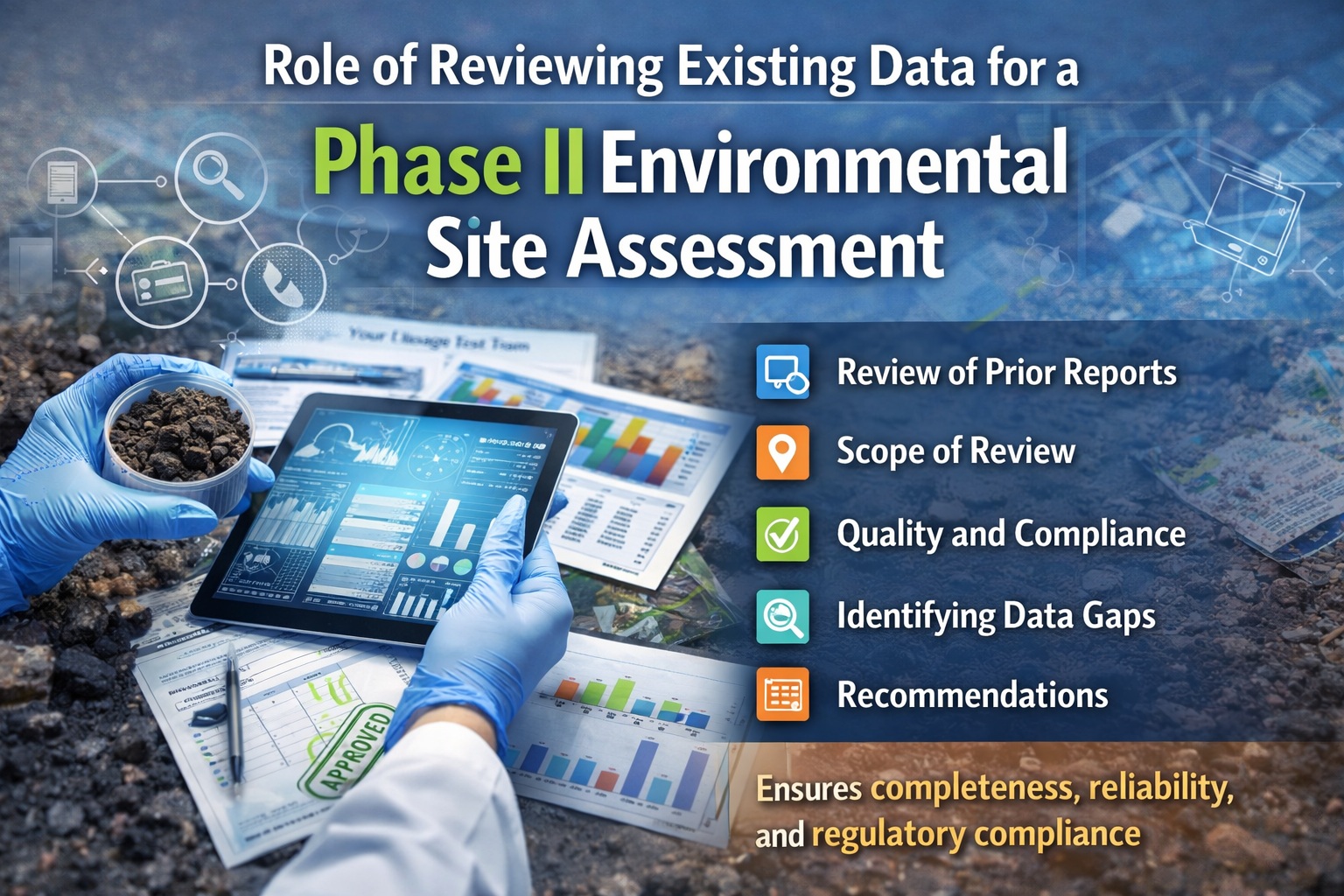
A Phase II Environmental Site Assessment (ESA) is a detailed and intrusive investigation aimed at confirming the presence, type, and extent of subsurface contamination. While fieldwork and laboratory analysis are often the most visible components of a Phase II ESA, one of the most critical—and sometimes underestimated—steps is the review of existing data.
Reviewing previously collected environmental data provides the foundation for informed decision-making. It ensures that the investigation is efficient, scientifically sound, and aligned with regulatory expectations. Without a thorough evaluation of historical reports, analytical results, and site information, Phase II ESAs risk redundancy, data gaps, or inaccurate conclusions.
This article explores the essential role of reviewing existing data in a Phase II ESA, including report structure, methodology, evaluation criteria, and best practices for ensuring high-quality outcomes.
Why Reviewing Existing Data Matters
Before new intrusive investigations begin, environmental professionals must assess what is already known about a site. This process helps to:
- Avoid duplication of previous work
- Identify data gaps and uncertainties
- Validate the reliability of existing information
- Refine the scope of investigation
- Support regulatory compliance
- Strengthen the conceptual site model (CSM)
In many cases, substantial environmental work may have already been completed—sometimes years earlier. However, not all historical data is equally reliable or relevant under current standards. A structured review ensures that only high-quality, applicable data informs the Phase II ESA.
Structure of the Data Review Report
The review of existing data may be integrated into the main Phase II ESA report or presented as a standalone addendum. Regardless of format, the report should follow a clear and systematic structure.
1. Introduction and Background
Purpose
The primary objective of the data review is to determine whether existing information adequately characterizes the nature and extent of contamination, particularly Contaminants of Potential Concern (CoPCs) identified during earlier investigations such as a Phase I ESA.
The review also evaluates whether the available data supports the intended use of the property and meets regulatory requirements for environmental reporting.
Site Description
A concise site description should include:
- Property location and boundaries
- Current land use and zoning
- Historical site activities (e.g., industrial, commercial, agricultural)
- Surrounding land uses
- Environmental setting (geology and hydrogeology)
Understanding the environmental context is essential for interpreting historical data and identifying potential contaminant sources and migration pathways.
Reference Documents
All existing documentation must be catalogued and reviewed. This typically includes:
- Previous Phase I and Phase II ESA reports
- Borehole logs and drilling records
- Laboratory analytical certificates
- Groundwater monitoring data
- Site plans and historical aerial photographs
- Regulatory correspondence
Each document should be listed with author, date, and scope to establish a clear record of available information.
2. Scope of Review
The scope defines what aspects of the existing data are evaluated. A comprehensive review should consider the following elements:
Sampling Locations and Depths
- Distribution of boreholes and monitoring wells
- Depth intervals sampled
- Coverage of Areas of Potential Environmental Concern (APECs)
Proper spatial coverage is critical for determining whether contamination has been adequately delineated.
Contaminants of Potential Concern (CoPCs)
- Types of contaminants analyzed (e.g., petroleum hydrocarbons, metals, VOCs)
- Relevance of selected analytes to historical site activities
- Completeness of analytical suites
Missing or incomplete contaminant testing is a common data gap.
Analytical Methods and QA/QC
- Laboratory methods used for analysis
- Detection limits and reporting thresholds
- Quality assurance/quality control (QA/QC) procedures
- Data validation status
Reliable analytical data must meet accepted standards for accuracy and precision.
Regulatory Standards
Existing data must be compared against applicable regulatory frameworks such as:
- Ontario Regulation 153/04
- Ontario Ministry of the Environment, Conservation and Parks guidelines
- Alberta Tier 1 and Tier 2 Soil and Groundwater Guidelines
- Federal environmental standards
It is important to determine whether historical data meets current regulatory criteria, not just those in place at the time of collection.
Hydrogeological Conditions
- Groundwater flow direction
- Hydraulic gradients
- Seasonal variations in groundwater levels
Hydrogeological understanding is essential for interpreting contaminant migration.
3. Methodology for Data Review
A structured methodology ensures consistency and defensibility in the evaluation process.
Standards and Guidelines
Data reviews should align with recognized industry standards such as:
- ASTM E1903 (Standard Guide for Environmental Site Assessments)
- CSA Z769-00 (Canadian standard for Phase II ESAs)
These frameworks provide guidance on data quality, sampling design, and reporting requirements.
Review Process
Typical steps include:
- Document Compilation: Gather all relevant reports and datasets
- Data Screening: Identify key information and eliminate irrelevant or redundant data
- Quality Assessment: Evaluate sampling methods, QA/QC procedures, and laboratory practices
- Regulatory Comparison: Compare results to current standards
- Gap Analysis: Identify missing or insufficient data
- CSM Evaluation: Update or validate the conceptual site model
This systematic approach ensures that all aspects of the existing data are critically assessed.
4. Findings and Evaluation
Data Reliability
A key outcome of the review is determining whether the data is reliable. This involves assessing:
- Sampling methodology
- Laboratory accreditation and procedures
- Data completeness
- Consistency across datasets
Any deviations from accepted practices should be clearly documented.
Regulatory Compliance
The review must evaluate whether previous investigations complied with applicable regulations at the time and whether they remain compliant under current standards.
Older data may require re-evaluation due to:
- Changes in regulatory limits
- Updated analytical methods
- Revised environmental guidelines
Contamination Status
The review should summarize:
- Areas where contaminant concentrations meet regulatory standards
- Areas with exceedances
- Trends in contaminant distribution
This information helps determine whether contamination has been adequately characterized.
Conceptual Site Model (CSM)
The Conceptual Site Model is a critical tool in environmental assessment. It integrates:
- Sources of contamination
- Pathways (soil, groundwater, vapor)
- Receptors (humans, ecosystems)
The data review should assess whether the existing information supports a robust and defensible CSM. If not, additional investigation may be required.
5. Data Gaps and Limitations
Identifying data gaps is one of the most important outcomes of the review process.
Common Data Gaps
- Incomplete delineation of contamination (horizontal or vertical)
- Lack of sampling in key APECs
- Missing CoPCs relevant to site history
- Insufficient groundwater data
- Outdated data (typically older than 18–24 months)
Limitations
Limitations may arise due to:
- Restricted site access
- Complex subsurface conditions
- Inconsistent historical methodologies
These limitations should be clearly documented to inform future investigation planning.
6. Conclusions and Recommendations
Adequacy of Existing Data
The report should provide a professional opinion on whether the existing data is sufficient to:
- Support site closure or “no further action”
- Demonstrate compliance with regulatory standards
- Enable submission of a Record of Site Condition (RSC)
If the data is deemed adequate, further intrusive work may not be required.
Recommended Actions
Where gaps are identified, recommendations may include:
- Additional boreholes or monitoring wells
- Expanded sampling programs
- Updated laboratory analysis
- Risk assessment or remediation planning
These recommendations should be clearly justified and aligned with regulatory expectations.
Key Reporting Standards
Phase II ESA data review reports must adhere to guidelines established by regulatory authorities and industry organizations, including:
- United States Environmental Protection Agency
- Provincial regulators such as Alberta Environment and Protected Areas
- Ontario Ministry of the Environment, Conservation and Parks
- ASTM and CSA standards
Compliance with these standards ensures that reports are defensible, consistent, and acceptable to regulators and stakeholders.
Best Practices for Reviewing Existing Data
To maximize the value of data reviews, environmental professionals should follow these best practices:
Maintain a Critical Perspective
Do not assume that previous work is accurate or complete. Evaluate all data objectively.
Use Current Standards
Always compare historical data against the latest regulatory criteria.
Integrate Multiple Data Sources
Combine geological, chemical, and hydrogeological data for a comprehensive understanding.
Document Everything
Maintain clear records of all reviewed documents, methodologies, and findings.
Collaborate Across Disciplines
Involve geologists, hydrogeologists, and environmental scientists to ensure a holistic assessment.
Emerging Trends in Data Review
Digital Data Management
Modern environmental consulting increasingly relies on digital platforms for managing and analyzing environmental data. These systems improve:
- Data accessibility
- Visualization (e.g., GIS mapping)
- Collaboration among stakeholders
Data Analytics and AI
Advanced analytics tools are being used to:
- Identify contamination patterns
- Predict contaminant migration
- Optimize sampling strategies
These technologies enhance the efficiency and accuracy of data reviews.
Integration with Environmental Software
Environmental data management systems (EDMS) are streamlining workflows by integrating:
- Field data collection
- Laboratory results
- Reporting tools
This integration reduces errors and improves consistency across projects.
Challenges in Reviewing Existing Data
Despite its importance, data review presents several challenges:
Inconsistent Data Quality
Historical data may vary widely in quality and methodology.
Outdated Information
Older datasets may not reflect current site conditions or regulatory standards.
Data Fragmentation
Information may be scattered across multiple reports and formats.
Interpretation Complexity
Subsurface conditions can be difficult to interpret, especially with limited data.
Addressing these challenges requires experience, technical expertise, and a structured approach.
Market and Industry Implications
The importance of reviewing existing data is increasing as the environmental consulting industry evolves. Key drivers include:
- Stricter regulatory requirements
- Increased liability in real estate transactions
- Growing emphasis on sustainability and ESG
- Advancements in data management technology
Efficient data review processes can reduce project costs, improve accuracy, and accelerate decision-making—making them a competitive advantage for consulting firms.
Conclusion
The review of existing data is a foundational component of a Phase II Environmental Site Assessment. It ensures that investigations are informed, efficient, and aligned with regulatory expectations.
By systematically evaluating historical information, identifying data gaps, and validating data quality, environmental professionals can develop more accurate conceptual site models and make better decisions regarding site management and redevelopment.
As environmental regulations become more stringent and the demand for sustainable development grows, the importance of high-quality data review will continue to increase. For consultants, developers, and regulators alike, investing in thorough and methodical data review processes is essential for achieving reliable and defensible outcomes.
👉 Learn more about our Automated Environmental Site Assessment Solution
Related Articles
- Methodology for Conducting a Phase II Environmental Site Assessment (ESA)
- Key Uses of a Phase II Environmental Site Assessment (ESA) Report
- Market Drivers and Trends for Phase II Environmental Site Assessments
- Methodology for Identifying Contaminants of Concern (COCs) for a Phase II Environmental Site Assessment
- Key Components of a Phase II ESA Sampling Plan
- Key Components of a Phase II ESA Health and Safety Plan (HASP)
- Key Considerations for Permit Acquisition for a Phase II ESA
- The Utility Clearance Process for a Phase II ESA
- Drilling and Sampling for a Phase II ESA: Methods, Equipment, and Best Practices
- Installation of Monitoring Wells for a Phase II Environmental Site Assessment (ESA)
- Phase II ESA Quality Control Procedures: Ensuring Accurate, Defensible Environmental Data
- Sample Handling Procedures for a Phase II ESA: Ensuring Data Integrity from Field to Laboratory
- Laboratory Analysis and Data Interpretation for a Phase II ESA
- Reporting and Recommendations for a Phase II Environmental Site Assessment (ESA)
- Differences Between a Phase II ESA in Canada and the United States