

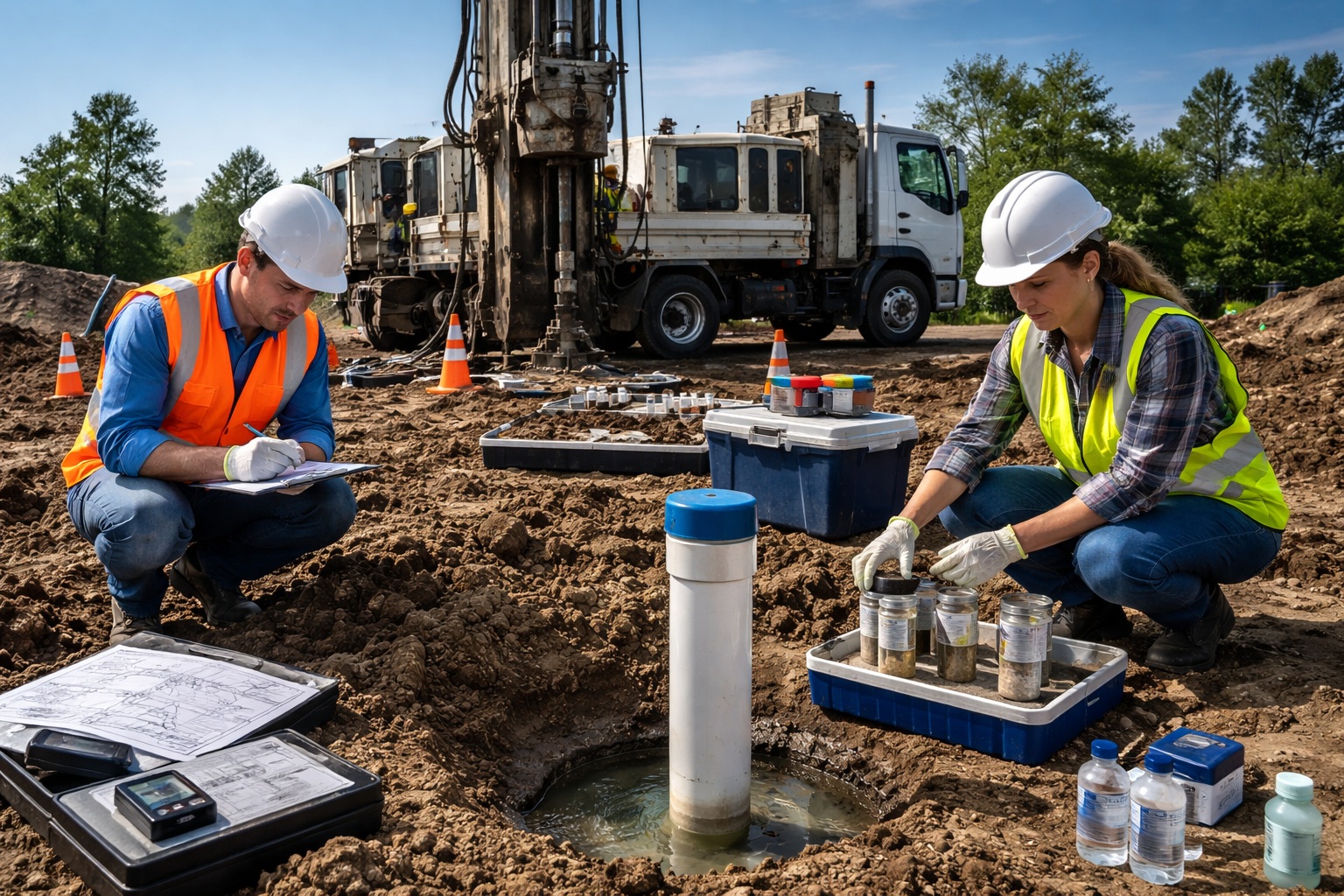
A Phase II Environmental Site Assessment (ESA) is a critical step in environmental due diligence, designed to move beyond the historical and observational findings of a Phase I ESA and into direct, scientific investigation. While a Phase I ESA identifies Recognized Environmental Conditions (RECs), a Phase II ESA seeks to confirm whether those conditions have resulted in actual contamination—and if so, to define its extent and potential risk.
This process is inherently more complex, requiring intrusive fieldwork, laboratory analysis, and professional interpretation. Typically guided by the ASTM E1903 standard, a Phase II ESA must be conducted by qualified environmental professionals such as professional geologists or engineers with expertise in subsurface investigations.
In this comprehensive guide, we break down the full methodology for conducting a Phase II ESA, covering planning, fieldwork, analysis, and reporting—along with practical insights that reflect real-world environmental consulting practices.
1. Scope Definition and Planning
The success of a Phase II ESA is largely determined during the planning stage. Unlike standardized assessments, Phase II investigations are highly site-specific, tailored directly to the risks identified in the Phase I ESA.
1.1 Review of Existing Data
The first step involves a deep review of all available background information, including:
- Phase I ESA findings and identified RECs
- Historical aerial photographs and fire insurance maps
- Previous environmental reports or site investigations
- Geological and hydrogeological data
- Regulatory databases and environmental records
Understanding site history is crucial. For example, a former industrial site may suggest heavy metals or solvents, while a retail fuel station raises concerns about petroleum hydrocarbons.
This step helps build a Conceptual Site Model (CSM)—a working hypothesis of how contamination may have occurred, migrated, and potentially impacted receptors.
1.2 Identification of Contaminants of Concern (COCs)
Contaminants of concern are selected based on historical site usage. Common examples include:
- Petroleum Hydrocarbons (PHCs) – associated with fuel storage and spills
- BTEX compounds (benzene, toluene, ethylbenzene, xylene)
- Volatile Organic Compounds (VOCs) – often linked to dry cleaning or degreasing
- Semi-Volatile Organic Compounds (SVOCs)
- Heavy metals such as lead, arsenic, or mercury
Selecting the correct analytical suite is essential. Over-testing increases costs, while under-testing risks missing critical contamination.
1.3 Development of a Sampling Plan
A well-designed sampling plan ensures efficient and defensible data collection. Key elements include:
- Sampling locations: Targeting areas most likely to be impacted (e.g., former UST locations)
- Sampling depths: Based on soil stratigraphy and groundwater depth
- Sampling density: Sufficient to characterize contamination distribution
- Media selection: Soil, groundwater, soil vapor, or a combination
- Sampling methods: Direct-push technology, hollow stem augers, test pits, etc.
The sampling plan must align with regulatory guidance and industry best practices.
1.4 Health and Safety Plan (HASP)
Fieldwork introduces potential hazards, including chemical exposure, heavy equipment operation, and physical risks.
A Health and Safety Plan (HASP) is mandatory and typically includes:
- Hazard identification
- Personal protective equipment (PPE) requirements
- Emergency procedures
- Air monitoring protocols
- Decontamination procedures
This plan ensures compliance with occupational safety regulations and protects field personnel.
1.5 Permit Acquisition
Before mobilizing to the site, necessary permits must be secured. These may include:
- Drilling permits
- Utility clearance approvals
- Environmental agency notifications
Failure to obtain proper permits can result in delays, fines, or legal complications.
2. Field Investigation
The field investigation phase is where the conceptual model is tested through direct subsurface exploration. This is the most visible and technically demanding stage of a Phase II ESA.
2.1 Utility Clearance
Before drilling or excavation, all underground utilities must be identified and marked. This is typically done through:
- Public utility locates
- Private utility scanning
- Ground-penetrating radar (GPR) surveys
This step is critical for both safety and compliance.
2.2 Drilling and Soil Sampling
Specialized drilling equipment is used to advance boreholes into the subsurface. Common methods include:
- Direct-push drilling (e.g., Geoprobe systems)
- Hollow stem auger drilling
- Test pit excavation
Soil samples are collected at predetermined intervals and analyzed for visual, olfactory, and chemical indicators of contamination.
Field observations may include:
- Soil staining
- Petroleum odors
- Presence of free product
- Soil texture and stratigraphy
2.3 Groundwater Investigation and Monitoring Wells
If groundwater is potentially impacted, monitoring wells are installed.
A typical monitoring well installation includes:
- PVC or stainless steel casing
- Slotted screen interval across the water table
- Filter sand pack
- Bentonite seal
- Protective surface casing
Once installed, wells are developed and later sampled to assess groundwater quality.
2.4 Soil Vapor Sampling (if applicable)
For sites with volatile contaminants, soil vapor sampling may be conducted to assess:
- Vapor intrusion risks
- Subsurface gas migration
This is particularly important for redevelopment projects involving buildings.
2.5 Quality Control (QC) Procedures
Data quality is essential for regulatory acceptance. Standard QC measures include:
- Field duplicates: Assess sampling consistency
- Trip blanks: Detect contamination during transport
- Equipment blanks: Verify decontamination effectiveness
- Chain-of-custody documentation
Strict adherence to QC protocols ensures defensible results.
2.6 Sample Handling and Preservation
Improper sample handling can invalidate results. Best practices include:
- Using appropriate containers (e.g., glass vials for VOCs)
- Minimizing headspace in volatile samples
- Storing samples at low temperatures (typically 4°C)
- Rapid shipment to accredited laboratories
Time-sensitive holding periods must also be respected.
3. Laboratory Analysis and Data Interpretation
Once samples reach the laboratory, they are analyzed using standardized methods such as:
- Gas chromatography (GC)
- Mass spectrometry (MS)
- Inductively coupled plasma (ICP) for metals
3.1 Comparison to Regulatory Standards
Analytical results are compared against applicable environmental criteria, which may include:
- Soil quality guidelines
- Groundwater standards
- Risk-based screening levels
These criteria vary by jurisdiction and land use (e.g., residential vs. industrial).
3.2 Determining Presence of Contamination
The primary objective is to determine whether contamination exists above regulatory thresholds.
Outcomes may include:
- No contamination detected
- Contamination below regulatory limits
- Contamination exceeding standards
3.3 Delineation of Contamination
If contamination is identified, its extent must be defined:
- Horizontal extent: How far contamination spreads laterally
- Vertical extent: How deep contamination reaches
This may require additional investigation phases.
3.4 Risk Evaluation
Environmental professionals assess risks based on:
- Exposure pathways (ingestion, inhalation, dermal contact)
- Proximity to receptors (humans, groundwater, ecosystems)
- Contaminant toxicity
This evaluation determines whether remediation is necessary.
4. Reporting and Recommendations
The final Phase II ESA report is a comprehensive document that communicates findings to stakeholders, regulators, and decision-makers.
4.1 Report Components
A typical report includes:
- Executive summary
- Site description and history
- Geological and hydrogeological setting
- Scope of work and methodology
- Field investigation details
- Boring logs and well construction diagrams
- Laboratory results and certificates
- Data tables and figures
- Site maps and cross-sections
4.2 Data Visualization
Clear visualization is critical. Reports often include:
- Contaminant concentration maps
- Soil and groundwater profiles
- Plume delineation diagrams
These visuals help stakeholders quickly understand site conditions.
4.3 Interpretation and Discussion
This section explains:
- Whether contamination is present
- How it compares to regulatory standards
- Potential sources and migration pathways
- Data limitations and uncertainties
Professional judgment is essential here.
4.4 Conclusions
The report clearly states whether:
- No further action is required
- Additional investigation is needed
- Remediation is necessary
4.5 Recommendations
Recommendations may include:
- No Further Action (NFA): If no significant contamination is found
- Delineation studies: To further define contamination boundaries
- Remediation planning (Phase III ESA): For cleanup strategies
- Long-term monitoring: Especially for groundwater impacts
Best Practices for a Successful Phase II ESA
To ensure reliable results and regulatory acceptance, consider the following best practices:
1. Develop a Strong Conceptual Site Model (CSM)
A well-defined CSM guides efficient sampling and reduces unnecessary costs.
2. Use Adaptive Sampling Strategies
Field conditions may require adjustments—flexibility is key.
3. Maintain Strict QA/QC Standards
High-quality data ensures defensibility and reduces rework.
4. Communicate with Regulators Early
Early engagement can streamline approvals and expectations.
5. Integrate Digital Data Management
Modern tools improve data accuracy, visualization, and reporting efficiency.
Common Challenges in Phase II ESAs
Despite careful planning, challenges can arise:
- Subsurface variability complicating sampling
- Limited site access
- Unexpected contamination types
- Regulatory changes
- Data gaps requiring additional work
Experienced environmental professionals anticipate and manage these challenges effectively.
Conclusion
A Phase II Environmental Site Assessment is a vital step in understanding subsurface environmental conditions and managing potential liabilities. By combining careful planning, precise fieldwork, rigorous laboratory analysis, and expert interpretation, a Phase II ESA provides the data needed to make informed decisions about property development, transactions, or remediation.
Whether confirming a clean site or identifying contamination requiring action, the methodology outlined above ensures a defensible and scientifically sound investigation.
As environmental regulations continue to evolve and redevelopment pressures increase, the importance of thorough, high-quality Phase II ESAs will only grow. Leveraging best practices, modern technology, and experienced professionals is key to delivering accurate results and protecting both human health and the environment.
👉 Learn more about our Automated Environmental Site Assessment Solution
Related Articles
- Methodology for Conducting a Phase II Environmental Site Assessment (ESA)
- Key Uses of a Phase II Environmental Site Assessment (ESA) Report
- Market Drivers and Trends for Phase II Environmental Site Assessments
- Role of Reviewing Existing Data for a Phase II Environmental Site Assessment
- Methodology for Identifying Contaminants of Concern (COCs) for a Phase II Environmental Site Assessment
- Key Components of a Phase II ESA Sampling Plan
- Key Components of a Phase II ESA Health and Safety Plan (HASP)
- Key Considerations for Permit Acquisition for a Phase II ESA
- The Utility Clearance Process for a Phase II ESA
- Drilling and Sampling for a Phase II ESA: Methods, Equipment, and Best Practices
- Installation of Monitoring Wells for a Phase II Environmental Site Assessment (ESA)
- Phase II ESA Quality Control Procedures: Ensuring Accurate, Defensible Environmental Data
- Sample Handling Procedures for a Phase II ESA: Ensuring Data Integrity from Field to Laboratory
- Laboratory Analysis and Data Interpretation for a Phase II ESA
- Reporting and Recommendations for a Phase II Environmental Site Assessment (ESA)
- Differences Between a Phase II ESA in Canada and the United States