

Introduction
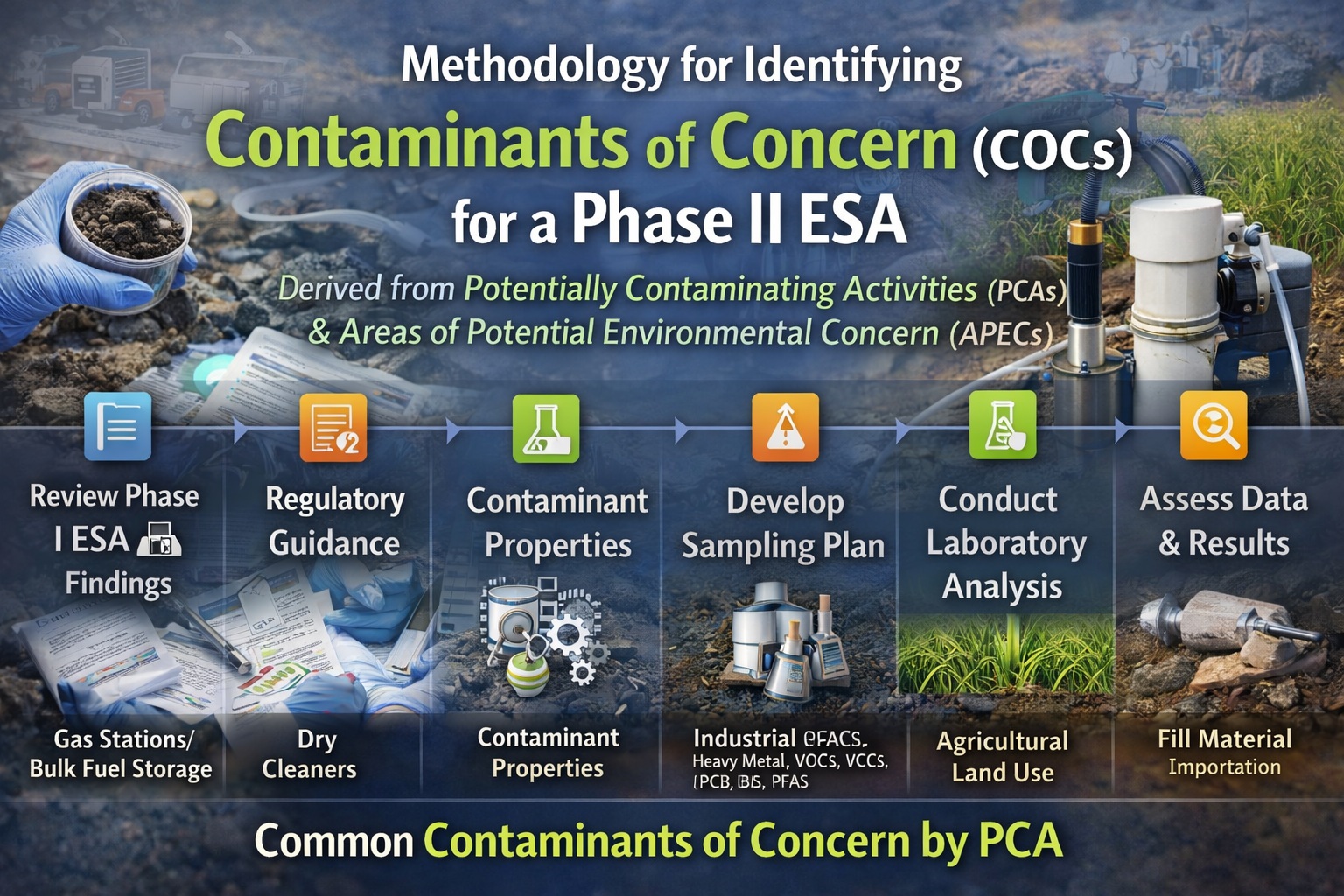
Identifying Contaminants of Concern (COCs) is one of the most critical steps in conducting a Phase II Environmental Site Assessment (ESA). The accuracy, efficiency, and defensibility of the entire investigation depend on selecting the right contaminants for analysis. If key contaminants are overlooked, the consequences can include regulatory non-compliance, costly remediation surprises, and liability exposure for property owners, developers, and lenders.
A Phase II ESA is not an exploratory exercise—it is a targeted, hypothesis-driven investigation. The contaminants selected for testing are not random; they are directly derived from site history, known or suspected sources of contamination, and regulatory requirements. This structured approach ensures that environmental professionals focus on substances that are most likely to be present and pose risks.
This article provides a comprehensive overview of the methodology used to identify COCs for a Phase II ESA, including regulatory frameworks, technical considerations, sampling strategies, and reporting practices.
Understanding the Role of COCs in a Phase II ESA
COCs are specific chemical substances that are suspected to be present at a site due to historical or current activities. These contaminants are selected for laboratory analysis to confirm their presence, concentration, and distribution in environmental media such as soil, groundwater, and soil vapor.
The identification of COCs is directly linked to:
- Potentially Contaminating Activities (PCAs)
- Areas of Potential Environmental Concern (APECs)
- Site-specific environmental conditions
- Applicable regulatory standards
A well-defined list of COCs ensures that the investigation is both comprehensive and cost-effective, avoiding unnecessary testing while minimizing the risk of missing critical contaminants.
Step-by-Step Methodology for Identifying COCs
1. Review of Phase I ESA Findings
The process begins with a thorough review of the Phase I ESA report. This document provides the historical and environmental context needed to identify likely contaminants.
Key elements reviewed include:
- Historical land uses (e.g., gas stations, dry cleaners, industrial operations)
- Records of spills, leaks, or waste disposal
- Site reconnaissance observations
- Regulatory database searches
- Identified PCAs and APECs
Each PCA is associated with specific contaminant types. For example, a former fuel storage area suggests petroleum hydrocarbons, while a dry-cleaning facility indicates chlorinated solvents.
This step establishes the initial list of potential COCs.
2. Application of Regulatory Guidance
Regulatory frameworks play a central role in defining which contaminants must be evaluated and what standards apply.
In Ontario, standards are governed by Ontario Regulation 153/04, administered by the Ontario Ministry of the Environment, Conservation and Parks. These standards specify acceptable concentrations for various contaminants in soil and groundwater based on land use (e.g., residential, commercial, industrial).
In addition, industry standards such as ASTM E1903 provide guidance on sampling strategies and analytical parameters.
Regulatory guidance helps to:
- Define required analytical suites
- Establish screening criteria
- Ensure compliance with current environmental standards
It is important to note that regulatory requirements evolve over time. Therefore, environmental professionals must ensure that the selected COCs align with current standards, not outdated ones.
3. Evaluation of Contaminant Properties
Understanding the physical and chemical properties of potential contaminants is essential for predicting their behavior in the subsurface.
Key factors include:
- Solubility: Determines how easily a contaminant dissolves in water
- Volatility: Indicates potential for vapor intrusion
- Density: Influences whether contaminants sink or float in groundwater
- Persistence: Affects how long contaminants remain in the environment
- Mobility: Determines how far contaminants can migrate
For example:
- Light non-aqueous phase liquids (LNAPLs), such as gasoline, tend to float on groundwater
- Dense non-aqueous phase liquids (DNAPLs), such as chlorinated solvents, can sink and accumulate at depth
These properties influence:
- Sampling locations and depths
- Selection of environmental media (soil, groundwater, vapor)
- Risk assessment considerations
4. Development of a Conceptual Site Model (CSM)
The Conceptual Site Model (CSM) is a visual and analytical representation of the site that integrates:
- Contaminant sources
- Migration pathways
- Potential receptors
The CSM helps to refine the list of COCs by linking site activities to environmental impacts.
For example:
- A former underground storage tank (UST) may act as a source of petroleum hydrocarbons
- Groundwater flow direction may transport contaminants toward nearby receptors
- Soil vapor pathways may indicate potential indoor air risks
The CSM is continuously updated as new data becomes available.
5. Designing the Sampling Plan
Once COCs are identified, a detailed sampling plan is developed to guide field investigations.
The sampling plan includes:
- Number and location of boreholes
- Installation of monitoring wells
- Sampling depths and intervals
- Environmental media to be tested
- Analytical parameters (COCs)
Sampling locations are strategically selected to target APECs and areas where contamination is most likely to occur.
A well-designed sampling plan ensures:
- Adequate site coverage
- Efficient use of resources
- High-quality, representative data
6. Field Investigation and Sample Collection
Fieldwork involves collecting environmental samples in accordance with established protocols.
Typical activities include:
- Drilling boreholes
- Collecting soil samples at various depths
- Installing groundwater monitoring wells
- Measuring groundwater levels
- Conducting field screening (e.g., PID readings)
Proper sampling techniques are essential to prevent cross-contamination and ensure data integrity.
7. Laboratory Analysis
Collected samples are sent to accredited laboratories for analysis of the selected COCs.
Laboratory procedures must adhere to strict quality assurance and quality control (QA/QC) standards, including:
- Calibration of analytical instruments
- Use of blanks and duplicates
- Verification of detection limits
Common analytical methods include:
- Gas chromatography for hydrocarbons and VOCs
- Mass spectrometry for complex organic compounds
- Inductively coupled plasma (ICP) for metals
The laboratory results provide quantitative data on contaminant concentrations.
8. Data Assessment and Interpretation
The final step involves comparing laboratory results to applicable regulatory standards.
This process determines:
- Whether contaminant concentrations exceed regulatory limits
- The extent and distribution of contamination
- Potential risks to human health and the environment
If exceedances are identified, further actions may include:
- Additional delineation (Phase III ESA)
- Risk assessment
- Remediation planning
Data interpretation also feeds back into the CSM, refining the understanding of site conditions.
Common Contaminants of Concern by PCA
The types of COCs vary depending on historical site activities. Below are common associations:
Gas Stations and Bulk Fuel Storage
- Petroleum Hydrocarbons (PHCs, F1–F4)
- BTEX (benzene, toluene, ethylbenzene, xylene)
- Polycyclic Aromatic Hydrocarbons (PAHs)
- Lead
Dry Cleaning Facilities
- Volatile Organic Compounds (VOCs)
- Tetrachloroethylene (PCE)
- Trichloroethylene (TCE) and degradation products
Industrial and Manufacturing Facilities
- Heavy metals (e.g., arsenic, lead, mercury)
- Polychlorinated Biphenyls (PCBs)
- VOCs and Semi-Volatile Organic Compounds (SVOCs)
- Per- and polyfluoroalkyl substances (PFAS)
Agricultural Land Use
- Pesticides
- Herbicides
- Fertilizer-related compounds
Imported Fill Materials
- Variable contaminants depending on source
- Metals, PAHs, and general soil parameters
Report Structure for COC Identification
A Phase II ESA report must clearly document how COCs were identified and evaluated.
Executive Summary
Provides a concise overview of findings, including confirmed contamination and key risks.
Introduction
Outlines the purpose of the investigation and applicable standards.
Site Description
Describes site conditions, including geology and hydrogeology.
Scope of Work
Details the sampling plan and selected COCs.
Field Investigation and Laboratory Results
Presents methodologies, data, and comparisons to regulatory standards.
Discussion and Conclusions
Interprets findings and assesses contamination risks.
Recommendations
Suggests next steps, such as:
- No further action
- Additional investigation
- Risk assessment
- Remediation
Challenges in Identifying COCs
Incomplete Historical Information
Limited or inaccurate site history can lead to missed contaminants.
Evolving Regulatory Standards
Changes in regulations may require additional testing for newly recognized contaminants (e.g., PFAS).
Complex Site Conditions
Heterogeneous geology and multiple contamination sources can complicate interpretation.
Cost Constraints
Balancing comprehensive testing with budget limitations is a common challenge.
Best Practices for COC Identification
To ensure accurate and defensible results:
- Conduct thorough Phase I ESA reviews
- Use current regulatory standards
- Develop a robust CSM
- Apply professional judgment and experience
- Incorporate multiple lines of evidence
- Document all assumptions and decisions
Emerging Trends
Inclusion of Emerging Contaminants
Substances such as PFAS are increasingly being included in analytical programs due to growing regulatory attention.
Advanced Data Analytics
Digital tools and modeling software are improving the identification and prediction of contaminant behavior.
Integration with Environmental Data Systems
Environmental Data Management Systems (EDMS) are streamlining data collection, analysis, and reporting.
Conclusion
The identification of Contaminants of Concern is a foundational element of a Phase II Environmental Site Assessment. It ensures that investigations are targeted, efficient, and aligned with regulatory requirements.
By systematically integrating Phase I findings, regulatory guidance, contaminant properties, and site-specific conditions, environmental professionals can develop a defensible and effective sampling strategy.
As environmental regulations become more stringent and new contaminants emerge, the importance of a rigorous and adaptable COC identification methodology will continue to grow. Ultimately, accurate identification of COCs is essential for protecting human health, supporting sustainable development, and managing environmental risk.
👉 Learn more about our Automated Environmental Site Assessment Solution
Related Articles
- Methodology for Conducting a Phase II Environmental Site Assessment (ESA)
- Key Uses of a Phase II Environmental Site Assessment (ESA) Report
- Market Drivers and Trends for Phase II Environmental Site Assessments
- Role of Reviewing Existing Data for a Phase II Environmental Site Assessment
- Key Components of a Phase II ESA Sampling Plan
- Key Components of a Phase II ESA Health and Safety Plan (HASP)
- Key Considerations for Permit Acquisition for a Phase II ESA
- The Utility Clearance Process for a Phase II ESA
- Drilling and Sampling for a Phase II ESA: Methods, Equipment, and Best Practices
- Installation of Monitoring Wells for a Phase II Environmental Site Assessment (ESA)
- Phase II ESA Quality Control Procedures: Ensuring Accurate, Defensible Environmental Data
- Sample Handling Procedures for a Phase II ESA: Ensuring Data Integrity from Field to Laboratory
- Laboratory Analysis and Data Interpretation for a Phase II ESA
- Reporting and Recommendations for a Phase II Environmental Site Assessment (ESA)
- Differences Between a Phase II ESA in Canada and the United States