

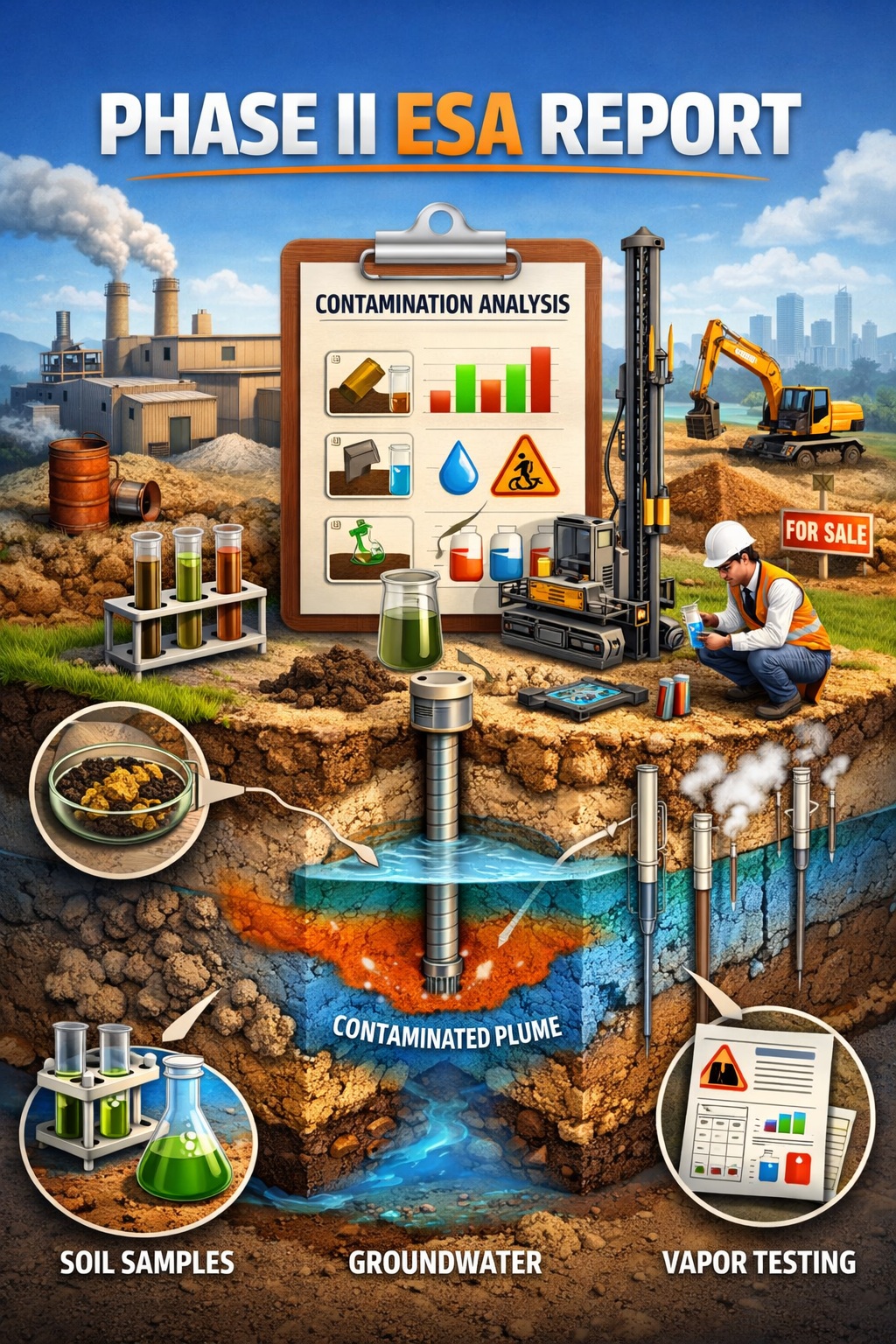
A Phase II Environmental Site Assessment (ESA) report is one of the most critical tools in environmental due diligence. While a Phase I ESA identifies potential environmental concerns—known as Recognized Environmental Conditions (RECs)—a Phase II ESA goes further by providing scientific, defensible evidence about the presence, absence, and extent of contamination in the subsurface.
This report plays a central role in real estate transactions, regulatory compliance, environmental risk management, and site redevelopment. Whether you are a property buyer, developer, lender, or environmental consultant, understanding how a Phase II ESA report is used can help you make better-informed decisions and reduce financial and legal risks.
In this article, we’ll explore the key uses of a Phase II ESA report, how it supports various stakeholders, and what components make it an indispensable document in environmental assessment.
What Is a Phase II ESA Report?
A Phase II ESA report is a detailed, intrusive environmental investigation conducted to confirm whether contamination exists at a property. It typically follows standards such as ASTM E1903 and involves:
- Soil sampling
- Groundwater monitoring
- Soil vapor testing (when applicable)
- Laboratory analysis of environmental media
Unlike a Phase I ESA—which is largely historical and observational—a Phase II ESA provides quantitative data. This data is used to determine:
- Types of contaminants present
- Concentrations relative to regulatory limits
- Horizontal and vertical extent of contamination
- Potential risks to human health and the environment
Confirming and Characterizing Contamination
The primary purpose of a Phase II ESA report is to confirm whether suspected contamination actually exists and, if so, to define its characteristics.
From Suspicion to Scientific Proof
Phase I ESAs often identify risks such as:
- Former industrial uses
- Underground storage tanks
- Chemical handling or spills
- Nearby contamination sources
However, these findings are inconclusive without sampling data. A Phase II ESA bridges this gap by collecting physical samples and analyzing them in certified laboratories.
What the Report Determines
A well-executed Phase II ESA report provides:
- Contaminant identification (e.g., petroleum hydrocarbons, heavy metals, VOCs)
- Concentration levels compared to regulatory standards
- Spatial distribution, including:
- Lateral extent (how far contamination spreads horizontally)
- Vertical extent (depth of contamination)
- Environmental media impacted, such as soil, groundwater, or vapor
Why Characterization Matters
Understanding the full extent of contamination is essential for:
- Estimating remediation costs
- Assessing environmental risk
- Determining feasibility of redevelopment
- Supporting regulatory submissions
Without this level of detail, stakeholders are essentially making decisions in the dark.
Facilitating Property Transactions
A Phase II ESA report is often a deal-defining document in real estate transactions involving commercial or industrial properties.
Reducing Uncertainty for Buyers
Environmental liability can significantly impact property value. A Phase II ESA helps buyers:
- Identify hidden environmental risks
- Quantify potential cleanup costs
- Make informed investment decisions
Supporting Negotiations
If contamination is identified, the report becomes a powerful negotiation tool. It can be used to:
- Renegotiate the purchase price
Buyers may request a price reduction to offset anticipated remediation costs. - Allocate environmental liability
Contracts may assign responsibility for cleanup between buyer and seller. - Request remediation prior to closing
Sellers may agree to clean up the site before finalizing the transaction. - Terminate the deal
If risks are too high, the buyer may walk away entirely.
Protecting Sellers
Sellers can also benefit from a Phase II ESA by:
- Demonstrating transparency
- Reducing post-sale disputes
- Establishing a clear environmental baseline
In competitive markets, having a completed Phase II ESA can even accelerate deal timelines.
Securing Financing and Environmental Insurance
Financial institutions and insurers rely heavily on Phase II ESA reports to evaluate risk.
Why Lenders Require Phase II ESAs
Banks and lenders want assurance that:
- The property’s value is not compromised by contamination
- There are no significant environmental liabilities
- The borrower will not default due to unexpected cleanup costs
A Phase II ESA provides objective data that supports these evaluations.
Impact on Loan Approval
Depending on the findings, a lender may:
- Approve financing without conditions
- Require environmental insurance
- Request remediation prior to funding
- Deny financing altogether
Environmental Insurance Applications
Insurance providers use Phase II ESA reports to:
- Assess environmental risk exposure
- Determine coverage limits
- Set premiums
Policies may include:
- Pollution legal liability insurance
- Remediation cost cap insurance
Without a Phase II ESA, obtaining such coverage is often difficult or impossible.
Ensuring Regulatory Compliance and Liability Protection
Environmental regulations impose strict requirements on property owners and developers. A Phase II ESA report plays a key role in meeting these obligations.
Supporting Due Diligence
Conducting a Phase II ESA demonstrates that a party has taken reasonable steps to investigate environmental conditions. This is critical for:
- Buyers acquiring potentially contaminated land
- Developers planning site redevelopment
- Lenders financing high-risk properties
Liability Protection
In many jurisdictions, completing proper environmental due diligence can provide legal protection, especially under “innocent landowner” or “due diligence” defenses.
A Phase II ESA report helps establish that:
- The buyer was unaware of contamination prior to purchase
- Appropriate investigations were conducted
- Risks were properly assessed
Meeting Regulatory Standards
The report also ensures compliance with:
- Federal environmental regulations
- Provincial/state guidelines
- Municipal requirements
In Canada, for example, Phase II ESA results are often compared against provincial soil and groundwater standards, which vary by land use (residential, commercial, industrial).
Guiding Redevelopment and Land Use Changes
Phase II ESA reports are especially important for brownfield redevelopment projects, where previously developed land is repurposed.
Enabling Safe Land Use Transitions
Consider a site transitioning from industrial to residential use. The environmental standards for residential land are significantly stricter.
A Phase II ESA helps determine:
- Whether contamination exceeds allowable limits
- What remediation is required to meet new land use standards
- Whether redevelopment is feasible
Supporting Brownfield Redevelopment
Brownfield projects often rely on Phase II ESA reports to:
- Secure government incentives or grants
- Satisfy planning and zoning requirements
- Obtain regulatory approvals
Example: Canadian Context
In provinces like Ontario, a Phase II ESA is often required before filing a Record of Site Condition (RSC)—a formal document that certifies a property is suitable for its intended use.
This is especially important when:
- Changing land use (e.g., industrial to residential)
- Redeveloping contaminated properties
- Seeking municipal approvals
Informing Remediation and Risk Management Strategies
When contamination is confirmed, the Phase II ESA report becomes the foundation for next steps.
Developing Remediation Plans (Phase III ESA)
The data collected during a Phase II ESA is used to design a remediation strategy, often referred to as a Phase III ESA.
This may involve:
- Excavation and disposal of contaminated soil
- Groundwater treatment systems
- In-situ remediation techniques (e.g., bioremediation, chemical oxidation)
Cost Estimation
Accurate characterization allows for:
- Reliable cost estimates
- Budget planning
- Financial risk assessment
Risk Management Approaches
In some cases, full remediation may not be necessary or feasible. Instead, risk management strategies may be implemented, such as:
- Soil management plans during construction
- Installation of vapor barriers
- Land use restrictions
- Long-term monitoring programs
Regulatory Closure
The Phase II ESA report also supports:
- Filing regulatory documents (e.g., RSC in Ontario)
- Demonstrating compliance with cleanup standards
- Achieving site closure
Key Components of a Phase II ESA Report
A comprehensive Phase II ESA report is structured to provide clarity, transparency, and defensibility.
1. Introduction and Objectives
This section outlines:
- Purpose of the investigation
- Scope of work
- Site background and context
2. Methodology
Details the procedures used, including:
- Drilling and sampling methods
- Monitoring well installation
- Laboratory analytical methods
- Quality assurance and quality control (QA/QC)
3. Field Investigation Results
Includes:
- Borehole logs
- Sample locations and depths
- Observations during drilling (e.g., soil conditions, odors, staining)
4. Laboratory Analysis
Presents:
- Analytical results for soil, groundwater, or vapor samples
- Comparison to applicable regulatory standards
- Identification of exceedances
5. Data Interpretation
Provides expert analysis of:
- Contaminant distribution
- Migration pathways
- Potential sources of contamination
- Environmental and human health risks
6. Conclusions and Recommendations
Summarizes findings and outlines:
- Whether contamination is present
- Extent and severity of impacts
- Recommended next steps (e.g., further investigation, remediation, monitoring)
Why a Phase II ESA Report Is Essential
A Phase II ESA report is more than just a technical document—it is a decision-making tool that influences financial, legal, and environmental outcomes.
Key Benefits
- Reduces uncertainty by providing scientific data
- Protects investments by identifying hidden liabilities
- Supports compliance with environmental regulations
- Guides redevelopment and land use planning
- Enables informed decisions across all stakeholders
Conclusion
A Phase II Environmental Site Assessment report is a cornerstone of environmental due diligence. By providing clear, defensible evidence of subsurface conditions, it enables stakeholders to:
- Confirm and understand contamination
- Navigate complex property transactions
- Secure financing and insurance
- Comply with environmental regulations
- Plan safe and effective redevelopment
- Implement remediation or risk management strategies
In an era where environmental responsibility and regulatory scrutiny are increasing, the value of a Phase II ESA report cannot be overstated. It transforms uncertainty into actionable insight—ensuring that decisions are based on data, not assumptions.
👉 Learn more about our Automated Environmental Site Assessment Solution
Related Articles
- Methodology for Conducting a Phase II Environmental Site Assessment (ESA)
- Market Drivers and Trends for Phase II Environmental Site Assessments
- Role of Reviewing Existing Data for a Phase II Environmental Site Assessment
- Methodology for Identifying Contaminants of Concern (COCs) for a Phase II Environmental Site Assessment
- Key Components of a Phase II ESA Sampling Plan
- Key Components of a Phase II ESA Health and Safety Plan (HASP)
- Key Considerations for Permit Acquisition for a Phase II ESA
- The Utility Clearance Process for a Phase II ESA
- Drilling and Sampling for a Phase II ESA: Methods, Equipment, and Best Practices
- Installation of Monitoring Wells for a Phase II Environmental Site Assessment (ESA)
- Phase II ESA Quality Control Procedures: Ensuring Accurate, Defensible Environmental Data
- Sample Handling Procedures for a Phase II ESA: Ensuring Data Integrity from Field to Laboratory
- Laboratory Analysis and Data Interpretation for a Phase II ESA
- Reporting and Recommendations for a Phase II Environmental Site Assessment (ESA)
- Differences Between a Phase II ESA in Canada and the United States