

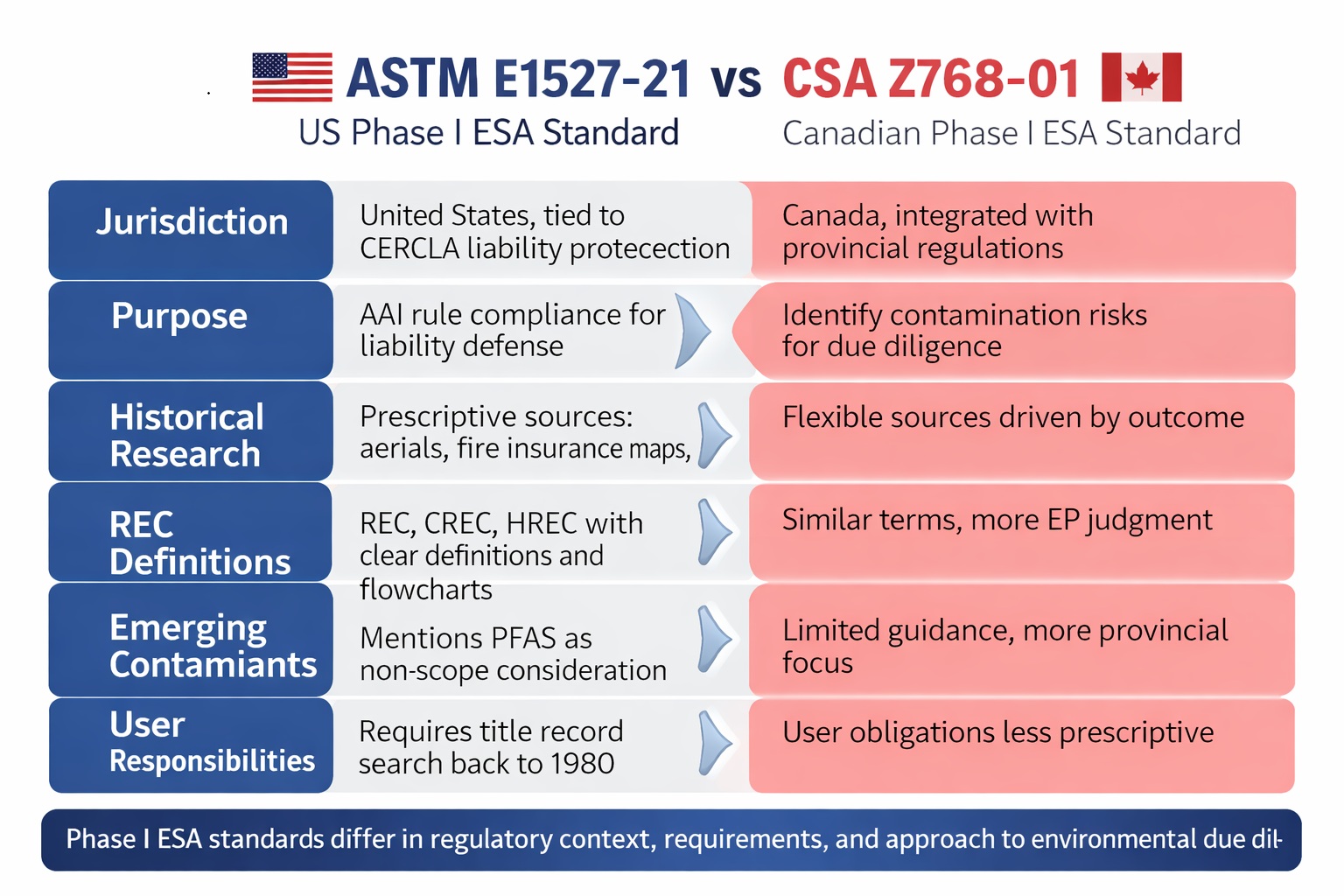
When conducting a Phase I Environmental Site Assessment (ESA), selecting the appropriate standard is critical—not just for technical consistency, but for legal defensibility, regulatory compliance, and stakeholder confidence. Two of the most widely used standards in North America are ASTM E1527-21 and CSA Z768-01.
While both standards aim to identify potential environmental liabilities associated with a property, they are designed for different jurisdictions and legal frameworks. Understanding their distinctions is essential for environmental professionals, lenders, developers, and cross-border investors.
This comprehensive guide explores the key differences between ASTM E1527-21 and CSA Z768-01, helping you determine which standard is appropriate—and how to navigate situations where both may apply.
Why These Standards Exist
Environmental due diligence plays a critical role in:
- Real estate transactions
- Financing and lending
- Risk management
- Regulatory compliance
Both ASTM and CSA standards provide a structured methodology for assessing environmental risk. However, their design reflects the legal and regulatory systems they operate within.
The Legal Foundation
In the United States, ASTM E1527-21 is closely tied to:
- CERCLA (Comprehensive Environmental Response, Compensation, and Liability Act)
- The EPA’s All Appropriate Inquiries (AAI) rule
In Canada, CSA Z768-01 is:
- A national standard used for due diligence
- Often supplemented by provincial regulations
Primary Jurisdiction
ASTM E1527-21 (United States)
ASTM E1527-21 is the recognized standard for conducting Phase I ESAs in the United States.
Its primary purpose is to:
- Satisfy AAI requirements
- Provide protection from liability under CERCLA
This makes it essential for:
- Property purchasers
- Lenders
- Investors seeking liability protection
CSA Z768-01 (Canada)
CSA Z768-01 is the national Canadian standard for Phase I ESAs.
It is:
- Widely accepted across provinces
- Often used alongside provincial regulations
Examples include:
- Ontario’s Record of Site Condition framework
- Provincial brownfield programs
Key Difference
- ASTM E1527-21: Legally tied to federal liability protection
- CSA Z768-01: A national guideline integrated with provincial systems
Purpose and Goal
ASTM E1527-21
The primary goal is legal defensibility.
Specifically:
- To meet AAI requirements
- To establish defenses against environmental liability
This makes the standard:
- Highly structured
- Focused on consistency
- Legally driven
CSA Z768-01
The goal is comprehensive environmental due diligence.
It focuses on:
- Identifying contamination risks
- Supporting informed decision-making
- Providing flexibility for different provincial contexts
Key Difference
- ASTM: Legal protection and liability defense
- CSA: Broad due diligence and risk identification
Historical Research Requirements
ASTM E1527-21
ASTM is highly prescriptive regarding historical sources.
It requires review of:
- Aerial photographs
- Fire insurance maps
- City directories
- Topographic maps
If these are reasonably ascertainable, they must be reviewed.
CSA Z768-01
CSA also requires historical research but allows:
- Greater flexibility in source selection
- Focus on achieving the objective rather than prescribing sources
Practical Implication
Under ASTM:
- You must justify missing sources
Under CSA:
- You must demonstrate sufficient historical understanding
Key Difference
- ASTM: Source-driven and prescriptive
- CSA: Outcome-driven and flexible
Definitions: REC, CREC, and HREC
ASTM E1527-21
ASTM provides:
- Clear, refined definitions
- Structured classification criteria
- Decision-making guidance (including flow charts)
Key definitions include:
- Recognized Environmental Condition (REC)
- Controlled REC (CREC)
- Historical REC (HREC)
CSA Z768-01
CSA uses similar terminology but:
- Provides less rigid definitions
- Relies more on professional judgment
- Allows adaptation to local regulatory context
Key Difference
- ASTM: Standardized and prescriptive classification
- CSA: Flexible, judgment-based interpretation
Emerging Contaminants (e.g., PFAS)
ASTM E1527-21
ASTM explicitly addresses emerging contaminants like:
- Per- and polyfluoroalkyl substances (PFAS)
It clarifies:
- PFAS are considered non-scope unless regulated as hazardous substances
CSA Z768-01
CSA provides:
- Limited explicit guidance on emerging contaminants
Instead:
- Requirements are driven by provincial regulations
- Client scope often determines inclusion
Key Difference
- ASTM: Explicit guidance on PFAS and emerging contaminants
- CSA: Less explicit, more context-driven
User Responsibilities
ASTM E1527-21
ASTM places strong emphasis on user responsibilities.
These include:
- Searching title records
- Identifying environmental liens
- Reviewing Activity and Use Limitations (AULs)
The standard specifies:
- Searches should go back to 1980
CSA Z768-01
CSA outlines user responsibilities but:
- Is less prescriptive
- Provides less detail on title search requirements
Key Difference
- ASTM: Detailed and mandatory user obligations
- CSA: General guidance with less specificity
Report Shelf Life and Validity
ASTM E1527-21
ASTM defines clear timelines:
- Key components must be updated after 180 days
- Entire report expires after 1 year
CSA Z768-01
CSA does not prescribe strict timelines but emphasizes:
- The need for current information
- Relevance at the time of transaction
Key Difference
- ASTM: Strict timelines
- CSA: Flexible, judgment-based timing
Level of Prescriptiveness
One of the most important distinctions is the level of detail and rigidity.
ASTM E1527-21
- Highly prescriptive
- Structured approach
- Detailed requirements
- Consistency across projects
CSA Z768-01
- More flexible
- Relies on EP judgment
- Adaptable to regional differences
Key Difference
- ASTM: Rule-based
- CSA: Principle-based
Integration with Regulatory Systems
ASTM E1527-21
Directly tied to:
- Federal law (CERCLA)
- EPA regulations
CSA Z768-01
Integrated with:
- Provincial regulations
- Local environmental frameworks
Example
In Ontario:
- CSA is used alongside Record of Site Condition requirements
Key Difference
- ASTM: Federal legal integration
- CSA: Provincial regulatory integration
Cross-Border Considerations
In many cases, projects involve:
- U.S. investors in Canadian properties
- Canadian firms working on U.S. assets
Adapting Reports
Often, reports are:
- Prepared under one standard
- Supplemented to meet the other
Best Practice
For cross-border transactions:
- Consider dual compliance
- Clarify requirements with stakeholders early
Practical Comparison Table
| Feature | ASTM E1527-21 | CSA Z768-01 |
|---|---|---|
| Jurisdiction | United States | Canada |
| Legal Basis | CERCLA / AAI | Provincial frameworks |
| Approach | Prescriptive | Flexible |
| Historical Research | Mandatory sources | Flexible sources |
| REC Definitions | Highly structured | Less prescriptive |
| Emerging Contaminants | Explicit (e.g., PFAS) | Limited guidance |
| User Responsibilities | Detailed | General |
| Report Validity | 180 days / 1 year | Not strictly defined |
Choosing the Right Standard
The choice depends on:
1. Property Location
- U.S. → ASTM
- Canada → CSA
2. Transaction Requirements
- Lenders may require ASTM
- Provincial regulations may require CSA
3. Risk Tolerance
- Higher legal exposure → ASTM preferred
- Flexible due diligence → CSA suitable
4. Stakeholder Expectations
Always confirm:
- Client requirements
- Legal expectations
- Regulatory obligations
Common Misconceptions
“They Are Interchangeable”
While similar, they are not identical.
Differences in:
- legal implications
- reporting requirements
- terminology
can significantly impact outcomes.
“CSA Is Less Rigorous”
CSA is not less rigorous—it is:
- More flexible
- Context-driven
“ASTM Covers Everything”
ASTM focuses on:
- liability protection
It does not necessarily address:
- all environmental risks
- all regulatory requirements
Conclusion
Both ASTM E1527-21 and CSA Z768-01 serve the same fundamental purpose: identifying environmental risk.
However, their differences reflect:
- Legal systems
- Regulatory structures
- Professional expectations
Key Takeaways
- ASTM is more prescriptive and legally driven
- CSA is more flexible and context-based
- The appropriate standard depends on jurisdiction and transaction requirements
- Cross-border projects may require dual compliance
Final Thought
Understanding the distinctions between ASTM E1527-21 and CSA Z768-01 is essential for delivering accurate, defensible, and valuable environmental assessments.
Choosing the right standard is not just a technical decision—it is a strategic one that affects liability, compliance, and ultimately, the success of a transaction.
👉 Learn more about our Automated Environmental Site Assessment Solution
Related Articles
- Overview of a Phase I Environmental Site Assessment (ESA): A Complete Guide for Due Diligence
- Key Uses of a Phase I Environmental Site Assessment
- Market for Phase I Environmental Site Assessments
- The Role of Historical Source Review in Phase I Environmental Site Assessments
- The Role of Environmental Database Reviews in Phase I Environmental Site Assessments
- The Review of Property Records in a Phase I Environmental Site Assessment
- The Role of Visual Inspections in a Phase I Environmental Site Assessment
- Identifying Hazardous Substances and Petroleum Products in a Phase I Environmental Site Assessment
- Documenting Drainage Patterns and Surface Water in a Phase I Environmental Site Assessment
- The Role of Photographs in Phase I Environmental Site Assessments
- The Use of Drones in a Phase I Environmental Site Assessment
- Conducting Interviews with Property Owners and Occupants for a Phase I ESA
- Conducting Interviews with Government Officials for a Phase I ESA
- Conducting Interviews with Neighbors for a Phase I ESA
- Key Components of a Phase I ESA Conclusion