

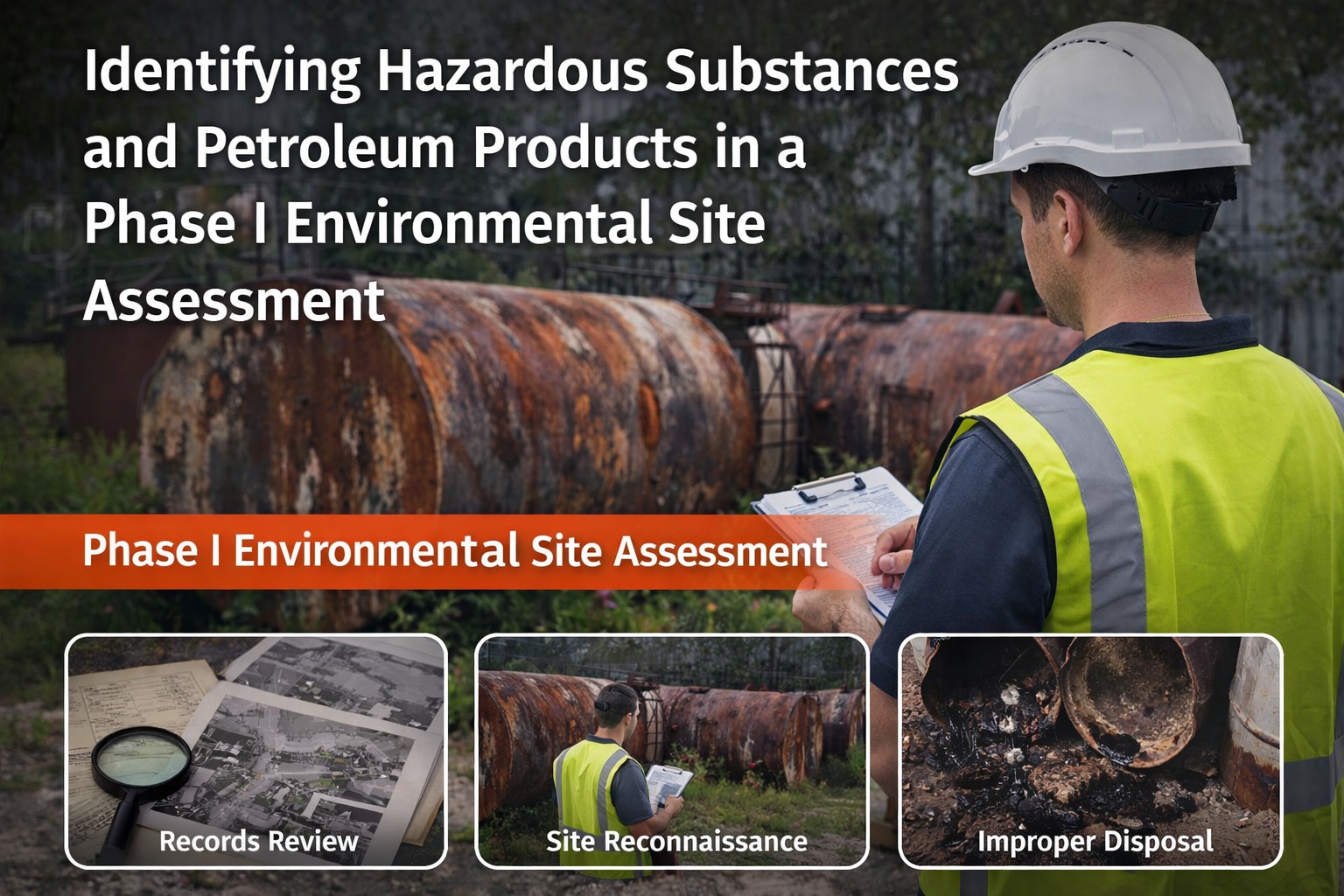
A Phase I Environmental Site Assessment (ESA) is a critical step in environmental due diligence, designed to identify potential environmental contamination liabilities associated with a property. Conducted in accordance with ASTM E1527-21, the Phase I ESA focuses on determining the presence or likely presence of hazardous substances and petroleum products through a structured, non-intrusive process.
Unlike Phase II investigations, which involve sampling and laboratory analysis, a Phase I ESA relies entirely on qualitative data collection and professional interpretation. The goal is to identify Recognized Environmental Conditions (RECs)—indicators of contamination resulting from past or current releases, or the potential for future releases.
This post provides a comprehensive overview of how hazardous substances and petroleum products are identified in a Phase I ESA, including:
- Records review
- Site reconnaissance
- Interviews
- Storage conditions and quantities
- Disposal methods
Understanding Hazardous Substances and Petroleum Products
Before diving into the identification process, it is important to understand what constitutes hazardous substances and petroleum products in the context of a Phase I ESA.
Hazardous Substances
Hazardous substances are defined under environmental regulations and typically include:
- Industrial chemicals and solvents
- Heavy metals (e.g., lead, arsenic, mercury)
- Polychlorinated biphenyls (PCBs)
- Pesticides and herbicides
- Hazardous wastes
These materials can pose risks to human health and the environment if released into soil, groundwater, or air.
Petroleum Products
Petroleum products include:
- Gasoline
- Diesel fuel
- Heating oil
- Lubricating oils
- Jet fuel and other refined hydrocarbons
While petroleum is regulated differently than many hazardous substances, it is still a major focus of Phase I ESAs due to its prevalence and potential for contamination.
The Non-Intrusive Nature of a Phase I ESA
A defining characteristic of a Phase I ESA is that it is non-intrusive. This means:
- No soil, groundwater, or vapor samples are collected
- No drilling, excavation, or testing is performed
- Conclusions are based on observation, documentation, and professional judgment
This approach allows for a cost-effective and efficient assessment while still providing valuable insight into potential environmental risks.
Records Review: Building the Historical Context
The records review is one of the most important components of a Phase I ESA. It provides a historical framework that helps identify potentially contaminating activities (PCAs) associated with the property and surrounding area.
Historical Sources
Environmental professionals review a range of historical documents, including:
- Aerial photographs
- Fire insurance maps (e.g., Sanborn maps)
- Topographic maps
- City directories
- Land title records
These sources help reconstruct the historical use of the property and identify activities that may have involved hazardous substances or petroleum products.
Regulatory Database Searches
A comprehensive regulatory review is conducted to identify listings related to:
- Underground storage tanks (USTs)
- Aboveground storage tanks (ASTs)
- Hazardous waste generators
- Spill incidents and cleanup cases
- Landfills and disposal sites
This includes searching federal, provincial/state, and local databases.
Identifying Potentially Contaminating Activities (PCAs)
Through records review, environmental professionals identify PCAs such as:
- Gas stations and fuel depots
- Dry cleaners (solvent use)
- Manufacturing facilities
- Automotive repair shops
- Agricultural chemical storage
These activities are associated with a higher likelihood of hazardous material use and potential releases.
Why Records Review Matters
Records review helps answer key questions:
- What activities historically occurred on the site?
- Were hazardous materials used or stored?
- Are there documented spills or regulatory issues?
This information sets the stage for targeted site reconnaissance and informed interviews.
Site Reconnaissance: Observing Current Conditions
Site reconnaissance involves a visual inspection of the property and adjacent areas. It provides real-time insight into current conditions and helps confirm or challenge findings from the records review.
Visual Indicators of Contamination
Environmental professionals look for signs such as:
- Surface staining on soil or pavement
- Stressed or dead vegetation
- Unusual chemical or petroleum odors
- Oily sheens or iridescence on water
- Corrosion or leaks from equipment
These indicators can suggest the presence of hazardous substances or petroleum products.
Identifying Infrastructure and Equipment
The site visit also focuses on identifying features that indicate material use or storage, including:
- Fill pipes and vent pipes (indicating USTs)
- Aboveground storage tanks
- Drums and containers
- Waste storage areas
- Floor drains and sumps
Even if tanks or equipment are no longer present, evidence of former systems (e.g., piping, depressions) can be critical.
Adjacent Properties
Reconnaissance is not limited to the subject site. Adjacent properties are also evaluated for potential off-site impacts, such as:
- Nearby gas stations
- Industrial operations
- Dry cleaning facilities
Contamination can migrate across property boundaries, making this step essential.
Interviews: Filling the Information Gaps
Interviews provide valuable context that may not be available in records or visible during site reconnaissance.
Key Interviewees
Environmental professionals typically interview:
- Current property owners
- Site operators or facility managers
- Past owners or occupants (if available)
- Local government officials (e.g., fire department, building department)
Information Gathered
Interviews help uncover:
- Historical site uses and operations
- Types of materials stored or used
- Storage practices and locations
- Known spills, leaks, or incidents
- Waste disposal practices
Importance of Interviews
Interviews can reveal:
- Undocumented activities
- Informal practices not captured in records
- Institutional knowledge of site conditions
This qualitative information is often critical in identifying RECs.
Storage Conditions and Quantities
A key aspect of identifying hazardous substances and petroleum products is understanding how they are stored and managed.
Storage Practices
Environmental professionals document:
- Presence of storage vessels (drums, ASTs, USTs)
- Condition of containers (e.g., rust, leaks, labeling)
- Organization and housekeeping practices
Improper storage—such as open containers, lack of labeling, or visible leaks—is a strong indicator of potential environmental risk.
Quantities of Materials
While Phase I ESAs do not involve precise inventories, they assess the scale of materials present, such as:
- A few small containers vs. numerous large drums
- Bulk storage tanks vs. minor quantities
Larger quantities generally correspond to higher potential risk.
Secondary Containment
The presence and condition of containment systems are evaluated, including:
- Berms or dikes
- Concrete pads
- Spill containment pallets
Proper containment reduces the likelihood of releases reaching soil or groundwater.
Why Storage Conditions Matter
Poor storage practices increase the risk of:
- Spills and leaks
- Chronic releases over time
- Environmental contamination
These conditions often contribute to the identification of RECs.
Disposal Methods: Evaluating Environmental Responsibility
Understanding how hazardous materials and petroleum products are disposed of is another critical component of a Phase I ESA.
Waste Management Records
Environmental professionals review available documentation, such as:
- Waste manifests
- Disposal receipts
- Regulatory filings
These records help determine whether materials were handled and disposed of properly by licensed facilities.
Observed Disposal Practices
During site reconnaissance, the EP looks for signs of improper disposal, including:
- Illegal dumping
- Buried debris or fill of unknown origin
- Stained soil in disposal areas
- Discharges to storm drains or surface water
Historical Disposal Practices
Older properties may have used practices that were acceptable at the time but are now considered environmentally harmful, such as:
- On-site burial of waste
- Discharge to unlined pits or lagoons
- Use of fill materials from unknown sources
Why Disposal Methods Matter
Improper disposal is a major source of environmental contamination and can lead to:
- Soil and groundwater impacts
- Regulatory liability
- Significant remediation costs
Integrating Findings to Identify RECs
The ultimate goal of identifying hazardous substances and petroleum products is to determine whether RECs are present.
What is a REC?
A Recognized Environmental Condition is defined as:
The presence or likely presence of hazardous substances or petroleum products due to a release, a past release, or a material threat of a release.
Lines of Evidence
Environmental professionals integrate multiple lines of evidence, including:
- Historical records
- Regulatory data
- Visual observations
- Interview information
A REC is typically identified when multiple indicators support the likelihood of contamination.
Types of Environmental Conditions
In addition to RECs, the assessment may identify:
- Controlled RECs (CRECs): Contamination managed under regulatory controls
- Historical RECs (HRECs): Past contamination that has been remediated to acceptable levels
Limitations of the Identification Process
While Phase I ESAs are highly effective, they have limitations:
- No direct confirmation through sampling
- Reliance on available records and access
- Potential gaps in historical information
- Subjectivity in interpretation
These limitations reinforce the importance of professional judgment.
The Role of Professional Judgment
Identifying hazardous substances and petroleum products requires:
- Experience with industrial and commercial operations
- Knowledge of contaminants and their behavior
- Understanding of regulatory frameworks
- Ability to synthesize diverse information sources
Professional judgment is essential in determining whether conditions warrant further investigation.
When a Phase II ESA is Recommended
If potential contamination is identified, a Phase II ESA may be recommended. This involves:
- Soil and groundwater sampling
- Laboratory analysis
- Quantification of contaminants
Phase II investigations provide the data needed to confirm and characterize environmental impacts.
Conclusion
Identifying hazardous substances and petroleum products in a Phase I Environmental Site Assessment is a comprehensive, multi-step process that relies on records review, site reconnaissance, and interviews. By evaluating storage conditions, quantities, and disposal methods, Environmental Professionals can assess the likelihood of contamination and identify Recognized Environmental Conditions.
Although non-intrusive, the Phase I ESA provides critical insight into environmental risk, helping property owners, developers, and lenders make informed decisions. When conducted thoroughly and interpreted by experienced professionals, it serves as a powerful tool for managing environmental liability and protecting both human health and the environment.
👉 Learn more about our Automated Environmental Site Assessment Solution
Related Articles
- Overview of a Phase I Environmental Site Assessment (ESA): A Complete Guide for Due Diligence
- Key Uses of a Phase I Environmental Site Assessment
- Market for Phase I Environmental Site Assessments
- The Role of Historical Source Review in Phase I Environmental Site Assessments
- The Role of Environmental Database Reviews in Phase I Environmental Site Assessments
- The Review of Property Records in a Phase I Environmental Site Assessment
- The Role of Visual Inspections in a Phase I Environmental Site Assessment
- Documenting Drainage Patterns and Surface Water in a Phase I Environmental Site Assessment
- The Role of Photographs in Phase I Environmental Site Assessments
- The Use of Drones in a Phase I Environmental Site Assessment
- Conducting Interviews with Property Owners and Occupants for a Phase I ESA
- Conducting Interviews with Government Officials for a Phase I ESA
- Conducting Interviews with Neighbors for a Phase I ESA
- Key Components of a Phase I ESA Conclusion
- Key Distinctions Between ASTM E1527-21 and CSA Z768-01