

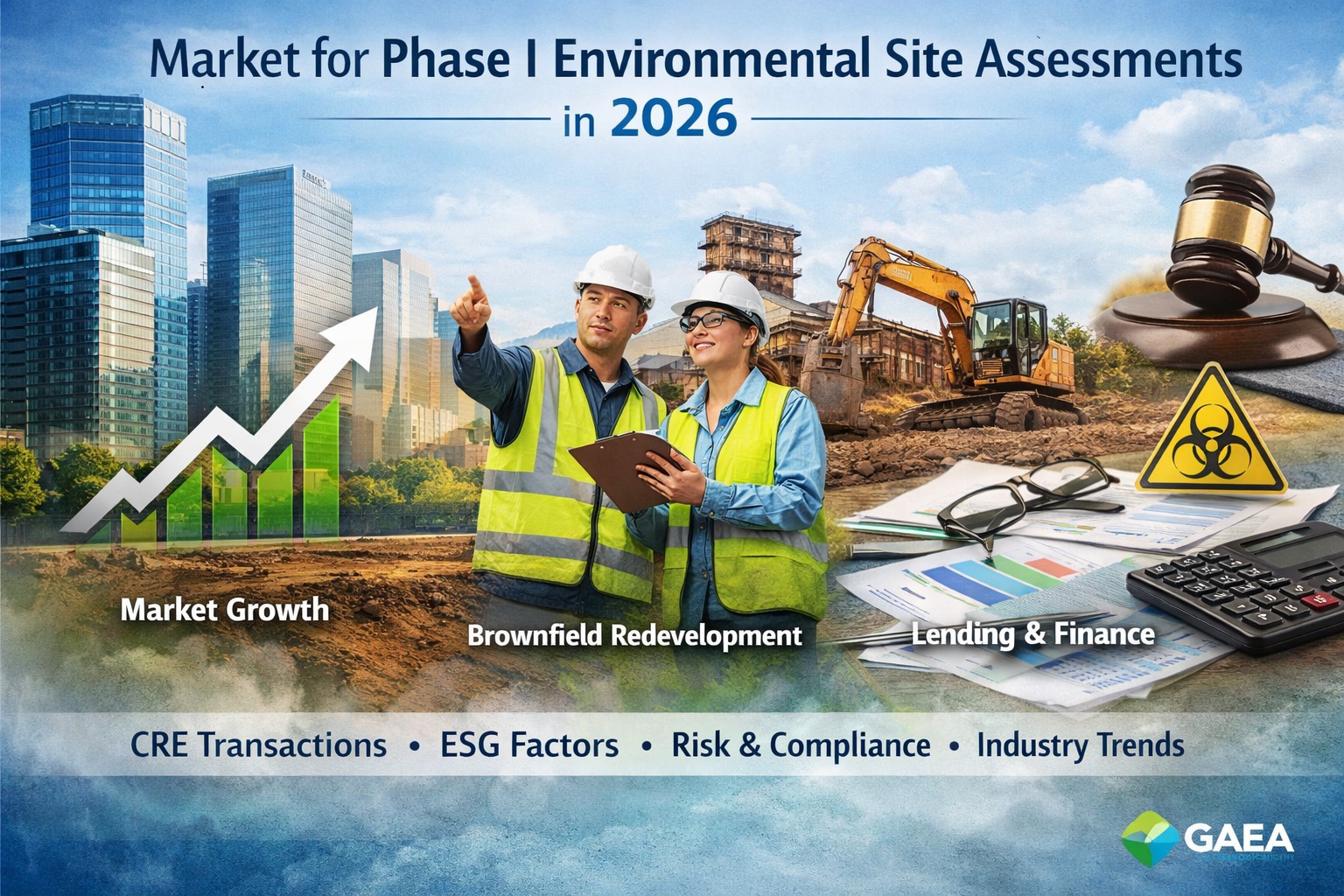
The market for Phase I Environmental Site Assessments (ESAs) is a well-established, cyclical segment of the environmental consulting industry, closely tied to the health of the commercial real estate (CRE) market and evolving regulatory requirements. In 2026, the sector is showing renewed momentum after a slower period, driven by improving transaction volumes, heightened regulatory scrutiny, and increasing alignment with Environmental, Social, and Governance (ESG) priorities.
A Phase I ESA is more than a procedural requirement—it is a risk management tool embedded in real estate transactions, financing decisions, and development planning. As such, its demand rises and falls with economic cycles, but its long-term relevance continues to strengthen.
This article explores the market size and growth, key drivers, challenges and trends, and future outlook for Phase I ESAs.
Market Size and Growth
The Phase I ESA market is part of the broader environmental consulting industry, which is valued in the tens of billions globally. Within this space, Phase I ESAs represent a core service line, particularly in North America where regulatory frameworks and lending practices strongly mandate environmental due diligence.
A Mature but Resilient Market
The Phase I ESA market is considered mature, meaning:
- It is widely adopted and standardized
- Demand is consistent across economic cycles
- Growth is incremental rather than explosive
However, maturity does not imply stagnation. Instead, the market demonstrates resilience, with demand rebounding quickly when transaction activity resumes.
Cyclical Nature
Demand for Phase I ESAs closely tracks:
- Commercial property transactions
- Refinancing activity
- Development cycles
In periods of economic expansion:
- Transaction volumes increase
- Demand for ESAs rises
During slowdowns:
- Fewer transactions reduce demand
- Projects may be delayed or canceled
The slowdown in late 2024—driven by higher interest rates and cautious investment activity—led to a temporary dip in ESA demand. However, as conditions stabilize in 2025, transactional activity is rebounding, bringing ESA demand back with it.
Regional Insights
- North America remains the largest market due to established regulations and lending practices
- Canada continues to see steady demand tied to infrastructure and urban development
- Europe shows growth driven by sustainability and redevelopment initiatives
- Emerging markets are gradually adopting ESA practices, though at a slower pace
Growth Expectations
While not a high-growth sector, the Phase I ESA market is expected to:
- Grow steadily in line with CRE activity
- Benefit from increasing regulatory requirements
- Expand through integration with ESG and sustainability frameworks
Key Market Drivers
Several key factors continue to drive demand for Phase I ESAs.
1. Commercial Real Estate Transactions
The primary driver of Phase I ESA demand is property transactions.
Every time a commercial property changes hands, stakeholders require environmental due diligence to:
- Identify potential contamination
- Assess liability risks
- Support investment decisions
As transaction volumes increase, so does demand for ESAs.
2. Financing Requirements
Lenders play a critical role in sustaining ESA demand.
Financial institutions typically require a Phase I ESA to:
- Protect collateral value
- Reduce exposure to environmental liability
- Ensure compliance with lending policies
Without an ESA, many deals simply cannot proceed.
3. Regulatory Frameworks
Environmental regulations continue to shape the ESA market.
In the United States, frameworks like CERCLA establish liability rules that make due diligence essential.
In Canada and other regions:
- Provincial and federal regulations require environmental assessments
- Brownfield redevelopment programs encourage site investigations
These frameworks ensure that ESAs remain a mandatory or strongly recommended step in many transactions.
4. Redevelopment and Urbanization
Urban redevelopment—particularly of previously used or industrial land—is a major driver.
Brownfield projects require:
- Environmental assessments
- Risk identification
- Remediation planning
As cities densify and land availability decreases, redevelopment activity continues to grow, supporting ESA demand.
5. ESG and Sustainability Initiatives
Environmental considerations are increasingly integrated into business strategy through ESG frameworks.
Organizations now evaluate:
- Environmental risks
- Sustainability performance
- Long-term impacts
Phase I ESAs contribute by:
- Identifying environmental liabilities
- Supporting responsible land use
- Aligning with sustainability goals
6. Risk Management and Liability Protection
Beyond compliance, ESAs are used as risk management tools.
They help stakeholders:
- Avoid unexpected cleanup costs
- Reduce legal exposure
- Protect asset value
This risk-focused perspective is becoming more prominent, particularly among institutional investors.
Challenges and Trends
While the market is stable, it faces several challenges and evolving trends.
1. Pricing Pressure and Competition
The Phase I ESA market is highly competitive, with many firms offering similar services.
This leads to:
- Pricing pressure
- Commoditization of services
- Reduced margins
Clients often prioritize cost and turnaround time, making differentiation more difficult.
2. Standardization vs. Value
Because Phase I ESAs follow standardized guidelines (e.g., ASTM standards), they can be perceived as interchangeable.
However, quality varies significantly depending on:
- Experience of the environmental professional
- Depth of research
- Interpretation of findings
Firms that emphasize quality and insight can differentiate themselves, but this requires educating clients on value beyond price.
3. Turnaround Time Expectations
Clients increasingly expect:
- Faster delivery
- Real-time updates
- Streamlined reporting
This puts pressure on firms to:
- Optimize workflows
- Use digital tools
- Improve efficiency
4. Technology Adoption
Technology is reshaping the ESA market.
Key developments include:
- Digital data collection tools
- GIS integration
- Automated report generation
- Cloud-based collaboration
Firms that adopt technology can:
- Reduce turnaround time
- Improve accuracy
- Enhance client experience
5. Data Availability and Interpretation
Access to environmental data has improved, but challenges remain:
- Incomplete historical records
- Inconsistent data quality
- Interpretation complexity
Environmental professionals must combine:
- Technical expertise
- Local knowledge
- Critical analysis
6. Expanding Scope Expectations
Clients increasingly expect more than a standard Phase I ESA.
They may request:
- Additional risk assessments
- ESG-related insights
- Non-scope evaluations
This trend is pushing firms to offer integrated services.
Future Outlook
The future of the Phase I ESA market is shaped by both economic cycles and long-term structural trends.
1. Continued Dependence on CRE Activity
The market will remain closely tied to:
- Real estate transactions
- Financing cycles
- Development activity
While short-term fluctuations will continue, the long-term outlook remains stable.
2. Integration with ESG and Sustainability
ESAs will play a larger role in:
- ESG reporting
- Sustainable investment strategies
- Corporate risk assessments
Environmental due diligence is becoming part of a broader sustainability narrative.
3. Increased Regulatory Scrutiny
Regulations are expected to:
- Become more stringent
- Expand in scope
- Emphasize environmental accountability
This will reinforce the importance of ESAs and potentially increase demand.
4. Technology-Driven Transformation
Technology will continue to reshape the industry through:
- Automation
- Data analytics
- Digital reporting
Firms that embrace innovation will gain a competitive advantage.
5. Growth in Redevelopment Projects
Urbanization and land scarcity will drive:
- Brownfield redevelopment
- Adaptive reuse projects
These projects rely heavily on environmental assessments, supporting long-term demand.
6. Shift Toward Advisory Services
Phase I ESAs will increasingly be seen as:
- Entry points to broader consulting services
- Tools for strategic decision-making
Firms that expand into advisory roles can:
- Increase value
- Strengthen client relationships
- Differentiate from competitors
Conclusion
The market for Phase I Environmental Site Assessments is a mature, cyclical, and resilient industry that remains essential to commercial real estate, financing, and environmental risk management.
In 2026, the market is experiencing renewed momentum, supported by:
- Rebounding transaction activity
- Strong regulatory frameworks
- Growing emphasis on ESG
While challenges such as pricing pressure and standardization persist, opportunities exist for firms that:
- Embrace technology
- Deliver high-quality insights
- Expand into advisory services
Looking ahead, the role of Phase I ESAs will continue to evolve—from a compliance-driven requirement to a strategic tool that informs investment, development, and sustainability decisions.
👉 Learn more about our Automated Environmental Site Assessment Solution
Related Articles
- Overview of a Phase I Environmental Site Assessment (ESA): A Complete Guide for Due Diligence
- Key Uses of a Phase I Environmental Site Assessment
- The Role of Historical Source Review in Phase I Environmental Site Assessments
- The Role of Environmental Database Reviews in Phase I Environmental Site Assessments
- The Review of Property Records in a Phase I Environmental Site Assessment
- The Role of Visual Inspections in a Phase I Environmental Site Assessment
- Identifying Hazardous Substances and Petroleum Products in a Phase I Environmental Site Assessment
- Documenting Drainage Patterns and Surface Water in a Phase I Environmental Site Assessment
- The Role of Photographs in Phase I Environmental Site Assessments
- The Use of Drones in a Phase I Environmental Site Assessment
- Conducting Interviews with Property Owners and Occupants for a Phase I ESA
- Conducting Interviews with Government Officials for a Phase I ESA
- Conducting Interviews with Neighbors for a Phase I ESA
- Key Components of a Phase I ESA Conclusion
- Key Distinctions Between ASTM E1527-21 and CSA Z768-01