

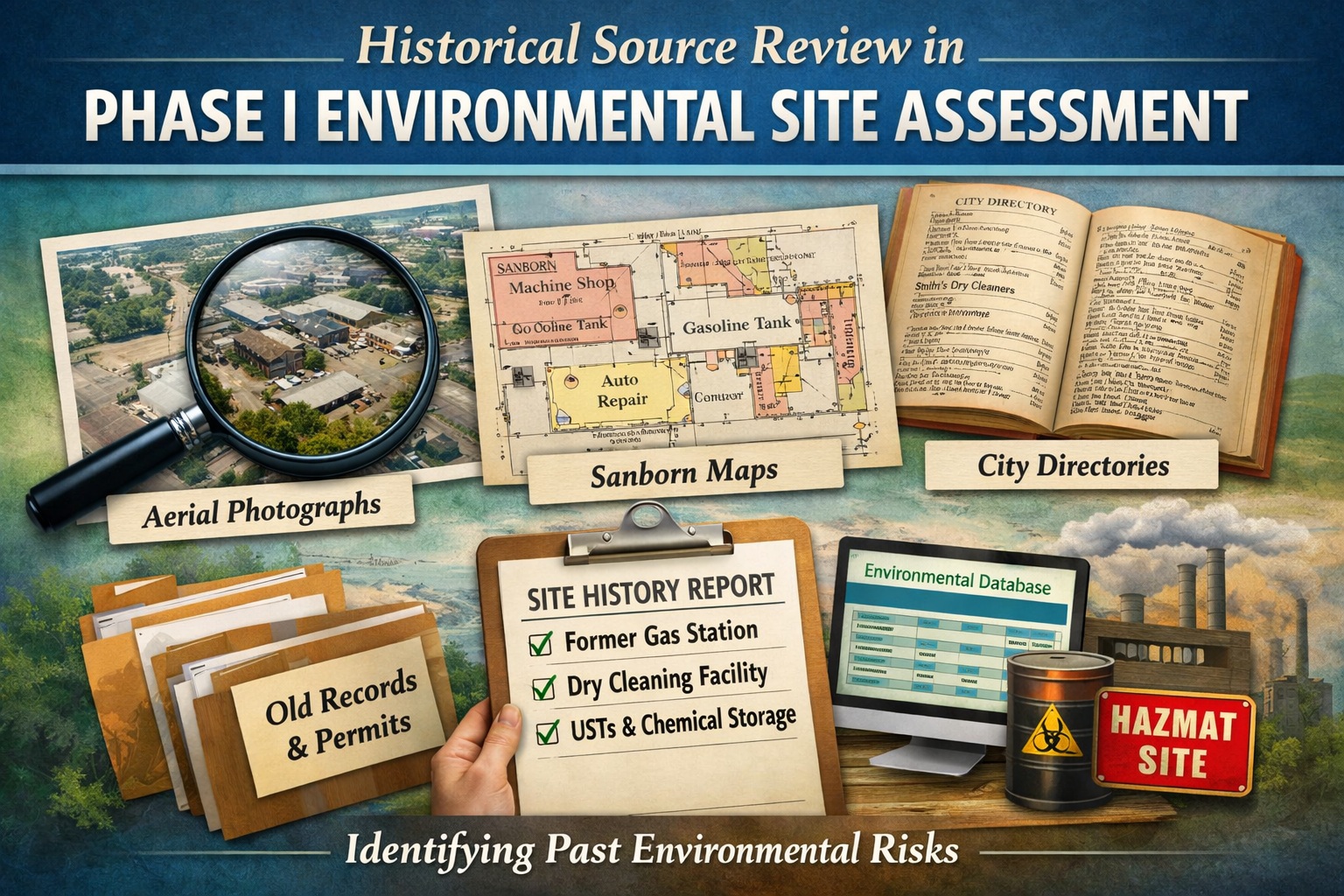
A Phase I Environmental Site Assessment (ESA) is fundamentally an investigation into the past. While the site visit and interviews provide a snapshot of current conditions, it is the historical source review that reveals how a property has evolved over time—and whether past uses may have introduced environmental risks.
Historical source review is one of the most critical components of a Phase I ESA. It allows environmental professionals to identify potential contamination pathways, legacy risks, and Recognized Environmental Conditions (RECs) that may not be visible today. In many cases, the most significant environmental liabilities originate from activities that occurred decades earlier.
This article explores the purpose and objective of historical research, the key sources reviewed, and how findings are analyzed and reported within the Phase I ESA process.
Purpose and Objective of Historical Source Review
The primary objective of historical source review is to reconstruct the environmental history of a property and its surrounding area. This involves identifying past uses and activities that could have resulted in the release of hazardous substances or petroleum products.
Understanding Past Land Use
Land use changes over time. A property that is currently:
- A commercial office
- A residential development
- Vacant land
…may previously have been:
- A gas station
- An industrial facility
- A dry cleaner
- Agricultural land with pesticide use
Historical research helps uncover these transitions and evaluate whether they present environmental concerns.
Identifying Recognized Environmental Conditions (RECs)
A central goal of a Phase I ESA is to identify Recognized Environmental Conditions (RECs)—defined as the presence or likely presence of hazardous substances due to a release or potential release.
Historical sources help identify:
- Former underground storage tanks (USTs)
- Industrial operations
- Waste disposal practices
- Chemical storage areas
Without historical review, many RECs would remain undetected.
Supporting All Appropriate Inquiry (AAI)
In jurisdictions such as the United States, historical research is essential for meeting All Appropriate Inquiry (AAI) requirements under CERCLA.
A properly conducted historical review:
- Demonstrates due diligence
- Supports liability protections
- Strengthens the defensibility of the ESA
Evaluating Adjacent Properties
Environmental risk is not confined to property boundaries. Contamination can migrate through:
- Soil
- Groundwater
- Air pathways
Historical research extends beyond the subject site to include adjacent and nearby properties, identifying off-site sources that could impact the property.
Filling Gaps in Site Knowledge
Interviews and site inspections may not reveal:
- Activities from decades ago
- Demolished structures
- Temporary industrial uses
Historical records provide a long-term perspective that fills these gaps.
Key Historical Sources Reviewed
A comprehensive historical source review relies on multiple data sources. Each provides a different perspective, and together they create a more complete picture of site history.
Aerial Photographs
Aerial photographs are one of the most valuable tools in historical research.
They allow environmental professionals to:
- Observe site development over time
- Identify structures, tanks, and operational areas
- Detect changes in land use
Aerial imagery often spans several decades, providing a visual timeline of the property.
Fire Insurance Maps (e.g., Sanborn Maps)
Fire insurance maps, such as those produced by Sanborn Map Company, provide detailed information about:
- Building footprints
- Construction materials
- Industrial uses
- Storage tanks
These maps are particularly useful in urban areas and can reveal historical uses not evident in other sources.
City Directories
City directories list businesses and occupants at specific addresses over time.
They help identify:
- Types of businesses operating on-site
- Duration of operations
- Changes in occupancy
For example, a property currently used as retail may have previously housed:
- Auto repair shops
- Manufacturing facilities
- Chemical storage operations
Topographic Maps
Topographic maps provide information about:
- Terrain and elevation
- Natural features such as streams and wetlands
- Historical land development
They can indicate:
- Potential drainage patterns
- Areas where contaminants may migrate
Building Permits and Records
Municipal records such as building permits and planning documents can reveal:
- Construction history
- Renovations or expansions
- Installation or removal of tanks
These records help establish a timeline of structural and operational changes.
Environmental Databases
While not strictly historical in the traditional sense, regulatory databases provide:
- Records of spills and contamination
- Registered storage tanks
- Cleanup activities
These databases complement historical sources by identifying known environmental issues.
Historical Reports and Previous ESAs
If available, previous environmental reports can provide:
- Past findings
- Sampling results
- Identified risks
These documents help build continuity in environmental assessment.
Interviews and Local Knowledge
Interviews with:
- Property owners
- Occupants
- Local authorities
…can provide insights not captured in written records, such as:
- Informal site uses
- Anecdotal evidence of spills or dumping
Combining Multiple Sources
No single source is sufficient on its own. Environmental professionals must:
- Cross-reference multiple data sources
- Identify inconsistencies
- Fill gaps where data is missing
This layered approach ensures a comprehensive and defensible historical review.
Analysis and Interpretation of Historical Data
Collecting historical data is only the first step. The real value lies in analyzing and interpreting the information to identify environmental risks.
Establishing a Chronological Narrative
Environmental professionals develop a timeline that:
- Tracks changes in land use
- Identifies periods of higher risk
- Highlights key transitions
This narrative helps stakeholders understand how the site has evolved.
Identifying High-Risk Activities
Certain historical uses are associated with higher environmental risk, including:
- Gas stations and fuel storage
- Dry cleaning operations
- Manufacturing and industrial processes
- Waste disposal and landfills
These uses are flagged for further evaluation.
Assessing Data Gaps
In some cases, historical records may be incomplete or unavailable.
Data gaps are:
- Identified and documented
- Evaluated for potential impact on conclusions
Significant gaps may lead to:
- Conservative assumptions
- Recommendations for further investigation
Evaluating Migration Pathways
Historical information is used to assess whether contaminants could:
- Migrate onto the site from nearby properties
- Move through soil or groundwater
This is particularly important in densely developed or industrial areas.
Determining Recognized Environmental Conditions (RECs)
Based on the analysis, environmental professionals determine whether:
- RECs are present
- Potential RECs exist
- Conditions have been addressed (historical RECs)
This classification is a key outcome of the Phase I ESA.
Reporting Historical Findings
The findings of the historical source review are documented in the Phase I ESA report.
Clear and Defensible Documentation
Reports must:
- Clearly describe historical sources reviewed
- Summarize findings
- Provide supporting evidence
This ensures that the ESA is:
- Transparent
- Defensible
- Compliant with standards
Integration with Other ESA Components
Historical findings are integrated with:
- Site inspection observations
- Interviews
- Regulatory database results
This holistic approach strengthens conclusions.
Supporting Conclusions and Recommendations
The historical review directly informs:
- Identification of RECs
- Recommendations for further investigation (e.g., Phase II ESA)
- Risk assessments
Communicating Risk to Stakeholders
The report must translate technical findings into:
- Clear, understandable language
- Actionable insights
Stakeholders—including buyers, lenders, and developers—rely on this information to make decisions.
Challenges in Historical Source Review
Despite its importance, historical research presents several challenges.
Incomplete or Missing Records
Older records may:
- Be unavailable
- Contain gaps
- Lack detail
Environmental professionals must work with incomplete information.
Inconsistent Data Quality
Different sources may:
- Provide conflicting information
- Use different terminology
- Vary in accuracy
Careful interpretation is required.
Time and Cost Constraints
Clients often expect:
- Fast turnaround
- Cost efficiency
Balancing thorough research with project timelines can be challenging.
Urban vs. Rural Differences
- Urban areas often have more detailed records
- Rural areas may have limited documentation
This affects the depth of historical analysis.
Best Practices for Effective Historical Review
To ensure high-quality results, environmental professionals should:
- Use multiple sources to cross-verify information
- Document all sources and limitations
- Identify and address data gaps
- Apply professional judgment and experience
- Maintain compliance with ASTM standards
The Strategic Value of Historical Research
Historical source review is not just a technical requirement—it is a strategic tool.
It enables stakeholders to:
- Understand long-term environmental risk
- Make informed investment decisions
- Plan for redevelopment and remediation
- Protect against liability
Conclusion
The role of historical source review in Phase I Environmental Site Assessments is both foundational and indispensable. By reconstructing the past, environmental professionals can identify risks that are not immediately visible, ensuring that stakeholders are fully informed before making critical decisions.
From uncovering legacy contamination to supporting regulatory compliance and liability protection under frameworks like CERCLA, historical research provides the context necessary for accurate and defensible environmental assessments.
In an industry where unseen risks can carry significant consequences, the ability to understand and interpret a property’s history is essential. A thorough and well-executed historical source review transforms a Phase I ESA from a procedural requirement into a powerful tool for risk management and strategic planning.
👉 Learn more about our Automated Environmental Site Assessment Solution
Related Articles
- Overview of a Phase I Environmental Site Assessment (ESA): A Complete Guide for Due Diligence
- Key Uses of a Phase I Environmental Site Assessment
- Market for Phase I Environmental Site Assessments
- The Role of Environmental Database Reviews in Phase I Environmental Site Assessments
- The Review of Property Records in a Phase I Environmental Site Assessment
- The Role of Visual Inspections in a Phase I Environmental Site Assessment
- Identifying Hazardous Substances and Petroleum Products in a Phase I Environmental Site Assessment
- Documenting Drainage Patterns and Surface Water in a Phase I Environmental Site Assessment
- The Role of Photographs in Phase I Environmental Site Assessments
- The Use of Drones in a Phase I Environmental Site Assessment
- Conducting Interviews with Property Owners and Occupants for a Phase I ESA
- Conducting Interviews with Government Officials for a Phase I ESA
- Conducting Interviews with Neighbors for a Phase I ESA
- Key Components of a Phase I ESA Conclusion
- Key Distinctions Between ASTM E1527-21 and CSA Z768-01