

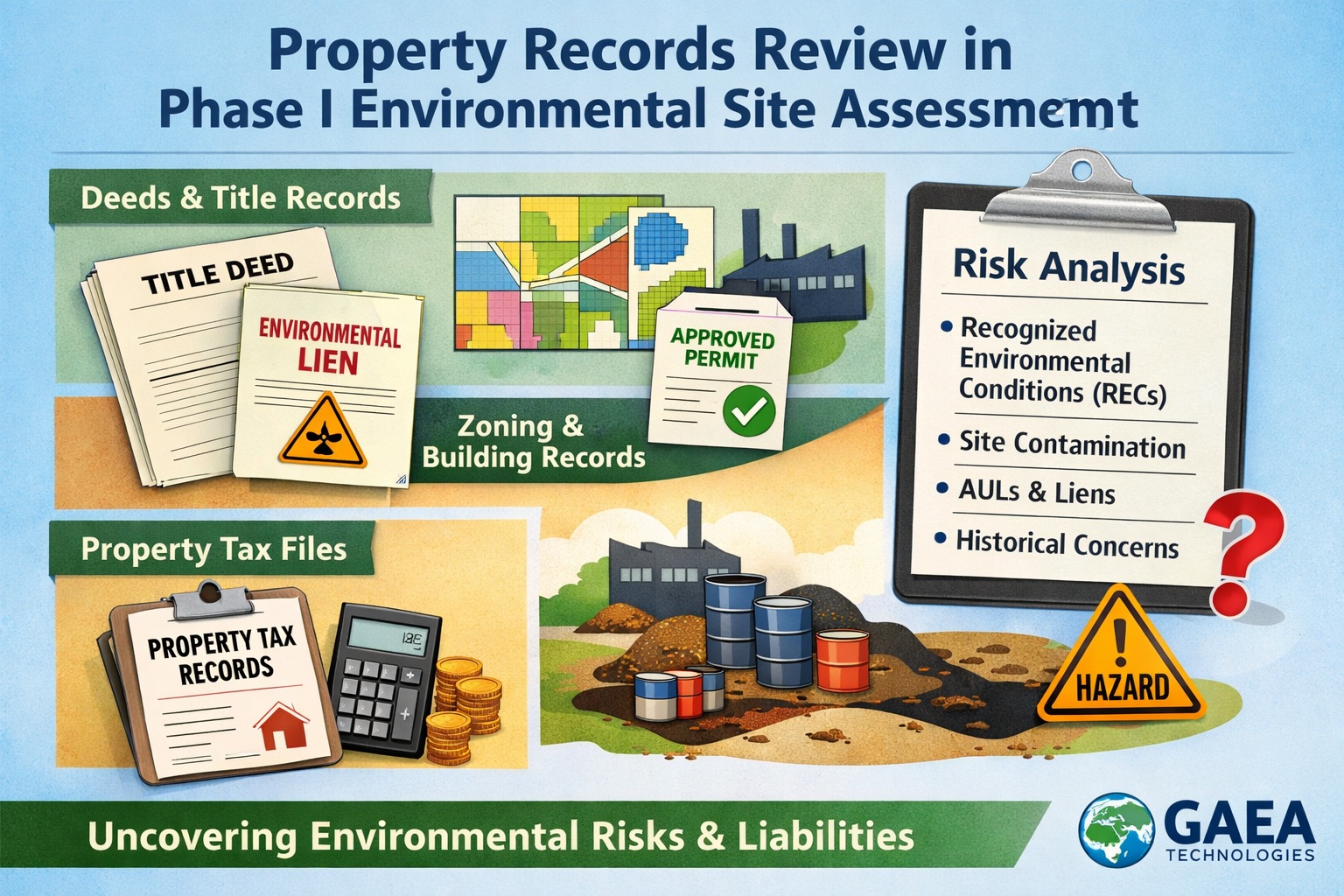
The review of property records is a critical, and sometimes underappreciated, component of a Phase I Environmental Site Assessment (ESA) conducted in accordance with ASTM E1527-21. While aerial photographs, fire insurance maps, and environmental databases often receive the most attention, property records provide a legal and administrative perspective that is essential for understanding a site’s environmental history.
These records offer insight into ownership, land use restrictions, regulatory actions, and site development over time. When interpreted correctly, they help environmental professionals (EPs) identify Recognized Environmental Conditions (RECs), confirm historical findings, and uncover potential environmental liabilities that may not be visible through other sources.
This article explores the purpose and significance of property record review, the key records analyzed, and how they contribute to a robust Phase I ESA.
Purpose and Significance of Property Record Review
The primary purpose of reviewing property records is to establish a clear legal and historical framework for the subject property. This includes understanding who owned and operated the site, how it was used, and whether any environmental restrictions or liabilities are attached to it.
Establishing Chain of Ownership
One of the most important functions of property record review is to identify:
- Past owners
- Operators
- Periods of ownership
This information allows the EP to:
- Link historical activities to specific parties
- Identify potential sources of contamination
- Understand when high-risk operations may have occurred
For example, if records show that a property was owned by an industrial operator during a certain period, this may indicate the presence of potentially contaminating activities (PCAs).
Identifying Environmental Liens
Environmental liens are a key concern in property record reviews.
Under environmental laws such as CERCLA, governments may place liens on properties where public funds have been used for cleanup.
These liens:
- Indicate past or ongoing contamination
- Represent financial and legal liabilities
- May affect property value and transferability
Identifying environmental liens is a critical responsibility of the Phase I ESA user, not just the environmental professional.
Identifying Activity and Use Limitations (AULs)
Activity and Use Limitations (AULs), also known as institutional controls, are restrictions placed on a property due to environmental conditions.
Examples include:
- Prohibiting residential use
- Restricting groundwater use
- Limiting excavation activities
AULs are often recorded in:
- Deeds
- Land title documents
- Environmental registries
Their presence indicates that:
- Contamination remains on-site
- Risk management measures are in place
Understanding AULs is essential for:
- Evaluating redevelopment potential
- Ensuring regulatory compliance
Corroborating Historical Data
Property records serve as a verification tool for other historical sources.
They help confirm:
- Dates of development
- Types of land use
- Ownership transitions
For example:
- Aerial photos may show a building appearing in a certain decade
- Property records can confirm when it was constructed and by whom
This cross-referencing improves the accuracy and defensibility of the Phase I ESA.
Supporting Liability Protection
A thorough property record review contributes to meeting All Appropriate Inquiry (AAI) requirements, which are necessary for liability protection under laws like CERCLA.
By documenting:
- Ownership history
- Environmental encumbrances
- Land use restrictions
…the ESA becomes more defensible and supports protections such as:
- Innocent landowner defense
- Bona fide prospective purchaser status
Key Property Records and Their Use
ASTM E1527-21 categorizes property records as additional historical resources, meaning they must be reviewed when useful and reasonably available.
Land Title Records (Deeds, Easements, and Related Documents)
Land title records are among the most important property records reviewed in a Phase I ESA.
What They Include
- Deeds
- Easements
- Covenants
- Environmental liens
- AULs
Key Insights
Land title records help:
- Establish ownership history
- Identify legal encumbrances
- Reveal restrictions on land use
Search Requirements
ASTM E1527-21 recommends:
- A search back to 1980 for environmental liens and AULs
- Justification if this timeframe is not met
In practice, many assessments go further:
- Conducting a full chain of title search
- Tracing ownership back to the first developed use
In jurisdictions like Ontario, regulations such as Ontario Regulation 153/04 may require deeper historical analysis.
Property Tax Records
Property tax files provide additional insight into:
- Ownership history
- Property value changes
- Improvements and structures
Why They Matter
Tax records can:
- Confirm occupancy types
- Indicate when buildings were added or modified
- Provide clues about site use
For example:
- A sudden increase in assessed value may indicate construction
- Changes in classification may reflect shifts in land use
Building Department Records
Building permits and municipal records are highly valuable for understanding site development.
What They Reveal
- Construction dates
- Building additions
- Structural modifications
- Installation or removal of equipment (e.g., USTs)
Environmental Relevance
These records can indicate:
- Industrial upgrades
- Changes in operations
- Installation of systems associated with contamination risk
For example:
- A permit for a fuel system installation may suggest the presence of underground storage tanks
Zoning Records
Zoning records provide information about:
- Permitted land uses
- Zoning changes over time
- Variances and exceptions
Why Zoning Matters
Zoning can:
- Confirm legal land use
- Identify non-conforming uses
- Suggest historical activities
For example:
- Industrial zoning may indicate higher risk activities
- Variances may suggest unusual or high-risk operations
Easements and Encumbrances
Easements and other encumbrances can affect:
- Property access
- Infrastructure placement
- Environmental risk
Examples include:
- Utility easements
- Drainage rights
- Access restrictions
These factors may influence:
- Contamination pathways
- Site redevelopment potential
Environmental Liens and Institutional Controls
As previously noted, these records are critical for identifying:
- Government involvement in cleanup
- Restrictions on property use
Their presence often signals:
- Known contamination
- Ongoing environmental management
Analysis and Interpretation of Property Records
Collecting property records is only part of the process. The real value lies in analyzing and interpreting the information.
Building a Chronological Timeline
Environmental professionals use property records to:
- Construct a timeline of ownership and use
- Identify key transitions
- Highlight periods of higher risk
This timeline is integrated with:
- Historical sources
- Site observations
- Database findings
Linking Ownership to Activities
By correlating ownership with known activities, EPs can:
- Identify responsible parties
- Assess risk associated with specific time periods
For example:
- Ownership by a manufacturing company may indicate potential contamination
- Subsequent ownership changes may reflect site redevelopment
Identifying Data Gaps
Property records may:
- Be incomplete
- Contain inconsistencies
- Lack detail
EPs must:
- Identify gaps
- Assess their significance
- Document limitations
Significant gaps may require:
- Conservative assumptions
- Additional investigation
Cross-Referencing with Other Sources
Property records are compared with:
- Aerial photographs
- City directories
- Environmental databases
This cross-referencing:
- Validates findings
- Resolves discrepancies
- Strengthens conclusions
Evaluating Environmental Risk
Based on the analysis, EPs assess:
- Likelihood of contamination
- Presence of RECs
- Need for further investigation
This evaluation is critical for:
- Decision-making
- Risk management
Challenges in Property Record Review
Despite their value, property records present several challenges.
Incomplete Records
Older records may:
- Be missing
- Be difficult to access
- Lack detail
Variability Across Jurisdictions
Different regions have:
- Different record systems
- Different accessibility
- Different requirements
Interpretation Complexity
Understanding legal documents requires:
- Experience
- Knowledge of regulations
- Attention to detail
Time Constraints
Thorough record review can be time-consuming, especially when:
- Multiple sources must be consulted
- Records are not digitized
Best Practices for Property Record Review
To ensure effective analysis, environmental professionals should:
- Review all reasonably available records
- Document sources and limitations
- Cross-reference multiple data sources
- Apply professional judgment
- Maintain compliance with ASTM standards
Conclusion
The review of property records is an essential component of a comprehensive Phase I Environmental Site Assessment. By examining deeds, tax records, building permits, zoning information, and environmental encumbrances, environmental professionals gain critical insight into a property’s history and legal context.
This process helps:
- Identify Recognized Environmental Conditions (RECs)
- Uncover environmental liabilities
- Verify historical data
- Support regulatory compliance
Most importantly, it provides the information necessary for stakeholders to make informed decisions and manage environmental risk effectively.
In an industry where unseen risks can have significant financial and legal consequences, the careful review and interpretation of property records ensure that no critical detail is overlooked—transforming the Phase I ESA from a procedural requirement into a powerful tool for due diligence and risk management.
👉 Learn more about our Automated Environmental Site Assessment Solution
Related Articles
- Overview of a Phase I Environmental Site Assessment (ESA): A Complete Guide for Due Diligence
- Key Uses of a Phase I Environmental Site Assessment
- Market for Phase I Environmental Site Assessments
- The Role of Historical Source Review in Phase I Environmental Site Assessments
- The Role of Environmental Database Reviews in Phase I Environmental Site Assessments
- The Role of Visual Inspections in a Phase I Environmental Site Assessment
- Identifying Hazardous Substances and Petroleum Products in a Phase I Environmental Site Assessment
- Documenting Drainage Patterns and Surface Water in a Phase I Environmental Site Assessment
- The Role of Photographs in Phase I Environmental Site Assessments
- The Use of Drones in a Phase I Environmental Site Assessment
- Conducting Interviews with Property Owners and Occupants for a Phase I ESA
- Conducting Interviews with Government Officials for a Phase I ESA
- Conducting Interviews with Neighbors for a Phase I ESA
- Key Components of a Phase I ESA Conclusion
- Key Distinctions Between ASTM E1527-21 and CSA Z768-01