

A Phase I Environmental Site Assessment (ESA) is a foundational step in environmental due diligence, designed to identify potential environmental liabilities associated with a property—without intrusive testing. Whether you’re a developer, lender, environmental consultant, or property owner, understanding the Phase I ESA process is essential for managing risk and ensuring regulatory compliance.
Conducted by a qualified Environmental Professional (EP), a Phase I ESA follows the internationally recognized ASTM E1527-21 standard and is widely accepted across North America as the benchmark for environmental due diligence.
Beyond being a best practice, Phase I ESAs are often necessary to meet All Appropriate Inquiries (AAI) requirements under the Comprehensive Environmental Response, Compensation, and Liability Act—a key legal safeguard that helps protect property buyers from liability related to contamination.
This comprehensive guide walks through the full Phase I ESA process, including methodology, regulatory context, reporting requirements, and best practices for environmental professionals.
What Is a Phase I Environmental Site Assessment?
A Phase I ESA is a non-invasive investigation that evaluates a property’s environmental condition by reviewing historical records, conducting site inspections, and gathering relevant information through interviews.
Key Objective
The primary goal is to determine whether Recognized Environmental Conditions (RECs) are present.
What Are RECs?
RECs are defined as:
The presence or likely presence of hazardous substances or petroleum products due to a release or potential release into the environment.
Key Characteristics of a Phase I ESA
- No soil, groundwater, or vapor sampling
- Focuses on historical and observational data
- Provides risk identification—not confirmation
- Conducted according to ASTM E1527-21
Why Phase I ESAs Are Critical in Real Estate and Development
Environmental liabilities can significantly impact:
- Property value
- Financing and lending decisions
- Project timelines
- Legal exposure
Failing to identify contamination before purchase can result in substantial remediation costs—even if the buyer did not cause the contamination.
CERCLA and Environmental Liability
Under the Comprehensive Environmental Response, Compensation, and Liability Act, property owners can be held responsible for environmental contamination regardless of fault.
AAI: Your Legal Protection
To qualify for liability protections, buyers must perform All Appropriate Inquiries (AAI). A properly conducted Phase I ESA is the industry-standard method for satisfying AAI requirements.
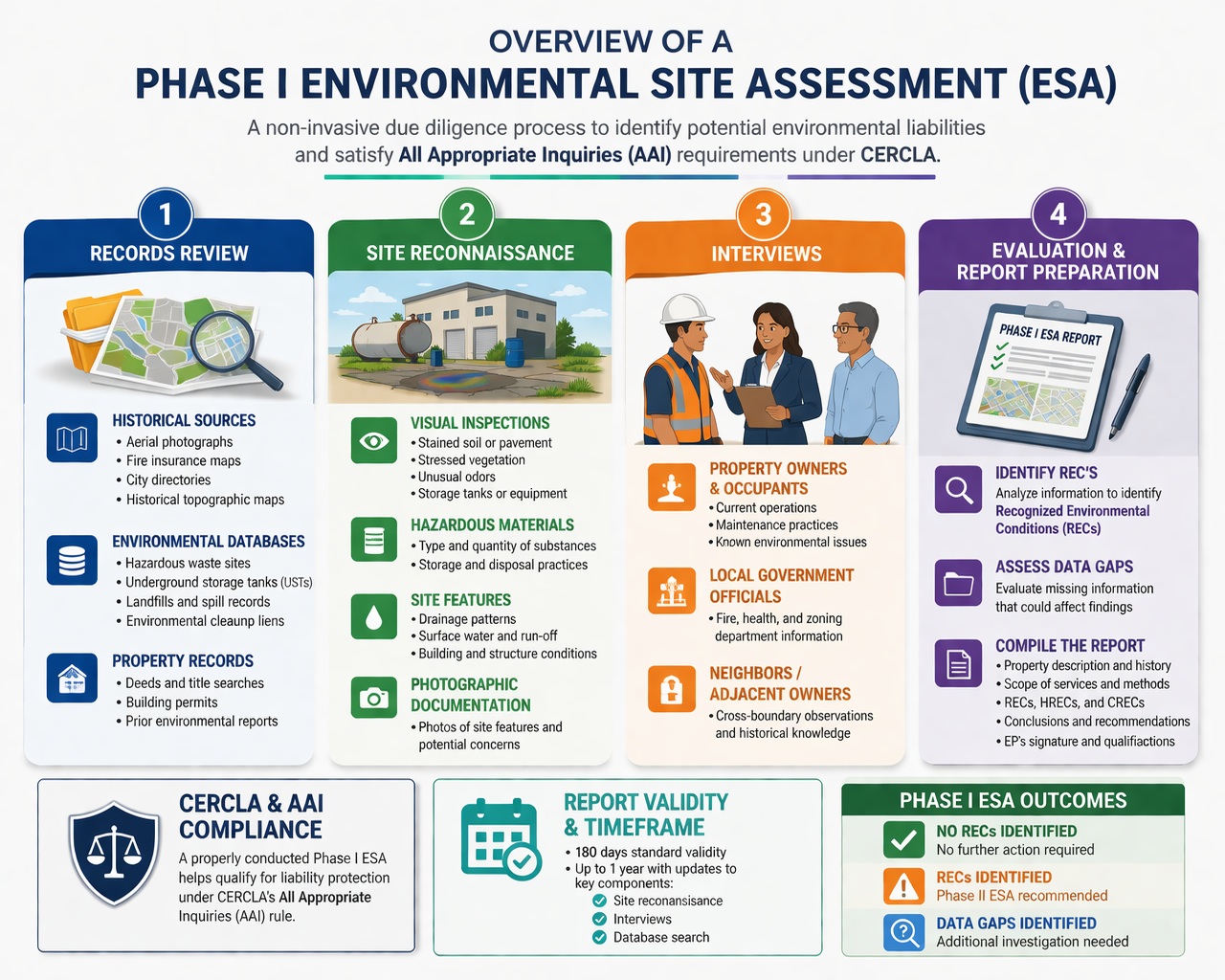
The Four Core Components of a Phase I ESA
A Phase I ESA consists of four essential components:
- Records Review
- Site Reconnaissance
- Interviews
- Evaluation and Report Preparation
Each plays a critical role in identifying potential environmental risks.
1. Records Review: Reconstructing Property History
The records review is one of the most critical steps in a Phase I ESA. It involves analyzing historical and regulatory information to identify past activities that may have caused contamination.
Historical Sources
The ASTM E1527-21 standard requires reviewing at least four historical sources, such as:
- Aerial photographs
- Fire insurance maps
- City directories
- Historical topographic maps
These sources help Environmental Professionals:
- Trace land use changes over time
- Identify previous industrial or commercial operations
- Detect potential contamination sources
Environmental Database Review
The EP searches multiple databases at the federal, provincial, and local levels to identify environmental concerns.
Common database findings include:
- Hazardous waste generators
- Underground storage tanks (USTs)
- Landfills and disposal sites
- Spill records
- Cleanup sites and environmental liens
This step also evaluates nearby properties, as contamination can migrate across boundaries.
Property Records Review
Additional documentation reviewed includes:
- Title records and deeds
- Building permits
- Zoning records
- Previous environmental reports
This helps establish ownership history and identify any previously documented environmental issues.
2. Site Reconnaissance: Visual Inspection of the Property
The site reconnaissance involves a physical inspection of the property and visual observation of adjacent areas.
Key Observations
Environmental Professionals look for signs of potential contamination, including:
- Stained soil or pavement
- Stressed or dead vegetation
- Unusual chemical odors
- Presence of drums, tanks, or containers
- Abandoned equipment or waste materials
Hazardous Materials Assessment
The EP evaluates:
- Storage conditions of hazardous substances
- Types and quantities of materials present
- Handling and disposal practices
Improper storage or handling can indicate potential environmental risk.
Site Features and Environmental Indicators
Additional observations include:
- Drainage patterns and surface water flow
- Low-lying areas where contaminants may accumulate
- Structural conditions of buildings
- Evidence of past site alterations
Photographic Documentation
Photographs are taken to:
- Document site conditions
- Support observations in the report
- Provide visual evidence of potential RECs
3. Interviews: Gathering First-Hand Knowledge
Interviews provide valuable qualitative insights that may not be captured in records or site inspections.
Key Interview Subjects
Property Owners and Occupants
- Current operations
- Maintenance practices
- Known environmental issues
Local Government Officials
- Fire departments
- Health departments
- Zoning authorities
These sources may provide information not found in databases.
Neighbors and Adjacent Property Owners
- Potential cross-boundary contamination
- Historical activities in the area
4. Evaluation and Report Preparation
After collecting all relevant information, the Environmental Professional evaluates the data to identify environmental risks.
Identifying Environmental Conditions
The EP classifies findings into:
- Recognized Environmental Conditions (RECs)
- Historical RECs (HRECs) (past issues resolved)
- Controlled RECs (CRECs) (managed with restrictions)
Data Gaps
Any missing or incomplete information is documented as a data gap. The EP must determine whether these gaps affect the ability to identify environmental risks.
Phase I ESA Report: What It Includes
The final Phase I ESA report is a comprehensive document that includes:
Property Description
- Location and boundaries
- Current use
- Surrounding land use
Scope of Services
- Methodology followed
- Sources reviewed
Findings
- Historical use summary
- Site observations
- Interview results
Environmental Conditions
- Identification and discussion of RECs, HRECs, and CRECs
Conclusions and Recommendations
- No further action required
- Additional investigation recommended (Phase II ESA)
Supporting Documentation
- Maps and figures
- Photographs
- Database search results
Professional Certification
- Environmental Professional’s qualifications
- Signature and certification
Phase I ESA Validity and Shelf Life
A Phase I ESA report is typically valid for:
- 180 days (6 months) for full compliance
- Up to 1 year, if certain components are updated
Key Components Requiring Updates
- Site reconnaissance
- Interviews
- Environmental database review
Failure to update these elements can render the report non-compliant with AAI requirements.
Common Recognized Environmental Conditions (RECs)
Understanding typical RECs helps stakeholders anticipate risks.
Examples of RECs
- Former gasoline stations
- Industrial manufacturing facilities
- Dry cleaning operations
- Waste disposal areas
- Leaking underground storage tanks
These conditions often trigger the need for a Phase II ESA.
Limitations of a Phase I ESA
While highly valuable, Phase I ESAs have limitations:
No Physical Testing
They do not confirm contamination.
Reliance on Available Data
Incomplete records can limit conclusions.
Potential for Data Gaps
Access restrictions or missing information may affect findings.
Because of these limitations, Phase I ESAs are often followed by Phase II investigations when risks are identified.
When Is a Phase II ESA Required?
A Phase II ESA is recommended when:
- RECs are identified
- Data gaps raise concerns
- Lenders or regulators require confirmation
Phase II ESAs involve:
- Soil sampling
- Groundwater testing
- Laboratory analysis
These steps confirm contamination and assess its extent.
Best Practices for Conducting a Phase I ESA
Follow ASTM Standards
Strict adherence to ASTM E1527-21 ensures defensibility.
Be Thorough in Records Review
Comprehensive research reduces uncertainty.
Document Everything
Clear documentation supports legal and regulatory acceptance.
Communicate Clearly
Translate technical findings into actionable insights for stakeholders.
Identify Data Gaps Early
Addressing gaps improves report quality and reliability.
The Role of Environmental Professionals (EPs)
Environmental Professionals are responsible for:
- Conducting assessments
- Interpreting data
- Applying professional judgment
- Ensuring compliance with standards
Their expertise ensures that ESAs are accurate, defensible, and actionable.
Technology in Modern Phase I ESAs
Modern ESAs increasingly use digital tools to improve efficiency and accuracy:
- GIS mapping and spatial analysis
- Digital database integration
- Automated reporting systems
- Cloud-based collaboration platforms
These technologies enhance:
- Data consistency
- Visualization
- Reporting speed
Conclusion: The Importance of Phase I ESAs
A Phase I Environmental Site Assessment is a critical tool for managing environmental risk in real estate and land development.
It provides:
- A structured approach to environmental due diligence
- Compliance with CERCLA and AAI requirements
- Early identification of potential environmental liabilities
- A foundation for informed decision-making
By identifying Recognized Environmental Conditions before a transaction is completed, Phase I ESAs help protect buyers, lenders, and developers from unexpected environmental costs and legal exposure.
For environmental professionals and stakeholders alike, mastering the Phase I ESA process is essential for navigating the complexities of modern property transactions.
👉 Learn more about our Automated Environmental Site Assessment Solution
Related Articles
- Key Uses of a Phase I Environmental Site Assessment
- Market for Phase I Environmental Site Assessments
- The Role of Historical Source Review in Phase I Environmental Site Assessments
- The Role of Environmental Database Reviews in Phase I Environmental Site Assessments
- The Review of Property Records in a Phase I Environmental Site Assessment
- The Role of Visual Inspections in a Phase I Environmental Site Assessment
- Identifying Hazardous Substances and Petroleum Products in a Phase I Environmental Site Assessment
- Documenting Drainage Patterns and Surface Water in a Phase I Environmental Site Assessment
- The Role of Photographs in Phase I Environmental Site Assessments
- The Use of Drones in a Phase I Environmental Site Assessment
- Conducting Interviews with Property Owners and Occupants for a Phase I ESA
- Conducting Interviews with Government Officials for a Phase I ESA
- Conducting Interviews with Neighbors for a Phase I ESA
- Key Components of a Phase I ESA Conclusion
- Key Distinctions Between ASTM E1527-21 and CSA Z768-01