

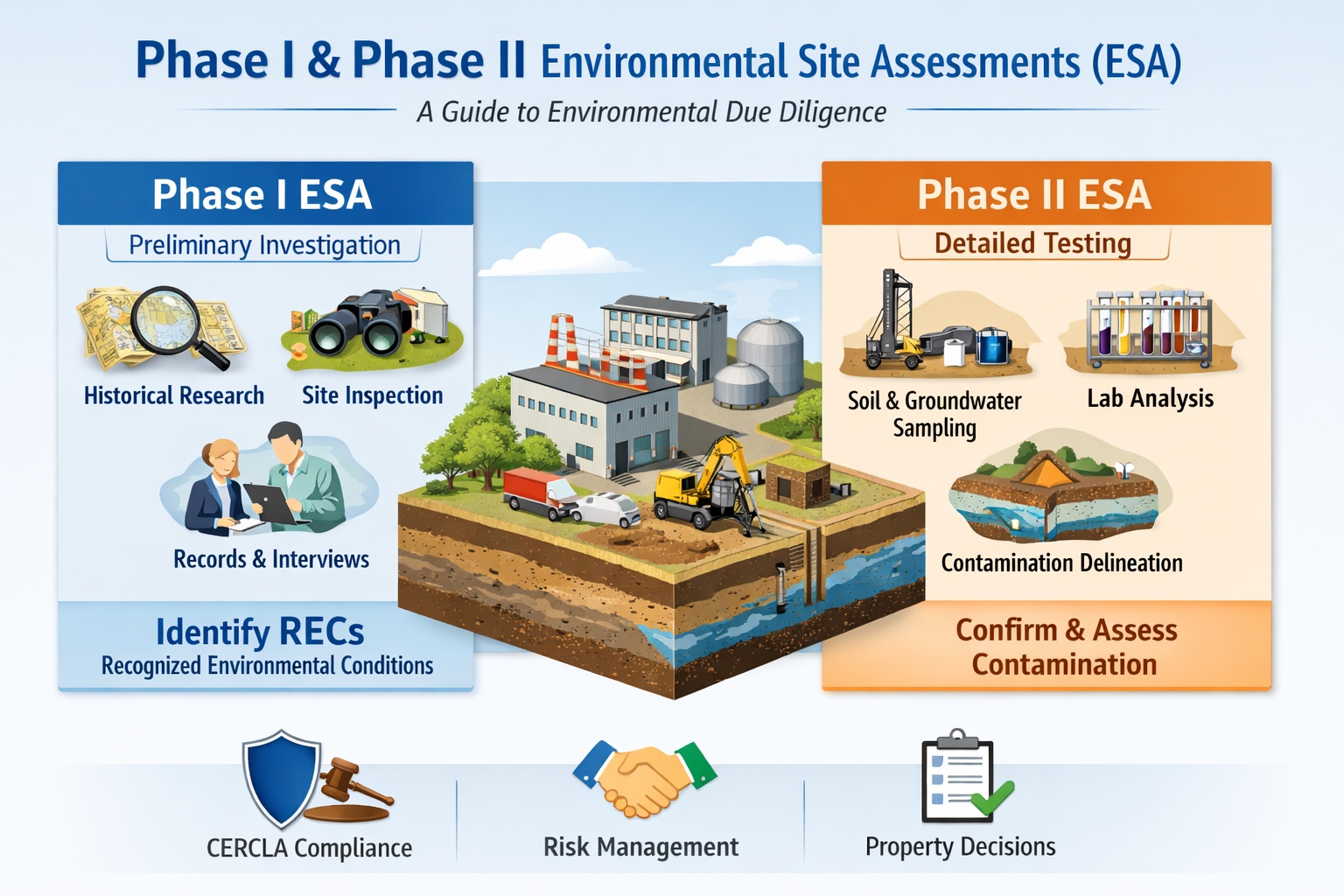
Environmental Site Assessments (ESAs) are a cornerstone of responsible real estate transactions, land development, and environmental risk management. Whether you are a developer, lender, environmental consultant, or property owner, understanding how Phase I and Phase II ESAs work—and why they matter—is essential.
These assessments are not just best practices; they are often legal safeguards. Under Comprehensive Environmental Response, Compensation, and Liability Act (CERCLA), parties involved in property transactions must perform All Appropriate Inquiries (AAI) to qualify for liability protections. ESAs provide the structured framework to meet that requirement.
This pillar guide delivers a comprehensive, practical breakdown of both Phase I and Phase II ESAs, including methodology, regulatory context, field procedures, reporting standards, and industry best practices.
Table of Contents
- What Is an Environmental Site Assessment?
- Regulatory Framework and AAI Requirements
- Phase I ESA: Purpose and Scope
- Phase I ESA Methodology (Step-by-Step)
- Recognized Environmental Conditions (RECs) Explained
- Phase II ESA: When and Why It’s Required
- Phase II ESA Investigation Methods
- Sampling, Laboratory Analysis, and Data Interpretation
- Reporting Standards and Documentation
- Risk Management and Decision-Making
- Common Challenges and Pitfalls
- Technology and Modern ESA Workflows
- Best Practices for Environmental Professionals
- Conclusion
What Is an Environmental Site Assessment?
An Environmental Site Assessment (ESA) is a structured process used to evaluate the environmental condition of a property and identify potential contamination risks.
ESAs are typically conducted during:
- Property transactions (acquisition or sale)
- Refinancing or lending
- Land development or rezoning
- Regulatory compliance reviews
The ESA process is divided into two primary phases:
Phase I ESA
- Non-invasive investigation
- Historical research and site inspection
- Identifies potential contamination risks
Phase II ESA
- Intrusive investigation
- Soil, groundwater, and vapor sampling
- Confirms presence and extent of contamination
Together, these phases provide a defensible, industry-standard approach to environmental due diligence.
Regulatory Framework and AAI Requirements
The ESA process is closely tied to CERCLA, a U.S. federal law governing contaminated site liability. While similar frameworks exist in Canada and internationally, CERCLA remains the benchmark for environmental due diligence practices.
Key Concept: All Appropriate Inquiries (AAI)
AAI is a legal standard requiring prospective purchasers to:
- Investigate past and present property uses
- Identify environmental contamination risks
- Demonstrate due diligence prior to acquisition
Failure to meet AAI requirements can result in:
- Liability for cleanup costs
- Legal exposure
- Financial risk
Standards and Guidelines
Phase I ESAs are typically conducted in accordance with:
- ASTM E1527-21 (current standard)
- CSA Z768 (Canada)
Phase II ESAs often follow:
- ASTM E1903
- CSA Z769 (Canada)
These standards ensure consistency, defensibility, and regulatory acceptance.
Phase I ESA: Purpose and Scope
The primary objective of a Phase I ESA is to identify Recognized Environmental Conditions (RECs).
A Phase I ESA answers the question:
Is there a reasonable likelihood that contamination exists on this property?
Key Characteristics
- Non-intrusive (no sampling)
- Relies on historical and observational data
- Focuses on risk identification—not confirmation
Typical Outcomes
- No RECs identified → No further action required
- RECs identified → Phase II ESA recommended
- Data gaps → Additional investigation needed
Phase I ESA Methodology (Step-by-Step)
A defensible Phase I ESA follows a standardized workflow:
Records Review
This step examines historical and regulatory data sources, including:
- Aerial photographs
- Fire insurance maps
- Topographic maps
- City directories
- Environmental databases
- Spill records and permits
The goal is to reconstruct the property’s historical use and identify potential contamination sources.
Site Reconnaissance
A physical inspection of the property is conducted to observe:
- Stained soils or distressed vegetation
- Storage tanks (aboveground or underground)
- Chemical storage areas
- Waste disposal practices
- Evidence of spills or leaks
This visual assessment provides real-world validation of historical findings.
Interviews
Interviews are conducted with:
- Current and past property owners
- Site operators or facility managers
- Local government officials (if applicable)
These conversations can reveal undocumented activities or incidents.
Regulatory Database Review
Environmental databases are reviewed to identify:
- Contaminated sites nearby
- Registered underground storage tanks (USTs)
- Hazardous waste generators
- Spill incidents
Proximity to contaminated sites can indicate potential migration risks.
Report Preparation
The Phase I ESA report includes:
- Property description
- Historical use analysis
- Site observations
- Identified RECs
- Conclusions and recommendations
This report must be clear, defensible, and compliant with applicable standards.
Recognized Environmental Conditions (RECs) Explained
RECs are central to the ESA process.
Definition
A REC is:
The presence or likely presence of hazardous substances or petroleum products under conditions indicating a release or potential release.
Types of RECs
- REC: Active or likely contamination
- Historical REC (HREC): Past contamination remediated to standards
- Controlled REC (CREC): Contamination managed with restrictions
Examples
- Former gas stations
- Industrial operations
- Dry cleaners
- Waste disposal areas
- Underground storage tanks
Identifying RECs determines whether a Phase II ESA is necessary.
Phase II ESA: When and Why It’s Required
A Phase II ESA is conducted when a Phase I identifies RECs.
Purpose
To confirm:
- Whether contamination exists
- What contaminants are present
- The extent and concentration of contamination
Key Difference from Phase I
| Phase I ESA | Phase II ESA |
|---|---|
| Non-invasive | Intrusive |
| Qualitative | Quantitative |
| Risk identification | Risk confirmation |
Phase II ESA Investigation Methods
Phase II investigations involve direct sampling and testing.
Soil Sampling
- Boreholes drilled using augers or direct-push rigs
- Samples collected at various depths
- Analyzed for hydrocarbons, metals, VOCs, etc.
Groundwater Sampling
- Monitoring wells installed
- Water samples collected
- Used to assess contaminant migration
Soil Vapor Intrusion Testing
- Evaluates vapor migration into buildings
- Important for volatile contaminants
Geophysical Surveys
- Detect buried tanks or drums
- Non-invasive but supports intrusive work
Test Pits and Excavations
- Used for shallow investigations
- Provides visual confirmation of contamination
Sampling, Laboratory Analysis, and Data Interpretation
Laboratory Analysis
Samples are analyzed for contaminants such as:
- Petroleum hydrocarbons (PHCs)
- Volatile organic compounds (VOCs)
- Semi-volatile organic compounds (SVOCs)
- Heavy metals
Accredited laboratories ensure data reliability and regulatory acceptance.
Data Interpretation
Results are compared against:
- Federal or provincial standards
- Site-specific criteria
- Risk-based thresholds
This determines whether contamination exceeds acceptable limits.
Conceptual Site Model (CSM)
A CSM is developed to illustrate:
- Sources of contamination
- Pathways (soil, groundwater, vapor)
- Receptors (humans, ecosystems)
The CSM guides further investigation or remediation.
Reporting Standards and Documentation
A Phase II ESA report typically includes:
- Investigation objectives and scope
- Field methods and procedures
- Borehole logs and well construction details
- Laboratory results
- Site maps and cross-sections
- Risk evaluation
- Conclusions and recommendations
Clear documentation is essential for regulatory review and legal defensibility.
Risk Management and Decision-Making
Once contamination is confirmed, stakeholders must decide:
Possible Outcomes
- No action required (below standards)
- Risk management plan
- Remediation required
- Property value renegotiation
- Transaction termination
Remediation Options
- Excavation and disposal
- Soil vapor extraction
- Pump-and-treat systems
- Bioremediation
Environmental consultants play a critical role in guiding these decisions.
Common Challenges and Pitfalls
Even experienced professionals encounter challenges:
Data Gaps
- Missing historical records
- Incomplete site access
Uncertainty
- Complex subsurface conditions
- Variable contaminant distribution
Regulatory Differences
- Varying standards by jurisdiction
Cost Constraints
- Limited budgets impacting scope
Mitigating these risks requires experience, planning, and clear communication.
Technology and Modern ESA Workflows
Modern ESAs increasingly rely on digital tools and automation.
Key Advancements
- Borehole logging software
- GIS-based mapping
- Automated reporting tools
- Cloud data management
These technologies improve:
- Accuracy
- Efficiency
- Data visualization
- Collaboration
For firms managing large volumes of environmental data, integrated platforms can significantly streamline workflows.
Best Practices for Environmental Professionals
To ensure high-quality ESA outcomes:
Follow Standards Rigorously
Adhere to ASTM and CSA guidelines for defensibility.
Maintain Clear Documentation
Every observation and decision should be traceable.
Develop Strong Conceptual Models
A solid CSM improves investigation accuracy.
Communicate Clearly with Stakeholders
Translate technical findings into actionable insights.
Use Technology Strategically
Leverage tools to reduce errors and increase efficiency.
Conclusion
Phase I and Phase II Environmental Site Assessments are indispensable tools in modern real estate and land management. They provide a structured, defensible approach to identifying and managing environmental risks, ensuring compliance with regulatory frameworks like CERCLA and meeting AAI requirements.
A Phase I ESA serves as the critical first step—identifying potential risks through historical and visual analysis. When risks are identified, a Phase II ESA provides the scientific confirmation needed to quantify contamination and guide decision-making.
Together, these assessments protect:
- Buyers from unforeseen liabilities
- Lenders from financial risk
- Property owners from regulatory exposure
As environmental regulations evolve and land use becomes more complex, the importance of ESAs will only continue to grow. Professionals who master these processes—and leverage modern tools to enhance them—will be best positioned to deliver value, mitigate risk, and support sustainable development.
Learn More
Related Articles
- Overview of a Phase I Environmental Site Assessment (ESA): A Complete Guide for Due Diligence
- Key Uses of a Phase I Environmental Site Assessment
- Market for Phase I Environmental Site Assessments
- The Role of Historical Source Review in Phase I Environmental Site Assessments
- The Role of Environmental Database Reviews in Phase I Environmental Site Assessments
- The Review of Property Records in a Phase I Environmental Site Assessment
- The Role of Visual Inspections in a Phase I Environmental Site Assessment
- Identifying Hazardous Substances and Petroleum Products in a Phase I Environmental Site Assessment
- Documenting Drainage Patterns and Surface Water in a Phase I Environmental Site Assessment
- The Role of Photographs in Phase I Environmental Site Assessments
- The Use of Drones in a Phase I Environmental Site Assessment
- Conducting Interviews with Property Owners and Occupants for a Phase I ESA
- Conducting Interviews with Government Officials for a Phase I ESA
- Conducting Interviews with Neighbors for a Phase I ESA
- Key Components of a Phase I ESA Conclusion
- Key Distinctions Between ASTM E1527-21 and CSA Z768-01
- Methodology for Conducting a Phase II Environmental Site Assessment (ESA)
- Key Uses of a Phase II Environmental Site Assessment (ESA) Report
- Market Drivers and Trends for Phase II Environmental Site Assessments
- Role of Reviewing Existing Data for a Phase II Environmental Site Assessment
- Methodology for Identifying Contaminants of Concern (COCs) for a Phase II Environmental Site Assessment
- Key Components of a Phase II ESA Sampling Plan
- Key Components of a Phase II ESA Health and Safety Plan (HASP)
- Key Considerations for Permit Acquisition for a Phase II ESA
- The Utility Clearance Process for a Phase II ESA
- Drilling and Sampling for a Phase II ESA: Methods, Equipment, and Best Practices
- Installation of Monitoring Wells for a Phase II Environmental Site Assessment (ESA)
- Phase II ESA Quality Control Procedures: Ensuring Accurate, Defensible Environmental Data
- Sample Handling Procedures for a Phase II ESA: Ensuring Data Integrity from Field to Laboratory
- Laboratory Analysis and Data Interpretation for a Phase II ESA
- Reporting and Recommendations for a Phase II Environmental Site Assessment (ESA)
- Differences Between a Phase II ESA in Canada and the United States