

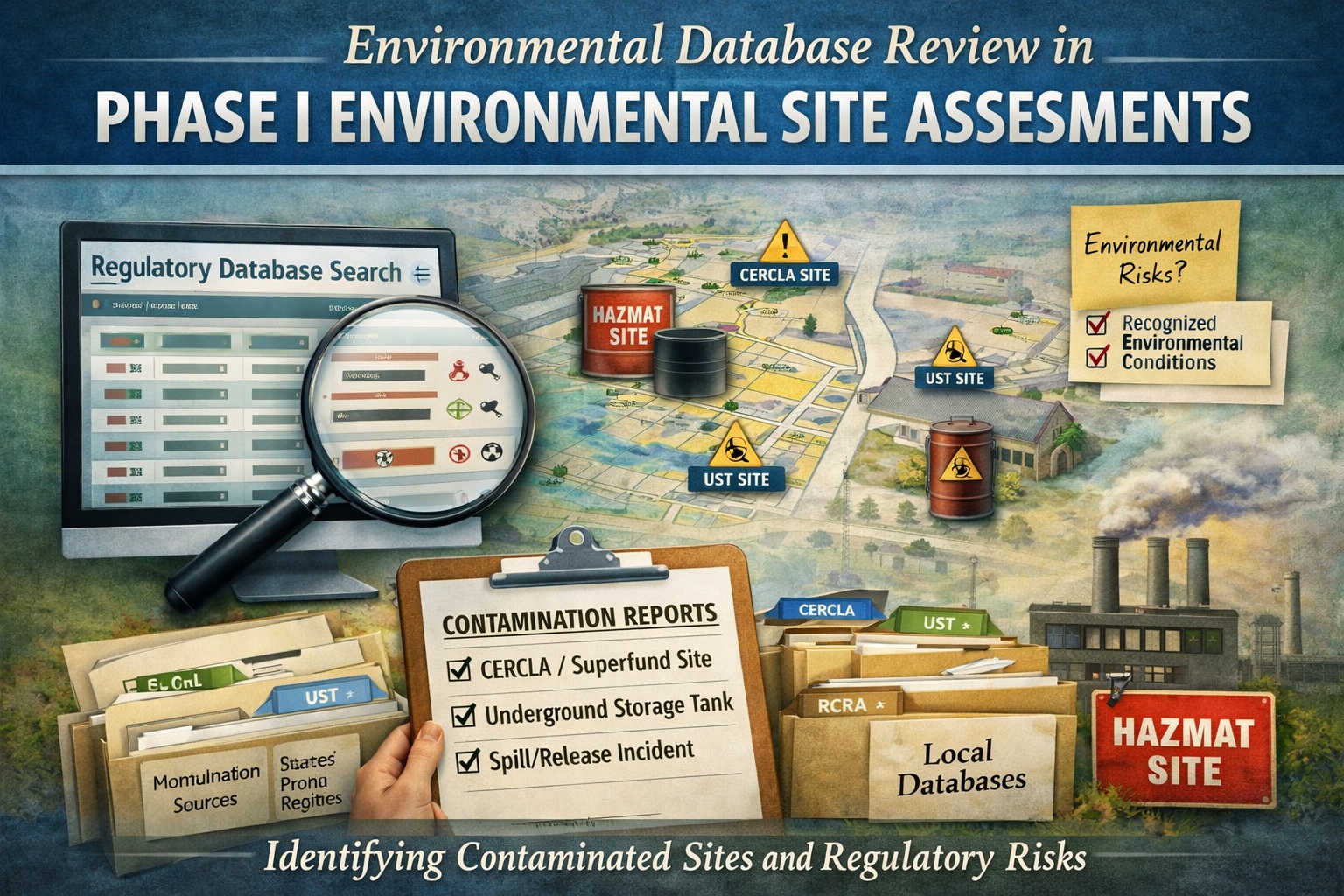
A Phase I Environmental Site Assessment (ESA) is a cornerstone of environmental due diligence in commercial real estate. While site inspections and historical research reveal visible and past conditions, environmental database reviews provide a regulatory and records-based perspective on potential contamination risks.
Environmental database reviews involve the systematic examination of federal, provincial/state, and local regulatory databases to identify known or suspected environmental issues associated with a property and its surroundings. These databases contain records of spills, hazardous waste handling, underground storage tanks, and contaminated sites—information that is critical for identifying Recognized Environmental Conditions (RECs).
This article explores the objective and scope of environmental database reviews, the key databases consulted, how findings are analyzed and interpreted, and how results are reported within a Phase I ESA.
Objective and Scope of Environmental Database Reviews
The primary objective of an environmental database review is to identify known environmental concerns associated with a property and nearby sites based on regulatory records.
Supporting Environmental Due Diligence
Database reviews are essential for:
- Identifying properties with documented contamination
- Verifying compliance with environmental regulations
- Supporting informed decision-making in transactions
They complement other ESA components by providing documented evidence of environmental issues.
Identifying Recognized Environmental Conditions (RECs)
Environmental database reviews play a direct role in identifying:
- Active or historical contamination
- Sites with hazardous substance releases
- Properties requiring remediation
These findings contribute to the determination of RECs, which are central to the Phase I ESA process.
Meeting Regulatory Requirements
In the United States, database reviews are required to meet All Appropriate Inquiry (AAI) standards under CERCLA.
Similarly, in Canada and other jurisdictions:
- Regulatory databases support environmental compliance
- Government records provide transparency on site conditions
Defining the Scope
Database reviews typically include:
- The subject property
- Adjacent properties
- A defined search radius (e.g., 0.25 to 1 mile/km depending on database type)
The scope ensures that both on-site and off-site risks are evaluated.
Addressing Off-Site Risk
Contamination can migrate beyond property boundaries through:
- Groundwater flow
- Soil transport
- Air dispersion
Database reviews help identify off-site sources that may impact the subject property.
Key Databases Reviewed
A comprehensive Phase I ESA includes a review of multiple environmental databases at different regulatory levels.
Federal Databases (United States)
Key federal databases include:
- National Priorities List (NPL) – Sites identified for long-term remediation under the Superfund program
- CERCLIS / Superfund Enterprise Management System (SEMS) – Records of hazardous waste sites investigated by the EPA
- Resource Conservation and Recovery Act (RCRA) databases – Facilities that generate, transport, or dispose of hazardous waste
- Emergency Response Notification System (ERNS) – Records of reported spills and releases
These databases identify high-priority and regulated sites.
Provincial and State Databases
In Canada and the U.S., provincial/state databases provide more localized information.
Examples include:
- Contaminated sites registries
- Spill reporting databases
- Underground storage tank (UST) records
- Brownfield inventories
These databases often contain more detailed and current information than federal sources.
Local and Municipal Records
Local databases and records may include:
- Fire department records
- Health department files
- Local environmental agency reports
These sources can provide site-specific insights not captured elsewhere.
Underground Storage Tank (UST) Databases
UST databases track:
- Registered tanks
- Leaks and releases
- Tank closures and removals
USTs are a common source of contamination, particularly at:
- Gas stations
- Industrial facilities
Hazardous Waste and Generator Databases
Facilities that handle hazardous materials are tracked in:
- RCRA generator databases
- Waste management records
These databases help identify:
- Facilities with potential contamination risks
- Improper handling or disposal practices
Brownfield and Voluntary Cleanup Programs
These databases include:
- Sites undergoing remediation
- Properties enrolled in cleanup programs
They indicate:
- Known contamination
- Ongoing environmental management
Differences by Jurisdiction
The specific databases reviewed vary depending on location. Environmental professionals must:
- Understand regional regulatory frameworks
- Access relevant databases
- Interpret results within local context
Analysis and Interpretation of Database Findings
Reviewing databases is not just about identifying listed sites—it requires careful analysis and interpretation.
Screening and Filtering Results
Database searches often return multiple listings. Environmental professionals must:
- Identify relevant records
- Exclude unrelated sites
- Focus on listings within the defined search radius
Determining Relevance to the Subject Property
Not all database listings pose a risk.
Key considerations include:
- Distance from the subject property
- Type of contamination
- Status of the site (active, closed, remediated)
Evaluating Migration Potential
For off-site listings, professionals assess whether contaminants could migrate to the subject property based on:
- Topography
- Groundwater flow direction
- Proximity
Assessing Regulatory Status
The status of a listed site is critical:
- Active sites may pose ongoing risk
- Closed sites may still have residual contamination
- Remediated sites may present minimal risk
Identifying Data Gaps and Limitations
Database reviews may have limitations:
- Incomplete records
- Delayed updates
- Missing historical data
These gaps must be:
- Identified
- Documented
- Considered in conclusions
Integration with Other ESA Components
Database findings are integrated with:
- Historical source review
- Site inspection
- Interviews
This combined analysis provides a comprehensive risk assessment.
Determining Recognized Environmental Conditions (RECs)
Based on database findings, environmental professionals determine:
- Whether RECs are present
- Whether potential RECs exist
- Whether conditions have been resolved
This is a key outcome of the Phase I ESA.
Challenges in Environmental Database Reviews
Despite their importance, database reviews present several challenges.
Data Accuracy and Completeness
Not all environmental issues are reported or recorded. Some risks may:
- Pre-date regulations
- Be undocumented
Interpretation Complexity
Understanding database entries requires:
- Technical knowledge
- Regulatory expertise
- Professional judgment
Variability Across Jurisdictions
Different regions have:
- Different databases
- Different reporting standards
This variability complicates analysis.
Over-Reliance on Listings
A database listing does not automatically indicate:
- Current risk
- Significant contamination
Context is essential.
Conclusion and Reporting
Environmental database reviews are a critical component of Phase I ESAs, providing regulatory insight into environmental conditions that may affect a property.
Clear Documentation
The Phase I ESA report must:
- List databases reviewed
- Summarize findings
- Identify relevant sites
Supporting Risk Assessment
Database findings contribute directly to:
- Identification of RECs
- Recommendations for further investigation
- Risk evaluation
Communicating Findings
Reports must present findings in a way that is:
- Clear
- Concise
- Actionable
Stakeholders rely on this information to make informed decisions.
The Broader Value
Environmental database reviews:
- Enhance due diligence
- Reduce uncertainty
- Protect stakeholders from liability
They provide a regulatory lens that complements historical and physical site assessments.
Final Thoughts
The role of environmental database reviews in Phase I Environmental Site Assessments is both essential and strategic. By identifying known environmental issues and providing regulatory context, these reviews ensure that stakeholders have a complete understanding of potential risks.
When combined with historical research and site inspections, database reviews transform a Phase I ESA into a comprehensive tool for environmental risk management and informed decision-making.
In an increasingly complex regulatory environment, the ability to accurately interpret and apply environmental database information is a key differentiator—one that can significantly impact the success of real estate transactions, development projects, and long-term asset management.
👉 Learn more about our Automated Environmental Site Assessment Solution
Related Articles
- Overview of a Phase I Environmental Site Assessment (ESA): A Complete Guide for Due Diligence
- Key Uses of a Phase I Environmental Site Assessment
- Market for Phase I Environmental Site Assessments
- The Role of Historical Source Review in Phase I Environmental Site Assessments
- The Review of Property Records in a Phase I Environmental Site Assessment
- The Role of Visual Inspections in a Phase I Environmental Site Assessment
- Identifying Hazardous Substances and Petroleum Products in a Phase I Environmental Site Assessment
- Documenting Drainage Patterns and Surface Water in a Phase I Environmental Site Assessment
- The Role of Photographs in Phase I Environmental Site Assessments
- The Use of Drones in a Phase I Environmental Site Assessment
- Conducting Interviews with Property Owners and Occupants for a Phase I ESA
- Conducting Interviews with Government Officials for a Phase I ESA
- Conducting Interviews with Neighbors for a Phase I ESA
- Key Components of a Phase I ESA Conclusion
- Key Distinctions Between ASTM E1527-21 and CSA Z768-01