

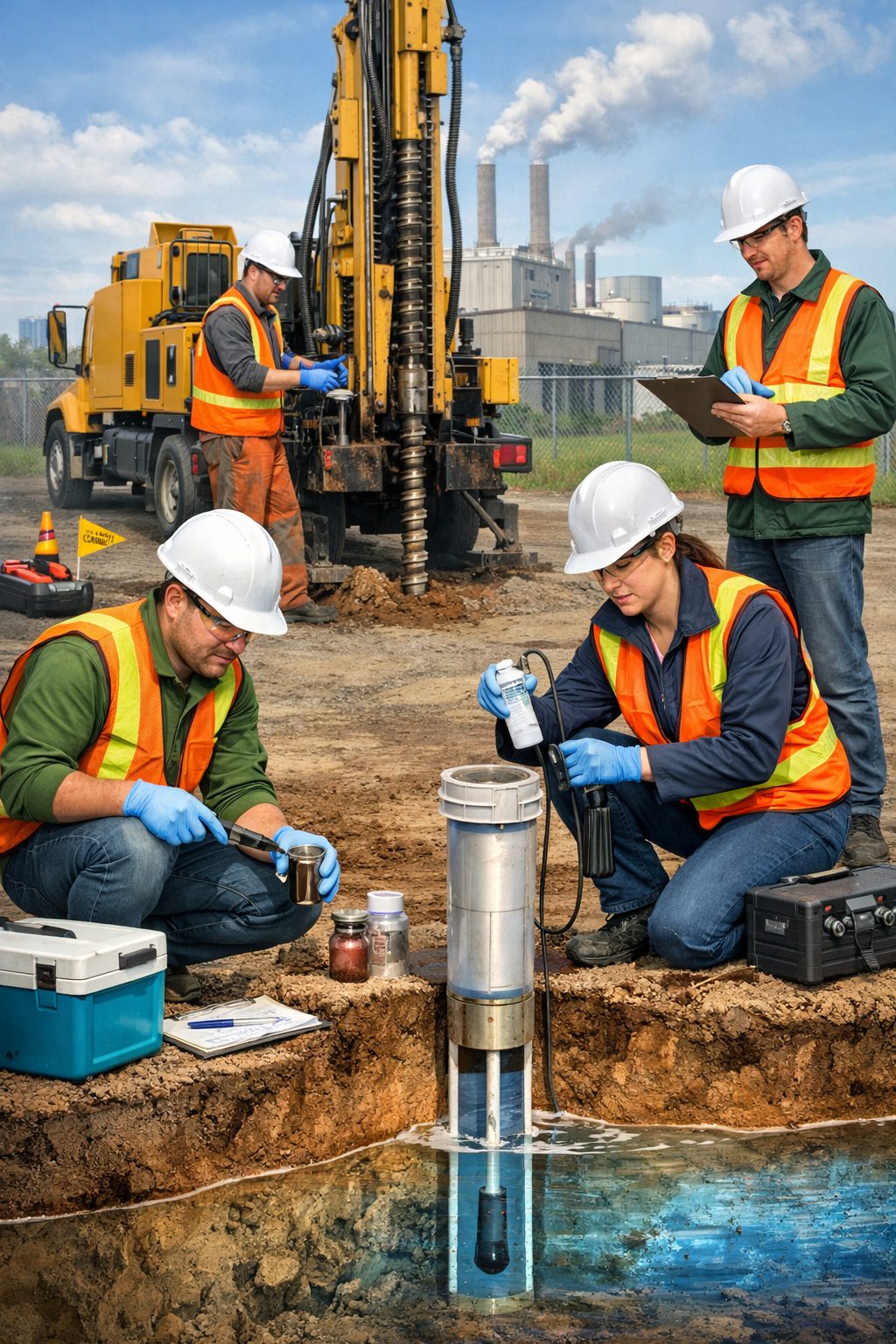
A Phase II Environmental Site Assessment (ESA) represents a critical transition from historical review to scientific verification. While a Phase I ESA identifies Areas of Potential Environmental Concern (APECs), it is the Phase II ESA that confirms whether contamination is actually present, how severe it is, and how far it has spread. At the heart of this process lies the sampling plan—a technically rigorous, site-specific roadmap that directs all intrusive investigation activities.
Prepared by a qualified environmental professional, the sampling plan must align with recognized standards such as ASTM International (e.g., ASTM E1903) or jurisdiction-specific regulations like Ontario Regulation 153/04. A well-designed plan ensures defensible, high-quality data that supports regulatory compliance, risk assessment, and informed decision-making.
This article provides a comprehensive breakdown of the key components of a Phase II ESA sampling plan, along with practical insights into implementation and flexibility.
Objectives of the Investigation
The foundation of any effective sampling plan is a clear set of objectives. These objectives are derived directly from the findings of the Phase I ESA and define the scope and direction of the investigation.
Key Goals:
- Confirm or refute the presence of contaminants of concern (COCs)
- Delineate the vertical and horizontal extent of contamination
- Characterize environmental media (soil, groundwater, sediment, soil vapor)
- Compare analytical results to applicable regulatory standards
Objectives must be specific, measurable, and aligned with regulatory frameworks. For example, in Ontario, results are typically compared to standards under O. Reg. 153/04 for the intended land use (e.g., residential, commercial, industrial).
A poorly defined objective can lead to insufficient sampling, wasted resources, or inconclusive results—making this step critical.
Site-Specific Health and Safety Plan (HASP)
A Health and Safety Plan (HASP) is mandatory for all Phase II ESA fieldwork. Intrusive investigations involve physical hazards, chemical exposure, and environmental risks that must be proactively managed.
Key Elements:
- Identification of site hazards (chemical, physical, biological)
- Personal protective equipment (PPE) requirements
- Emergency procedures and contact information
- Air monitoring protocols (if applicable)
- Decontamination procedures
The HASP ensures compliance with occupational health and safety regulations while protecting field personnel. It is not a generic document—each site requires a customized HASP based on known or suspected hazards.
Utility Clearance and Subsurface Investigation Safety
Before any drilling or excavation begins, utility clearance is essential to prevent damage to underground infrastructure and ensure worker safety.
Common Practices:
- Requesting locates from utility providers
- Using ground-penetrating radar (GPR)
- Reviewing site drawings and as-built plans
- Marking utilities clearly on-site
Failure to properly identify subsurface utilities can result in serious accidents, project delays, and legal liabilities. This step is both a safety requirement and a regulatory expectation.
Sampling Locations and Frequency
Strategic selection of sampling locations is one of the most technically important aspects of a Phase II ESA.
Considerations:
- Locations of APECs identified in Phase I ESA
- Historical site activities (e.g., fuel storage, industrial processes)
- Geological and hydrogeological conditions
- Potential contaminant migration pathways
Typical Sampling Points:
- Boreholes for soil sampling
- Monitoring wells for groundwater sampling
- Test pits for shallow investigations
- Soil vapor probes for volatile contaminants
A detailed site map is included in the sampling plan, showing:
- Exact coordinates of sampling points
- Proposed depths
- Rationale for placement
Sampling frequency must be sufficient to characterize contamination without being excessive. This balance requires professional judgment and experience.
Sampling Methodology
The sampling methodology outlines how samples will be collected, ensuring consistency, reliability, and compliance with standards.
Common Techniques:
- Direct Push Technology (DPT): სწრაფ and minimally invasive, ideal for soil and groundwater
- Hollow Stem Auger Drilling: Suitable for deeper boreholes and well installation
- Test Pitting: Effective for shallow soil investigations
Key Protocols:
- Use of appropriate sampling tools (e.g., split spoon samplers)
- Decontamination of equipment between samples
- Avoidance of cross-contamination
- Proper sample labeling and logging
The chosen methodology must align with site conditions and the physical/chemical properties of the contaminants.
Sample Handling and Preservation
Maintaining sample integrity is critical for accurate laboratory analysis. Improper handling can invalidate results.
Best Practices:
- Use of appropriate containers (e.g., glass vials for VOCs)
- Preservation techniques (e.g., cooling to ≤4°C)
- Adherence to maximum holding times
- Avoidance of sample disturbance or exposure
For example:
- Volatile organic compounds (VOCs) often require methanol-preserved vials
- Metals samples may require acid preservation
Strict adherence to these protocols ensures defensible data.
Laboratory Analysis and Parameters
The sampling plan must clearly define:
- Which contaminants will be analyzed
- Which analytical methods will be used
Considerations:
- COCs identified in Phase I ESA
- Regulatory requirements
- Site history and potential contamination sources
Laboratories must be accredited and use validated analytical methods (e.g., EPA or equivalent methods recognized in Canada).
Common Analytical Parameters:
- Petroleum hydrocarbons (PHCs)
- Volatile organic compounds (VOCs)
- Polycyclic aromatic hydrocarbons (PAHs)
- Heavy metals
The selection of parameters must align with both regulatory standards and the conceptual site model.
Quality Assurance / Quality Control (QA/QC)
QA/QC procedures are essential to ensure data reliability and defensibility.
Types of QA/QC Samples:
- Field duplicates: Assess sampling precision
- Trip blanks: Detect contamination during transport
- Equipment blanks: Verify decontamination effectiveness
- Field blanks: Identify ambient contamination
These controls help identify errors or contamination introduced during sampling, handling, or analysis.
Without QA/QC, even technically correct sampling can produce unreliable results.
Documentation and Reporting
Comprehensive documentation is required to support the findings of a Phase II ESA.
Key Documentation:
- Field notes and observations
- Borehole logs and stratigraphy
- Groundwater monitoring data
- Chain-of-custody forms
- Laboratory certificates of analysis
Final Report Must Include:
- Summary of objectives and methods
- Site conditions and observations
- Analytical results and comparisons to standards
- Interpretation of findings
- Conclusions and recommendations
Reports must comply with standards such as ASTM E1903 or jurisdictional requirements like O. Reg. 153/04.
Implementation and Flexibility in the Field
While the sampling plan provides a structured approach, Phase II ESA investigations are inherently dynamic.
Why Flexibility Matters:
- Unexpected soil conditions may be encountered
- Contamination may extend beyond anticipated areas
- Field observations may contradict initial assumptions
Qualified professionals must be prepared to:
- Adjust sampling locations
- Increase sampling density
- Modify analytical parameters
This iterative process ensures that the investigation fully characterizes the site, rather than strictly adhering to an outdated plan.
Integration with Conceptual Site Model (CSM)
A strong sampling plan is grounded in a Conceptual Site Model (CSM), which describes:
- Sources of contamination
- Pathways of migration
- Receptors (e.g., humans, ecosystems)
The CSM evolves as new data is collected, guiding decisions throughout the Phase II ESA.
Common Challenges and Best Practices
Challenges:
- Limited site access
- Complex geology or hydrogeology
- Mixed contaminant types
- Budget constraints
Best Practices:
- Use multiple lines of evidence
- Prioritize high-risk APECs
- Maintain clear communication with stakeholders
- Document all decisions and deviations
A proactive and adaptive approach leads to more accurate and defensible results.
Conclusion
A Phase II ESA sampling plan is far more than a procedural document—it is the scientific backbone of environmental site investigation. Each component, from clearly defined objectives to rigorous QA/QC protocols, plays a vital role in ensuring that the data collected is accurate, reliable, and actionable.
By adhering to recognized standards such as those from ASTM International and regulatory frameworks like Ontario Regulation 153/04, environmental professionals can deliver high-quality assessments that support sound decision-making.
Ultimately, the goal is clear: to fully characterize environmental conditions, protect human health and the environment, and determine the appropriate path forward—whether that involves redevelopment, risk management, or remediation.
A well-executed sampling plan ensures that this goal is achieved with confidence, precision, and regulatory compliance.
👉 Learn more about our Automated Environmental Site Assessment Solution
Related Articles
- Methodology for Conducting a Phase II Environmental Site Assessment (ESA)
- Key Uses of a Phase II Environmental Site Assessment (ESA) Report
- Market Drivers and Trends for Phase II Environmental Site Assessments
- Role of Reviewing Existing Data for a Phase II Environmental Site Assessment
- Methodology for Identifying Contaminants of Concern (COCs) for a Phase II Environmental Site Assessment
- Key Components of a Phase II ESA Health and Safety Plan (HASP)
- Key Considerations for Permit Acquisition for a Phase II ESA
- The Utility Clearance Process for a Phase II ESA
- Drilling and Sampling for a Phase II ESA: Methods, Equipment, and Best Practices
- Installation of Monitoring Wells for a Phase II Environmental Site Assessment (ESA)
- Phase II ESA Quality Control Procedures: Ensuring Accurate, Defensible Environmental Data
- Sample Handling Procedures for a Phase II ESA: Ensuring Data Integrity from Field to Laboratory
- Laboratory Analysis and Data Interpretation for a Phase II ESA
- Reporting and Recommendations for a Phase II Environmental Site Assessment (ESA)
- Differences Between a Phase II ESA in Canada and the United States