

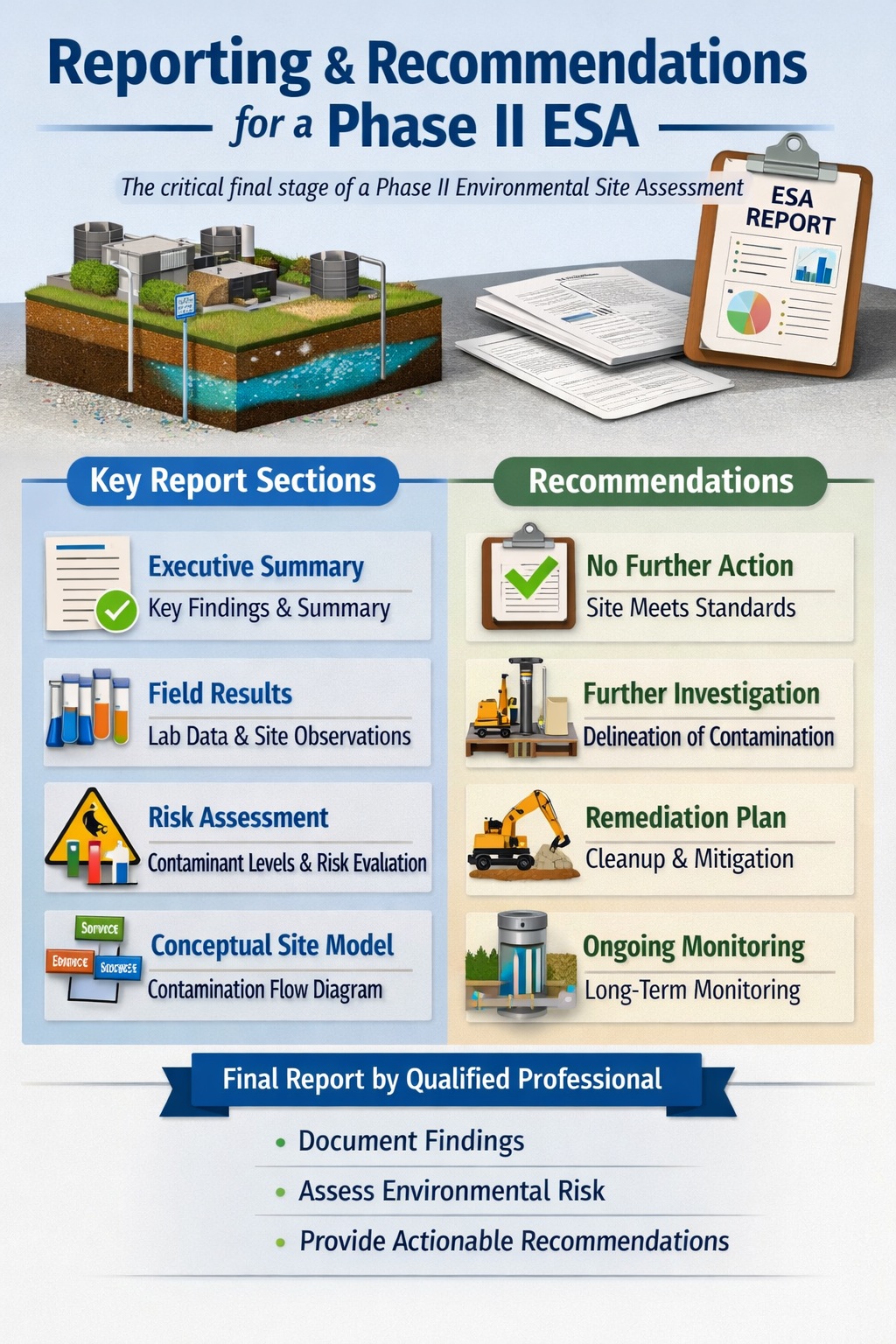
The reporting and recommendations stage of a Phase II Environmental Site Assessment (ESA) represents the culmination of all investigative work. It is where raw field data, laboratory results, and professional interpretation are synthesized into a defensible, decision-making document. This final report not only communicates findings but also establishes the environmental status of a property and defines the path forward—whether that involves closure, further investigation, remediation, or long-term monitoring.
Prepared in accordance with recognized standards such as ASTM E1903 and Ontario Regulation 153/04, the Phase II ESA report must withstand regulatory scrutiny, support legal and financial decisions, and provide clarity for stakeholders including property owners, developers, lenders, and regulators.
The Purpose of Phase II ESA Reporting
A Phase II ESA report serves several critical functions:
- Documentation of Investigation Activities
It records all fieldwork, sampling methodologies, and analytical procedures undertaken during the assessment. - Data Interpretation and Validation
It transforms laboratory data into meaningful conclusions regarding contamination presence, extent, and risk. - Regulatory Compliance
It ensures alignment with applicable environmental standards and reporting requirements. - Decision-Making Framework
It provides clear, actionable recommendations based on scientific evidence and professional judgment.
Ultimately, the report must be signed and sealed by a qualified professional, such as a Professional Geoscientist (P.Geo.) or Professional Engineer (P.Eng.), confirming accountability and technical integrity.
Key Components of a Phase II ESA Report
A well-structured report follows a logical format that communicates findings clearly and comprehensively.
Executive Summary
The Executive Summary is often the most widely read section of the report. It provides a concise, non-technical overview of the entire investigation and is tailored for stakeholders who may not have a technical background.
Key elements include:
- Purpose and scope of the investigation
- Summary of field activities
- Key findings, including any contamination identified
- Regulatory exceedances (if applicable)
- High-level conclusions
- Primary recommendations
A strong Executive Summary allows readers to quickly understand the environmental condition of the site without needing to review the full report.
Site Description
This section provides context for interpreting environmental data. It describes both natural and built features of the site, including:
- Geology: Soil stratigraphy, fill materials, and native deposits
- Hydrogeology: Depth to groundwater, flow direction, and hydraulic conditions
- Topography: Surface elevation and drainage characteristics
- Infrastructure: Buildings, underground utilities, and paved areas
Understanding these characteristics is essential for identifying contaminant migration pathways and potential receptors.
Scope of Work
The Scope of Work outlines how the investigation was designed and executed. It demonstrates that the assessment followed industry standards and was appropriate for the site conditions.
Typical elements include:
- Sampling plan rationale
- Borehole and monitoring well locations
- Number and depth of samples collected
- Types of media sampled (soil, groundwater, soil vapour)
- Analytical parameters (e.g., PHCs, VOCs, metals)
- Field screening techniques (e.g., PID readings)
This section ensures transparency and allows reviewers to assess whether the investigation was sufficient.
Field Investigation and Laboratory Results
This section presents the raw and processed data collected during the investigation.
Field Observations
- Soil staining or discoloration
- Hydrocarbon or chemical odors
- PID (photoionization detector) readings
- Presence of debris or fill materials
Laboratory Results
- Analytical certificates from accredited laboratories
- Tabulated contaminant concentrations
- Comparison to regulatory standards
- Identification of exceedances
Data Presentation
- Tables summarizing results
- Figures showing sampling locations
- Contaminant distribution maps
Clear presentation of data is critical for accurate interpretation and regulatory review.
Quality Assurance / Quality Control (QA/QC)
QA/QC procedures ensure the reliability and defensibility of the data.
This section typically includes:
- Field duplicates and trip blanks
- Equipment decontamination procedures
- Laboratory QA/QC protocols
- Data validation processes
- Discussion of anomalies or outliers
Any deviations from the original sampling plan must be documented and justified. Strong QA/QC practices enhance confidence in the conclusions drawn from the data.
Data Interpretation and Risk Assessment
This is the analytical core of the report, where data is translated into conclusions.
Key Activities
- Comparing contaminant concentrations to applicable standards
- Identifying exceedances of soil and groundwater criteria
- Evaluating spatial distribution of contaminants
- Assessing potential migration pathways
- Determining potential risks to human health and the environment
Risk Considerations
- Exposure pathways (ingestion, inhalation, dermal contact)
- Receptors (humans, aquatic systems, buildings)
- Land use (residential, commercial, industrial)
The outcome of this section determines whether further action is required.
Conceptual Site Model (CSM)
The Conceptual Site Model (CSM) is a visual and narrative representation of site conditions. It integrates all available data into a coherent framework.
Components of a CSM
- Sources: Origin of contamination (e.g., fuel tanks, spills)
- Pathways: Routes contaminants travel (soil, groundwater, vapour)
- Receptors: Entities potentially affected (humans, ecosystems, infrastructure)
A well-developed CSM helps stakeholders understand how contamination behaves and supports decision-making for remediation or monitoring.
Developing Recommendations
The recommendations section translates scientific findings into actionable next steps. These recommendations must be clear, justified, and aligned with regulatory requirements.
1. No Further Action
If all analytical results meet applicable standards, the site may be considered environmentally acceptable.
Actions
- Decommission monitoring wells in accordance with regulations
- Document closure activities
- Consider filing a Record of Site Condition (RSC)
This outcome is ideal for property transactions and redevelopment projects.
2. Delineation and Further Investigation (Phase III ESA)
If contamination exceeds standards but is not fully defined, further investigation is required.
Actions
- Install additional boreholes and monitoring wells
- Expand sampling grid horizontally and vertically
- Define the extent of contamination (plume delineation)
This phase ensures accurate characterization before remediation decisions are made.
3. Remediation or Risk Assessment
When contamination is confirmed and delineated, the report may recommend:
Remediation
- Excavation and off-site disposal of contaminated soil
- In-situ treatment (e.g., bioremediation, chemical oxidation)
- Groundwater treatment systems
Risk Assessment
If remediation is impractical:
- Conduct a site-specific risk assessment
- Develop risk management measures
- Implement engineering or administrative controls
The choice depends on technical feasibility, cost, and regulatory acceptance.
4. Ongoing Monitoring
In some cases, contamination may be stable or naturally attenuating.
Actions
- Establish a monitoring schedule
- Track contaminant concentrations over time
- Evaluate trends and plume stability
Monitoring ensures that conditions improve or remain controlled.
The Importance of Clear and Defensible Reporting
A Phase II ESA report must be:
- Accurate: Based on validated data
- Transparent: Clearly documenting methods and assumptions
- Defensible: Able to withstand regulatory and legal review
- Action-Oriented: Providing clear next steps
Poor reporting can lead to delays, regulatory rejection, or increased liability.
Conclusion
The reporting and recommendations phase of a Phase II Environmental Site Assessment is where technical investigation meets real-world decision-making. It transforms field observations and laboratory data into a structured, defensible narrative that defines the environmental condition of a property.
By integrating comprehensive data analysis, robust QA/QC procedures, and a clear conceptual site model, the final report provides stakeholders with confidence in the findings. More importantly, it establishes a clear path forward—whether that involves closure, further investigation, remediation, or long-term monitoring.
For property owners, developers, and regulators alike, the Phase II ESA report is not just a document—it is the foundation for informed environmental management and responsible land use.
👉 Learn more about our Automated Environmental Site Assessment Solution
Related Articles
- Methodology for Conducting a Phase II Environmental Site Assessment (ESA)
- Key Uses of a Phase II Environmental Site Assessment (ESA) Report
- Market Drivers and Trends for Phase II Environmental Site Assessments
- Role of Reviewing Existing Data for a Phase II Environmental Site Assessment
- Methodology for Identifying Contaminants of Concern (COCs) for a Phase II Environmental Site Assessment
- Key Components of a Phase II ESA Sampling Plan
- Key Components of a Phase II ESA Health and Safety Plan (HASP)
- Key Considerations for Permit Acquisition for a Phase II ESA
- The Utility Clearance Process for a Phase II ESA
- Drilling and Sampling for a Phase II ESA: Methods, Equipment, and Best Practices
- Installation of Monitoring Wells for a Phase II Environmental Site Assessment (ESA)
- Phase II ESA Quality Control Procedures: Ensuring Accurate, Defensible Environmental Data
- Sample Handling Procedures for a Phase II ESA: Ensuring Data Integrity from Field to Laboratory
- Laboratory Analysis and Data Interpretation for a Phase II ESA
- Differences Between a Phase II ESA in Canada and the United States