

Introduction
Borehole databases form the foundation of geological and geotechnical data analysis. Engineers and geologists rely on borehole logs to interpret subsurface stratigraphy, build geological cross-sections, and construct three-dimensional subsurface models.
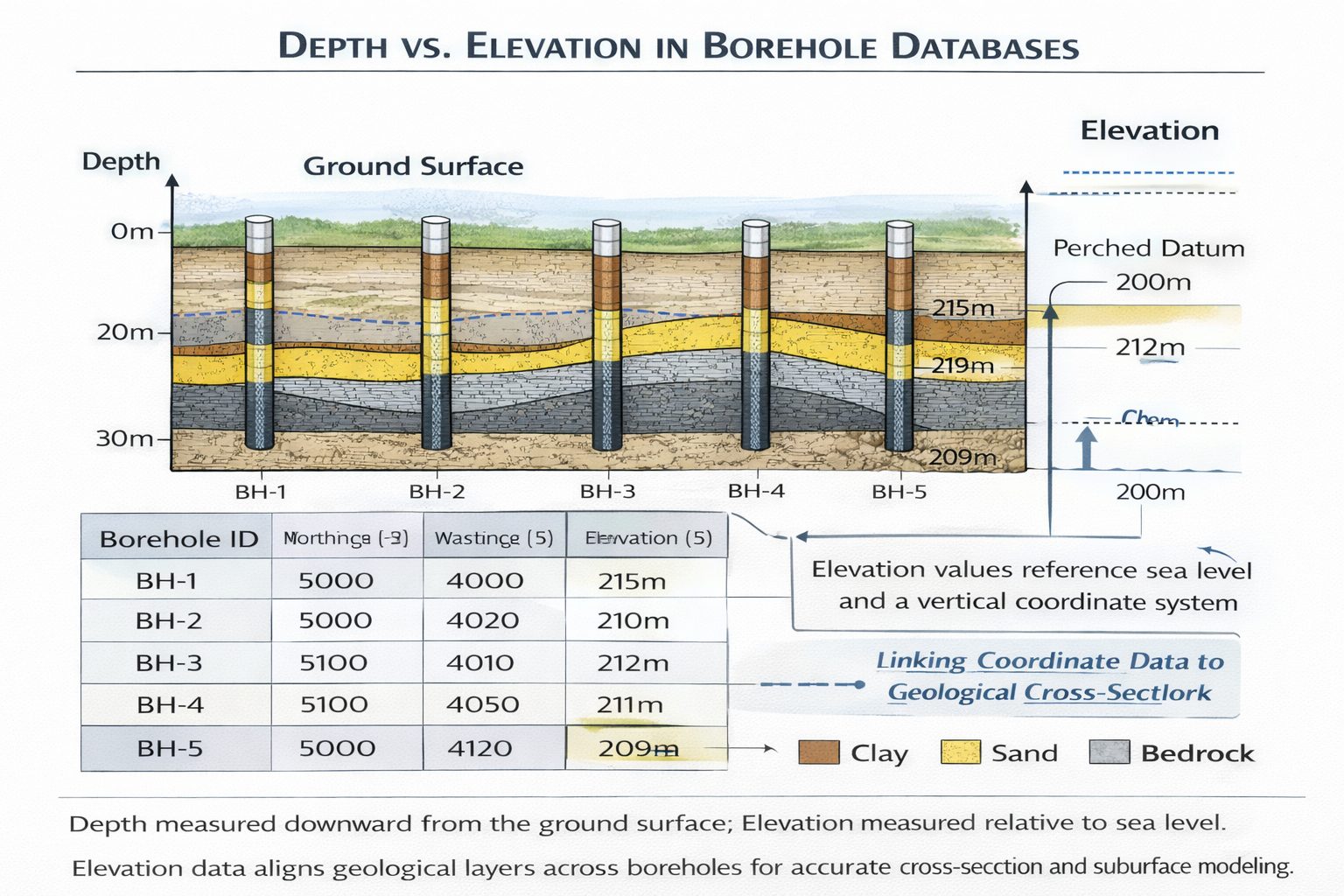
Each borehole log records the sequence of geological materials encountered during drilling. These materials are typically documented using depth measurements, which represent how far below the ground surface a particular layer occurs.
However, geological modeling software often requires elevation values rather than depth measurements. Elevation values represent the absolute vertical position of geological layers relative to a reference datum, such as sea level.
Understanding the difference between depth and elevation is essential for preparing borehole databases for cross-section software and three-dimensional modeling tools. Confusion between these two measurement systems can lead to incorrect geological interpretations and distorted subsurface models.
Many geological modeling errors occur because depth and elevation values are mixed incorrectly or because ground surface elevations are missing from borehole databases.
This article explains the difference between depth and elevation, why both measurements are important in geological modeling, and how to convert between them when preparing borehole datasets.
Understanding Depth Measurements
Depth measurements are the most common way of recording geological information in borehole logs.
Depth represents the vertical distance below the ground surface at which a geological layer occurs.
For example, a borehole log might record the following intervals:
| From Depth | To Depth | Lithology |
|---|---|---|
| 0 m | 2 m | Clay |
| 2 m | 5 m | Sand |
| 5 m | 10 m | Gravel |
These measurements describe how geological materials occur beneath the surface at the borehole location.
Depth values are straightforward to record during drilling operations because the drilling equipment measures the penetration depth of the borehole.
However, depth measurements alone do not indicate the absolute elevation of geological layers relative to other boreholes.
If two boreholes are drilled on ground surfaces with different elevations, identical depth measurements may correspond to different absolute elevations.
This is why elevation values are often required for geological modeling.
Understanding Elevation Measurements
Elevation represents the vertical position of a point relative to a reference datum, usually mean sea level.
Elevation measurements are commonly expressed as meters above sea level (mASL) or feet above sea level (ftASL).
In geological modeling, elevation values are used to position geological layers in three-dimensional space.
For example, a borehole may have a ground surface elevation of 100 meters above sea level. If a clay layer occurs at a depth of 5 meters, the elevation of the top of the clay layer would be:
100 m – 5 m = 95 m elevation
Using elevation values allows geologists to compare geological layers between boreholes located at different surface elevations.
Elevation values are particularly important when constructing geological cross-sections across sloping terrain.
Why Elevation Is Important in Geological Modeling
Geological modeling software often relies on elevation values rather than depth measurements because elevation allows layers to be positioned correctly in three-dimensional space.
If only depth values are used, geological layers may appear misaligned when boreholes are located at different ground elevations.
Consider two boreholes:
| Borehole | Ground Elevation | Sand Layer Depth |
|---|---|---|
| BH1 | 100 m | 5 m |
| BH2 | 110 m | 5 m |
If depth values alone are used, both sand layers appear at the same depth.
However, converting to elevation reveals the true positions:
BH1 sand layer = 95 m elevation
BH2 sand layer = 105 m elevation
The sand layers are actually 10 meters apart vertically, even though they occur at the same depth below the surface.
Without elevation data, geological models may incorrectly correlate these layers.
Converting Depth to Elevation
Converting depth measurements to elevation values is a simple but essential step in geological data preparation.
The basic formula is:
Elevation = Ground Surface Elevation – Depth
For example:
| Borehole | Ground Elevation | Depth | Elevation |
|---|---|---|---|
| BH1 | 120 m | 3 m | 117 m |
| BH1 | 120 m | 7 m | 113 m |
This conversion allows geological layers to be positioned correctly relative to other boreholes.
Many geological modeling programs perform this conversion automatically if ground elevation data is included in the borehole database.
However, if ground elevation values are missing, elevation calculations cannot be performed.
Elevation in Geological Cross-Sections
Elevation values are essential when constructing geological cross-sections.
Cross-sections represent a vertical slice through the Earth’s subsurface and typically display geological layers relative to elevation rather than depth.
Using elevation values ensures that layers are positioned correctly when boreholes occur on uneven terrain.
For example, if a cross-section spans a hillside, boreholes at higher elevations must be plotted accordingly.
If only depth measurements are used, geological layers may appear artificially horizontal or misaligned.
Using elevation values allows cross-sections to accurately represent the true geometry of subsurface geology.
Elevation in 3D Geological Models
Three-dimensional geological models rely heavily on elevation values.
These models construct surfaces representing geological layer boundaries across the investigation area.
For example, a model may generate a surface representing the top of a clay layer based on elevation values recorded in boreholes.
Interpolation algorithms then estimate how the layer extends between boreholes.
If elevation data is incorrect or missing, the resulting surfaces may be distorted.
This can affect engineering analysis such as groundwater flow modeling or volumetric calculations.
Maintaining accurate elevation data is therefore essential for reliable 3D geological modeling.
Common Errors When Mixing Depth and Elevation
Several common mistakes occur when depth and elevation values are mixed incorrectly.
Missing Ground Elevation
If ground elevation is not recorded in the borehole database, depth values cannot be converted to elevation.
This can prevent geological software from generating accurate cross-sections.
Incorrect Elevation Values
Survey errors or data entry mistakes may produce incorrect ground elevation values.
This can shift geological layers upward or downward in cross-sections.
Mixing Depth and Elevation Units
Depth values may be recorded in meters while elevation values are recorded in feet.
If units are not consistent, geological models may be distorted.
Double Conversion Errors
Sometimes elevation values are mistakenly converted from depth more than once.
This can cause geological layers to appear much deeper than they actually are.
Careful data validation helps prevent these errors.
Managing Depth and Elevation in Borehole Databases
Proper database structure helps manage depth and elevation values effectively.
A typical borehole database includes:
Collar Table
Contains borehole location and ground elevation.
Fields may include:
- borehole ID
- easting
- northing
- ground elevation
Lithology Table
Contains depth intervals describing geological layers.
Fields may include:
- borehole ID
- from depth
- to depth
- lithology description
Geological software can then convert depth intervals into elevation values using the collar elevation.
Quality Control for Depth and Elevation Data
Quality control checks help ensure that depth and elevation values are consistent.
Common checks include:
- verifying ground elevations using survey data
- confirming that depth intervals do not exceed borehole depth
- checking that elevation values decrease with depth
Visualizing borehole data in cross-section software can also reveal elevation errors.
If geological layers appear distorted, depth and elevation values should be reviewed.
Best Practices for Managing Vertical Data
Several best practices can help prevent depth and elevation errors.
First, record ground surface elevation accurately using surveying equipment.
Second, maintain consistent measurement units across all borehole data.
Third, ensure that depth intervals are continuous and correctly ordered.
Fourth, store elevation data separately from depth values within the database.
Finally, perform quality control checks before importing data into geological modeling software.
Following these practices improves the reliability of geological interpretations.
Importance for Engineering Projects
Accurate vertical positioning of geological layers is essential for engineering design.
Foundation design, slope stability analysis, and groundwater modeling all depend on reliable subsurface data.
If geological layers are misrepresented due to depth and elevation errors, engineering decisions may be based on incorrect assumptions.
For example, a foundation may be designed to bear on a sand layer that appears at the wrong elevation due to data errors.
Maintaining accurate depth and elevation data ensures that geological models support safe and effective engineering design.
Conclusion
Depth and elevation measurements are both essential components of borehole databases used in geological and geotechnical investigations.
Depth values describe how geological layers occur below the ground surface, while elevation values allow these layers to be positioned correctly relative to other boreholes.
Understanding the relationship between depth and elevation is critical for constructing accurate geological cross-sections and three-dimensional subsurface models.
By carefully recording ground surface elevations, converting depth values correctly, and implementing quality control procedures, engineers and geologists can ensure that borehole datasets support reliable geological interpretation.
Accurate vertical data ultimately improves the quality of subsurface models and supports better decision-making in engineering and environmental projects.
Learn more about our Solutions
- GaeaSynergy Platform for Geoscientific Analysis
- WinLoG Borehole and Well Log Data Management
- WinFence Cross-section and Fence Diagram Visualization
Related Articles
- GaeaSynergy: Integrated Geological, Geotechnical, and Environmental Data Management Platform
- Subsurface Visualization: Turning Borehole Data into Clear Geological Insight
- Geological Cross-Sections from Borehole Data: A Complete Engineering Guide
- Common Mistakes When Creating Geological Cross-Sections from Borehole Data
- How Borehole Spacing Affects Geological Cross-Section Accuracy
- Preparing Borehole Databases for Cross-Section Software
- How Lithological Correlation Works Between Boreholes
- Understanding Fence Diagrams in Geological Modeling
- Common Data Errors in Borehole Databases and How to Fix Them
- Using Geological Cross-Sections in Geotechnical Engineering
- Borehole Coordinate Systems and Mapping for Geological Modeling
- Interpreting Geological Variability Between Boreholes
- Building Geological Cross-Sections from Borehole Data: A Step-by-Step Workflow
- How Geological Software Interpolates Subsurface Layers Between Boreholes
- Borehole Data Visualization Techniques for Geological Modeling
- Managing Large Borehole Data Sets in Engineering Projects
- Understanding Pinch-Outs and Missing Geological Layers in Subsurface Interpretation