

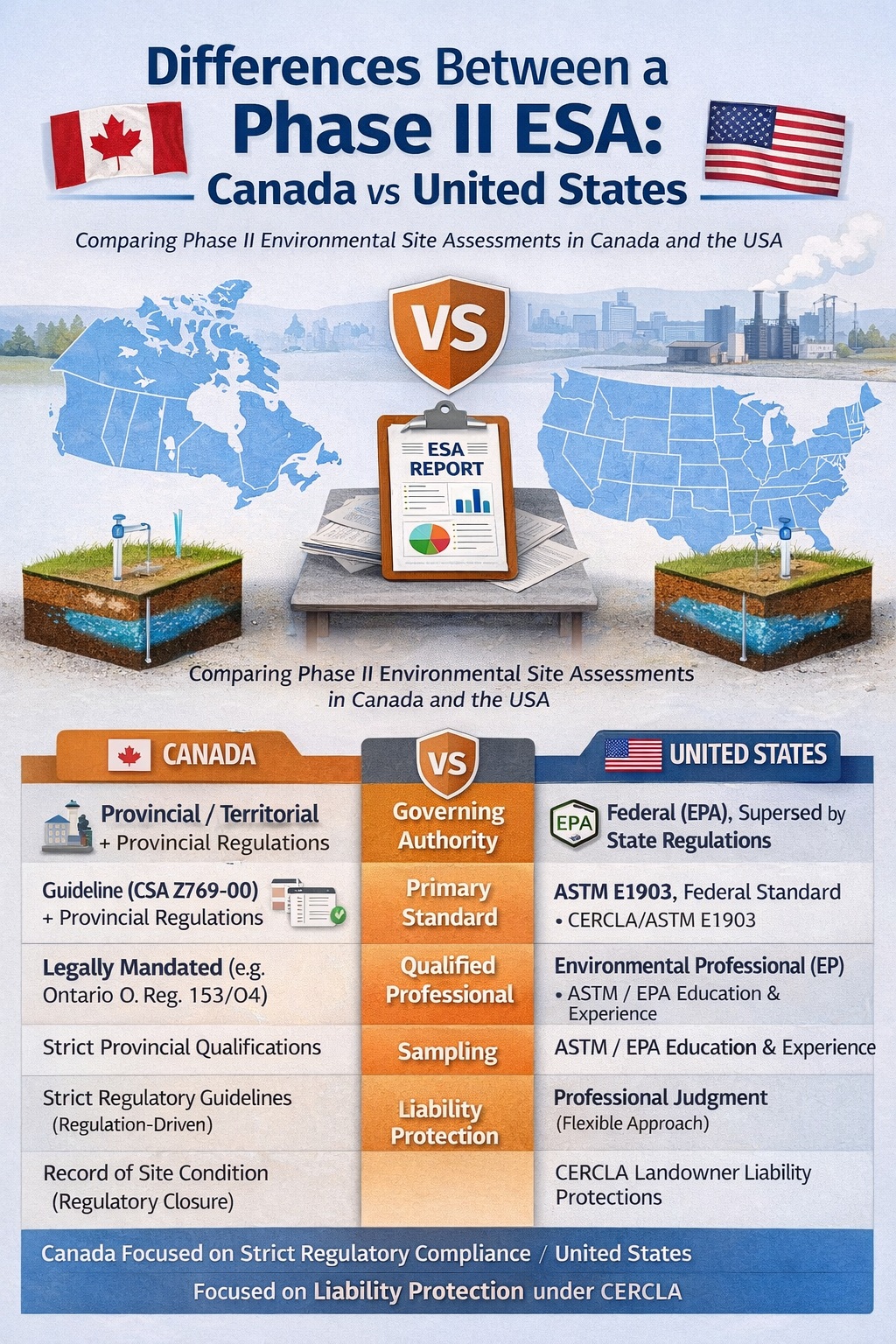
A Phase II Environmental Site Assessment (ESA) is a critical step in evaluating potential contamination identified during a Phase I ESA. While the core objective—confirming the presence, nature, and extent of contamination through intrusive sampling—remains consistent across borders, the regulatory frameworks, standards, reporting requirements, and liability implications differ significantly between Canada and the United States.
Understanding these differences is essential for environmental professionals, developers, lenders, and property owners involved in cross-border transactions or projects. This article provides a comprehensive comparison of Phase II ESA practices in both countries, focusing on regulatory authority, professional qualifications, sampling methodologies, reporting expectations, and liability protections.
Overview of Phase II ESA Objectives
In both countries, a Phase II ESA is conducted to:
- Investigate recognized environmental conditions (RECs) identified in a Phase I ESA
- Collect and analyze soil, groundwater, and sometimes soil vapour samples
- Determine whether contaminant concentrations exceed applicable standards
- Support decisions related to property transactions, redevelopment, or risk management
Despite this shared foundation, the way these objectives are achieved varies considerably due to differing legal and regulatory systems.
Regulatory Framework and Governing Authorities
Canada: Provincial Authority with Federal Guidance
In Canada, environmental regulation is primarily governed at the provincial or territorial level, with federal agencies providing guidance and overarching legislation.
Key Characteristics:
- Each province has its own environmental legislation and standards
- Regulations can vary significantly between jurisdictions
- Federal guidelines (e.g., CCME soil and groundwater criteria) provide baseline recommendations
- Legal requirements are often tied to specific actions, such as redevelopment or land use change
For example, in Ontario, Ontario Regulation 153/04 under the Environmental Protection Act establishes detailed requirements for conducting ESAs and filing a Record of Site Condition (RSC).
United States: Federal Framework with State Implementation
In the United States, environmental site assessments are influenced heavily by federal legislation, particularly:
- Comprehensive Environmental Response, Compensation, and Liability Act (CERCLA)
- Oversight by the United States Environmental Protection Agency (EPA)
Key Characteristics:
- Federal laws establish liability and due diligence requirements
- States may implement additional or more stringent regulations
- Standards are often tied to liability protection rather than mandatory cleanup requirements
Unlike Canada, the U.S. system is more focused on protecting buyers and lenders from liability rather than prescribing exactly how investigations must be conducted.
Standards and Guidance Documents
Canada: CSA Standards and Provincial Regulations
The primary national standard is:
- CSA Standard Z769-00 Phase II ESA
However, this standard is not legally binding unless adopted into provincial regulation.
Important Notes:
- Provinces may adopt, modify, or supplement CSA standards
- In jurisdictions like Ontario, regulations (e.g., O. Reg. 153/04) override or expand upon CSA guidance
- Standards are often more prescriptive, especially for redevelopment projects
United States: ASTM Standards and EPA Alignment
The key standard in the U.S. is:
- ASTM E1903 Phase II ESA
This standard is widely recognized and closely tied to federal due diligence requirements.
Important Notes:
- ASTM standards are considered industry best practice
- Following ASTM guidance supports compliance with CERCLA’s “all appropriate inquiries”
- Standards are generally framework-based, allowing flexibility in execution
Mandatory Requirements vs. Professional Discretion
Canada: Prescriptive and Regulation-Driven
In Canada, especially in provinces like Ontario:
- Sampling density and methodology may be explicitly defined
- Minimum requirements are often mandated (e.g., number of samples per excavation area)
- Reporting formats and content may be regulated
- Deviations from standards must be justified and documented
This approach reduces ambiguity but limits flexibility in the field.
United States: Flexible and Judgment-Based
In the United States:
- ASTM standards provide guidance rather than strict rules
- Environmental professionals determine sampling strategies based on site conditions
- Greater reliance on professional judgment
- Flexibility allows adaptation to complex or unique sites
This approach encourages tailored investigations but can lead to variability in quality and scope.
Qualified Professionals and Oversight
Canada: Qualified Person (QP)
In Canada, Phase II ESAs must be conducted or supervised by a Qualified Person (QP).
Typical Requirements:
- Professional designation (e.g., P.Eng. or P.Geo.)
- Membership in a recognized regulatory body
- Defined experience requirements (often specified in provincial regulations)
In Ontario, the QP must meet criteria outlined in Ontario Regulation 153/04, which ensures a high level of accountability and consistency.
United States: Environmental Professional (EP)
In the United States, the equivalent role is the Environmental Professional (EP).
Defined by:
- United States Environmental Protection Agency
- ASTM standards (e.g., E1527 for Phase I, E1903 for Phase II)
Requirements:
- Specific education (science or engineering)
- Relevant work experience
- Ability to exercise professional judgment
Unlike Canada, the EP designation is not tied to licensure in all cases, though many practitioners are licensed professionals.
Sampling and Investigation Approaches
Canada: Structured and Quantitative
Canadian Phase II ESAs often include:
- Prescribed sampling densities
- Defined analytical parameters based on land use
- Strict adherence to regulatory tables and standards
- Detailed documentation requirements
Example:
Under Ontario Regulation 153/04, excavation sampling may require:
- Minimum numbers of sidewall and base samples
- Specific spacing intervals
- Mandatory laboratory analysis for defined contaminant groups
This structured approach ensures consistency but can increase costs and limit flexibility.
United States: Adaptive and Risk-Based
In the United States:
- Sampling plans are developed based on site-specific conditions
- Focus is on confirming or refuting recognized environmental conditions (RECs)
- Greater use of screening tools and iterative investigation
- Flexibility to adjust sampling in real-time
This allows for efficient investigations but requires strong professional expertise to ensure adequacy.
Reporting Requirements
Canada: Detailed and Regulatory-Driven
Canadian reports, particularly in regulated jurisdictions, must include:
- Comprehensive documentation of methods and results
- Tables comparing results to regulatory standards
- Figures showing sampling locations and contaminant distribution
- QA/QC documentation
- Certification by a Qualified Person
Reports may be submitted to regulatory agencies as part of formal processes such as:
- Record of Site Condition (RSC) filings
- Brownfield redevelopment approvals
United States: Documentation for Due Diligence
In the United States:
- Reports are typically prepared for clients (buyers, lenders, insurers)
- Content follows ASTM guidelines but is not always submitted to regulators
- Focus is on demonstrating due diligence rather than regulatory closure
- Reporting format is more flexible
This reflects the U.S. emphasis on liability protection rather than formal site certification.
Liability Protection and Legal Implications
Canada: Regulatory Closure Through Compliance
In Canada, liability protection is often achieved through:
- Compliance with provincial regulations
- Filing of a Record of Site Condition (RSC)
- Acceptance by regulatory authorities
Outcome:
- Formal acknowledgment of site condition
- Protection from future liability (for identified contaminants)
- Clear pathway for redevelopment
United States: Liability Defense Under CERCLA
In the United States, liability protection is linked to:
- Compliance with Comprehensive Environmental Response, Compensation, and Liability Act (CERCLA)
- Demonstrating “all appropriate inquiries”
- Following ASTM standards
Outcome:
- Legal defense against liability claims
- Protection for innocent landowners and purchasers
- Does not guarantee regulatory closure
Additional state programs may be required for full site cleanup approval.
Key Differences Summary
| Feature | Canada | United States |
|---|---|---|
| Governing Authority | Provincial/Territorial | Federal (EPA) + State |
| Primary Standard | CSA Z769 (guideline) + provincial regs | ASTM E1903 (industry standard) |
| Regulatory Approach | Prescriptive | Flexible |
| Professional Role | Qualified Person (QP) | Environmental Professional (EP) |
| Sampling Requirements | Often mandated and quantitative | Based on professional judgment |
| Reporting | Regulatory-focused | Due diligence-focused |
| Liability Protection | Regulatory closure (e.g., RSC) | CERCLA liability defense |
Practical Implications for Stakeholders
For Developers and Property Owners
- In Canada, expect more structured investigations and clearer regulatory endpoints
- In the U.S., expect greater flexibility but potentially more uncertainty regarding closure
For Environmental Professionals
- Canadian projects require strict adherence to provincial regulations
- U.S. projects require strong professional judgment within ASTM frameworks
For Lenders and Investors
- Canadian ESAs often provide formal regulatory assurance
- U.S. ESAs provide liability protection, but not always closure
Cross-Border Considerations
Organizations operating in both countries must:
- Understand jurisdiction-specific requirements
- Adapt investigation strategies accordingly
- Ensure compliance with both regulatory and liability frameworks
- Engage qualified professionals familiar with local standards
Failure to recognize these differences can result in:
- Regulatory delays
- Increased costs
- Inadequate liability protection
Conclusion
While Phase II Environmental Site Assessments in Canada and the United States share a common goal—evaluating environmental contamination—their execution is shaped by fundamentally different regulatory philosophies.
Canada’s approach is prescriptive and regulation-driven, emphasizing compliance and formal site closure through mechanisms such as Records of Site Condition. In contrast, the United States emphasizes flexibility and liability protection, with ASTM standards guiding due diligence under CERCLA.
For stakeholders, understanding these differences is not just beneficial—it is essential. Whether managing redevelopment projects, conducting due diligence, or navigating environmental risk, aligning with the appropriate framework ensures both regulatory compliance and informed decision-making.
👉 Learn more about our Automated Environmental Site Assessment Solution
Related Articles
- Methodology for Conducting a Phase II Environmental Site Assessment (ESA)
- Key Uses of a Phase II Environmental Site Assessment (ESA) Report
- Market Drivers and Trends for Phase II Environmental Site Assessments
- Role of Reviewing Existing Data for a Phase II Environmental Site Assessment
- Methodology for Identifying Contaminants of Concern (COCs) for a Phase II Environmental Site Assessment
- Key Components of a Phase II ESA Sampling Plan
- Key Components of a Phase II ESA Health and Safety Plan (HASP)
- Key Considerations for Permit Acquisition for a Phase II ESA
- The Utility Clearance Process for a Phase II ESA
- Drilling and Sampling for a Phase II ESA: Methods, Equipment, and Best Practices
- Installation of Monitoring Wells for a Phase II Environmental Site Assessment (ESA)
- Phase II ESA Quality Control Procedures: Ensuring Accurate, Defensible Environmental Data
- Sample Handling Procedures for a Phase II ESA: Ensuring Data Integrity from Field to Laboratory
- Laboratory Analysis and Data Interpretation for a Phase II ESA
- Reporting and Recommendations for a Phase II Environmental Site Assessment (ESA)