

In geotechnical and environmental engineering, data is the foundation of every decision—from site characterization to design and regulatory reporting. Yet many organizations still rely on fragmented systems, spreadsheets, and disconnected tools to manage this critical information.
The result? Data silos, inefficiencies, and increased risk.
What Is Centralized Data Management in Geotechnical Projects?
Centralized data management refers to storing and managing all project data in a single, unified system rather than across multiple disconnected tools.
In a centralized system:
- Borehole data
- Laboratory results
- Environmental samples
- Monitoring data
- Reports
are all stored in one structured database.
In contrast, decentralized systems rely on:
- Spreadsheets
- Separate logging tools
- Manual file sharing
This difference fundamentally impacts how efficiently and accurately projects are executed.
Why Is Centralized Data So Important in Geotechnical Engineering?
Geotechnical projects depend on large volumes of interconnected data, including:
- Soil stratigraphy
- Laboratory testing results
- Groundwater measurements
- Contaminant concentrations
Without centralization:
- Data becomes fragmented
- Errors increase
- Decision-making is slower
With centralization:
- Data is consistent and accessible
- Engineers work from a single source of truth
- Projects become more efficient and reliable
What Problems Do Fragmented Data Systems Create?
Data Silos
When data is stored in multiple locations:
- Teams work with different versions
- Updates are not synchronized
- Collaboration suffers
Duplicate Data Entry
Engineers often:
- Re-enter borehole data
- Copy lab results into reports
- Reformat data for modeling
This wastes time and introduces errors.
Increased Risk of Errors
Manual data handling leads to:
- Typos
- Incorrect units
- Missing data
These errors can impact design decisions and regulatory compliance.
Inefficient Reporting
Without centralized data:
- Reports must be compiled manually
- Data must be verified repeatedly
- Updates require rework
How Does Centralized Data Improve Data Quality?
Single Source of Truth
Centralized systems ensure that:
- All users access the same data
- Updates are reflected everywhere
- Version control is maintained
Built-In Validation
Modern systems include:
- Data validation rules
- Standardized formats
- Automated checks
Auditability
Centralized platforms provide:
- Audit trails
- Change tracking
- Data lineage
This is critical for compliance and quality assurance.
How Does GAEA Implement Centralized Data Management?
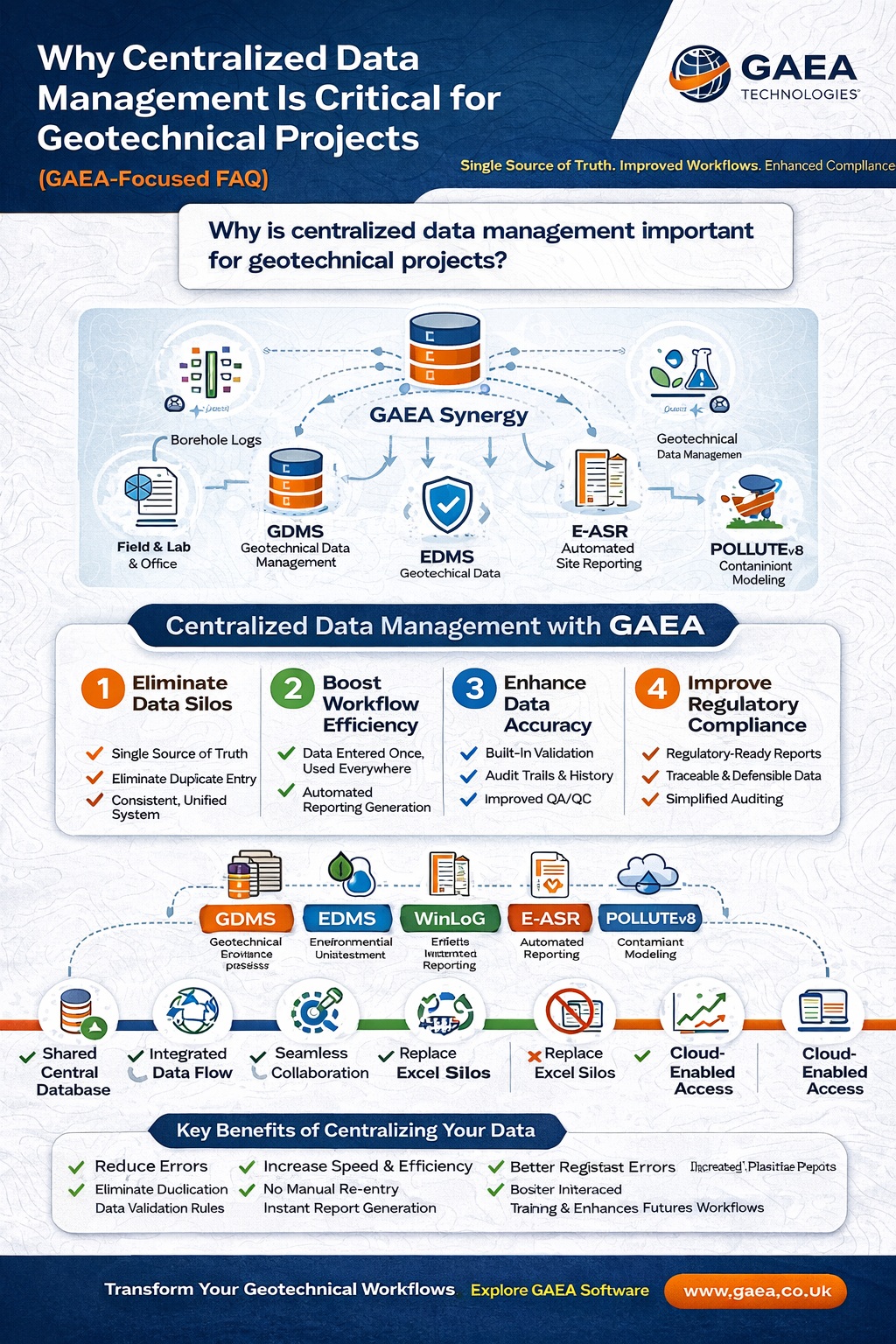
At the core of GAEA’s ecosystem is GaeaSynergy, a centralized database platform that connects all modules.
GAEA’s centralized architecture includes:
- GDMS – Geotechnical data management
- EDMS – Environmental data management
- WinLoG – Borehole logging
- WinFence – Cross-sections
All modules share a common database, eliminating silos and enabling seamless workflows.
How Does Centralization Improve Workflow Efficiency?
Data Entered Once, Used Everywhere
With GAEA:
- Enter borehole data once → used in logs, reports, and models
- Import lab data once → instantly available across the system
Automated Data Flow
Data moves automatically between:
- Field collection (EDMS Field)
- Database (Gaea Synergy)
- Logging (WinLoG)
- Reporting (E-ASR)
Reduced Manual Work
Centralization eliminates:
- Re-entry of data
- File conversions
- Manual formatting
How Does Centralized Data Support Borehole Logging?
Borehole logs are a key deliverable in geotechnical projects.
Without centralization:
- Logs are created manually
- Data must be copied from multiple sources
With GAEA:
- WinLoG pulls data directly from GDMS
- Logs are generated automatically
- Updates are reflected instantly
This ensures accuracy and consistency.
How Does It Improve Laboratory Data Management?
Laboratory data is often one of the most complex datasets to manage.
Challenges Without Centralization:
- Data arrives in multiple formats
- Manual entry is required
- Errors are common
GAEA Solution:
EDMS Lab:
- Imports lab data directly
- Links results to samples automatically
- Stores data in a structured database
This improves both efficiency and accuracy.
How Does Centralization Enhance Reporting?
Traditional Reporting Challenges:
- Manual data compilation
- Inconsistent formatting
- Time-consuming updates
GAEA Solution:
E-ASR (Environmental Automated Site Reporting):
- Generates reports directly from the database
- Uses standardized templates
- Updates automatically when data changes
Result:
- Faster reporting
- Consistent outputs
- Reduced errors
How Does Centralized Data Improve Collaboration?
In Decentralized Systems:
- Teams share files via email
- Version conflicts occur
- Collaboration is limited
With GAEA:
- Multiple users access the same database
- Real-time updates are visible to all
- Teams collaborate seamlessly
This is especially important for:
- Large projects
- Multi-office teams
- Remote work environments
How Does Centralization Support Environmental Projects?
Environmental workflows require:
- Sample tracking
- Regulatory reporting
- Data validation
GAEA’s EDMS provides:
- Full lifecycle tracking of samples
- Integrated compliance workflows
- Automated reporting via E-ASR
This ensures environmental data is:
- Accurate
- Traceable
- Compliant
How Does Centralized Data Improve Modeling?
Modeling tools require accurate and consistent input data.
Without centralization:
- Data must be reformatted
- Errors can occur during transfer
With GAEA:
POLLUTEv8 integrates directly with the database:
- Uses real project data
- Eliminates manual preparation
- Ensures consistency
Does Centralization Reduce Project Risk?
Yes—Significantly
Centralized systems reduce risk by:
- Eliminating data inconsistencies
- Improving traceability
- Supporting QA/QC processes
This leads to:
- More reliable designs
- Better regulatory compliance
- Reduced liability
How Does Centralization Support Regulatory Compliance?
Regulatory requirements often demand:
- Accurate data
- Traceable workflows
- Standardized reporting
GAEA Supports Compliance Through:
- Audit trails
- Data validation
- Automated reporting
This makes it easier to meet:
- Environmental regulations
- Engineering standards
- Client requirements
Can Centralized Data Replace Excel Workflows?
Yes—and It Should
While Excel is widely used, it introduces:
- Version control issues
- Data silos
- High error risk
GAEA replaces Excel with:
- Structured databases
- Automated workflows
- Integrated reporting
This improves reliability and efficiency.
How Does Centralization Improve Scalability?
As firms grow, data volume and complexity increase.
Centralized systems allow you to:
- Add more users
- Handle larger datasets
- Expand workflows
GAEA’s modular approach enables:
- Starting small (GDMS or EDMS)
- Expanding to full integration
What Role Does Cloud Technology Play?
Centralized systems are increasingly cloud-enabled.
Benefits:
- Remote access
- Real-time collaboration
- Scalable infrastructure
GAEA supports:
- Cloud deployment via GaeaSynergy
- Secure remote access
- Field-to-office connectivity
How Does Centralization Improve ROI?
Key Cost Savings:
- Reduced manual labor
- Faster reporting
- Fewer errors
Productivity Gains:
- Streamlined workflows
- Better collaboration
- Faster decision-making
Over time, centralized systems deliver significant return on investment.
What Makes GAEA’s Approach Unique?
GAEA stands out because it:
- Integrates geotechnical and environmental workflows
- Uses a shared centralized database (Gaea Synergy)
- Automates reporting (E-ASR)
- Connects field, lab, and office processes
Rather than offering isolated tools, GAEA provides a complete, connected ecosystem.
What Is the Key Takeaway?
Centralized data management is no longer optional—it is essential for modern geotechnical and environmental projects.
Without Centralization:
- Data is fragmented
- Workflows are inefficient
- Errors are more likely
With GAEA:
- Data is unified
- Workflows are automated
- Projects are faster, more accurate, and scalable
Conclusion
Geotechnical and environmental engineering is becoming increasingly data-driven. As projects grow in complexity, the limitations of fragmented systems become more apparent.
Centralized data management provides:
- A single source of truth
- Improved data quality
- Streamlined workflows
- Enhanced collaboration
- Better compliance
GAEA Technologies delivers these benefits through its integrated ecosystem, helping firms move beyond disconnected tools toward a fully connected, efficient, and future-ready workflow.
Learn more about our Software Solutions
- GaeaSynergy Platform for Geoscientific Analysis and Visualization
- WinLoG: Borehole and Well Logs
- WinFence: Cross-sections and Fence Diagrams
- GDMS: Geotechnical Data Management System
- EDMS: Environmental Data Management System
- POLLUTEv8: Contaminant Transport Modeling and Landfill Design
- E-ASR: Automated Environmental Reporting
Related Articles
- How to Evaluate Geotechnical & Environmental Software (Buyer’s Guide)
- GaeaSynergy: Integrated Geological, Geotechnical, and Environmental Data Management Platform
- Integrated vs Standalone Geotechnical Software: Which Is Better?
- Top Features to Look for in Geotechnical & Environmental Software
- How to Streamline Geotechnical Workflows from Field to Report
- How Automation Improves Efficiency in Environmental Data Management
- Cloud vs Desktop Geotechnical Software: Pros and Cons
- How to Automate Environmental Reporting
- How Environmental Software Helps with Regulatory Compliance
- How to Run a Successful Software Pilot Project
- Understanding Total Cost of Ownership for Engineering Software
- How to Calculate ROI for Geotechnical and Environmental Software Investments
- Top 10 Mistakes When Buying Engineering Software (And How to Avoid Them)
- Future Trends in Geotechnical and Environmental Software
- Step-by-Step Guide to Selecting Engineering Software