

Environmental data management has evolved from spreadsheets and manual reporting into a complex, data-driven discipline. Today’s projects generate massive volumes of sampling data, laboratory results, monitoring records, and regulatory documentation.
Yet many organizations still rely on manual workflows, leading to inefficiencies, errors, and delays.
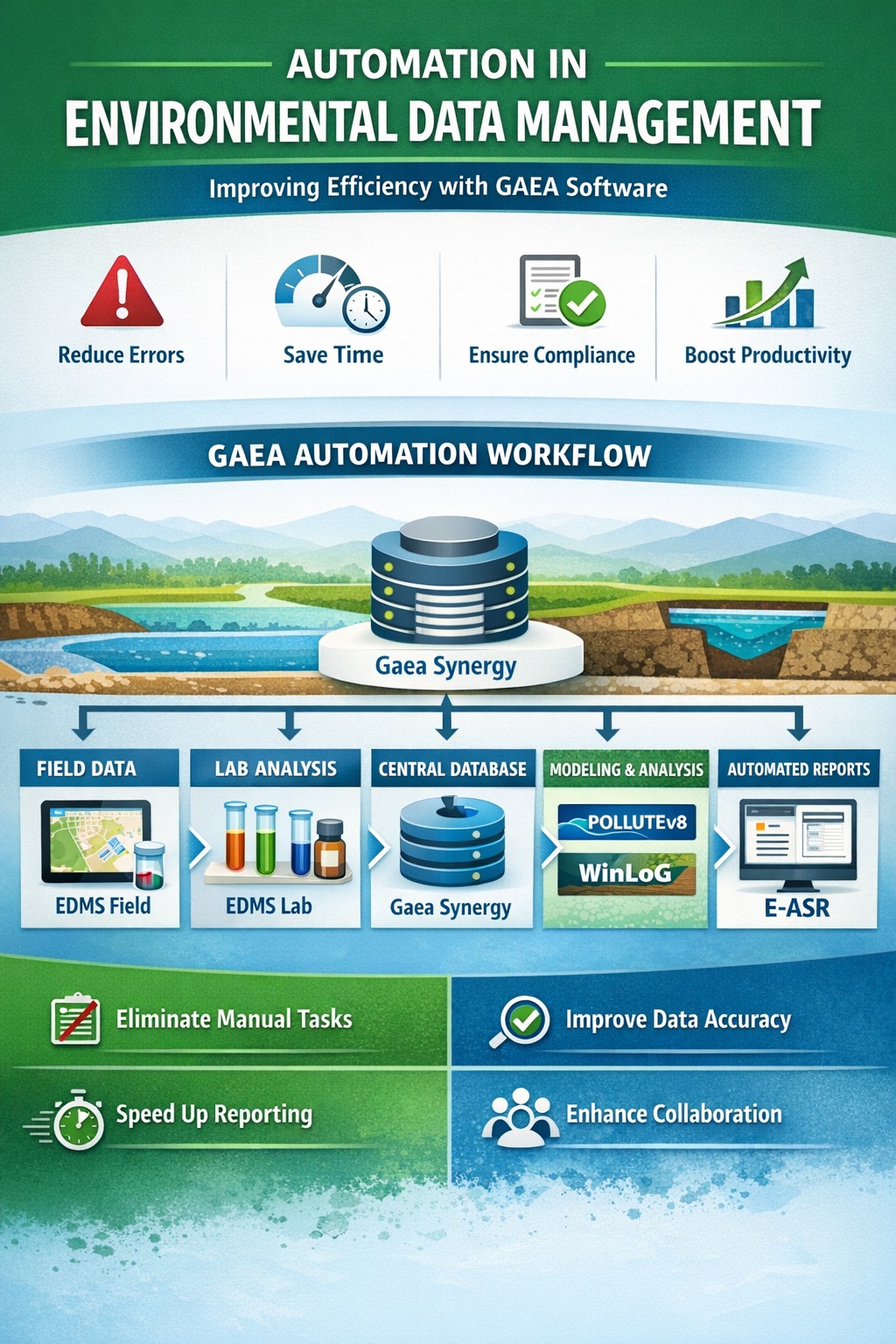
Automation is the solution—and platforms like GAEA Technologies (EDMS, GaeaSynergy, E-ASR, GDMS, WinLoG, and POLLUTEv8) are designed to bring automation into every stage of environmental data management.
What Is Environmental Data Management?
Environmental data management involves collecting, storing, analyzing, and reporting environmental data such as:
- Soil and groundwater samples
- Laboratory analytical results
- Monitoring data
- Compliance records
This data is used for:
- Environmental site assessments
- Contamination analysis
- Regulatory reporting
- Remediation planning
What Does Automation Mean in Environmental Data Management?
Automation refers to using software to:
- Reduce manual data entry
- Automatically process data
- Generate reports
- Streamline workflows
Instead of:
- Copying data between spreadsheets
- Manually compiling reports
Automation allows:
- Data to flow automatically
- Processes to run with minimal intervention
Why Are Manual Environmental Workflows Inefficient?
Manual Data Entry
- Time-consuming
- Error-prone
Disconnected Systems
- Field, lab, and reporting tools are separate
- Data must be transferred manually
Repetitive Tasks
- Formatting reports
- Rechecking data
- Updating multiple files
Result:
- Delays
- Increased costs
- Higher risk of errors
How Does Automation Improve Efficiency?
Automation improves efficiency by:
1. Eliminating Repetition
2. Reducing Errors
3. Accelerating Workflows
4. Improving Data Consistency
Key Outcome:
More time spent on analysis, less on administration
How Does GAEA Enable Automation?
GAEA provides automation through its integrated ecosystem:
- EDMS – Environmental data management
- Gaea Synergy – Centralized database
- E-ASR – Automated reporting
- WinLoG – Data integration and visualization
- POLLUTEv8 – Modeling
These tools work together to automate the entire workflow.
How Does Automation Improve Data Collection?
Traditional Approach:
- Paper forms
- Manual entry later
GAEA Approach:
EDMS Field
- Digital data capture
- Real-time validation
- Direct database integration
Benefits:
- Faster data collection
- Reduced transcription errors
- Immediate availability
How Does Automation Improve Laboratory Data Integration?
Lab data is often one of the biggest bottlenecks.
Challenges:
- Multiple formats
- Manual entry
- High error risk
GAEA Solution:
EDMS Lab
- Automated data import
- Sample matching
- Validation rules
Result:
- No manual entry
- Faster processing
- Improved accuracy
How Does Automation Improve Data Processing?
Without Automation:
- Data must be cleaned manually
- Formatting takes time
With GAEA:
- Data is structured automatically
- Validation rules ensure consistency
- Errors are flagged instantly
Outcome:
- Clean, reliable datasets
How Does Automation Improve Reporting?
Traditional Reporting:
- Copy-paste workflows
- Manual formatting
- Time-consuming updates
GAEA Solution:
E-ASR (Environmental Automated Site Reporting)
- Pulls data directly from EDMS
- Uses templates
- Updates automatically
Benefits:
- Reports generated in hours
- Consistent formatting
- Reduced human error
How Does Automation Reduce Errors?
Manual processes introduce:
- Typographical errors
- Missing data
- Incorrect units
GAEA Automation:
- Validation rules
- Controlled data entry
- Automated workflows
Result:
- Higher data integrity
- More reliable decisions
How Does Automation Improve Compliance?
Environmental projects must meet strict regulations.
Requirements:
- Accurate data
- Traceability
- Standardized reporting
GAEA Supports:
- Audit trails
- Data validation
- Automated regulatory reports
Outcome:
- Easier compliance
- Reduced risk
How Does Automation Improve Workflow Speed?
Automation removes delays between:
- Field → Lab → Office → Reporting
With GAEA:
- Data flows instantly
- Processes run automatically
Result:
- Faster project completion
- Improved client satisfaction
How Does Automation Improve Collaboration?
Traditional Collaboration:
- Email file sharing
- Version conflicts
GAEA Collaboration:
- Shared database (Gaea Synergy)
- Real-time updates
- Multi-user access
Outcome:
- Teams work simultaneously
- Improved communication
Can Automation Replace Excel Workflows?
Yes—and It Should
Excel workflows:
- Are not scalable
- Lack validation
- Create silos
GAEA Replaces Excel With:
- Structured databases
- Automated processes
- Integrated reporting
How Does Automation Improve Data Consistency?
Without Automation:
- Different formats
- Inconsistent naming
With GAEA:
- Standardized data structures
- Automated formatting
- Controlled inputs
Result:
- Consistent, reliable data
How Does Automation Support Large Projects?
Large projects involve:
- Thousands of data points
- Multiple teams
- Complex workflows
GAEA Automation Enables:
- Scalable data management
- Efficient processing
- Centralized control
What Are the Biggest Time Savings from Automation?
1. Data Entry
2. Report Generation
3. Data Validation
4. File Management
Automation can reduce these tasks by 50–80% or more.
How Does Automation Improve ROI?
Cost Savings:
- Reduced labor
- Fewer errors
Productivity Gains:
- Faster workflows
- Better resource allocation
Long-Term Benefit:
Higher profitability and efficiency.
What Makes GAEA’s Automation Unique?
GAEA stands out because it:
- Integrates all workflows
- Automates reporting (E-ASR)
- Connects field, lab, and office
- Provides a centralized database
Key Advantage:
End-to-end automation—not just isolated features
What Is the Key Takeaway?
Automation is no longer optional—it is essential for modern environmental data management.
Without Automation:
- Manual processes
- Higher error risk
- Slower workflows
With GAEA:
- Automated data flow
- Faster reporting
- Improved accuracy and compliance
Conclusion
Environmental data management is becoming increasingly complex, and manual workflows can no longer keep up with the demands of modern projects.
Automation transforms how organizations manage data by:
- Eliminating repetitive tasks
- Improving accuracy
- Accelerating workflows
- Enhancing collaboration
GAEA Technologies delivers these benefits through a fully integrated ecosystem that connects:
- Field data collection (EDMS Field)
- Laboratory data integration (EDMS Lab)
- Centralized data management (Gaea Synergy)
- Automated reporting (E-ASR)
- Modeling and analysis (POLLUTEv8)
The result is a streamlined, efficient, and scalable workflow that empowers engineering teams to focus on what matters most—analysis, decision-making, and delivering high-quality projects.
Learn more about our Software Solutions
- GaeaSynergy Platform for Geoscientific Analysis and Visualization
- WinLoG: Borehole and Well Logs
- WinFence: Cross-sections and Fence Diagrams
- GDMS: Geotechnical Data Management System
- EDMS: Environmental Data Management System
- POLLUTEv8: Contaminant Transport Modeling and Landfill Design
- E-ASR: Automated Environmental Reporting
Related Articles
- How to Evaluate Geotechnical & Environmental Software (Buyer’s Guide)
- GaeaSynergy: Integrated Geological, Geotechnical, and Environmental Data Management Platform
- Integrated vs Standalone Geotechnical Software: Which Is Better?
- Top Features to Look for in Geotechnical & Environmental Software
- Why Centralized Data Management Is Critical for Geotechnical Projects
- How to Streamline Geotechnical Workflows from Field to Report
- Cloud vs Desktop Geotechnical Software: Pros and Cons
- How to Automate Environmental Reporting
- How Environmental Software Helps with Regulatory Compliance
- How to Run a Successful Software Pilot Project
- Understanding Total Cost of Ownership for Engineering Software
- How to Calculate ROI for Geotechnical and Environmental Software Investments
- Top 10 Mistakes When Buying Engineering Software (And How to Avoid Them)
- Future Trends in Geotechnical and Environmental Software
- Step-by-Step Guide to Selecting Engineering Software