

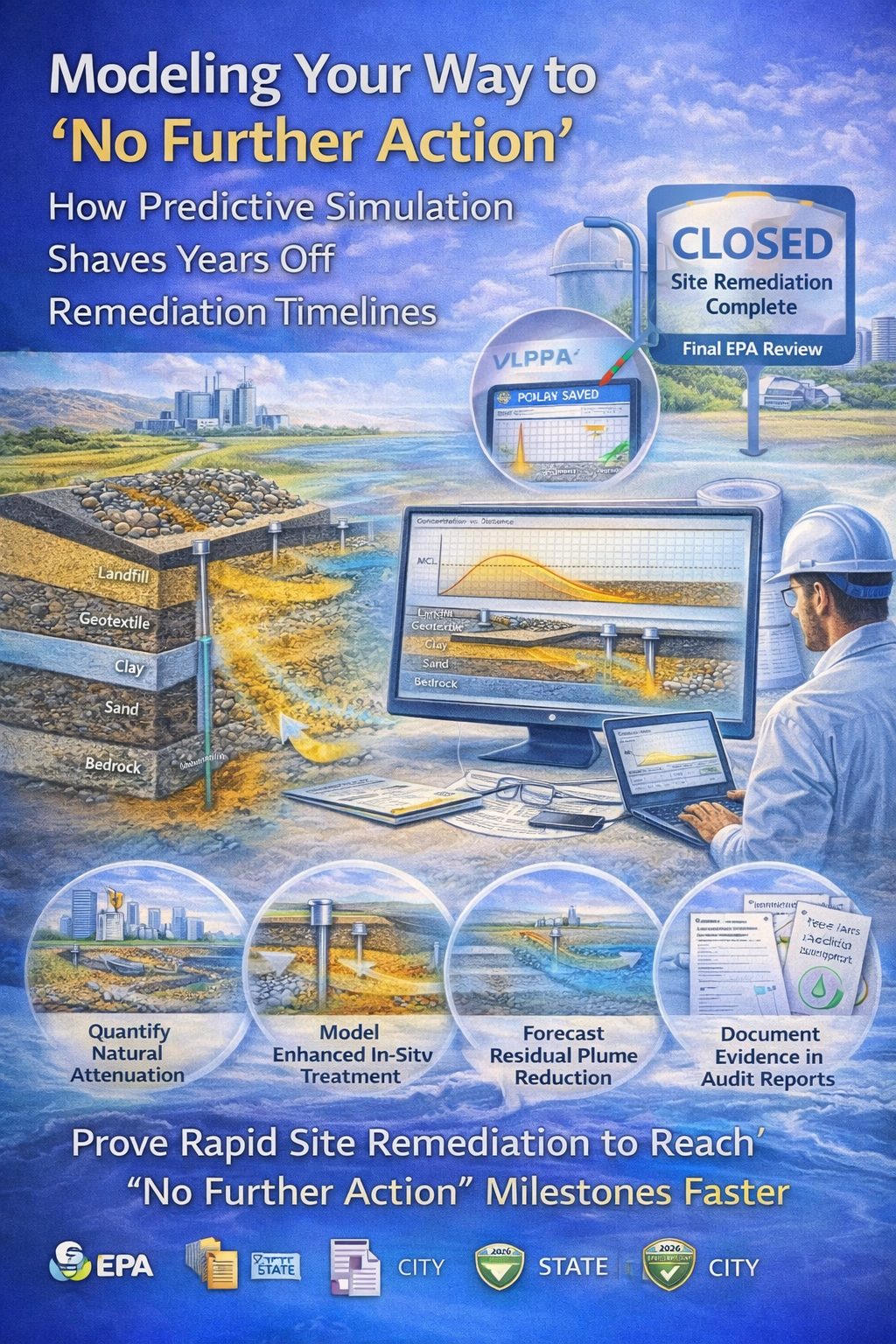
Did you know that predictive simulation can dramatically reduce the time needed for environmental remediation projects? For businesses and organizations grappling with contamination issues and landfill management, this innovative approach provides a pathway to not only achieving compliance but doing so in a fraction of the time. In this comprehensive guide, we will explore how contaminant transport modeling can transform your remediation timelines from years to mere months, saving you resources and enhancing project outcomes. We will cover key concepts, practical applications, and actionable insights for adopting this effective methodology, with a strong emphasis on how POLLUTE software advances fast and accurate modeling.
Understanding Contaminant Transport Modeling
Contaminant transport modeling is a scientific method used to analyze the movement and behavior of contaminants in the environment. It can be applied to various scenarios, including groundwater contamination, industrial spills, and landfill leachate management. The goal is to predict how pollutants disperse through soils and water systems, which is essential for developing effective remedial strategies.
The Science Behind Contaminant Transport
At its core, contaminant transport modeling combines principles of hydrodynamics, geochemistry, and environmental science. The models take into account various factors such as:
- Source Identification: Determining the origin and type of contaminants.
- Hydraulic Properties: Understanding the permeability and porosity of the soil and rock layers.
- Chemical Behavior: Assessing how pollutants react with the environment, including degradation processes.
- Flow Dynamics: Calculating how water moves through the subsurface, which influences contaminant transport.
Why Predictive Simulation is a Game Changer
Predictive simulation allows environmental professionals to anticipate the spread of contaminants and test remediation strategies before implementing them in the field. Here’s how it transforms remediation timelines:
1. Faster Decision Making
Traditional remediation efforts can be lengthy, often requiring extensive data collection and analysis before any action is taken. Predictive models provide timely insights that allow decision-makers to act quickly based on projected scenarios.
2. Resource Optimization
By simulating various remediation approaches, organizations can identify the most effective methods and allocate resources accordingly. This reduces unnecessary spending on ineffective strategies.
3. Risk Assessment
Understanding how contaminants will behave under different scenarios helps in assessing potential risks. This preemptive understanding minimizes future liabilities and improves compliance with regulatory standards.
Key Components of Effective Predictive Simulation
To ensure successful implementation of predictive simulation, consider the following key components:
Data Quality
High-quality, accurate data is foundational. Collect relevant site-specific data regarding geology, hydrology, and contaminant characteristics before starting your model.
Model Selection
Choosing the right model depends on your site conditions and the contaminants involved. POLLUTE offers specialized modeling capabilities tailored for specific applications, ensuring precise results.
Calibration and Validation
Models must be calibrated using observed data to ensure accuracy. Use POLLUTE to validate your model by comparing predicted results with real-world observations, adjusting parameters as needed.
Implementing Predictive Simulations: Step-by-Step Guide
Step 1: Define Objectives
Clearly outline your remediation goals, including compliance requirements and environmental objectives.
Step 2: Gather Data
Collect data from site assessments, previous studies, and ongoing monitoring efforts. High-quality data will enhance model accuracy.
Step 3: Take Advantage of POLLUTE
Utilize POLLUTE’s powerful simulation tools to model your data effectively. The software allows for easy integrations and various modeling options suitable to your specific contamination scenario.
Step 4: Run Simulations
Input your gathered data into POLLUTE and run simulations. Adjust parameters based on preliminary results to optimize accuracy.
Step 5: Analyze Results
Review the results to determine potential remediation options using POLLUTE’s comprehensive analysis tools.
Step 6: Develop a Remediation Plan
Create a detailed remediation plan based on simulation data, utilizing insights from POLLUTE to outline methods, timelines, and required resources.
Common Challenges and How to Overcome Them
While predictive simulation offers many benefits, practitioners may encounter obstacles such as:
- Data Limitations: Ensure continual data collection and updates throughout the project to refine models and improve accuracy. Use POLLUTE to optimize your data management processes.
- Stakeholder Engagement: Keep stakeholders informed during the modeling process as transparency builds trust and facilitates decision-making.
- Regulatory Framework: Align your modeling efforts with regulatory expectations; staying abreast of regulatory changes is crucial for compliance and successful project implementation.
Where Do We Go From Here? Embracing Predictive Simulation in Your Projects
As we’ve uncovered in this guide, effective modeling techniques can significantly reduce remediation timelines, lower costs, and enhance compliance with environmental regulations. By leveraging predictive simulation and POLLUTE’s advanced capabilities, organizations can not only navigate the complexities of contaminated sites more effectively but also pave the way for quicker resolutions. The journey toward ‘No Further Action’ is not just a goal; it is now a more attainable reality thanks to these innovative methodologies. To learn more about how POLLUTE software can assist you in your predictive simulation efforts, visit.
Embrace the future of contaminant transport modeling, make informed decisions, and contribute to a cleaner environment.
Learn more about our Contaminant Transport Modeling Solutions
Related Articles
- Contaminant Transport Modelling and Landfill Design: A Complete Guide for Environmental Engineers
- How Contaminant Transport Models Predict Groundwater Pollution
- Designing Landfill Liner Systems to Prevent Groundwater Contamination
- Understanding Leachate Generation and Transport in Landfills
- Advection–Dispersion Modelling in Groundwater Systems
- Hydrogeological Data Required for Contaminant Transport Models
- Regulatory Requirements for Landfill Design and Groundwater Protection
- Unlock Global Expertise: Free Research Viewer for POLLUTE and MIGRATE
- Mastering the Plume: POLLUTEv8 vs. MODFLOW vs. FEFLOW vs. PATH3D
- Core Features of POLLUTEv8
- Mastering Contaminant Transport: Special Features of POLLUTEv8
- Navigating Contaminant Migration with POLLUTE: A Modern Approach to Landfill Design
- Beyond The MCL: Building Audit-Proof Contaminant Fate Models For 2026 Regulatory Submissions
- Using Predictive Models to Meet 2026 Primary Drinking Water Regulations
- Driving Environmental Research: How GAEA Technologies POLLUTE Software is Used in Academic and Industry Reports
- Meeting The New 2026 EPA Reporting Standards For PFAS: Why Traditional Spreadsheet Modeling No Longer Suffices
- Using Predictive Models to Meet 2026 Primary Drinking Water Regulations
- Unlocking Sustainable Solutions: The Role of POLLUTE Software in Landfill Design and Contaminant Transport Modelling
- Contaminant Transport Modelling and Landfill Design Insights
- Geomembrane Degradation in Landfill Liners: Causes, Modeling, and Long-Term Performance
- Clogging of Landfill Leachate Collection Systems: Causes, Impacts, and Prevention
- Determining Diffusion Coefficients for Contaminant Transport Modeling
- Use and Determination of Distribution Coefficients for Contaminant Transport Modeling
- Non-Linear Sorption in Contaminant Transport Modeling
- Phase Change in Collection Systems in Contaminant Transport Modeling for Landfills
- Biological and Radioactive Decay in Contaminant Transport Modeling