

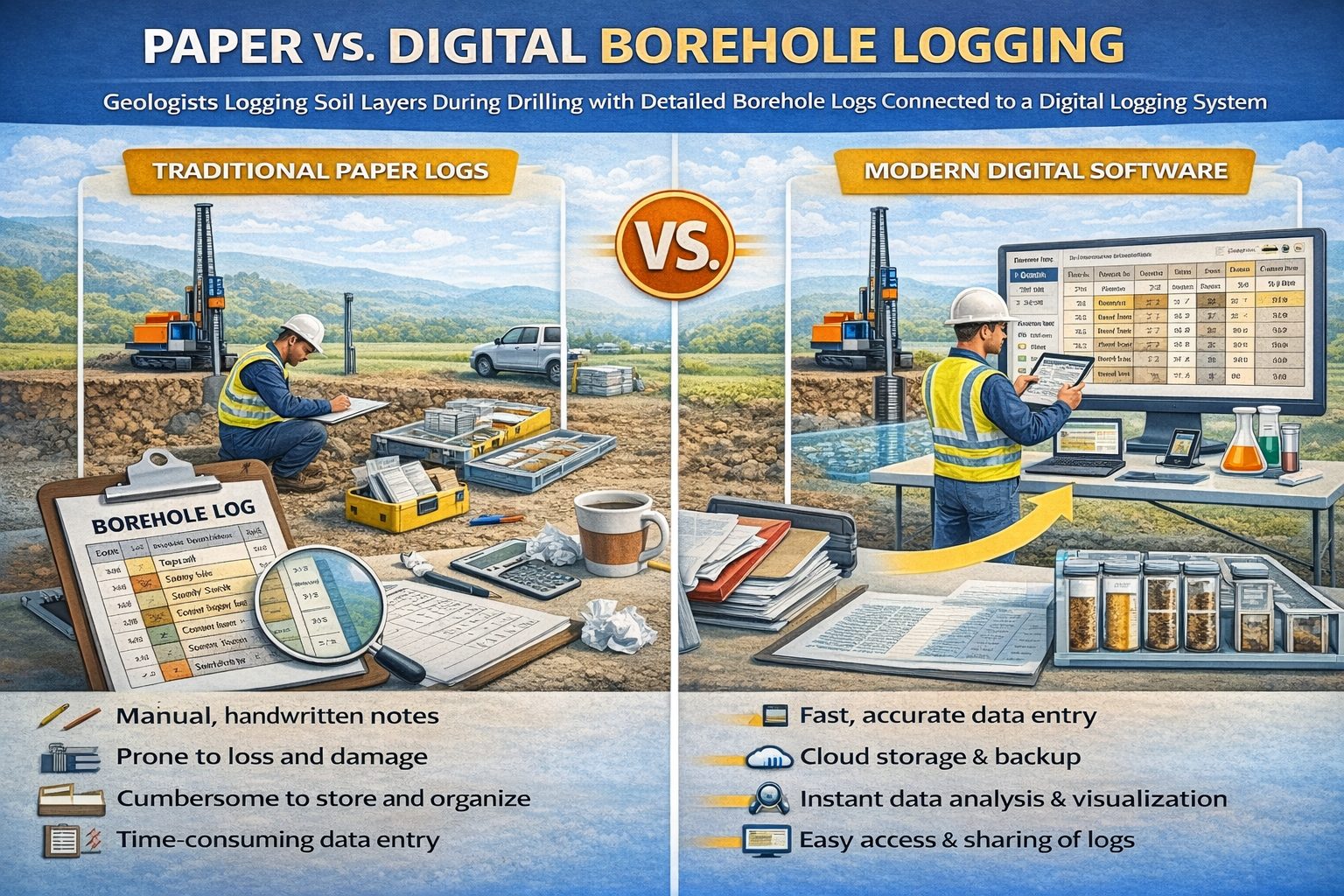
Drilling investigations are essential for understanding subsurface conditions in engineering, environmental science, hydrogeology, and mineral exploration. During these investigations, geologists and engineers document soil layers, rock formations, groundwater conditions, and sampling intervals encountered as boreholes are drilled.
This documentation process is known as borehole logging. Traditionally, borehole logs were recorded manually using paper field sheets and notebooks. While this approach has been used successfully for decades, advances in technology have introduced digital borehole logging systems that significantly improve how drilling data is collected, stored, and analyzed.
What is Traditional Borehole Logging?
Traditional borehole logging refers to the manual recording of drilling observations using paper-based field logs.
- Soil and rock types
- Depth intervals
- Sample locations
- Drilling methods
- Field test results
- Groundwater observations
These observations are written on standardized field sheets and later transferred into reports or databases.
Limitations of Traditional Field Logs
- Manual data entry can introduce errors
- Inconsistent formatting between geologists
- Time required to digitize data for reports
- Limited accessibility for remote teams
- Risk of losing paper records
What is Digital Borehole Logging?
Digital borehole logging involves recording drilling data using specialized software on tablets, laptops, or mobile devices.
Field geologists enter observations directly into structured forms designed for geological logging.
How Digital Logging Works
Real-Time Data Entry
Geologists enter lithology descriptions, sampling data, and drilling observations directly into software during drilling.
Structured Data Fields
Digital systems include standardized fields for soil classification, lithology descriptions, groundwater levels, and sampling intervals.
Automated Validation
Many systems check for errors such as missing depth intervals or duplicate sample IDs.
Database Integration
Digital logging software can connect directly to centralized borehole databases used for data management.
Advantages of Digital Borehole Logging
- Improved data accuracy
- Faster data processing
- Immediate access to drilling data
- Automated report generation
- Integration with GIS systems
- Better long-term data management
Challenges of Digital Logging
- Requires electronic devices in the field
- Staff training on software tools
- Device durability in harsh environments
- Need for reliable data backup systems
Comparing Digital and Traditional Logging
Traditional logging relies on handwritten field notes that must later be digitized. Digital logging captures structured data immediately and allows project teams to access information in real time.
Digital logging significantly improves reporting efficiency and ensures consistent data formats across projects.
The Future of Borehole Logging
Modern drilling programs increasingly use cloud-based systems and mobile applications for borehole logging. These tools allow teams to share subsurface data instantly and integrate borehole records with GIS mapping, environmental databases, and engineering analysis software.
Conclusion
Digital borehole logging systems provide significant advantages over traditional paper field logs. By capturing drilling data directly in structured databases, digital logging improves data accuracy, reduces reporting time, and enhances collaboration across engineering and environmental teams.
As technology continues to evolve, digital logging will play an increasingly important role in managing borehole data and supporting modern geotechnical and environmental investigations.
For a broader overview see the guide: The Complete Guide to Borehole Data Solutions.
Learn more about our Solutions
Related Articles
Explore additional articles in the Borehole Data Solutions series.
- What is Borehole Data? A Complete Introduction
- Types of Borehole Data Collected During Drilling
- Borehole Logging Explained: Methods, Tools, and Data
- Borehole Database Systems: How They Work
- How Borehole Data Supports Geotechnical Engineering
- How Borehole Data Supports Environmental Site Assessments
- The Role of Borehole Data in Groundwater Monitoring
- Integrating Borehole Data with GIS Systems
- Borehole Data Standardization and Data Quality
- Borehole Data Visualization and Subsurface Modeling
- Best Practices for Borehole Data Management
- Centralizing Borehole Data Across Multiple Projects
- Automating Borehole Log Generation
- Cloud-Based Borehole Data Solutions
- Borehole Data Integration with Laboratory Data
- Borehole Data Management for Large Infrastructure Projects
- Choosing Borehole Data Management Software
- WinLoG Borehole Logging Software for Managing Drilling Data
- Subsurface Data Management for Engineering Projects
- How Engineering Firms Build Centralized Geological Databases
- The Future of Digital Subsurface Investigation Data