

Introduction
Contaminant transport modeling is a critical tool used by hydrogeologists, environmental engineers, and geoscientists to understand how pollutants migrate through soil and groundwater systems. When contaminants enter the subsurface environment, their movement is influenced by a combination of physical and chemical processes such as advection, dispersion, sorption, and diffusion.
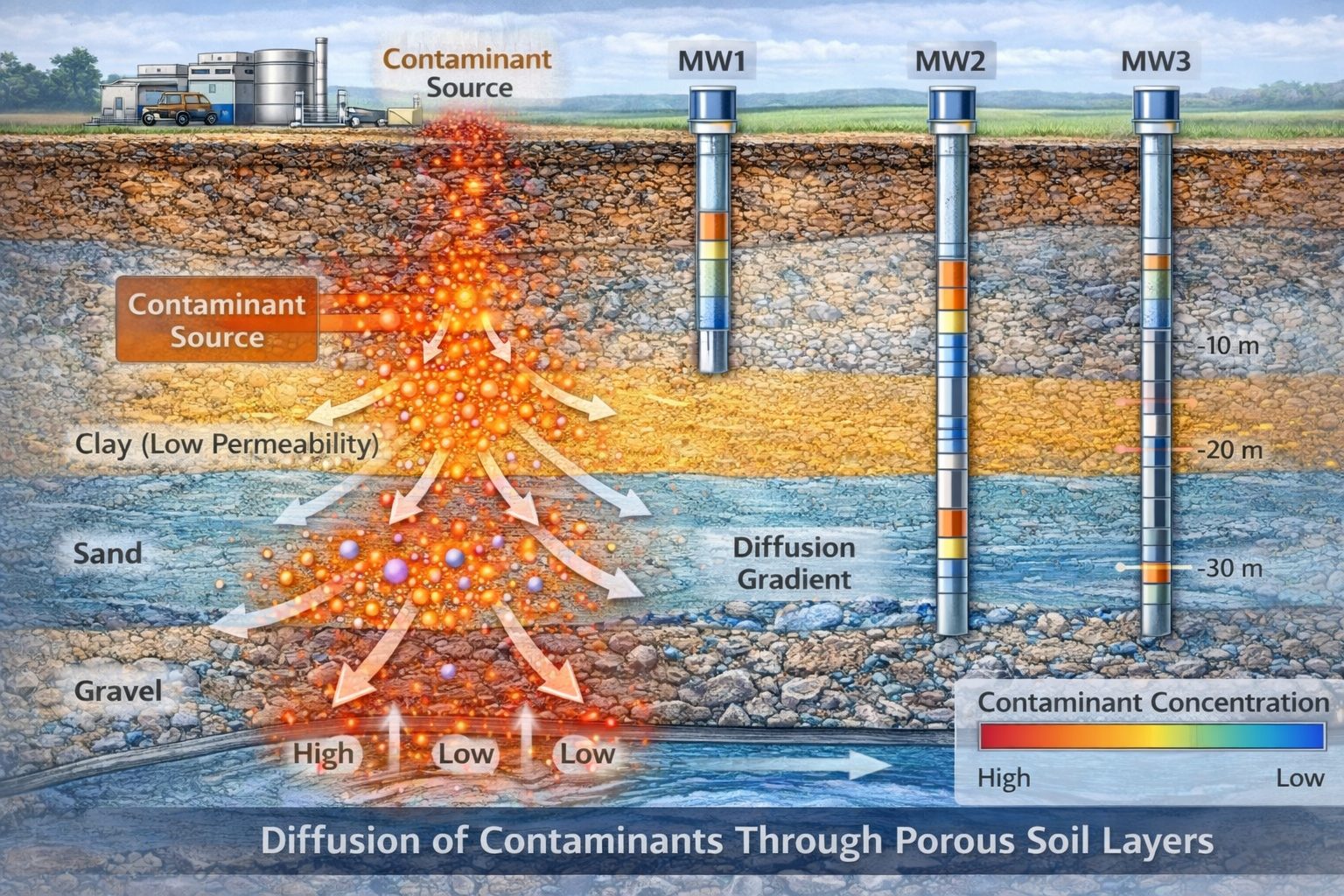
Among these processes, diffusion plays an important role in controlling contaminant migration in low-permeability environments such as clay layers, shale formations, and fine-grained sediments. Diffusion describes the movement of dissolved molecules from areas of higher concentration to areas of lower concentration due to molecular motion.
In groundwater systems where water velocities are low, diffusion may become the dominant transport mechanism controlling contaminant movement. This is especially important in environmental investigations involving landfill liners, contaminated sediments, waste containment systems, and aquitards that restrict groundwater flow.
To accurately simulate contaminant behavior in numerical transport models, scientists must determine diffusion coefficients, which quantify the rate at which contaminants spread through porous media. These coefficients are fundamental input parameters in transport equations used to simulate contaminant migration over time.
This article explores the role of diffusion in contaminant transport modeling, explains how diffusion coefficients are determined, and discusses how these values are used in environmental modeling applications.
What Is Diffusion in Groundwater Systems?
Diffusion is the process by which dissolved molecules move from regions of high concentration to regions of lower concentration due to random molecular motion. Unlike advection, which depends on groundwater flow, diffusion occurs even in stagnant water.
In subsurface environments, diffusion is especially important in materials with very low permeability, where groundwater flow is limited. Examples include:
- Clay layers
- Silt deposits
- Shale formations
- Compacted landfill liners
- Geological aquitards
When contaminants accumulate in these materials, diffusion may control how pollutants migrate through the porous medium.
Diffusion also plays a key role in contaminant exchange between different geological layers. For example, contaminants stored within clay formations may slowly diffuse into surrounding aquifers over long periods of time.
Fick’s Law and Diffusion Processes
Diffusion in porous media is commonly described using Fick’s Law, which relates the diffusive flux of a substance to the concentration gradient.
J = -D \frac{dC}{dx}
Where:
- J = diffusive mass flux
- D = diffusion coefficient
- C = contaminant concentration
- x = spatial coordinate
The negative sign indicates that diffusion occurs from areas of higher concentration toward areas of lower concentration.
In contaminant transport models, diffusion is often combined with advection and dispersion to simulate overall contaminant movement.
Types of Diffusion Coefficients
Several types of diffusion coefficients are used in environmental modeling, depending on the medium and processes involved.
Molecular Diffusion Coefficient
The molecular diffusion coefficient describes the rate of diffusion of a chemical species in pure water.
These coefficients depend on several factors:
- Temperature
- Molecular size
- Chemical properties of the solute
- Properties of the solvent
Typical molecular diffusion coefficients for dissolved contaminants in water are on the order of:
10⁻⁹ to 10⁻¹⁰ m²/s
These values are commonly reported in chemical engineering and environmental science literature.
Effective Diffusion Coefficient
In porous media such as soil or sediment, diffusion occurs through a network of interconnected pores rather than open water.
The effective diffusion coefficient accounts for the influence of:
- Porosity
- Tortuosity of flow paths
- Constrictions within pore spaces
Effective diffusion coefficients are typically lower than molecular diffusion coefficients because the geometry of the pore network slows molecular movement.
Apparent Diffusion Coefficient
In some cases, chemical reactions and sorption processes affect contaminant migration. The apparent diffusion coefficient incorporates these additional effects and represents the overall diffusion behavior observed in laboratory experiments.
Apparent diffusion coefficients may therefore reflect:
- Molecular diffusion
- Sorption interactions
- Chemical reactions
These values are often used when calibrating contaminant transport models.
Diffusion in Porous Media
Diffusion in soils and geological formations is strongly influenced by the physical structure of the porous medium.
Porosity
Porosity determines the amount of space available for water and dissolved contaminants within a soil or rock formation.
Higher porosity typically allows greater diffusive transport because more interconnected pathways exist for molecular movement.
Tortuosity
Tortuosity describes how winding or indirect the pathways are through the pore network.
In highly tortuous systems, molecules must travel longer distances through complex pathways, which slows diffusion rates.
Moisture Content
In unsaturated soils, diffusion occurs primarily through water-filled pores. When soils are partially dry, diffusion rates may decrease because fewer pathways are available.
Temperature Effects
Temperature strongly influences diffusion processes. As temperature increases, molecular motion becomes more energetic, increasing diffusion rates.
Environmental models often incorporate temperature corrections when estimating diffusion coefficients.
Methods for Determining Diffusion Coefficients
Diffusion coefficients can be determined using laboratory experiments, field measurements, or empirical relationships.
Laboratory Diffusion Tests
Laboratory diffusion tests are commonly used to measure diffusion coefficients in soils, sediments, or engineered barrier materials.
Typical experimental setups include:
- Diffusion cells
- Column experiments
- Batch diffusion tests
In a diffusion cell experiment, a soil sample is placed between two chambers containing solutions with different contaminant concentrations. Over time, contaminant movement across the sample is monitored.
By measuring concentration changes over time, researchers can estimate the effective diffusion coefficient.
Tracer Experiments
Tracer experiments involve introducing a known tracer substance into a soil or groundwater system and monitoring its movement over time.
Common tracers include:
- Chloride
- Bromide
- Fluorescent dyes
- Stable isotopes
Tracer tests can be performed in both laboratory and field environments. The resulting concentration data are analyzed to determine diffusion rates.
Empirical Relationships
In some cases, diffusion coefficients can be estimated using empirical relationships based on soil properties.
For example, effective diffusion coefficients may be approximated using relationships that account for porosity and tortuosity.
These empirical equations are useful when laboratory measurements are not available, although they may introduce uncertainty into transport models.
Inverse Modeling
Inverse modeling is a computational method used to estimate diffusion coefficients by fitting model simulations to observed contaminant concentration data.
In this approach, numerical models simulate contaminant transport using different parameter values. The model parameters are then adjusted until the simulated results match observed field or laboratory data.
Inverse modeling is commonly used when analyzing long-term contaminant migration in environmental studies.
Use of Diffusion Coefficients in Transport Models
Diffusion coefficients are essential input parameters in contaminant transport models used to simulate pollutant migration in groundwater systems.
These models typically combine several transport processes, including:
- Advection
- Dispersion
- Diffusion
- Sorption
- Chemical reactions
Diffusion becomes particularly important in environments where groundwater flow is slow or absent.
For example, diffusion plays a critical role in modeling:
- Contaminant migration through clay liners
- Diffusive transport from contaminated sediments
- Long-term release of contaminants from low-permeability formations
- Waste containment systems
Accurate diffusion coefficients allow models to simulate how contaminants slowly migrate through these materials over extended periods.
Diffusion in Landfill and Waste Containment Systems
Diffusion processes are especially important in landfill engineering and waste containment systems.
Clay liners and geosynthetic clay liners are often used as barriers to prevent contaminant migration. These materials have extremely low permeability, meaning groundwater flow through them is minimal.
In such cases, contaminant transport may occur primarily through diffusion.
Transport models used in landfill design therefore incorporate diffusion coefficients to evaluate:
- Long-term contaminant migration through liner systems
- Potential release of pollutants from waste containment facilities
- Performance of engineered barrier systems
These models help engineers design landfill systems that protect groundwater resources.
Challenges in Determining Diffusion Coefficients
Although diffusion coefficients are essential for transport modeling, accurately determining these values can be challenging.
Several factors contribute to uncertainty in diffusion estimates.
Heterogeneity of Geological Materials
Soils and sediments often contain complex mixtures of materials with varying properties. This heterogeneity can cause diffusion rates to vary across small spatial scales.
Chemical Interactions
Many contaminants interact with soil minerals through sorption or chemical reactions, complicating the interpretation of diffusion experiments.
Scale Effects
Laboratory experiments may not fully capture the complexity of natural geological systems. Diffusion rates measured in small laboratory samples may differ from those occurring at field scale.
Temperature and Environmental Conditions
Environmental conditions such as temperature, moisture content, and groundwater chemistry can influence diffusion behavior.
Because of these uncertainties, transport models often include sensitivity analyses to evaluate how diffusion coefficients influence model predictions.
Advances in Diffusion Measurement and Modeling
Recent advances in experimental techniques and numerical modeling are improving our understanding of diffusion processes in porous media.
Modern research methods include:
- High-resolution imaging of pore structures
- Micro-scale diffusion experiments
- Advanced tracer studies
- Reactive transport modeling
These techniques allow scientists to study diffusion processes with greater accuracy and incorporate more realistic parameters into environmental models.
Improved understanding of diffusion processes helps engineers design more effective waste containment systems and better predict contaminant migration in groundwater systems.
Conclusion
Diffusion is a fundamental process controlling contaminant transport in groundwater systems, particularly in low-permeability environments such as clay layers and engineered barrier systems. The diffusion coefficient is a key parameter used in environmental transport models to describe how contaminants migrate through porous media.
Accurate determination of diffusion coefficients requires a combination of laboratory experiments, field studies, empirical relationships, and numerical modeling techniques. By integrating these methods, scientists and engineers can estimate diffusion behavior and incorporate these values into contaminant transport models.
Although challenges remain due to geological complexity and environmental variability, advances in measurement techniques and modeling tools continue to improve our ability to quantify diffusion processes.
Understanding and accurately representing diffusion in contaminant transport models is essential for predicting long-term environmental impacts and designing effective strategies to protect groundwater resources.
Learn more about our Contaminant Transport Modeling Solutions
Related Articles
- Contaminant Transport Modelling and Landfill Design: A Complete Guide for Environmental Engineers
- How Contaminant Transport Models Predict Groundwater Pollution
- Designing Landfill Liner Systems to Prevent Groundwater Contamination
- Understanding Leachate Generation and Transport in Landfills
- Advection–Dispersion Modelling in Groundwater Systems
- Hydrogeological Data Required for Contaminant Transport Models
- Regulatory Requirements for Landfill Design and Groundwater Protection
- Unlock Global Expertise: Free Research Viewer for POLLUTE and MIGRATE
- Mastering the Plume: POLLUTEv8 vs. MODFLOW vs. FEFLOW vs. PATH3D
- Core Features of POLLUTEv8
- Mastering Contaminant Transport: Special Features of POLLUTEv8
- Navigating Contaminant Migration with POLLUTE: A Modern Approach to Landfill Design
- Beyond The MCL: Building Audit-Proof Contaminant Fate Models For 2026 Regulatory Submissions
- Using Predictive Models to Meet 2026 Primary Drinking Water Regulations
- Driving Environmental Research: How GAEA Technologies POLLUTE Software is Used in Academic and Industry Reports
- Modeling Your Way to ‘No Further Action’: How Predictive Simulation Shaves Years Off Remediation Timelines
- Meeting The New 2026 EPA Reporting Standards For PFAS: Why Traditional Spreadsheet Modeling No Longer Suffices
- Unlocking Sustainable Solutions: The Role of POLLUTE Software in Landfill Design and Contaminant Transport Modelling
- Contaminant Transport Modelling and Landfill Design Insights
- Geomembrane Degradation in Landfill Liners: Causes, Modeling, and Long-Term Performance
- Clogging of Landfill Leachate Collection Systems: Causes, Impacts, and Prevention
- Use and Determination of Distribution Coefficients for Contaminant Transport Modeling
- Non-Linear Sorption in Contaminant Transport Modeling
- Phase Change in Collection Systems in Contaminant Transport Modeling for Landfills
- Biological and Radioactive Decay in Contaminant Transport Modeling