

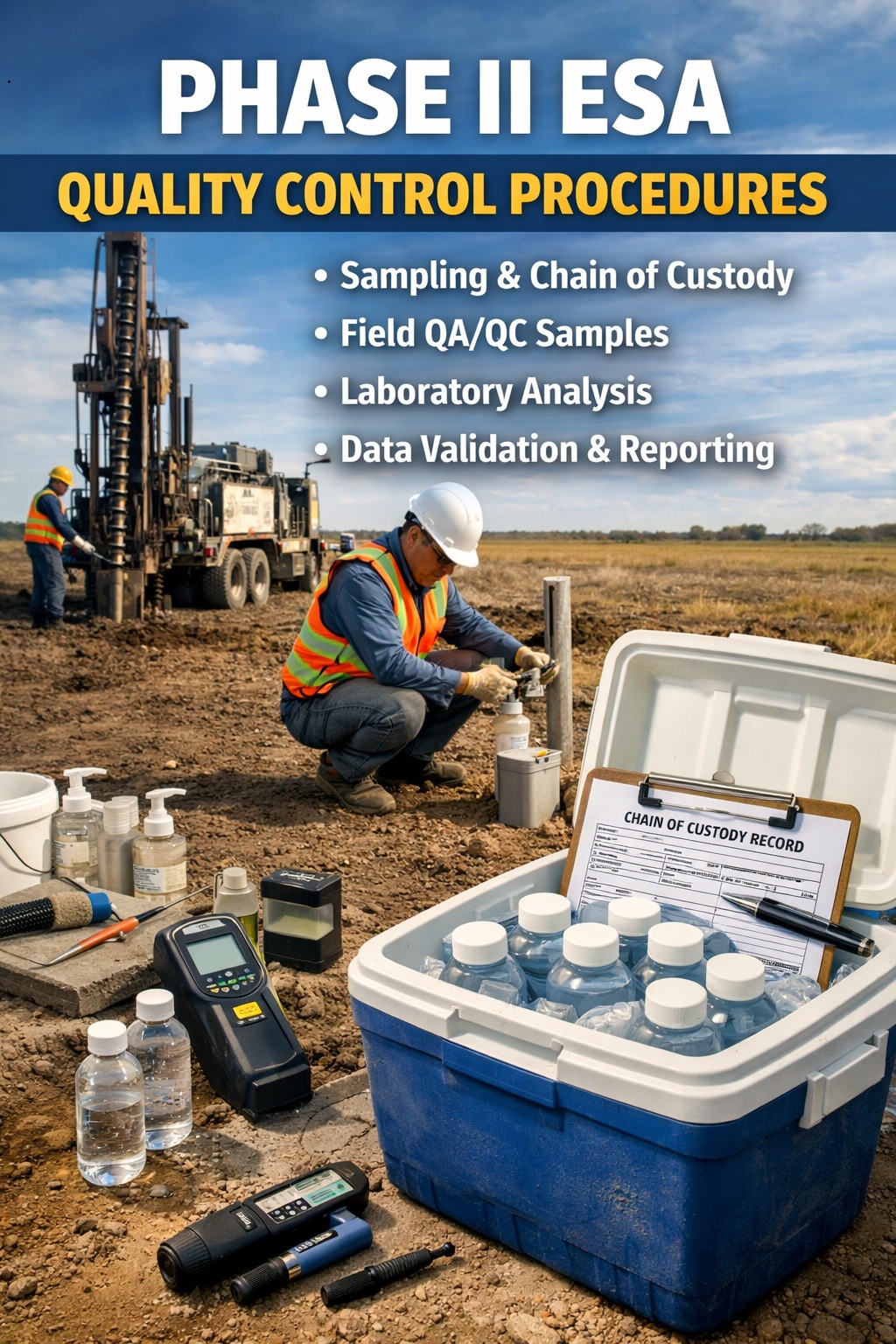
Quality control (QC) procedures are the backbone of any Phase II Environmental Site Assessment (ESA). Without them, even the most extensive drilling and sampling program can produce unreliable or legally indefensible results. QC ensures that all environmental data—whether soil, groundwater, or vapour—is accurate, repeatable, and representative of actual site conditions.
In a regulatory and legal context, QC is not optional. Standards established by organizations such as CSA Group and ASTM International provide structured frameworks that environmental professionals must follow. These frameworks ensure consistency across projects and jurisdictions while supporting scientifically sound decision-making.
This comprehensive guide explores QC procedures across the entire lifecycle of a Phase II ESA—from planning and fieldwork to laboratory analysis and final reporting.
Understanding Quality Control in a Phase II ESA
Quality control refers to the operational techniques and activities used to fulfill requirements for data quality. In a Phase II ESA, QC ensures that:
- Samples accurately represent subsurface conditions
- Analytical results are precise and reproducible
- Contamination is not introduced during sampling or handling
- Data meets regulatory and legal standards
QC is closely tied to Quality Assurance (QA), which focuses on system-level planning and oversight. Together, QA/QC programs form a defensible framework for environmental investigations.
Planning and Field Preparation QC
Effective QC begins long before any drilling rig arrives on site. Planning-stage controls establish the structure that ensures consistency throughout the project.
Sampling and Analysis Plan (SAP)
The Sampling and Analysis Plan (SAP) is the cornerstone of QC. It defines:
- Sampling locations and rationale
- Target depths and media (soil, groundwater, vapour)
- Analytical parameters (e.g., PHCs, VOCs, metals)
- Required QA/QC samples (duplicates, blanks)
- Equipment and methods
A well-prepared SAP ensures that all field staff follow a standardized and repeatable approach, minimizing variability and uncertainty.
Equipment Calibration
Field instruments must be calibrated to ensure measurement accuracy. Common equipment includes:
- Photoionization detectors (PIDs)
- pH meters
- Temperature probes
- Turbidity meters
Calibration is typically performed daily before use or according to manufacturer specifications using certified standards. All calibration activities are documented in field logs, providing traceability and accountability.
Personnel Training
QC depends heavily on the competency of field personnel. All staff must be trained in:
- Standard Operating Procedures (SOPs)
- Sampling techniques
- Health and safety protocols
- Documentation practices
Consistent training ensures that sampling is performed uniformly, reducing variability between personnel.
Laboratory Coordination
Selecting a qualified laboratory is critical. Most projects require laboratories accredited by:
- Canadian Association for Laboratory Accreditation
- National Environmental Laboratory Accreditation Program
Accreditation ensures that laboratories follow validated analytical methods and maintain strict internal QC procedures.
Field Sampling QC Procedures
Once fieldwork begins, QC procedures become highly operational. The Qualified Person (QP) oversees implementation to ensure consistency and compliance.
Standard Operating Procedures (SOPs)
All sampling activities must follow written SOPs that define:
- Sampling techniques
- Equipment usage
- Sample handling protocols
- Decontamination procedures
SOPs ensure repeatability, allowing results to be compared across locations and over time.
Sample Custody and Documentation
One of the most critical QC elements is the chain-of-custody (COC) process. This system tracks samples from collection to analysis.
COC forms include:
- Sample IDs
- Date and time of collection
- Requested analyses
- Signatures of all handlers
This documentation ensures legal defensibility by demonstrating that samples were not tampered with or misidentified.
Sample Handling and Preservation
Proper handling preserves sample integrity and prevents degradation.
Containers
- Pre-cleaned, laboratory-supplied containers
- Appropriate preservatives depending on analysis
Temperature Control
- Samples stored in coolers with ice
- Maintained at approximately 4°C
Holding Times
Laboratories must analyze samples within defined timeframes:
- Petroleum hydrocarbons (PHCs) in water: typically within 14 days
- Volatile organic compounds (VOCs): often shorter holding times
Failure to meet holding times can compromise data validity.
Equipment Decontamination
Cross-contamination is a major risk in environmental sampling. To prevent this, all reusable equipment must be decontaminated between sampling locations.
Typical process:
- Detergent wash
- Tap water rinse
- Deionized water rinse
In many cases, disposable equipment (e.g., bailers, tubing) is used to further reduce contamination risk.
Field QA/QC Samples
QA/QC samples are collected alongside primary samples to evaluate data quality and identify potential errors.
Field Duplicates
- Collected at the same time and location as primary samples
- Submitted under a separate identifier
Purpose:
- Measure precision of the sampling and analytical process
Trip Blanks
- Prepared using analyte-free water in the laboratory
- Travel with sample containers but are not opened in the field
Purpose:
- Detect contamination during transport or storage
Equipment Blanks (Rinse Blanks)
- Collected after decontamination
- Analyte-free water passed over sampling equipment
Purpose:
- Confirm effectiveness of cleaning procedures
Laboratory QC Procedures
Certified laboratories maintain rigorous internal QC systems to ensure analytical accuracy.
Internal Standards and Surrogates
Known compounds are added to samples to measure extraction efficiency and analytical performance.
Laboratory Control Samples (LCS)
Samples with known contaminant concentrations are analyzed to verify method accuracy.
Method Blanks
Analyte-free samples are processed alongside actual samples to detect any contamination introduced during laboratory procedures.
Data Validation and Reporting
The final step in QC is data validation, performed by the Qualified Person (QP).
Key Validation Activities
- Confirm analytical methods meet regulatory requirements
- Verify that holding times were met
- Review QA/QC sample results
- Identify anomalies or inconsistencies
Handling Data Issues
If issues are identified:
- Data may be flagged or qualified
- Additional sampling may be required
- Explanations are documented in the report
Transparent Reporting
The final Phase II ESA report must include:
- Description of QC procedures
- Summary of QA/QC findings
- Discussion of any deviations or limitations
Transparency ensures that stakeholders—including regulators, clients, and legal professionals—can rely on the conclusions.
Importance of QC for Regulatory Compliance
QC procedures are essential for meeting regulatory requirements and supporting decisions such as:
- Site remediation
- Risk assessment
- Property transactions
- Environmental compliance
Inadequate QC can lead to:
- Rejected data
- Project delays
- Increased costs
- Legal liability
Best Practices for Phase II ESA Quality Control
To ensure high-quality data, environmental professionals should:
- Develop detailed and project-specific Sampling and Analysis Plans
- Use standardized SOPs for all field activities
- Maintain thorough documentation
- Work with accredited laboratories
- Provide ongoing staff training
- Conduct comprehensive data validation
Conclusion
Quality control procedures are fundamental to the success of any Phase II ESA. From planning and field preparation to laboratory analysis and reporting, QC ensures that environmental data is accurate, reliable, and defensible.
By adhering to recognized standards from organizations like CSA Group and ASTM International, and implementing comprehensive QA/QC programs, environmental professionals can confidently support critical decisions related to site management, remediation, and regulatory compliance.
Strong QC practices not only protect data integrity but also safeguard public health, environmental quality, and overall project success.
👉 Learn more about our Automated Environmental Site Assessment Solution
Related Articles
- Methodology for Conducting a Phase II Environmental Site Assessment (ESA)
- Key Uses of a Phase II Environmental Site Assessment (ESA) Report
- Market Drivers and Trends for Phase II Environmental Site Assessments
- Role of Reviewing Existing Data for a Phase II Environmental Site Assessment
- Methodology for Identifying Contaminants of Concern (COCs) for a Phase II Environmental Site Assessment
- Key Components of a Phase II ESA Sampling Plan
- Key Components of a Phase II ESA Health and Safety Plan (HASP)
- Key Considerations for Permit Acquisition for a Phase II ESA
- The Utility Clearance Process for a Phase II ESA
- Drilling and Sampling for a Phase II ESA: Methods, Equipment, and Best Practices
- Installation of Monitoring Wells for a Phase II Environmental Site Assessment (ESA)
- Sample Handling Procedures for a Phase II ESA: Ensuring Data Integrity from Field to Laboratory
- Laboratory Analysis and Data Interpretation for a Phase II ESA
- Reporting and Recommendations for a Phase II Environmental Site Assessment (ESA)
- Differences Between a Phase II ESA in Canada and the United States