

Introduction
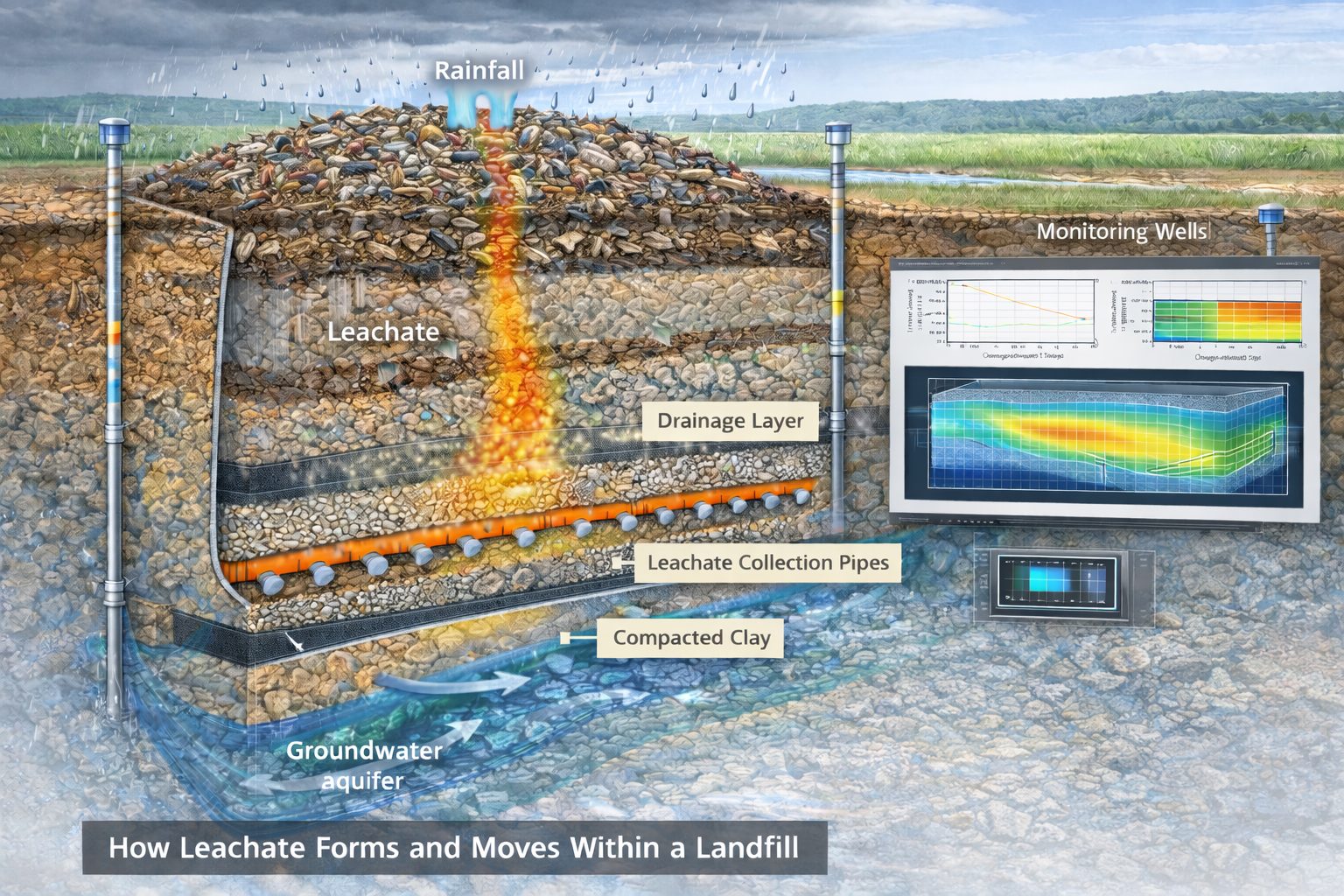
Modern landfills are highly engineered facilities designed to manage waste safely while protecting surrounding soil, groundwater, and ecosystems. One of the most critical environmental challenges associated with landfills is the generation and movement of leachate. Leachate is a liquid that forms when water infiltrates landfill waste and dissolves soluble contaminants, creating a potentially hazardous mixture of organic and inorganic pollutants.
If leachate is not properly controlled, it can migrate through soil and rock layers and contaminate groundwater resources. Because many communities depend on groundwater for drinking water and agriculture, preventing leachate contamination is a central focus of modern landfill engineering and environmental regulation.
Understanding how leachate forms and how it moves through landfill systems is essential for designing effective containment structures, leachate collection systems, and environmental monitoring programs. Engineers and hydrogeologists rely on site investigations, geological modeling, and environmental monitoring to evaluate leachate generation and transport.
This article explores the processes that produce landfill leachate, the factors that influence its movement through the subsurface, and the engineering strategies used to control leachate and protect groundwater resources.
What Is Leachate?
Leachate is the liquid that forms when water percolates through waste materials and extracts dissolved or suspended contaminants. The resulting liquid often contains a complex mixture of chemical compounds and biological materials derived from decomposing waste.
Leachate composition varies depending on several factors, including:
- The type of waste in the landfill
- The age of the landfill
- Climate and rainfall patterns
- Biological decomposition processes
- Chemical reactions within the waste
In municipal solid waste landfills, leachate commonly contains:
- Organic compounds
- Ammonia and nitrogen compounds
- Heavy metals
- Dissolved salts
- Volatile organic compounds (VOCs)
- Pathogens and microorganisms
Because of this complex composition, untreated leachate can pose serious environmental risks if it enters groundwater or nearby surface water systems.
How Leachate Is Generated
Leachate generation occurs when liquids infiltrate landfill waste and interact with the materials inside the landfill.
Sources of Water in Landfills
Several sources contribute to leachate formation.
Rainfall Infiltration
Rainfall is the most common source of leachate. When precipitation falls on the landfill surface, some water infiltrates the waste layers and begins dissolving contaminants.
Snowmelt
In colder climates, snow accumulation and seasonal melting can produce large volumes of water that infiltrate landfill waste.
Moisture in Waste Materials
Waste materials themselves often contain moisture. Organic waste such as food, yard waste, and paper products releases water during decomposition.
Surface Runoff
Surface water can enter landfill areas if drainage systems are not properly designed or maintained.
Groundwater Intrusion
In poorly designed landfill sites, groundwater may flow into the waste mass, increasing leachate generation.
All of these water sources contribute to the total volume of leachate produced within a landfill.
Biological Processes in Leachate Formation
Biological decomposition of waste plays a major role in generating leachate and influencing its chemical composition.
Landfills contain large quantities of organic materials that break down through microbial activity. This process occurs in several stages.
Aerobic Decomposition
Shortly after waste is deposited, oxygen trapped within the landfill supports aerobic microbial activity. Microorganisms break down organic matter, producing carbon dioxide, heat, and water.
Anaerobic Decomposition
As oxygen becomes depleted, anaerobic bacteria begin to dominate the decomposition process. These bacteria produce methane, carbon dioxide, and various organic acids.
Methanogenesis
In later stages of landfill decomposition, methane-producing bacteria convert organic acids into methane gas and carbon dioxide.
Throughout these stages, water and dissolved contaminants are released into the surrounding waste, contributing to leachate formation.
Chemical Composition of Leachate
Leachate composition changes significantly over time as waste materials degrade.
Young Landfill Leachate
In newly established landfills, leachate often contains high concentrations of biodegradable organic compounds and volatile acids.
Typical characteristics include:
- High biochemical oxygen demand (BOD)
- High chemical oxygen demand (COD)
- Low pH due to organic acid formation
Mature Landfill Leachate
As landfill decomposition progresses, the chemical composition of leachate changes.
Older leachate typically contains:
- Higher concentrations of ammonia
- Lower biodegradable organic content
- More stable chemical compounds
Understanding these changes is important for designing appropriate leachate treatment systems.
Transport of Leachate in Landfills
Once leachate is generated within a landfill, it begins to move through the waste mass and underlying soils.
The movement of leachate is influenced by several physical processes.
Gravity-Driven Flow
Leachate typically flows downward due to gravity, moving through the pores and void spaces within waste materials.
The rate of downward movement depends on:
- Waste permeability
- Compaction levels
- Moisture content
Lateral Flow
Leachate may also move laterally within landfill layers, particularly if impermeable layers or barriers redirect flow paths.
Lateral migration can spread contaminants across larger areas within the landfill.
Capillary Movement
Capillary forces within porous materials can cause water to move upward or sideways against gravity. This process can redistribute moisture within landfill waste.
Diffusion
Diffusion allows dissolved contaminants to spread from areas of high concentration to areas of lower concentration, even in relatively stagnant environments.
Together, these processes control how leachate migrates through landfill systems.
Factors That Influence Leachate Generation
Several environmental and engineering factors influence how much leachate a landfill produces.
Climate
Climate has a major influence on leachate generation. Regions with high rainfall or snowmelt typically produce more leachate than arid climates.
Landfill Cover Systems
Landfill covers reduce water infiltration by preventing precipitation from entering the waste mass.
Modern cover systems include:
- Soil cover layers
- Geomembranes
- Vegetative covers
These systems significantly reduce leachate generation.
Waste Composition
Waste materials with high moisture content produce more leachate during decomposition.
Organic waste such as food and yard debris contributes significantly to leachate formation.
Waste Compaction
Compacted waste reduces pore space, which can influence both water infiltration and leachate flow.
Proper compaction also improves landfill stability.
Landfill Age
Leachate generation tends to decrease over time as decomposition processes stabilize and moisture levels decline.
Engineering Systems for Leachate Control
Modern landfills incorporate multiple engineering systems to control leachate and prevent groundwater contamination.
Landfill Liner Systems
Liner systems form the primary barrier between landfill waste and surrounding soil and groundwater.
These systems often include:
- Compacted clay liners
- HDPE geomembrane liners
- Geosynthetic clay liners
These materials have extremely low permeability and prevent leachate from escaping the landfill.
Leachate Collection Systems
Leachate collection systems remove liquids from the landfill base before they can accumulate.
Key components include:
- Drainage layers
- Perforated collection pipes
- Pumping systems
Collected leachate is typically transported to treatment facilities.
Surface Water Management
Proper surface water management prevents excess water from entering the landfill.
Engineering measures include:
- Stormwater diversion channels
- Surface grading
- Drainage infrastructure
These systems minimize water infiltration and reduce leachate production.
Monitoring Leachate and Groundwater
Environmental monitoring plays a crucial role in ensuring landfill containment systems remain effective.
Monitoring programs typically include:
Leachate Monitoring
Operators measure leachate volume and chemical composition to track changes over time.
Groundwater Monitoring Wells
Monitoring wells are installed around landfill sites to detect potential contamination.
Groundwater samples are regularly tested for contaminants associated with landfill waste.
Environmental Reporting
Landfill operators must report monitoring results to regulatory agencies to demonstrate compliance with environmental standards.
Monitoring programs provide early warning if containment systems fail.
Modeling Leachate Transport
Environmental engineers often use computer models to predict leachate movement and evaluate potential groundwater contamination risks.
These models simulate processes such as:
- Water infiltration
- Leachate generation
- Contaminant transport through soil and rock
- Groundwater flow patterns
Modeling helps engineers:
- Evaluate landfill design alternatives
- Predict long-term environmental impacts
- Assess the effectiveness of liner systems
Model results support regulatory approvals and environmental risk assessments.
Long-Term Environmental Considerations
Even after landfill operations cease, leachate generation may continue for many years.
Post-closure landfill management typically includes:
- Continued leachate collection and treatment
- Groundwater monitoring
- Maintenance of landfill cover systems
Long-term environmental protection requires ongoing monitoring and maintenance to ensure that containment systems remain effective.
Advances in Leachate Management
Advances in environmental engineering continue to improve leachate management technologies.
Recent developments include:
Improved Geosynthetic Materials
Modern liner systems use advanced geosynthetic materials with greater durability and chemical resistance.
Advanced Leachate Treatment
Leachate treatment technologies now include biological treatment, membrane filtration, and advanced oxidation processes.
Real-Time Monitoring
Sensor networks and automated monitoring systems allow landfill operators to track environmental conditions more effectively.
Integrated Environmental Modeling
Modern software platforms integrate geological modeling, groundwater simulations, and contaminant transport modeling to support landfill design and environmental risk assessment.
These innovations improve environmental protection and support sustainable waste management practices.
Conclusion
Leachate generation and transport are central environmental challenges in landfill engineering. As water infiltrates landfill waste, it dissolves contaminants and creates a complex liquid that can threaten groundwater resources if not properly controlled.
Understanding the processes that produce and transport leachate allows engineers to design effective containment systems, including liner systems, leachate collection infrastructure, and surface water management systems. Together, these engineering solutions help prevent contamination and protect surrounding ecosystems.
Through careful landfill design, environmental monitoring, and advances in engineering technology, modern waste management systems can significantly reduce the risks associated with leachate migration.
As global waste generation continues to increase, improving our understanding of leachate processes will remain essential for protecting groundwater resources and ensuring environmentally responsible landfill management.
Learn more about our Contaminant Transport Modeling Solutions
Related Articles
- Contaminant Transport Modelling and Landfill Design: A Complete Guide for Environmental Engineers
- How Contaminant Transport Models Predict Groundwater Pollution
- Designing Landfill Liner Systems to Prevent Groundwater Contamination
- Advection–Dispersion Modelling in Groundwater Systems
- Hydrogeological Data Required for Contaminant Transport Models
- Regulatory Requirements for Landfill Design and Groundwater Protection
- Unlock Global Expertise: Free Research Viewer for POLLUTE and MIGRATE
- Mastering the Plume: POLLUTEv8 vs. MODFLOW vs. FEFLOW vs. PATH3D
- Core Features of POLLUTEv8
- Mastering Contaminant Transport: Special Features of POLLUTEv8
- Navigating Contaminant Migration with POLLUTE: A Modern Approach to Landfill Design
- Beyond The MCL: Building Audit-Proof Contaminant Fate Models For 2026 Regulatory Submissions
- Using Predictive Models to Meet 2026 Primary Drinking Water Regulations
- Driving Environmental Research: How GAEA Technologies POLLUTE Software is Used in Academic and Industry Reports
- Modeling Your Way to ‘No Further Action’: How Predictive Simulation Shaves Years Off Remediation Timelines
- Meeting The New 2026 EPA Reporting Standards For PFAS: Why Traditional Spreadsheet Modeling No Longer Suffices
- Using Predictive Models to Meet 2026 Primary Drinking Water Regulations
- Unlocking Sustainable Solutions: The Role of POLLUTE Software in Landfill Design and Contaminant Transport Modelling
- Contaminant Transport Modelling and Landfill Design Insights
- Geomembrane Degradation in Landfill Liners: Causes, Modeling, and Long-Term Performance
- Clogging of Landfill Leachate Collection Systems: Causes, Impacts, and Prevention
- Determining Diffusion Coefficients for Contaminant Transport Modeling
- Use and Determination of Distribution Coefficients for Contaminant Transport Modeling
- Non-Linear Sorption in Contaminant Transport Modeling
- Phase Change in Collection Systems in Contaminant Transport Modeling for Landfills
- Biological and Radioactive Decay in Contaminant Transport Modeling
External References
- EPA guidance on landfill design and leachate management
- EPA landfill liner and leachate collection regulations
- USGS groundwater contamination resources
- USGS groundwater flow and transport processes
- International Solid Waste Association landfill guidelines
- Canadian landfill environmental regulations
- Technical guidance on geomembrane landfill liners
- Geosynthetics used in landfill liner systems
- Hydrogeology and groundwater contamination research
- Biochemical clogging of landfill leachate collection systems
- Calcium carbonate precipitation in leachate collection system
- Mineral Precipitation and Hydraulic Performance of Drainage Layers
- Influence Factors in Clogging of Landfill Leachate Collection System
- Influence of Calcium Leaching on LCS Clogging
- Biofilm and Mineral Interaction in Clogging
- Reactive Transport Modeling of LCS Clogging
- Diffusion as a Key Transport Mechanism in Low-Permeability Media
- Groundwater Contaminant Migration Processes