

Introduction
Groundwater systems play a critical role in supplying drinking water, supporting agriculture, and sustaining ecosystems around the world. However, groundwater resources are vulnerable to contamination from industrial activities, agricultural runoff, landfills, and accidental chemical spills. Once pollutants enter the subsurface environment, they can migrate through aquifers and potentially impact drinking water wells, rivers, and wetlands.
Understanding how contaminants move through groundwater systems is therefore essential for environmental protection and water resource management. One of the most widely used scientific approaches for analyzing contaminant migration is advection–dispersion modelling. This modelling technique describes how dissolved contaminants travel through groundwater under the influence of groundwater flow and spreading processes.
Advection–dispersion models are widely used by hydrogeologists, environmental engineers, and regulatory agencies to predict the movement of contaminant plumes, evaluate environmental risks, and design remediation strategies. These models integrate groundwater flow simulations, geological data, and mathematical equations to represent the physical processes that control contaminant transport.
This article explores the principles of advection–dispersion modelling in groundwater systems, explains the processes that influence contaminant transport, and discusses how these models are used in environmental engineering and hydrogeology.
The Importance of Groundwater Contaminant Transport Modelling
Groundwater contamination is often difficult to detect and manage because it occurs beneath the surface and may spread slowly over large areas. Pollutants that enter an aquifer can migrate for years or even decades before reaching sensitive receptors such as drinking water wells.
Predicting the movement of contaminants is essential for several reasons:
- Protecting drinking water resources
- Evaluating environmental impacts of industrial activities
- Designing remediation systems for contaminated sites
- Assessing risks associated with landfills and waste disposal
- Supporting environmental regulatory compliance
Advection–dispersion modelling provides a scientific framework for predicting how contaminants will move through groundwater systems over time.
Understanding Groundwater Flow
Before examining contaminant transport, it is important to understand how groundwater moves through the subsurface.
Groundwater flows through porous materials such as sand, gravel, and fractured rock. The movement of groundwater is controlled by differences in hydraulic head, which create hydraulic gradients that drive water from higher pressure areas to lower pressure areas.
The relationship between groundwater velocity and hydraulic gradient is commonly described by Darcy’s Law, which forms the basis for most groundwater flow models.
Darcy’s Law
Q = -K A \frac{dh}{dl}
Where:
- Q is the volumetric flow rate
- K is hydraulic conductivity
- A is cross-sectional area
- dh/dl is the hydraulic gradient
Darcy’s Law allows hydrogeologists to estimate groundwater velocities and flow directions within aquifers. Because contaminant transport largely follows groundwater movement, accurate flow modelling is essential for predicting contaminant migration.
What Is Advection in Groundwater Systems?
Advection refers to the process by which dissolved contaminants are transported by the bulk movement of groundwater.
When groundwater flows through an aquifer, dissolved pollutants move along with the water molecules. This means that contaminants tend to travel in the same direction as groundwater flow.
Advection is typically the primary transport mechanism for contaminants in groundwater systems.
Key characteristics of advective transport include:
- Movement aligned with groundwater flow direction
- Contaminant velocity proportional to groundwater velocity
- Transport along hydraulic gradients
If groundwater moves rapidly through a highly permeable aquifer, contaminants may migrate long distances relatively quickly.
Understanding Dispersion in Groundwater
While advection moves contaminants along the flow path, dispersion causes contaminants to spread out as they travel through the subsurface.
Dispersion occurs because groundwater does not flow uniformly through porous materials. Variations in pore sizes, flow paths, and velocities cause contaminant particles to move at slightly different speeds and directions.
This spreading effect causes contaminant plumes to widen and dilute as they migrate.
Dispersion is typically divided into two components:
Mechanical Dispersion
Mechanical dispersion results from variations in groundwater velocity within the pore spaces of the aquifer.
Some water moves through large pores more quickly than water moving through smaller pores. These differences cause contaminant particles to separate and spread.
Molecular Diffusion
Molecular diffusion occurs when contaminant molecules move from areas of higher concentration to areas of lower concentration due to random molecular motion.
Diffusion is generally more important in low-permeability environments where groundwater flow is slow.
The Advection–Dispersion Equation
The combined effects of advection and dispersion are described mathematically by the Advection–Dispersion Equation (ADE). This equation forms the foundation of contaminant transport modelling in groundwater systems.
\frac{\partial C}{\partial t} + v\frac{\partial C}{\partial x} = D\frac{\partial^2 C}{\partial x^2}
Where:
- C = contaminant concentration
- t = time
- x = distance along the flow path
- v = groundwater velocity (advection term)
- D = dispersion coefficient
This equation describes how contaminant concentrations change over time due to both advective transport and dispersive spreading.
More complex forms of the equation can include additional terms representing chemical reactions, sorption, and biodegradation.
Contaminant Plume Development
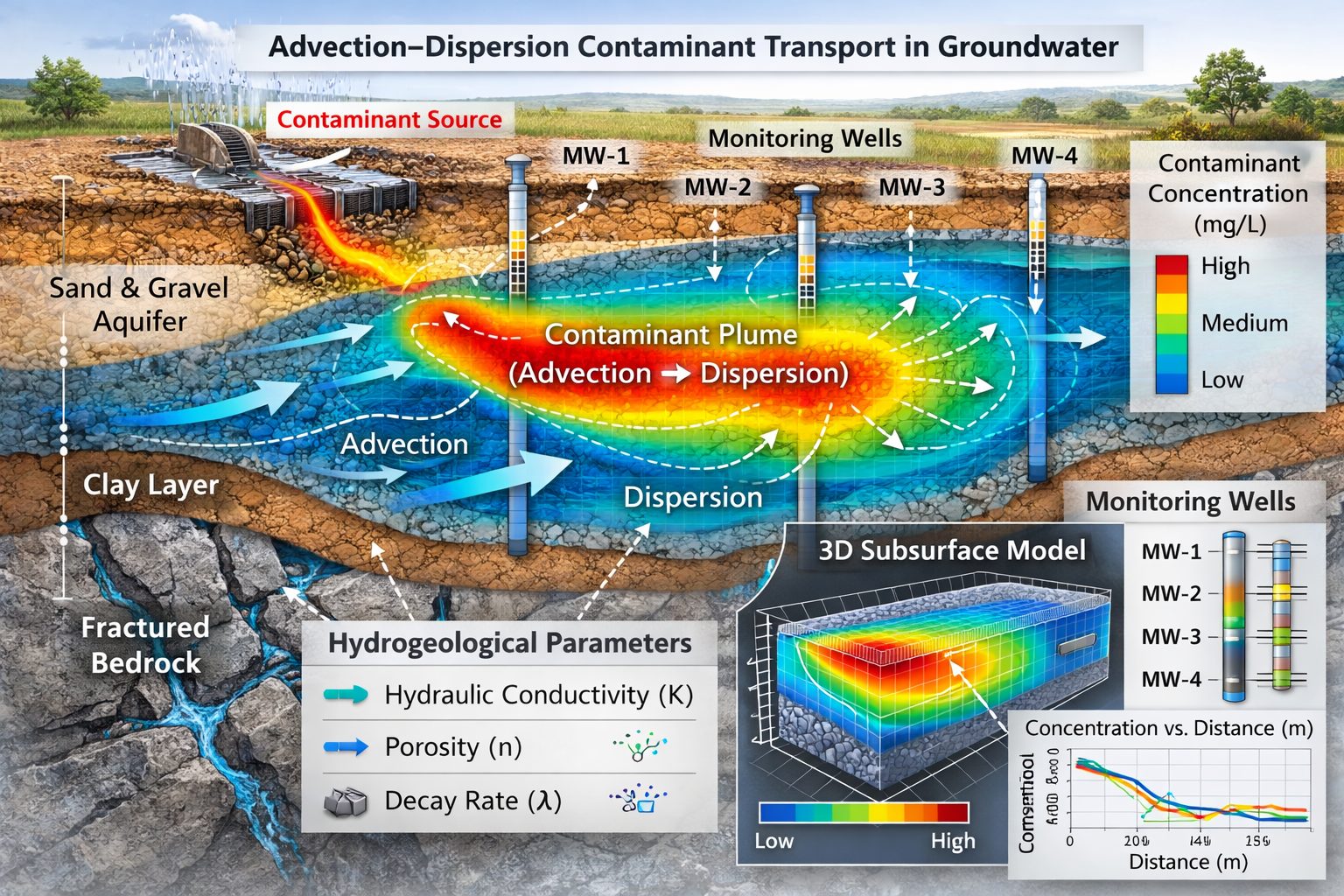
One of the most important outcomes of advection–dispersion modelling is the prediction of contaminant plumes.
A contaminant plume represents the spatial distribution of dissolved pollutants within groundwater.
Typical plume characteristics include:
- A high-concentration source zone
- A plume core moving with groundwater flow
- Gradual spreading due to dispersion
- Dilution as contaminants migrate away from the source
Plumes often develop elongated shapes aligned with groundwater flow direction.
Advection–dispersion models allow scientists to estimate how these plumes will grow and migrate over time.
Factors Affecting Contaminant Transport
Several geological and environmental factors influence the behavior of contaminant plumes in groundwater systems.
Aquifer Permeability
Highly permeable materials such as sand and gravel allow groundwater to move quickly, increasing advective transport rates.
Low-permeability materials such as clay slow groundwater flow and reduce contaminant migration.
Porosity
Porosity refers to the fraction of pore space within a soil or rock formation.
Higher porosity allows more water and contaminants to move through the aquifer.
Hydraulic Gradient
The hydraulic gradient controls the direction and velocity of groundwater flow.
Steeper gradients typically lead to faster contaminant transport.
Sorption Processes
Some contaminants interact with soil and rock surfaces through adsorption or absorption processes.
Sorption slows contaminant movement because some portion of the contaminant mass becomes attached to solid materials.
Chemical Reactions and Biodegradation
Certain contaminants may degrade over time due to chemical reactions or microbial activity.
These processes can reduce contaminant concentrations and influence plume development.
Numerical Modelling of Advection–Dispersion
Because real-world groundwater systems are complex, analytical solutions to the advection–dispersion equation are often insufficient. Instead, environmental engineers use numerical models to simulate contaminant transport.
Numerical models divide the subsurface environment into a grid or mesh and calculate contaminant concentrations at each grid point over time.
These models can incorporate:
- Three-dimensional groundwater flow
- Complex geological structures
- Multiple contaminant species
- Chemical reactions and biodegradation
Numerical modelling allows scientists to simulate realistic environmental conditions and predict contaminant migration under various scenarios.
Applications of Advection–Dispersion Modelling
Advection–dispersion modelling is used in a wide range of environmental engineering and hydrogeology applications.
Groundwater Contamination Assessment
When contamination is detected at industrial sites, modelling helps determine how pollutants may migrate through the aquifer.
Landfill Environmental Studies
Transport models are used to evaluate potential groundwater contamination risks associated with landfill leachate.
Remediation System Design
Models help engineers design cleanup strategies such as pump-and-treat systems, reactive barriers, or in-situ bioremediation.
Environmental Impact Assessments
Modelling helps predict the environmental impacts of industrial facilities, mining operations, or waste disposal sites.
Water Resource Protection
Advection–dispersion models are used to protect drinking water wells by predicting potential contaminant migration.
Model Calibration and Validation
To ensure that contaminant transport models provide reliable predictions, they must be calibrated using observed field data.
Calibration
Model calibration involves adjusting model parameters until simulated groundwater levels and contaminant concentrations match observed measurements.
Common calibration parameters include:
- Hydraulic conductivity
- Porosity
- Dispersivity
- Recharge rates
Validation
After calibration, models are validated by comparing predictions with independent data sets.
Validation ensures that the model accurately represents the physical behavior of the groundwater system.
Challenges and Uncertainty in Transport Modelling
Although advection–dispersion modelling is a powerful tool, several sources of uncertainty can affect model predictions.
Limited Subsurface Data
Subsurface geological conditions are difficult to observe directly. Boreholes and monitoring wells provide only limited information about aquifer properties.
Geological Heterogeneity
Natural aquifers often contain complex variations in permeability and porosity that are difficult to represent accurately in models.
Uncertain Contaminant Sources
In many contamination cases, the exact timing and magnitude of contaminant releases are not fully known.
Model Simplifications
To make simulations computationally manageable, models often simplify complex geological features and chemical processes.
To address these uncertainties, modelers often conduct sensitivity analyses and simulate multiple scenarios.
Advances in Groundwater Transport Modelling
Recent advances in environmental modeling and computational technology are improving the accuracy and usefulness of advection–dispersion models.
High-Resolution Geological Modelling
Improved geological modeling techniques allow scientists to represent complex subsurface structures in greater detail.
Integrated Data Platforms
Modern data platforms integrate borehole databases, geological models, and groundwater simulations within a single environment.
Cloud-Based Environmental Modeling
Cloud computing allows researchers to run large simulations more efficiently and collaborate across multidisciplinary teams.
Real-Time Environmental Monitoring
Sensor networks and automated monitoring systems may eventually provide real-time data to update groundwater models continuously.
These advances are helping scientists better understand and predict groundwater contamination processes.
Conclusion
Advection–dispersion modelling is a fundamental tool for understanding contaminant transport in groundwater systems. By combining the processes of groundwater flow, advective transport, and dispersive spreading, these models provide a scientific framework for predicting how pollutants move through aquifers.
Environmental engineers and hydrogeologists rely on advection–dispersion models to assess groundwater contamination risks, design remediation strategies, and protect drinking water resources. Although uncertainties remain due to limited subsurface data and natural geological variability, advances in modeling technology and data integration continue to improve predictive capabilities.
As environmental challenges related to groundwater contamination increase, advection–dispersion modelling will remain an essential component of sustainable groundwater management and environmental protection.
Learn more about our Contaminant Transport Modeling Solutions
Related Articles
- Contaminant Transport Modelling and Landfill Design: A Complete Guide for Environmental Engineers
- How Contaminant Transport Models Predict Groundwater Pollution
- Designing Landfill Liner Systems to Prevent Groundwater Contamination
- Understanding Leachate Generation and Transport in Landfills
- Hydrogeological Data Required for Contaminant Transport Models
- Regulatory Requirements for Landfill Design and Groundwater Protection
- Unlock Global Expertise: Free Research Viewer for POLLUTE and MIGRATE
- Mastering the Plume: POLLUTEv8 vs. MODFLOW vs. FEFLOW vs. PATH3D
- Core Features of POLLUTEv8
- Mastering Contaminant Transport: Special Features of POLLUTEv8
- Navigating Contaminant Migration with POLLUTE: A Modern Approach to Landfill Design
- Beyond The MCL: Building Audit-Proof Contaminant Fate Models For 2026 Regulatory Submissions
- Using Predictive Models to Meet 2026 Primary Drinking Water Regulations
- Driving Environmental Research: How GAEA Technologies POLLUTE Software is Used in Academic and Industry Reports
- Modeling Your Way to ‘No Further Action’: How Predictive Simulation Shaves Years Off Remediation Timelines
- Meeting The New 2026 EPA Reporting Standards For PFAS: Why Traditional Spreadsheet Modeling No Longer Suffices
- Using Predictive Models to Meet 2026 Primary Drinking Water Regulations
- Unlocking Sustainable Solutions: The Role of POLLUTE Software in Landfill Design and Contaminant Transport Modelling
- Contaminant Transport Modelling and Landfill Design Insights
- Geomembrane Degradation in Landfill Liners: Causes, Modeling, and Long-Term Performance
- Clogging of Landfill Leachate Collection Systems: Causes, Impacts, and Prevention
- Determining Diffusion Coefficients for Contaminant Transport Modeling
- Use and Determination of Distribution Coefficients for Contaminant Transport Modeling
- Non-Linear Sorption in Contaminant Transport Modeling
- Phase Change in Collection Systems in Contaminant Transport Modeling for Landfills
- Biological and Radioactive Decay in Contaminant Transport Modeling
External References
- USGS groundwater contamination resources
- USGS groundwater flow and transport processes
- International Solid Waste Association landfill guidelines
- Canadian landfill environmental regulations
- Technical guidance on geomembrane landfill liners
- Geosynthetics used in landfill liner systems
- Hydrogeology and groundwater contamination research
- Reactive Transport Modeling of LCS Clogging
- Determining Diffusion Coefficients in Porous Media (Benning et al.)
- Determining Apparent Diffusion Coefficients Using Tracer Tests
- Diffusion as a Key Transport Mechanism in Low-Permeability Media
- Groundwater Contaminant Migration Processes
- Effective Diffusion in Porous Media