

Introduction
Modern landfill facilities rely on carefully engineered containment systems to protect groundwater and surrounding ecosystems from contamination. One of the most important components of these systems is the leachate collection system (LCS). This infrastructure collects and removes contaminated liquids produced within the landfill before they can accumulate above the liner system and potentially migrate into the surrounding environment.
Leachate forms when rainwater, surface water, or moisture within waste materials percolates through landfill waste and dissolves contaminants. The resulting liquid may contain organic compounds, heavy metals, salts, ammonia, and other pollutants. Without effective collection and removal, leachate can build up within the landfill and increase the risk of leakage through liner systems.
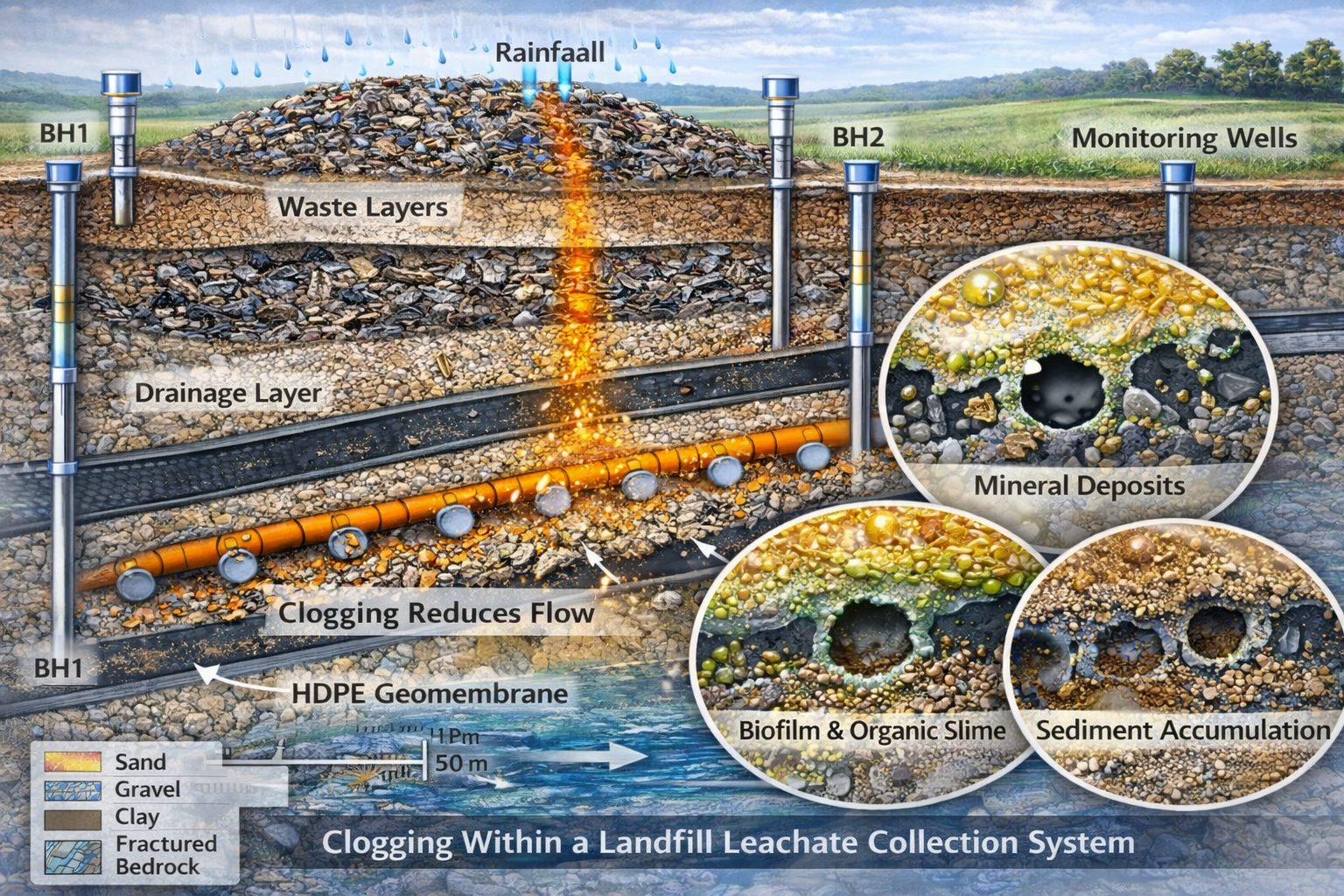
To manage this liquid, landfill designers install drainage layers, perforated pipes, and pumping systems that direct leachate toward treatment or disposal facilities. However, over time these systems may experience clogging, which reduces their ability to collect and transport leachate efficiently.
Clogging of leachate collection systems is one of the most important long-term challenges in landfill engineering. The accumulation of biological growth, chemical precipitates, suspended solids, and fine particles can gradually obstruct drainage layers and pipes. If clogging becomes severe, leachate may accumulate within the landfill, increasing hydraulic pressure on liner systems and raising the risk of environmental contamination.
This article explores the causes of clogging in landfill leachate collection systems, the physical and chemical processes involved, methods used to evaluate clogging risks, and engineering strategies that help prevent or mitigate long-term system failure.
Role of Leachate Collection Systems in Landfill Design
Leachate collection systems are designed to remove liquids from the base of the landfill as quickly as possible. By doing so, they reduce the hydraulic head acting on the liner system and prevent leachate from escaping the landfill.
A typical leachate collection system includes several key components:
- A drainage layer made of gravel or geosynthetic materials
- Perforated collection pipes installed within the drainage layer
- Filter materials or geotextiles that prevent fine particles from entering the system
- Pumping systems that transport collected leachate to treatment facilities
These systems are installed above the landfill liner and beneath the waste mass. As leachate flows downward through the landfill, it enters the drainage layer and is directed toward the collection pipes.
Environmental regulations often require that leachate collection systems maintain a maximum liquid head of approximately 30 cm above the liner system to minimize leakage risk.
Because these systems must function for many decades, maintaining hydraulic conductivity within the drainage layer and pipes is critical.
What Is Leachate Collection System Clogging?
Clogging occurs when materials accumulate within the drainage layer, geotextiles, or collection pipes, reducing the permeability and flow capacity of the system.
Over time, clogging may cause:
- Reduced drainage efficiency
- Increased hydraulic head on the liner system
- Higher risk of leachate leakage
- Reduced system lifespan
Clogging typically develops gradually over many years, making it difficult to detect until system performance is significantly affected.
Understanding the mechanisms that cause clogging is essential for designing long-lasting leachate collection systems.
Mechanisms of Clogging in Leachate Collection Systems
Several physical, chemical, and biological processes contribute to clogging within landfill drainage systems.
Biological Clogging
Biological activity is one of the most common causes of clogging in leachate collection systems.
Landfill leachate contains high concentrations of organic compounds and nutrients that support microbial growth. Microorganisms can colonize drainage materials and pipes, forming biofilms that gradually accumulate within the system.
These microbial communities produce extracellular polymeric substances that trap suspended particles and further restrict water flow.
Biological clogging can lead to:
- Reduced permeability of drainage layers
- Blockage of pipe perforations
- Accumulation of organic sludge within pipes
The growth of microbial communities is often most intense during the early stages of landfill operation when organic decomposition rates are highest.
Chemical Precipitation
Chemical reactions within landfill leachate can cause dissolved minerals to precipitate and accumulate within the drainage system.
One of the most common precipitates found in clogged leachate collection systems is calcium carbonate. This mineral forms when calcium ions react with carbonate ions in the leachate.
Other common precipitates include:
- Iron hydroxides
- Magnesium carbonates
- Silica deposits
These mineral deposits may coat drainage materials and gradually fill pore spaces, reducing permeability.
Chemical precipitation is strongly influenced by leachate chemistry, temperature, and pH conditions.
Physical Sedimentation
Suspended solids carried by landfill leachate may settle within the drainage layer or collection pipes.
These solids may originate from several sources:
- Fine soil particles within waste materials
- Degraded waste fragments
- Biological biomass
- Corrosion products
Over time, these particles accumulate within drainage materials and pipes, reducing flow capacity.
Sedimentation often occurs when flow velocities are low, allowing particles to settle out of suspension.
Geotextile Clogging
Many landfill designs include geotextile filters that prevent fine particles from entering drainage layers.
While these materials are designed to maintain permeability, they may eventually become clogged by:
- Biological growth
- Fine sediment accumulation
- Chemical precipitates
Once clogged, geotextiles may significantly reduce drainage efficiency and contribute to leachate buildup.
Factors Influencing Clogging Rates
The rate at which clogging occurs depends on several environmental and design factors.
Leachate Composition
The chemical composition of leachate strongly influences clogging potential.
High concentrations of calcium, iron, and organic matter increase the likelihood of chemical precipitation and biological growth.
Waste Composition
Landfills containing large amounts of organic waste typically produce leachate with high nutrient content, which promotes microbial growth and biofilm formation.
Temperature
Higher temperatures accelerate microbial activity and chemical reactions, increasing the potential for clogging.
Hydraulic Conditions
Low flow velocities encourage sedimentation and particle accumulation within drainage systems.
Proper hydraulic design is essential for maintaining sufficient flow velocities.
Drainage Material Characteristics
The size, shape, and permeability of drainage materials affect clogging susceptibility.
Coarser gravel materials generally resist clogging more effectively than fine-grained materials.
Modeling Clogging in Leachate Collection Systems
Because leachate collection systems must operate for decades, engineers often use mathematical models to predict clogging behavior and long-term system performance.
These models simulate how biological growth, chemical precipitation, and sediment accumulation affect the permeability of drainage layers over time.
Clogging models typically incorporate several key parameters:
- Biological growth rates
- Chemical precipitation rates
- Particle deposition rates
- Flow velocity within drainage materials
The reduction in hydraulic conductivity due to clogging can be represented using empirical relationships that describe how permeability changes over time.
Modeling helps engineers evaluate design alternatives and estimate system lifespan under different operating conditions.
Impacts of Clogging on Landfill Performance
Clogging of leachate collection systems can have significant consequences for landfill containment performance.
Increased Hydraulic Head
When drainage capacity decreases, leachate may accumulate above the liner system. This increases hydraulic pressure and raises the potential for leakage.
Reduced Leachate Removal Efficiency
Clogged pipes and drainage layers reduce the ability of the system to transport leachate to collection points.
Increased Environmental Risk
If leachate levels rise excessively, contaminants may migrate through liner defects or geological formations.
Reduced System Lifespan
Severe clogging may require costly repairs or retrofitting of drainage systems.
Because landfill infrastructure is difficult to access once waste is in place, preventing clogging during the design phase is essential.
Engineering Strategies to Prevent Clogging
Engineers use several strategies to minimize the risk of clogging in leachate collection systems.
Proper Drainage Layer Design
Drainage layers should consist of coarse, well-graded materials that maintain high permeability even when partially clogged.
Gravel sizes are typically selected to balance filtration performance and hydraulic conductivity.
Pipe Design and Spacing
Collection pipes must be properly sized and spaced to maintain adequate flow capacity.
Perforation design is also important to prevent particle intrusion while allowing efficient drainage.
Use of Geosynthetic Drainage Materials
Geonets and geocomposite drainage systems can provide high flow capacity and reduce clogging risks.
These materials are increasingly used in modern landfill designs.
Leachate Recirculation Management
Some landfills use leachate recirculation to enhance waste decomposition. However, excessive recirculation may increase clogging risks by promoting microbial growth.
Careful management of recirculation systems is necessary.
Regular Monitoring and Maintenance
Leachate flow rates and system performance should be monitored throughout landfill operation.
Monitoring programs may include:
- Leachate volume measurements
- Pipe inspection systems
- Hydraulic head monitoring above liners
Early detection of clogging problems allows operators to take corrective actions.
Advances in Leachate Collection Technology
Recent advances in landfill engineering are improving the long-term reliability of leachate collection systems.
Emerging technologies include:
- Advanced geosynthetic drainage materials
- Improved geotextile filtration systems
- Chemical inhibitors that reduce mineral precipitation
- Smart monitoring systems that detect flow reductions
These innovations help improve system durability and reduce environmental risks.
Conclusion
Leachate collection systems are essential components of modern landfill containment systems. By removing contaminated liquids from the base of the landfill, these systems help protect groundwater resources and maintain environmental safety.
However, clogging of drainage layers and collection pipes is a significant long-term challenge. Biological growth, chemical precipitation, and sediment accumulation can gradually reduce system permeability and impair leachate removal efficiency.
Understanding the mechanisms of clogging allows engineers to design more resilient drainage systems and predict long-term performance using mathematical models. Through proper design, material selection, and monitoring programs, landfill operators can minimize clogging risks and ensure that leachate collection systems remain effective for many decades.
As landfill engineering continues to evolve, advances in geosynthetic materials, monitoring technologies, and predictive modeling will further improve the reliability of leachate collection systems and support sustainable waste management practices.
Learn more about our Contaminant Transport Modeling Solutions
Related Articles
- Contaminant Transport Modelling and Landfill Design: A Complete Guide for Environmental Engineers
- How Contaminant Transport Models Predict Groundwater Pollution
- Designing Landfill Liner Systems to Prevent Groundwater Contamination
- Understanding Leachate Generation and Transport in Landfills
- Advection–Dispersion Modelling in Groundwater Systems
- Hydrogeological Data Required for Contaminant Transport Models
- Regulatory Requirements for Landfill Design and Groundwater Protection
- Unlock Global Expertise: Free Research Viewer for POLLUTE and MIGRATE
- Mastering the Plume: POLLUTEv8 vs. MODFLOW vs. FEFLOW vs. PATH3D
- Core Features of POLLUTEv8
- Mastering Contaminant Transport: Special Features of POLLUTEv8
- Navigating Contaminant Migration with POLLUTE: A Modern Approach to Landfill Design
- Beyond The MCL: Building Audit-Proof Contaminant Fate Models For 2026 Regulatory Submissions
- Using Predictive Models to Meet 2026 Primary Drinking Water Regulations
- Driving Environmental Research: How GAEA Technologies POLLUTE Software is Used in Academic and Industry Reports
- Modeling Your Way to ‘No Further Action’: How Predictive Simulation Shaves Years Off Remediation Timelines
- Meeting The New 2026 EPA Reporting Standards For PFAS: Why Traditional Spreadsheet Modeling No Longer Suffices
- Unlocking Sustainable Solutions: The Role of POLLUTE Software in Landfill Design and Contaminant Transport Modelling
- Contaminant Transport Modelling and Landfill Design Insights
- Geomembrane Degradation in Landfill Liners: Causes, Modeling, and Long-Term Performance
- Determining Diffusion Coefficients for Contaminant Transport Modeling
- Use and Determination of Distribution Coefficients for Contaminant Transport Modeling
- Non-Linear Sorption in Contaminant Transport Modeling
- Phase Change in Collection Systems in Contaminant Transport Modeling for Landfills
- Biological and Radioactive Decay in Contaminant Transport Modeling
External References
- Biochemical clogging of landfill leachate collection systems
- Calcium carbonate precipitation in leachate collection system
- Mineral Precipitation and Hydraulic Performance of Drainage Layers
- Influence Factors in Clogging of Landfill Leachate Collection System
- Influence of Calcium Leaching on LCS Clogging
- Biofilm and Mineral Interaction in Clogging
- Reactive Transport Modeling of LCS Clogging