

Introduction
Understanding how contaminants move through soil and groundwater systems is a fundamental challenge in environmental engineering and hydrogeology. When pollutants are released into the subsurface environment—whether from industrial spills, landfills, mining operations, or agricultural runoff—their movement is governed by several complex processes. These include groundwater flow, dispersion, diffusion, chemical reactions, and interactions between contaminants and geological materials.
One of the most important processes affecting contaminant migration is sorption, the interaction between dissolved contaminants and solid surfaces in soil or rock. Sorption can significantly slow contaminant transport by temporarily removing pollutants from groundwater and attaching them to mineral or organic surfaces.
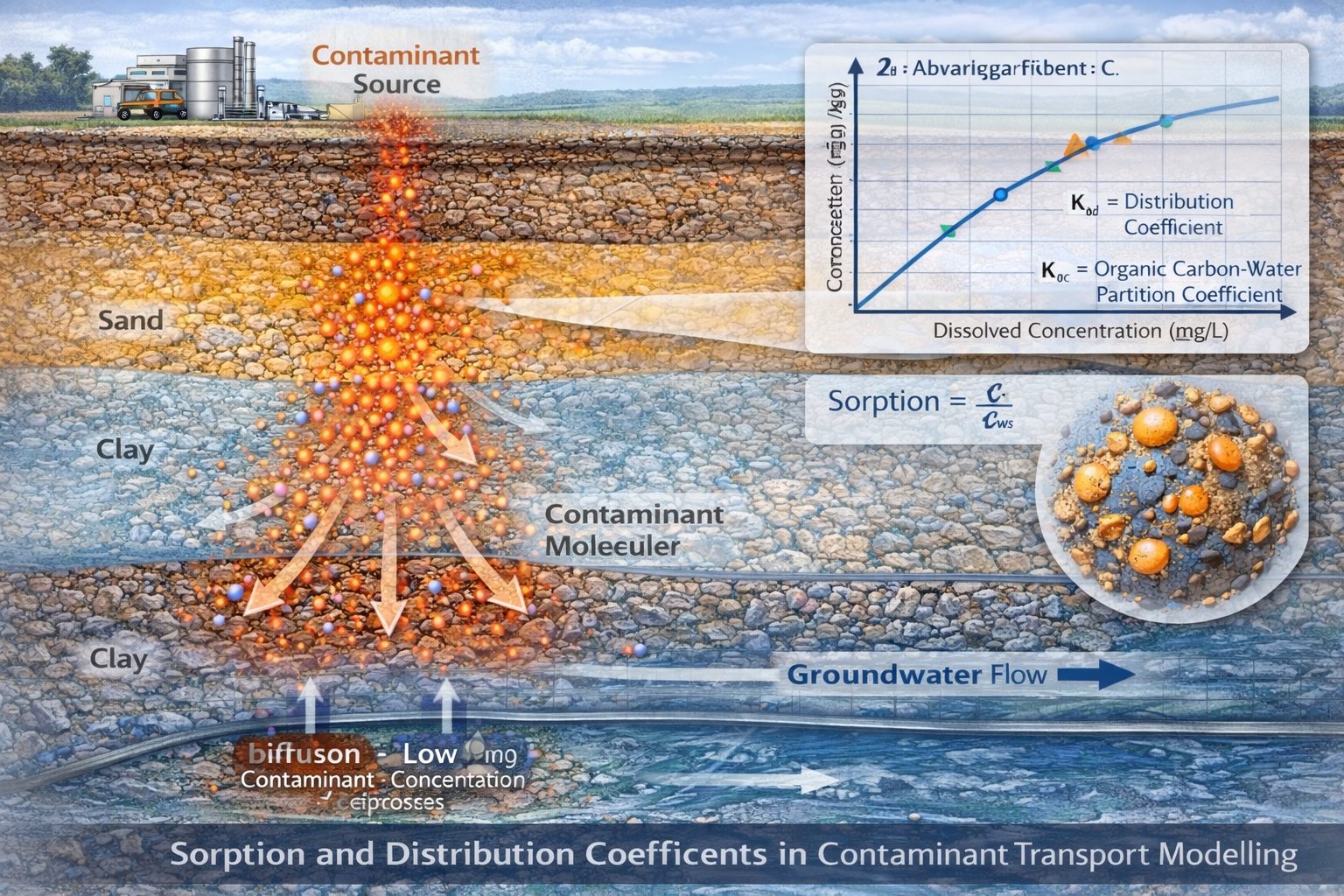
To represent this behavior in contaminant transport models, scientists use a parameter known as the distribution coefficient, commonly denoted as Kd. The distribution coefficient describes the partitioning of a contaminant between the solid phase (soil or rock) and the liquid phase (groundwater).
Accurate determination of distribution coefficients is essential for predicting contaminant migration, estimating groundwater contamination risks, and designing remediation strategies. Environmental engineers use laboratory experiments, field measurements, and empirical relationships to determine Kd values and incorporate them into transport models.
This article explores the role of distribution coefficients in contaminant transport modeling, explains how they are determined, and discusses their applications in environmental investigations and groundwater protection.
What Is a Distribution Coefficient?
The distribution coefficient (Kd) represents the ratio of a contaminant’s concentration in the solid phase to its concentration in the aqueous phase under equilibrium conditions.
K_d = \frac{C_s}{C_w}
Where:
- Kd = distribution coefficient
- Cs = concentration of contaminant adsorbed onto solid material
- Cw = concentration of contaminant dissolved in water
The distribution coefficient provides a measure of how strongly a contaminant interacts with soil or rock surfaces.
A large Kd value indicates strong sorption, meaning the contaminant tends to attach to soil particles and move slowly through groundwater systems.
A small Kd value indicates weak sorption, meaning the contaminant remains dissolved in water and can migrate more easily through the subsurface.
Because sorption slows contaminant migration, Kd values play a critical role in determining how far and how fast contaminants move in groundwater systems.
Sorption Processes in Soil and Groundwater Systems
Sorption is the general term used to describe interactions between contaminants and solid materials. It includes two main mechanisms:
Adsorption
Adsorption occurs when contaminants adhere to the surface of mineral grains or organic matter.
This process is influenced by several factors:
- Mineral surface area
- Surface charge properties
- pH conditions
- ionic strength of groundwater
- chemical structure of the contaminant
Clay minerals and organic matter typically have large surface areas and high sorption capacity.
Absorption
Absorption occurs when contaminants penetrate into the internal structure of solid materials rather than simply attaching to the surface.
This process is common in organic-rich soils where contaminants may dissolve into organic matter.
Ion Exchange
In some soils, ions in groundwater may exchange with ions bound to mineral surfaces.
This mechanism can significantly affect the mobility of certain metals and radionuclides.
Importance of Distribution Coefficients in Transport Models
Distribution coefficients are widely used in groundwater contaminant transport models to represent sorption processes.
One of the most important ways Kd values influence transport models is through the retardation factor, which describes how sorption slows contaminant movement relative to groundwater flow.
The retardation factor can be expressed as:
R = 1 + \frac{\rho_b K_d}{n}
Where:
- R = retardation factor
- ρb = bulk density of soil
- Kd = distribution coefficient
- n = porosity
The retardation factor indicates how much slower a contaminant moves compared with groundwater velocity.
For example:
- If R = 1, the contaminant moves at the same speed as groundwater.
- If R > 1, contaminant transport is slowed due to sorption.
Many environmental models use this relationship to estimate contaminant plume migration.
Factors Affecting Distribution Coefficients
Distribution coefficients vary depending on several environmental and chemical conditions.
Soil Mineralogy
Different soil minerals have different sorption capacities.
For example:
- Clay minerals often have high sorption capacity due to their large surface area and electrical charge.
- Quartz sands typically exhibit low sorption because they have limited reactive surface area.
Organic Matter Content
Organic-rich soils can strongly sorb many organic contaminants.
Hydrophobic organic compounds such as pesticides and hydrocarbons often bind to organic matter in soils.
Higher organic carbon content generally results in higher Kd values for these contaminants.
Groundwater Chemistry
Groundwater chemistry plays an important role in sorption behavior.
Parameters affecting sorption include:
- pH
- ionic strength
- competing ions
- redox conditions
Changes in groundwater chemistry can alter sorption equilibrium and affect contaminant mobility.
Contaminant Properties
The chemical properties of the contaminant itself influence sorption behavior.
Important properties include:
- molecular polarity
- solubility
- charge
- molecular size
Hydrophobic compounds tend to sorb strongly to soil organic matter, while highly soluble compounds often remain dissolved in water.
Laboratory Methods for Determining Distribution Coefficients
Distribution coefficients are commonly measured using laboratory experiments.
Batch Sorption Tests
Batch tests are the most widely used method for determining Kd values.
In this procedure:
- Soil samples are mixed with contaminant solutions in sealed containers.
- The mixture is agitated to allow sorption equilibrium to develop.
- The solution is separated from the soil and analyzed for contaminant concentration.
The difference between initial and final solution concentrations is used to estimate the amount of contaminant adsorbed onto the soil.
Batch tests are relatively simple and widely used in environmental laboratories.
Column Experiments
Column experiments simulate contaminant transport through soil under flowing groundwater conditions.
In these experiments:
- Soil is packed into a column.
- Contaminated water is passed through the column.
- Effluent concentrations are monitored over time.
Column tests allow researchers to observe how sorption affects contaminant migration under dynamic conditions.
Sorption Isotherms
Sorption isotherms describe the relationship between contaminant concentration in water and the amount sorbed onto solid materials.
Common isotherm models include:
- Linear isotherms
- Freundlich isotherms
- Langmuir isotherms
In many groundwater models, the linear isotherm assumption is used, which leads directly to the distribution coefficient concept.
Field Determination of Distribution Coefficients
In some cases, Kd values may be estimated from field observations.
Tracer Tests
Tracer tests involve injecting contaminants or tracer compounds into groundwater and monitoring their movement through the aquifer.
By comparing contaminant migration with groundwater flow velocities, scientists can estimate retardation factors and calculate Kd values.
Inverse Modeling
Inverse modeling techniques use observed contaminant plume data to estimate model parameters.
Transport models are calibrated by adjusting Kd values until simulated contaminant concentrations match field observations.
Inverse modeling is commonly used in environmental site assessments.
Use of Distribution Coefficients in Environmental Models
Distribution coefficients are widely used in groundwater contaminant transport models.
These models simulate processes such as:
- contaminant plume migration
- groundwater contamination risk
- landfill leachate migration
- contaminant transport through soil barriers
- remediation system performance
Transport models incorporating Kd values help engineers predict how contaminants will behave over time and evaluate potential environmental impacts.
Distribution Coefficients in Landfill and Waste Containment Studies
Distribution coefficients play a critical role in modeling contaminant transport in landfill and waste containment systems.
For example, clay liners used in landfill containment systems often exhibit strong sorption properties that slow contaminant migration.
Transport models use Kd values to estimate:
- long-term contaminant release from landfill liners
- migration of pollutants through geological barriers
- effectiveness of engineered containment systems
Accurate Kd values help engineers evaluate whether landfill designs will protect groundwater resources.
Uncertainty in Distribution Coefficient Estimates
Although distribution coefficients are widely used in environmental modeling, several sources of uncertainty exist.
Spatial Variability
Soil properties may vary significantly across a site, causing Kd values to vary spatially.
Nonlinear Sorption
Some contaminants exhibit nonlinear sorption behavior, which cannot be accurately represented by a constant Kd value.
Time-Dependent Sorption
Sorption processes may change over time due to chemical reactions or changes in environmental conditions.
Laboratory vs Field Conditions
Laboratory experiments may not fully represent complex field conditions.
Because of these uncertainties, modelers often perform sensitivity analyses to evaluate how Kd values influence model predictions.
Advances in Sorption Modeling
Modern environmental modeling approaches are improving the representation of sorption processes.
Advanced methods include:
- reactive transport modeling
- multi-site sorption models
- kinetic sorption models
- geochemical equilibrium modeling
These approaches provide more realistic representations of contaminant behavior in groundwater systems.
Conclusion
Distribution coefficients are fundamental parameters used in contaminant transport modeling to represent sorption interactions between contaminants and geological materials. By describing how pollutants partition between solid and aqueous phases, Kd values help determine how quickly contaminants migrate through soil and groundwater systems.
Accurate determination of distribution coefficients requires laboratory experiments, field investigations, and careful consideration of soil properties and groundwater chemistry. Although uncertainties remain due to environmental variability, advances in experimental techniques and modeling approaches continue to improve our understanding of sorption processes.
Incorporating reliable distribution coefficients into contaminant transport models is essential for predicting groundwater contamination risks, designing effective remediation strategies, and protecting environmental resources.
As environmental modeling technologies continue to evolve, improved characterization of sorption processes will play a critical role in advancing groundwater protection and sustainable environmental management.
Learn more about our Contaminant Transport Modeling Solutions
Related Articles
- Contaminant Transport Modelling and Landfill Design: A Complete Guide for Environmental Engineers
- How Contaminant Transport Models Predict Groundwater Pollution
- Designing Landfill Liner Systems to Prevent Groundwater Contamination
- Understanding Leachate Generation and Transport in Landfills
- Advection–Dispersion Modelling in Groundwater Systems
- Hydrogeological Data Required for Contaminant Transport Models
- Regulatory Requirements for Landfill Design and Groundwater Protection
- Unlock Global Expertise: Free Research Viewer for POLLUTE and MIGRATE
- Mastering the Plume: POLLUTEv8 vs. MODFLOW vs. FEFLOW vs. PATH3D
- Core Features of POLLUTEv8
- Mastering Contaminant Transport: Special Features of POLLUTEv8
- Navigating Contaminant Migration with POLLUTE: A Modern Approach to Landfill Design
- Beyond The MCL: Building Audit-Proof Contaminant Fate Models For 2026 Regulatory Submissions
- Using Predictive Models to Meet 2026 Primary Drinking Water Regulations
- Driving Environmental Research: How GAEA Technologies POLLUTE Software is Used in Academic and Industry Reports
- Modeling Your Way to ‘No Further Action’: How Predictive Simulation Shaves Years Off Remediation Timelines
- Meeting The New 2026 EPA Reporting Standards For PFAS: Why Traditional Spreadsheet Modeling No Longer Suffices
- Unlocking Sustainable Solutions: The Role of POLLUTE Software in Landfill Design and Contaminant Transport Modelling
- Contaminant Transport Modelling and Landfill Design Insights
- Geomembrane Degradation in Landfill Liners: Causes, Modeling, and Long-Term Performance
- Clogging of Landfill Leachate Collection Systems: Causes, Impacts, and Prevention
- Determining Diffusion Coefficients for Contaminant Transport Modeling
- Non-Linear Sorption in Contaminant Transport Modeling
- Phase Change in Collection Systems in Contaminant Transport Modeling for Landfills
- Biological and Radioactive Decay in Contaminant Transport Modeling
External References
- Hydrogeology and groundwater contamination research
- Determining Diffusion Coefficients in Porous Media (Benning et al.)
- Determining Apparent Diffusion Coefficients Using Tracer Tests
- Diffusion as a Key Transport Mechanism in Low-Permeability Media
- Groundwater Contaminant Migration Processes
- Effective Diffusion in Porous Media
- U.S. EPA – Understanding Variation in Partition Coefficient (Kd) Values
- U.S. Geological Survey – Distribution Coefficients in Groundwater Transport
- Environmental Chemistry Research on Kd Determination
- Review of Distribution Coefficients for Heavy Metals
- Soil–Water Partitioning and Sorption Processes