

Introduction
Modern landfill facilities are engineered systems designed to safely contain waste and prevent contamination of the surrounding environment. One of the most important environmental protection components of a landfill is the leachate collection system, which removes contaminated liquids produced within the waste mass before they can accumulate above the liner system.
Leachate forms when precipitation, surface water, or moisture contained in waste materials percolates through the landfill and dissolves contaminants. The resulting liquid contains a complex mixture of organic compounds, metals, salts, and nutrients that must be collected and managed to protect groundwater resources.
In many landfill environments, however, contaminants do not exist solely in dissolved form. Changes in temperature, pressure, chemical composition, or biological activity can cause contaminants to change phase, transitioning between dissolved, gaseous, and solid states. These phase change processes can significantly influence how contaminants move through landfill collection systems and how they are represented in contaminant transport models.
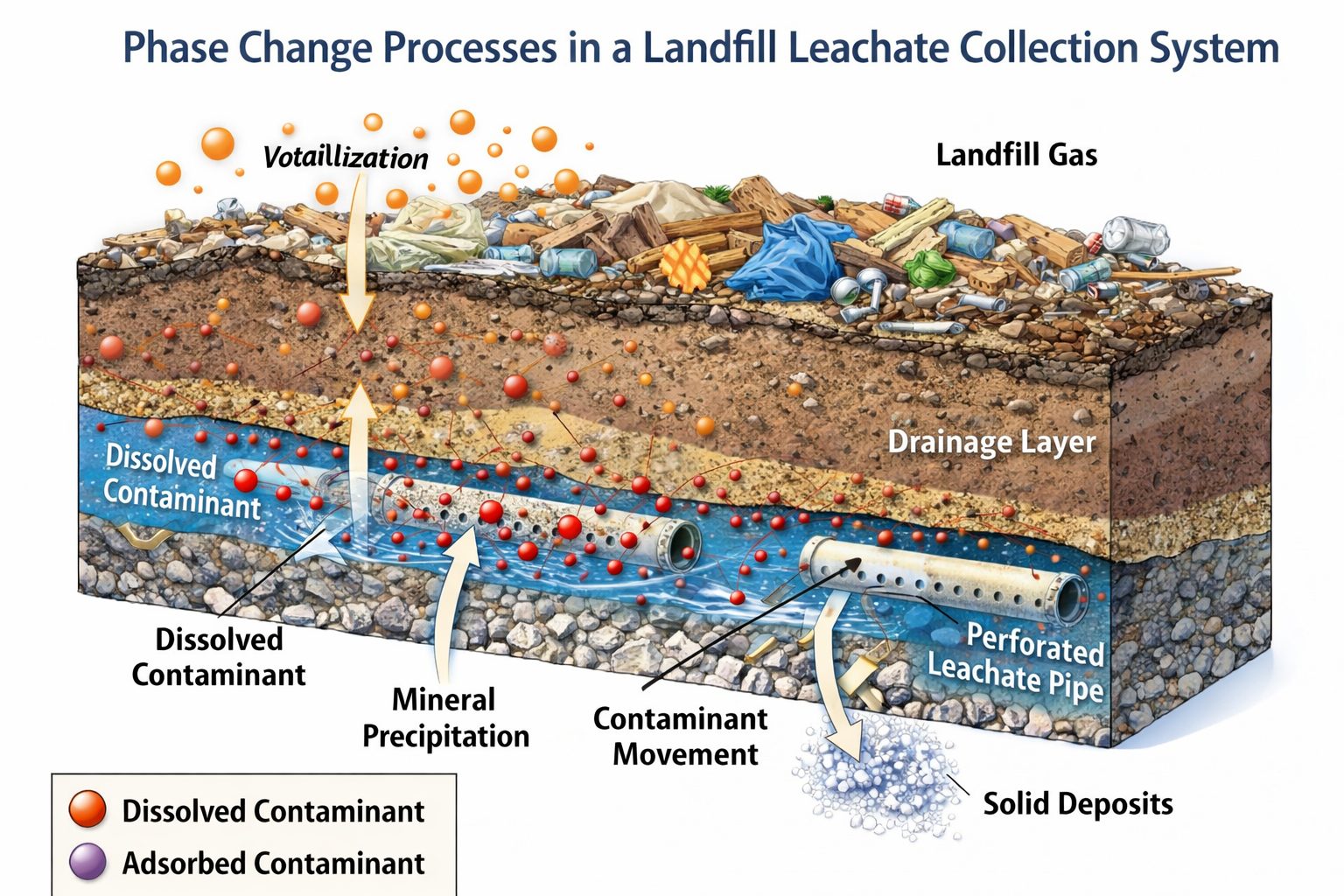
Phase change phenomena may occur in several forms within landfill leachate collection systems, including:
- volatilization of dissolved compounds into landfill gas
- precipitation of dissolved minerals into solid deposits
- condensation of vapors within collection infrastructure
- dissolution of solid phases back into leachate
These transformations affect contaminant mobility, system performance, and the long-term behavior of landfill containment systems.
Understanding phase change processes is therefore essential for accurate contaminant transport modeling, landfill design, and long-term environmental risk assessment.
This article examines the mechanisms of phase change in landfill collection systems, the role these processes play in contaminant transport modeling, and the implications for landfill design and environmental protection.
Overview of Landfill Leachate Collection Systems
Landfill leachate collection systems are designed to capture and remove leachate from the base of the landfill before it accumulates above the liner system.
A typical leachate collection system consists of several key components:
- Drainage layer composed of gravel or geosynthetic drainage materials
- Perforated collection pipes that transport leachate to sump locations
- Pumping systems that remove leachate from the landfill
- Monitoring systems used to evaluate system performance
These systems are installed directly above the landfill liner system and beneath the waste mass.
Regulatory guidelines often require that leachate levels remain below a specified hydraulic head, typically around 30 cm above the liner, to minimize the risk of leakage through the liner system.
Because landfill waste undergoes biological decomposition and chemical reactions over long periods, the composition and physical state of leachate and landfill gas can change significantly over time.
These changes can trigger phase transitions that influence contaminant transport and system performance.
Understanding Phase Change Processes
A phase change occurs when a substance transitions between different physical states, such as:
- liquid to gas
- gas to liquid
- dissolved to solid
- solid to dissolved
In landfill environments, phase changes are driven by changes in environmental conditions including:
- temperature variations
- pressure differences
- chemical reactions
- biological processes
- changes in solubility
These processes influence how contaminants behave within landfill leachate and gas systems.
Volatilization of Dissolved Contaminants
One of the most important phase change processes affecting contaminant transport in landfills is volatilization, the transfer of dissolved chemicals from the liquid phase into the gas phase.
Many organic contaminants present in landfill leachate are volatile or semi-volatile compounds. Examples include:
- benzene
- toluene
- vinyl chloride
- chlorinated solvents
These compounds can partition between leachate and landfill gas depending on temperature and chemical properties.
The tendency of a contaminant to volatilize is often described by Henry’s Law, which relates the concentration of a dissolved compound in water to its concentration in the gas phase.
C_g = H C_w
Where:
- Cg = concentration of contaminant in the gas phase
- Cw = concentration in the aqueous phase
- H = Henry’s law constant
When volatile contaminants transfer from leachate into landfill gas, their mobility may increase because gases can move more easily through porous waste materials.
In transport models, volatilization processes must be incorporated to accurately represent contaminant distribution between liquid and gas phases.
Gas Condensation in Collection Systems
While volatilization transfers contaminants into landfill gas, the reverse process can also occur.
As landfill gas moves through pipes or drainage layers, temperature changes may cause vapors to condense back into liquid form.
Condensation can occur when:
- gas temperatures drop within pipes or collection systems
- vapor concentrations exceed saturation limits
- environmental conditions change during transport
Condensed liquids may contain concentrated contaminants that re-enter the leachate collection system.
This process can alter contaminant distribution and influence long-term transport behavior.
Mineral Precipitation and Solid Phase Formation
Another important phase change in landfill leachate systems is chemical precipitation, where dissolved minerals form solid deposits.
Landfill leachate often contains high concentrations of dissolved ions such as:
- calcium
- magnesium
- iron
- carbonate
When chemical conditions change, these ions may combine to form insoluble minerals.
Common precipitates include:
- calcium carbonate
- iron hydroxides
- magnesium carbonates
These solids may accumulate within drainage layers or collection pipes, contributing to clogging and reduced system performance.
Precipitation reactions are often controlled by chemical equilibrium processes and can be represented using geochemical modeling.
Dissolution of Solid Phases
Solid deposits formed within landfill systems may also dissolve back into leachate under changing chemical conditions.
Dissolution processes occur when:
- pH conditions change
- leachate chemistry evolves
- mineral solubility increases
This dynamic balance between precipitation and dissolution influences contaminant concentrations within leachate.
Transport models must often account for these reversible reactions to accurately simulate long-term contaminant behavior.
Phase Change Effects on Contaminant Transport
Phase change processes significantly influence contaminant transport in landfill systems.
Enhanced Gas-Phase Transport
Volatilization may allow contaminants to migrate through landfill gas pathways more rapidly than through liquid transport alone.
Concentration Redistribution
Condensation and dissolution processes may redistribute contaminants within the landfill system.
Solid Phase Storage
Precipitated minerals may temporarily store contaminants within solid phases, delaying their release into groundwater.
Clogging of Collection Systems
Mineral precipitation and biological growth may reduce the hydraulic conductivity of drainage layers and pipes.
These processes can significantly influence the long-term performance of landfill containment systems.
Modeling Phase Change Processes in Landfill Systems
Environmental engineers use mathematical models to simulate phase change processes within landfill systems.
These models often incorporate several key processes:
- gas-liquid partitioning
- mineral precipitation reactions
- dissolution kinetics
- multiphase flow
Multiphase transport models allow scientists to simulate interactions between gas, liquid, and solid phases within landfill environments.
These models are used to evaluate contaminant migration over long time periods and assess potential environmental impacts.
Multiphase Transport Modeling
In landfill environments, contaminants may exist simultaneously in multiple phases.
For example, a volatile organic compound may be present as:
- dissolved contaminant in leachate
- vapor in landfill gas
- sorbed contaminant on soil particles
Multiphase transport models track contaminant movement across these phases and simulate how phase changes affect transport behavior.
These models typically combine equations describing:
- groundwater flow
- gas transport
- chemical reactions
- phase equilibrium
Such models are essential for evaluating the long-term performance of landfill containment systems.
Implications for Landfill Design
Understanding phase change processes has important implications for landfill engineering.
Leachate Collection System Design
Engineers must design drainage layers and pipes that minimize the accumulation of precipitated solids.
Gas Collection Infrastructure
Proper gas collection systems help control volatile contaminants and reduce environmental emissions.
Temperature Management
Landfill temperatures influence chemical reactions and gas-liquid partitioning processes.
Monitoring Systems
Monitoring programs help detect changes in leachate composition and system performance over time.
These design considerations help maintain effective containment and reduce environmental risks.
Environmental Monitoring and Phase Change Indicators
Landfill operators monitor several parameters that may indicate phase change processes occurring within collection systems.
Important monitoring parameters include:
- leachate chemistry
- gas composition
- temperature profiles
- mineral deposition within pipes
- hydraulic performance of drainage layers
Changes in these parameters may indicate precipitation reactions, volatilization processes, or other phase transitions affecting system performance.
Challenges in Modeling Phase Change
Although phase change processes are important in landfill systems, modeling them accurately can be challenging.
Key challenges include:
Complex Chemical Interactions
Landfill leachate contains complex mixtures of chemicals that interact through numerous reactions.
Spatial Variability
Chemical conditions may vary across different regions of the landfill.
Limited Field Data
Field measurements of multiphase processes are often difficult to obtain.
Long-Term Uncertainty
Landfill systems operate for decades, making long-term predictions difficult.
Despite these challenges, advances in reactive transport modeling and geochemical simulation are improving our ability to represent phase change processes in environmental models.
Future Advances in Landfill Phase Change Modeling
New research areas are improving understanding of phase change processes in landfill systems.
These developments include:
- advanced geochemical modeling software
- integrated gas and leachate transport simulations
- improved monitoring technologies
- data-driven modeling approaches
These advances will improve the accuracy of contaminant transport predictions and support better environmental management of landfill systems.
Conclusion
Phase change processes play an important role in contaminant transport within landfill leachate collection systems. Transitions between gas, liquid, and solid phases can significantly influence contaminant mobility, chemical reactions, and system performance.
Volatilization, condensation, precipitation, and dissolution processes all affect how contaminants move through landfill environments. These processes must be considered when developing contaminant transport models and designing landfill containment systems.
Although modeling phase change processes presents significant challenges due to complex chemical interactions and environmental variability, advances in environmental modeling and monitoring technologies continue to improve our understanding of these phenomena.
By incorporating phase change processes into contaminant transport models, environmental engineers can better predict long-term landfill behavior, improve system design, and protect groundwater resources.
Learn more about our Contaminant Transport Modeling Solutions
Related Articles
- Contaminant Transport Modelling and Landfill Design: A Complete Guide for Environmental Engineers
- How Contaminant Transport Models Predict Groundwater Pollution
- Designing Landfill Liner Systems to Prevent Groundwater Contamination
- Understanding Leachate Generation and Transport in Landfills
- Advection–Dispersion Modelling in Groundwater Systems
- Hydrogeological Data Required for Contaminant Transport Models
- Regulatory Requirements for Landfill Design and Groundwater Protection
- Unlock Global Expertise: Free Research Viewer for POLLUTE and MIGRATE
- Mastering the Plume: POLLUTEv8 vs. MODFLOW vs. FEFLOW vs. PATH3D
- Core Features of POLLUTEv8
- Mastering Contaminant Transport: Special Features of POLLUTEv8
- Navigating Contaminant Migration with POLLUTE: A Modern Approach to Landfill Design
- Beyond The MCL: Building Audit-Proof Contaminant Fate Models For 2026 Regulatory Submissions
- Using Predictive Models to Meet 2026 Primary Drinking Water Regulations
- Driving Environmental Research: How GAEA Technologies POLLUTE Software is Used in Academic and Industry Reports
- Modeling Your Way to ‘No Further Action’: How Predictive Simulation Shaves Years Off Remediation Timelines
- Meeting The New 2026 EPA Reporting Standards For PFAS: Why Traditional Spreadsheet Modeling No Longer Suffices
- Unlocking Sustainable Solutions: The Role of POLLUTE Software in Landfill Design and Contaminant Transport Modelling
- Contaminant Transport Modelling and Landfill Design Insights
- Geomembrane Degradation in Landfill Liners: Causes, Modeling, and Long-Term Performance
- Clogging of Landfill Leachate Collection Systems: Causes, Impacts, and Prevention
- Determining Diffusion Coefficients for Contaminant Transport Modeling
- Use and Determination of Distribution Coefficients for Contaminant Transport Modeling
- Non-Linear Sorption in Contaminant Transport Modeling
- Biological and Radioactive Decay in Contaminant Transport Modeling
External References
- USGS groundwater flow and transport processes
- Hydrogeology and groundwater contamination research
- Reactive transport modeling in porous media
- Henry’s Law and Gas–Liquid Partitioning in Landfills
- Modeling the Fate of Organic Chemicals in Landfills
- Models of Biodegradation During Contaminant Transport
- Modeling Decay Chains of Radioactive Contaminants